


Skip to content

Why Automated Insurance Claims Start at FNOL

Featured Image

TL;DR:

Automated insurance claims work best when they start at FNOL. This is the first moment an insurer receives claim information, sets customer expectations, and captures critical data. By automating FNOL, UK insurers speed up claims, reduce costs, detect fraud earlier, support better underwriting decisions, and deliver smoother digital experiences through modern customer portals.

Most UK insurers already prove that early automation improves trust, efficiency, and regulatory confidence across the entire claims journey.

In This Blog, You’ll Learn

→ Why FNOL is the true starting point for successful claims automation
→ How early automation reshapes cost, speed, and customer trust
→ What automated FNOL looks like at a systems and process level
→ How UK insurers use FNOL data for fraud, compliance, and underwriting
→ Why delaying automation increases risk across the claims lifecycle

This is a practical deep dive into how automated claims actually work, starting where trust is first tested.

A vehicle crash took place on a key commuter route.

A burst pipe at home.

A stolen phone on the commute back from work.

In those moments, customers are not thinking about policies or processes. They are looking for clarity, reassurance, and speed. What they experience next decides whether trust begins, or quietly disappears.

That moment has a name: FNOL, or First Notice of Loss. It is the very first interaction between an insurer and a customer after something has gone wrong. It is where facts are captured, emotions are managed, and expectations are set for the entire claims journey.

In today’s UK insurance market, shaped by instant digital services and increasing regulatory pressure, FNOL is no longer just an operational step. It is a strategic one. Automation is no longer a “nice to have” tucked away in later stages of claims. It has become a survival strategy,  and it almost always starts at FNOL.

This blog explores why automated insurance claims must begin at FNOL, how leading UK insurers are already seeing measurable benefits, and why delaying automation creates unnecessary cost, friction, and risk across the claims lifecycle.

Understanding FNOL in the UK Insurance Context

FNOL is the first point at which an insurer becomes aware of a claim. Traditionally, this happens via phone calls, emails, or manual forms, often during moments of stress for the customer.

In the UK, FNOL is particularly critical because:

→ Customers expect quick acknowledgement and reassurance
→ FCA regulations demand transparency and fair treatment
→ Claims costs stay under constant scrutiny
→ Fraud detection begins from the very first data point

If FNOL is slow, inconsistent, or incomplete, every downstream process inherits that weakness.

This is exactly why automation starts here, not later.

The Real Problem With Manual FNOL

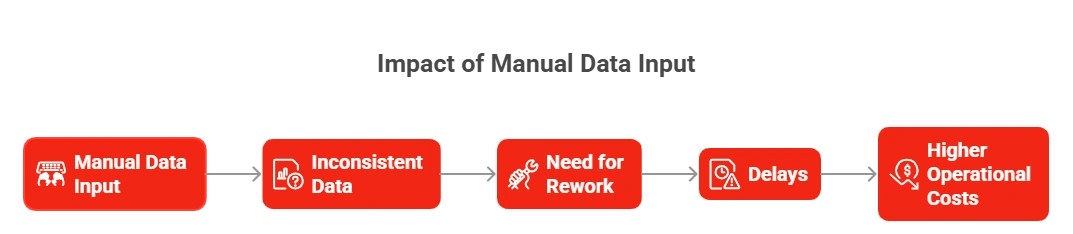
Manual FNOL does not break loudly. It breaks quietly, one frustrated caller, one missing detail, one delayed decision at a time.

Picture a UK motor insurer on a Monday morning. Phones ringing. Customers repeating the same story to different agents. Notes typed in a hurry. Photos emailed separately. By the time the claim reaches assessment, half the context is already lost.

That invisible damage adds up fast.

According to research on insurance claims processes by Deloitte UK, insurers that automate early stages of claims achieve significantly faster settlements, lower operational costs, and enhanced customer satisfaction compared with peers relying on manual intake. The data shows that inefficiencies at FNOL increase cycle times and inflate downstream workload, underlining the benefit of digital-first claims automation.

Manual FNOL also overloads call centres. Customers are asked similar questions multiple times because data is fragmented across systems. Triage slows down because information arrives late or incomplete. What should take minutes stretches into days.

The most damaging issue, however, is structural.

When poor-quality data enters the system at FNOL, every decision that follows becomes slower and riskier. Assessment teams hesitate. Investigations widen unnecessarily. Settlements get delayed. Later-stage automation struggles, not because the technology is weak, but because the foundation is flawed.

Once bad data enters the system, fixing it later becomes expensive, manual, and slow.

Why Automation Must Begin at FNOL

Automation creates value only when uncertainty is removed early, not after costs have already built up. FNOL is the first moment where insurers control data quality, risk visibility, and customer expectations.

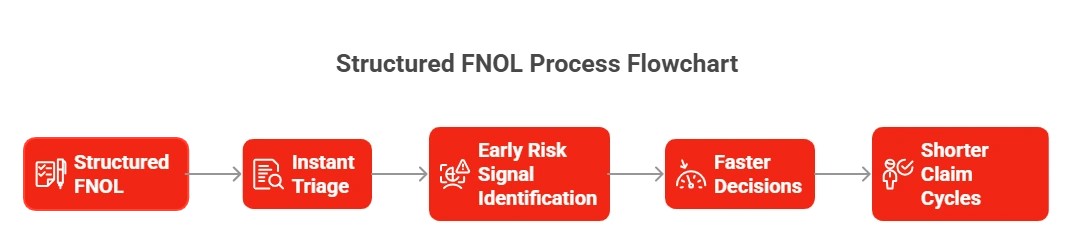
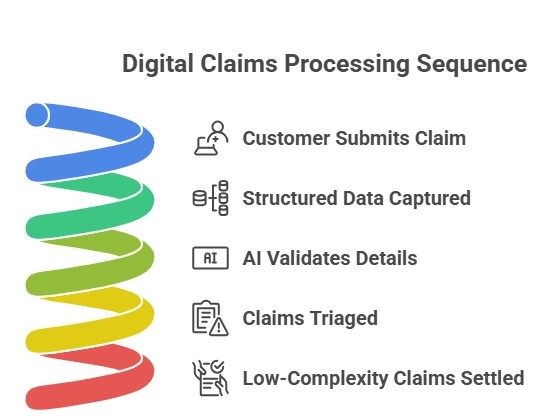
When FNOL is automated, information is captured while it is fresh and decisions begin immediately. This prevents delays, rework, and unnecessary investigation later in the claims journey. Below is the typical automated FNOL flow that enables this control from the very start.

1. Standardised Data From the First Interaction

Manual FNOL relies heavily on conversations, free-text notes, and human interpretation. That means the same accident can be recorded in ten different ways. Automation removes this variability.

Automated FNOL uses guided digital journeys to capture structured data, incident type, time, location, photos, policy details, in a consistent format from the very first interaction. Validation happens instantly, not days later.

UK example:
Aviva introduced digital-first FNOL journeys for motor and home insurance, allowing customers to submit claims online with structured inputs and image uploads. This reduced dependency on call-centre-led intake and significantly improved data quality at the start of the claim. Industry analysis from McKinsey highlights that Aviva’s early digital capture helped reduce rework and accelerate downstream processing.

Why this matters:
Clean data at FNOL prevents delays, reduces manual correction, and makes automation possible later.

Standardised Data From the First Interaction

2. Enterprise Data Unification and Governance

When FNOL data arrives late or incomplete, decision-making stalls. Claims wait in queues. Triage becomes reactive. Costs rise before anyone acts.

Automated FNOL enables real-time triage. Rules engines and analytics classify claims instantly, identifying low-complexity cases that can move straight through and high-risk cases that need investigation early.

This is where Claims Processing Automation and Fraud Detection & Risk Analysis begin to deliver real value.

UK example:
Direct Line Group has invested in early digital claims intake combined with analytics-led triage. By automating FNOL and linking it to internal decision systems, Direct Line improved early fraud identification while speeding up genuine claims. Public statements and Deloitte UK insights show that early intervention reduced unnecessary investigations and shortened claim lifecycles.

Why this matters:
Decisions made early cost less than decisions made late.

Enterprise Data Unification and Governance

3. Customer Confidence When It Matters Most

Customers do not judge insurers on process diagrams. They judge them on how they feel right after something goes wrong.

Manual FNOL often creates uncertainty, waiting on hold, repeating information, unclear next steps. Automation replaces that uncertainty with visibility and reassurance.

Digital FNOL delivered through modern Customer Experience Portals gives customers immediate confirmation, clear status updates, and transparency around what happens next.

UK example:
Admiral Group digitised large parts of its FNOL journey for motor insurance, allowing customers to submit claims online and track progress digitally. This reduced inbound calls and improved customer satisfaction scores while maintaining strong operational control. Deloitte UK case analysis highlights Admiral’s focus on early digital engagement to improve both experience and efficiency.

Why this matters:
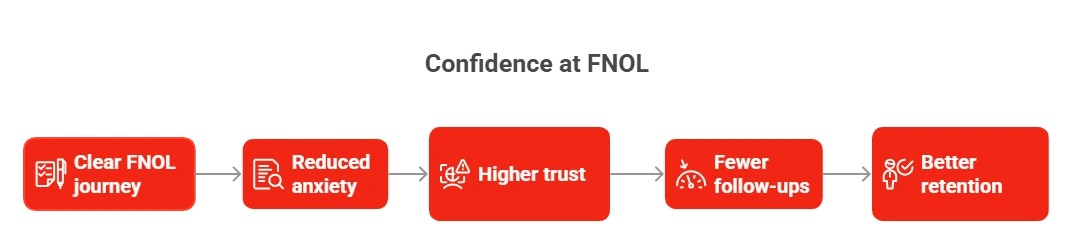
Confidence at FNOL reduces complaints, repeat calls, and churn.

Customer Confidence When It Matters Most

A Quick, Relatable Scenario (Because Insurance Is Still Human)

Two drivers experience identical minor car accidents in London on the same day.

One calls an insurer, waits on hold, explains the incident twice, and receives a vague response: “Someone will contact you.”

The other opens an app, uploads photos, answers guided questions, and receives instant confirmation: “Your claim is logged. Next steps are underway.”

Same accident. Very different emotional outcomes.

That difference begins at FNOL, and it is entirely driven by automation.

Why FNOL Becomes the Control Point for Modern Insurance Operations

FNOL is not just where claims begin. It is where insurers gain early control over risk, cost, automation, and decision quality. When FNOL is automated, its impact extends far beyond claims intake and reshapes the entire insurance value chain.

Below are four areas where FNOL automation delivers immediate and measurable value.

FNOL as the Starting Point for Fraud Detection

Fraud signals appear early, often within the first version of a story.

Automated FNOL captures structured data, timestamps, behavioural cues, and contextual signals that manual processes miss. This allows Fraud Detection & Risk Analysis to run before claims move further into the system.

UK insurers increasingly rely on early analytics because fraud becomes more expensive the longer it goes unnoticed. The Association of British Insurers consistently highlights that early-stage detection reduces investigation cost and protects genuine customers from unnecessary friction.

Research from McKinsey & Company also shows that applying analytics at FNOL improves fraud accuracy while reducing false positives later in the claims journey.

FNOL and Claims Cost Control

Claims costs rarely spike suddenly. They accumulate quietly through delays, rework, and late decisions.

When FNOL is automated, insurers reduce avoidable costs early. Claims are triaged faster, low-complexity cases move through without manual intervention, and complex claims receive attention before expenses escalate.

UK insurers such as Direct Line Group have publicly focused on early digital claims intake to control cost leakage and reduce unnecessary investigations. Early routing ensures resources are spent where they are genuinely needed.

Cost control works best when action happens before cost builds, FNOL is that moment.

Confidence at FNOL reduces complaints, repeat calls, and churn.

Connecting FNOL to Claims Processing Automation

Claims automation does not fail because of technology. It fails because of poor inputs.

Claims Processing Automation depends on clean, structured, and timely data. Automated FNOL provides exactly that. When claims start digitally, straight-through processing becomes possible for simple cases, while assisted handling remains available for complex ones.

Insurers that attempt to automate later stages without fixing FNOL often see limited returns. Automation works only when the foundation is stable.

FNOL is that foundation.

FNOL and the Role of Underwriting Decision Engines

Claims data does not live in isolation. It directly influences pricing, risk appetite, and portfolio decisions.

Automated FNOL feeds reliable, real-time insights into Underwriting Decision Engines, allowing insurers to reassess risk exposure and detect emerging trends earlier. This is especially important in the UK market, where pricing fairness and transparency are under close regulatory scrutiny.

By improving the quality of claims data from the start, FNOL automation strengthens underwriting decisions long after the claim is settled.

How Automated FNOL Works in Practice

Automated FNOL works like a funnel, wide at the top to capture information, narrow at the bottom to drive fast decisions. Each step removes uncertainty, filters risk, and prepares the claim for efficient handling. By the time a claim exits the funnel, it is already classified, validated, and routed. This is how speed, accuracy, and compliance are built in from the start.

Automated Insurance Claims Start at FNOL Uk Process

This funnel-based approach reduces manual handoffs, accelerates resolution, and strengthens regulatory control across the claims lifecycle.

The Customer Experience Angle (Where Most Insurers Lose)

Most insurers lose customers not because claims are rejected, but because the experience feels slow, unclear, or impersonal.

FNOL is the most emotionally charged moment in the insurance journey. Automated FNOL delivered through intuitive Customer Experience Portals provides reassurance, clarity, and visibility at exactly the right time. Customers know their claim is logged, what happens next, and when to expect updates.

This early confidence reduces repeat calls, complaints, and churn, while quietly building long-term trust.

How Azilen Helps Insurers Get FNOL Automation Right

At Azilen Technologies, a Digital Transformative Company, FNOL automation is not positioned as a surface-level enhancement or a quick technology plug-in. It is architected as a foundational, enterprise-grade system that unifies customer experience, claims operations, risk intelligence, and regulatory control into one cohesive framework.

Azilen helps insurers design FNOL in a way that works in the real world, across legacy systems, compliance requirements, and operational constraints, while still enabling intelligent automation.

✅ Azilen designs FNOL journeys that capture structured, decision-ready data from the very first customer interaction, reducing ambiguity and rework across claims handling teams.

✅ Azilen integrates FNOL seamlessly with claims platforms, fraud analytics, and underwriting systems, ensuring automation does not break when claims move beyond intake.

✅ Azilen enables early Fraud Detection & Risk Analysis by embedding analytics and validation logic directly into the FNOL layer, not as a delayed investigation step.

✅ Azilen supports scalable Claims Processing Automation by ensuring FNOL data is clean, standardised, and suitable for straight-through processing where appropriate.

✅ Azilen aligns FNOL automation with UK regulatory expectations by building auditability, transparency, and explainability into every decision point.

The outcome is not just faster FNOL. It is a claims operation that starts with clarity, moves with confidence, and scales without creating hidden risk.

Azilen helps insurers move from reactive claims intake to intelligent, end-to-end claims orchestration, starting exactly where it should: at FNOL.

Final Thoughts: FNOL Is Where Claims Are Won or Lost

Automated insurance claims do not succeed simply because settlements happen faster. They succeed because the right decisions are made at the very beginning, when information is fresh and trust is fragile.

FNOL is the point where data quality is defined, customer confidence is either built or broken, and claim costs are quietly shaped. Insurers that automate FNOL do more than speed up processing, they create clarity for teams, confidence for customers, and resilience across operations.

That is why automated insurance claims do not start with settlement.
They start with FNOL.

FAQs: AI in Insurance Decision-Making

1. What is FNOL in insurance claims?

FNOL stands for First Notice of Loss. It is the first moment an insurer is informed about a claim. FNOL sets the foundation for the entire claims process because this is where data is captured, customer expectations are formed, and early decisions around risk, routing, and validation begin.

2. Why is FNOL important for claims automation?

FNOL is important because automation depends on clean and structured data from the start. When FNOL is automated, insurers reduce delays, prevent rework, and enable faster claim decisions. Poor FNOL data limits the effectiveness of claims automation later in the process and increases operational cost.

3. How does automated FNOL reduce insurance fraud?

Automated FNOL captures structured data, timestamps, and behavioural signals early in the claim journey. This allows fraud detection systems to identify inconsistencies before costs escalate. Early fraud detection at FNOL helps insurers investigate high-risk claims sooner while allowing genuine claims to move forward without friction.

4. Can FNOL automation improve customer experience?

Yes. FNOL is the most emotionally sensitive stage of the claims journey. Automated FNOL provides immediate acknowledgement, clear next steps, and transparency through digital channels. This reduces customer anxiety, repeat follow-ups, and complaints, while building trust at the moment it matters most.

5. How does FNOL connect to claims processing automation?

Claims processing automation relies on accurate and standardised inputs. Automated FNOL ensures claims enter the system with validated data, making straight-through processing possible for low-complexity cases. Without FNOL automation, downstream claims automation struggles to scale or deliver consistent outcomes.

Glossary

FNOL (First Notice of Loss): The first moment an insurer is informed about a loss or incident. FNOL marks the starting point of the claims journey and plays a critical role in data quality, decision-making, and customer trust.

Automated FNOL: A digital process where claims are reported through online forms, apps, or conversational AI instead of manual phone calls or emails. Automated FNOL enables faster triage, cleaner data capture, and early risk assessment.

Claims Processing Automation: The use of technology to handle claims tasks such as validation, routing, assessment, and settlement with minimal manual intervention. Its success depends heavily on accurate data captured at FNOL.

Fraud Detection & Risk Analysis: The application of analytics and rules to identify suspicious claims patterns. When applied at FNOL, fraud detection helps insurers flag high-risk cases early and reduce investigation costs later.

Customer Experience Portals: Digital platforms that allow customers to submit claims, upload documents, track status, and receive updates. These portals improve transparency and reduce customer anxiety during the claims process.

Underwriting Decision Engines: Technology systems that use data and rules to assess insurance risk and pricing. FNOL data feeds into these engines to support better underwriting decisions and portfolio management.

Kulmohan Makhija
Kulmohan Makhija
VP - Growth

Kulmohan Makhija writes at the intersection of technology and business, with a strong Europe-focused enterprise lens. His work covers digital transformation, product engineering, and applied AI, with attention to regulatory, cultural, and operational realities across European markets. He explores how complex organizations modernize core systems without disrupting what already works. His perspective balances innovation with pragmatism, shaped by how transformation actually plays out on the ground

Related Insights