

Skip to content

Reimagining Loan Origination in the UK: AI-Driven Credit Platforms Replacing Legacy Lending Systems

Featured Image

TL;DR:

The UK lending market is entering a major transformation phase. Legacy platforms are struggling to keep up with rising customer expectations and regulatory complexity, pushing institutions to rethink their loan origination system UK strategies. AI-driven platforms now assess credit risk in seconds, delivering faster approvals and smarter decision-making.

For lenders, modernisation is no longer optional. AI credit underwriting is reducing costs, improving accuracy, and reshaping risk models, while advanced mortgage origination software UK handles complex cases with minimal manual effort. Banks adopting intelligent systems are already gaining measurable competitive advantage.

In This Blog, You’ll Learn

→ The operational difference between OCR and Intelligent Document Processing (IDP) in insurance workflows
→ Where traditional OCR creates hidden cost, compliance risk, and manual workload
→ How IDP interprets context, validates extracted data, and supports real-time claims decision-making
→ When insurers should deploy OCR, IDP, or a hybrid automation strategy
→ Why IDP is becoming essential under FCA Consumer Duty and rising claims pressure

This is a practical deep dive into how modern claims automation actually works – starting at the moment customer trust is first tested: the submission of a claim.

Let’s be brutally honest: Most UK banks are still running loan origination systems built when dial-up internet was considered revolutionary.

Picture this: A customer walks into a branch (remember those?) or fills out an online application. That information then embarks on a Byzantine journey through multiple disconnected systems, credit bureau checks here, affordability calculations there, manual document verification somewhere else entirely.

Each step involves human touchpoints, each touchpoint introduces delays, and each delay represents another opportunity for your customer to abandon ship and head to a competitor who can approve them while they’re still finishing their morning coffee.

The average UK mortgage application in 2024 still took 23 days to complete. Twenty-three days! In a world where Amazon delivers packages in hours and Netflix streams 4K content instantly, we’re asking borrowers to wait nearly a month for a simple yes or no.

This isn’t just inconvenient, it’s commercially catastrophic.

The Perfect Storm Forcing Change in UK Lending

The Perfect Storm Forcing Change in UK Lending

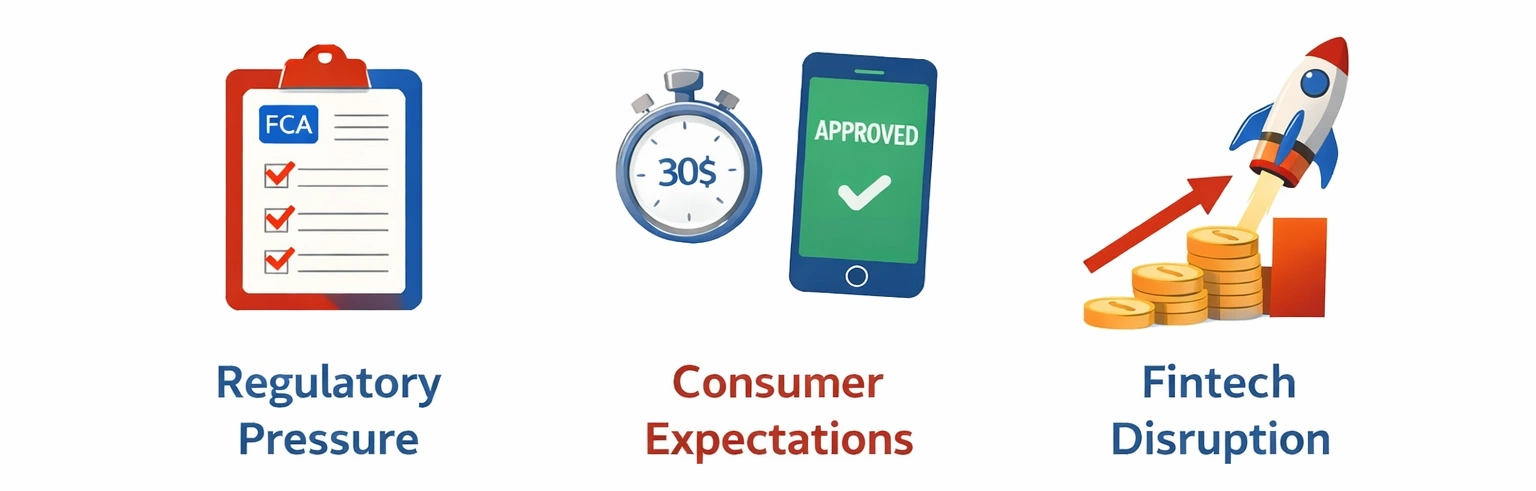
Three massive forces are colliding to make legacy loan origination system UK infrastructure untenable:

1. Regulatory Pressure That Actually Bites

Post-2008 regulations (CRD IV, IFRS 9, Basel III) require banks to demonstrate sophisticated risk management and maintain detailed audit trails. Legacy systems weren’t built for this level of granular reporting.

The FCA’s Consumer Duty requirements, which took effect in July 2023, demand demonstrable good outcomes for customers, vague credit decisions from black-box legacy systems don’t cut it anymore.

2. Consumer Expectations Shaped by Big Tech

Your customers don’t compare you to other banks anymore, they compare you to Uber, Netflix, and Amazon. They expect instant decisions, transparent pricing, and mobile-first experiences. When Monzo can approve an overdraft in 30 seconds, why should your mortgage pre-approval take three weeks.

3. Fintechs Eating Everyone’s Lunch

UK fintech lending platforms like Zopa, Funding Circle, and Iwoca have collectively originated over £12 billion in loans using AI-powered decisioning. They’re not burdened by legacy infrastructure. They’re not dealing with mainframe migrations. They just… build it right from day one.

What Modern AI-Driven Loan Origination Actually Looks Like

Let me paint you a picture of what AI credit underwriting UK platforms can actually do today, not in a futuristic lab environment, but in live production environments across the UK lending market.

The 90-Second Mortgage Decision (Yes, Really)

Here’s how a modern AI-powered mortgage origination software UK system works in practice:

Traditional Process:

Application received → Manual data entry → Credit bureau request (24-48 hrs) →
Affordability spreadsheet → Risk committee review → Valuation ordered →
Underwriter review → Decision (18-30 days)

AI-Powered Process:

Application received → Instant data validation → Real-time open banking integration →
AI risk assessment (13 data sources) → Automated valuation model →
Decision with explanation (47 seconds)

Modern vs Legacy Loan Origination Systems
Capability
Legacy Systems
Modern AI-Driven Platforms
Data Access Static credit reports & manual documents Open Banking APIs with 12+ months live transaction data
Risk Models Fixed rule-based scoring Machine learning trained on millions of outcomes
Data Sources Traditional financial history only Alternative data like rental & utility payments
Decision Transparency Limited visibility Explainable AI with full justification
System Learning Manual updates Continuous learning with every application
Decision Speed Hours to days Seconds to minutes

The Technical Architecture: How Modern Banks Actually Works

Behind every instant approval, every real-time affordability check, and every AI-driven decision sits a carefully engineered technical architecture. Modern banks are no longer running simple rule-based workflows stitched together over decades. They operate intelligent, API-connected, cloud-native systems designed to ingest data, analyse risk, and generate compliant decisions within seconds.

When someone applies for a loan, a modern loan origination system UK does three big things:

Step 1: Data Collection – What Information Is Being Used?

Data Collection- What Information Is Being Used

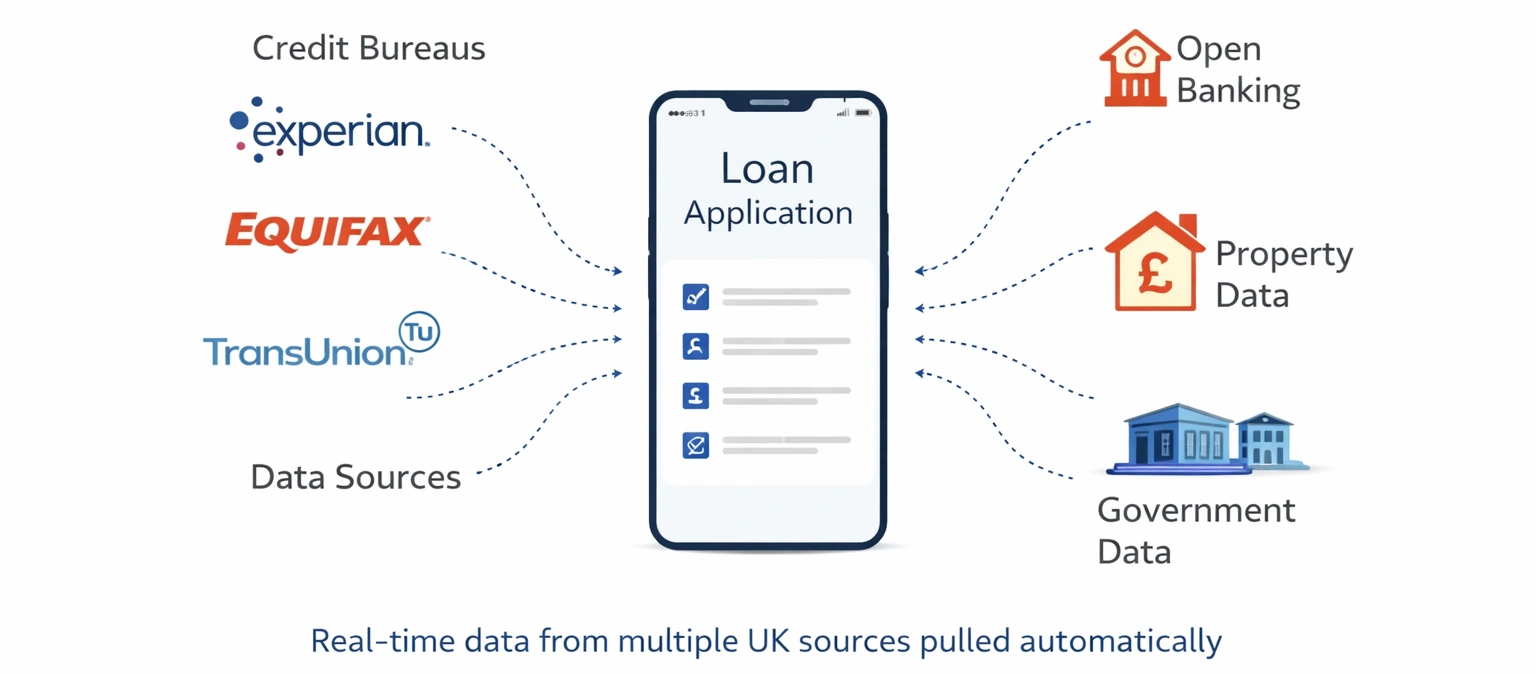
When a customer applies for a loan, the system does not just look at a credit score anymore. It automatically pulls data from multiple UK sources in real time:

➝ Credit Bureaus (Experian, Equifax, TransUnion)
➝ Open Banking APIs (TrueLayer, Yapily)
➝ Property Intelligence (Zoopla, Hometrack)
➝ Government Registries (HM Land Registry, Companies House)

What This Means in Practice

Instead of asking a borrower to upload 12 documents and waiting days for verification, the system:

➝ 12+ months of transactional behaviour ingested in real time
➝ Income stability patterns identified automatically
➝ Recurring financial obligations mapped instantly
➝ Cash flow volatility detected and scored

For example, Lloyds Banking Group uses Open Banking feeds to improve affordability checks.

This is how modern mortgage origination software UK reduces manual review time dramatically.

Step 2: Risk Analysis – How the AI Actually Decides

Step 2 Risk Analysis – How the AI Actually Decides

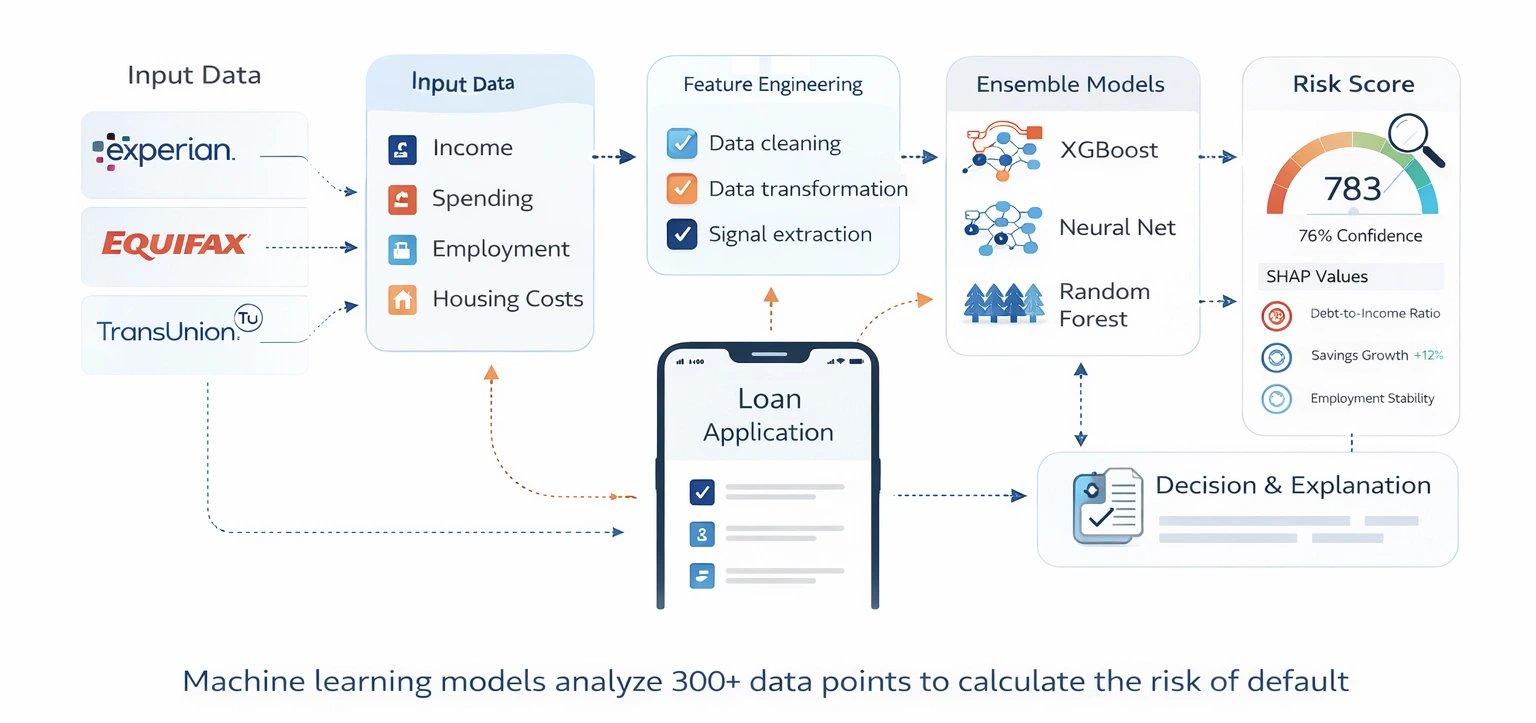
Now comes the important part. Traditional systems inside older loan origination system UK platforms:

→ Use fixed scoring formulas
→ Analyse 5–10 variables
→ Update risk models a few times a year

Modern AI credit underwriting UK works very differently. Here is what actually happens behind the scenes:

→ All incoming data is cleaned and structured (feature engineering)
→ The system converts behaviour into measurable signals (spending volatility, debt burden ratio, income stability)
→ Multiple machine learning models analyse 300+ variables simultaneously
→ The models compare the applicant with millions of historical loan outcomes
→ A probability of default score is generated

Example: Zopa uses machine learning models trained on historical lending data to dynamically adjust risk pricing. Funding Circle evaluates SME borrowers using AI that factors in sector risk and macroeconomic signals.

The Key Difference?

AI does not just ask: “Does this person meet the rule?”

It asks: “Based on millions of similar cases, what is the real probability this loan will be repaid?”

That is a fundamental shift in underwriting philosophy.

Step 3: Explainability – Why the Decision Was Made

Explainability – Why the Decision Was Made Step 3

Here is where many people get confused. If AI makes the decision, how does a regulator trust it?

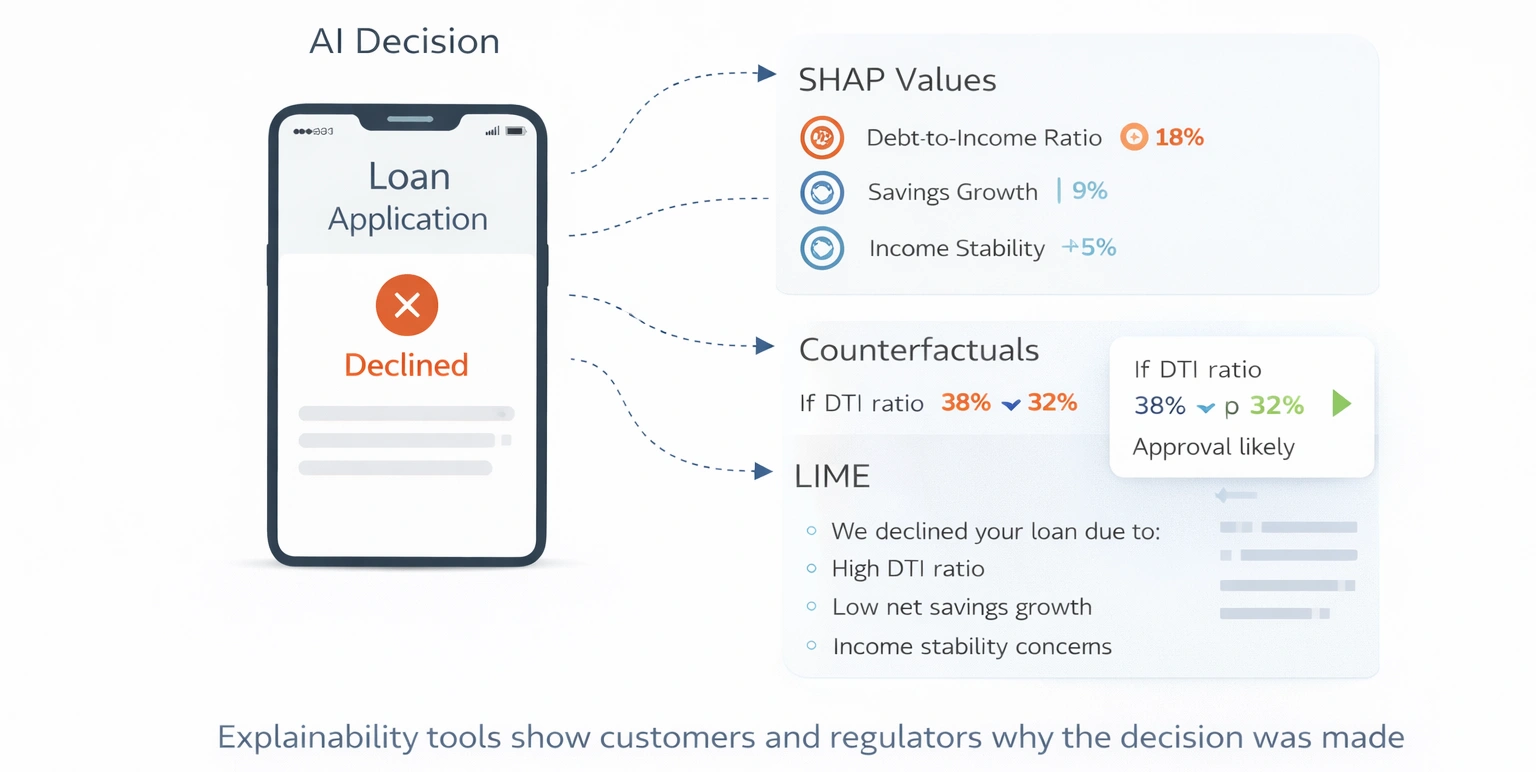
The Financial Conduct Authority requires lenders to justify outcomes under Consumer Duty. Modern AI credit underwriting UK systems solve this using explainability tools:

➝ SHAP values quantify feature contribution to the final decision
➝ Decision breakdown example: “DTI contributed 18% to the decline outcome.”
➝ Counterfactual insight: “£250 lower monthly debt increases approval probability by 12%.”

This Means:

→ Regulators understand the decision
→ Customers receive clearer explanations
→ Appeals handling becomes structured

Banks like Barclays and NatWest Group have invested heavily in model risk governance frameworks aligned with these requirements.

The Business Case: Numbers That Make CFOs Weep (With Joy)

Let’s talk brass tacks. What does AI-driven loan origination actually deliver?

Legacy vs AI Lending Performance Comparison
Metric
Legacy System
AI-Driven Platform
Improvement
Application Processing Time 18–30 days 47 seconds – 2 days 94–99% reduction
Cost Per Application £420–850 £45–120 70–85% reduction
Default Rate 3.2–4.8% 1.8–2.9% 35–40% reduction
Approval Rate 64% 78% +14 percentage points
False Decline Rate 11–15% 3–6% 60–70% reduction
Time to Market (New Products) 6–18 months 2–6 weeks 92–95% reduction
Customer Satisfaction 6.2/10 8.7/10 +40% improvement

Real-world example: When Barclays implemented AI-powered decisioning for personal loans in 2022, they reduced approval times from 5 days to under 60 seconds for 73% of applications, while simultaneously cutting default rates by 32%.

(Source: Barclays’ 2023 Technology Innovation Report)

Three Real-World Use Cases Transforming UK Lending

Use Case 1: The Self-Employed Mortgage Nightmare – Solved

The Problem: Self-employed borrowers represent 15% of the UK workforce but historically face rejection rates 2.3x higher than salaried employees.

Why? Legacy systems rely on standard payslips and P60s. Gig workers, contractors, and business owners don’t fit the mould.

The AI Solution: Modern mortgage origination software UK platforms use:

→ Open Banking to analyse 24 months of cash flow patterns
→ Machine learning to identify income stability despite irregularity
→ Alternative verification through HMRC integration
→ Predictive models specifically trained on self-employed outcomes

Real Result: Atom Bank’s AI underwriting increased self-employed approvals by 64% while maintaining the same risk profile.

Their ML model identified that consistent £2,500+ monthly deposits, even with income variation, were stronger repayment indicators than traditional affordability multiples.
This reflects how alternative data is reshaping responsible lending decisions.

Our Digital Onboarding & KYC Automation ensures verified financial data flows directly into underwriting models in real time.

Use Case 2: Buy-to-Let Lending at Scale

The Problem: Buy-to-let mortgages are complex beasts, rental yield calculations, HMO licensing, portfolio landlord assessments, stress testing at 5.5% rates. Traditional systems require senior underwriters and take 4-6 weeks.

The AI Solution: Intelligent systems now:

→ Pull rental yield data from Zoopla/Rightmove APIs in real time
→ Assess local market conditions using property price indices
→ Calculate stress-tested scenarios automatically
→ Flag compliance issues (HMO licensing, EPC ratings) before completion
→ Handle portfolio analysis across multiple properties simultaneously

Real Result: Fleet Mortgages implemented an AI-powered loan origination system UK as part of its modern Loan Origination & Credit Platforms strategy, enabling buy-to-let applications to be processed 83% faster while accurately managing complex portfolio-level calculations that would otherwise take human underwriters hours.

Use Case 3: Thin-File Lending for Young Borrowers

The Problem: 18-25 year-olds often have minimal credit history—the classic Catch-22: can’t get credit without credit history, can’t build credit history without credit.

The AI Solution: AI credit underwriting UK platforms now analyse:

→ Rent payment history (via Credit Ladder, CreditLadder)
→ Utility bill payments
→ Educational background and employment trajectory
→ Social mobility indicators
→ Even Netflix subscription regularity (seriously)

Real Result: Monzo’s machine learning models approved 34% more first-time borrowers by incorporating alternative data, with default rates actually lower than traditional approaches.

Why? Because someone who’s paid rent on time for 24 months is arguably more predictable than someone with a mediocre credit card history.

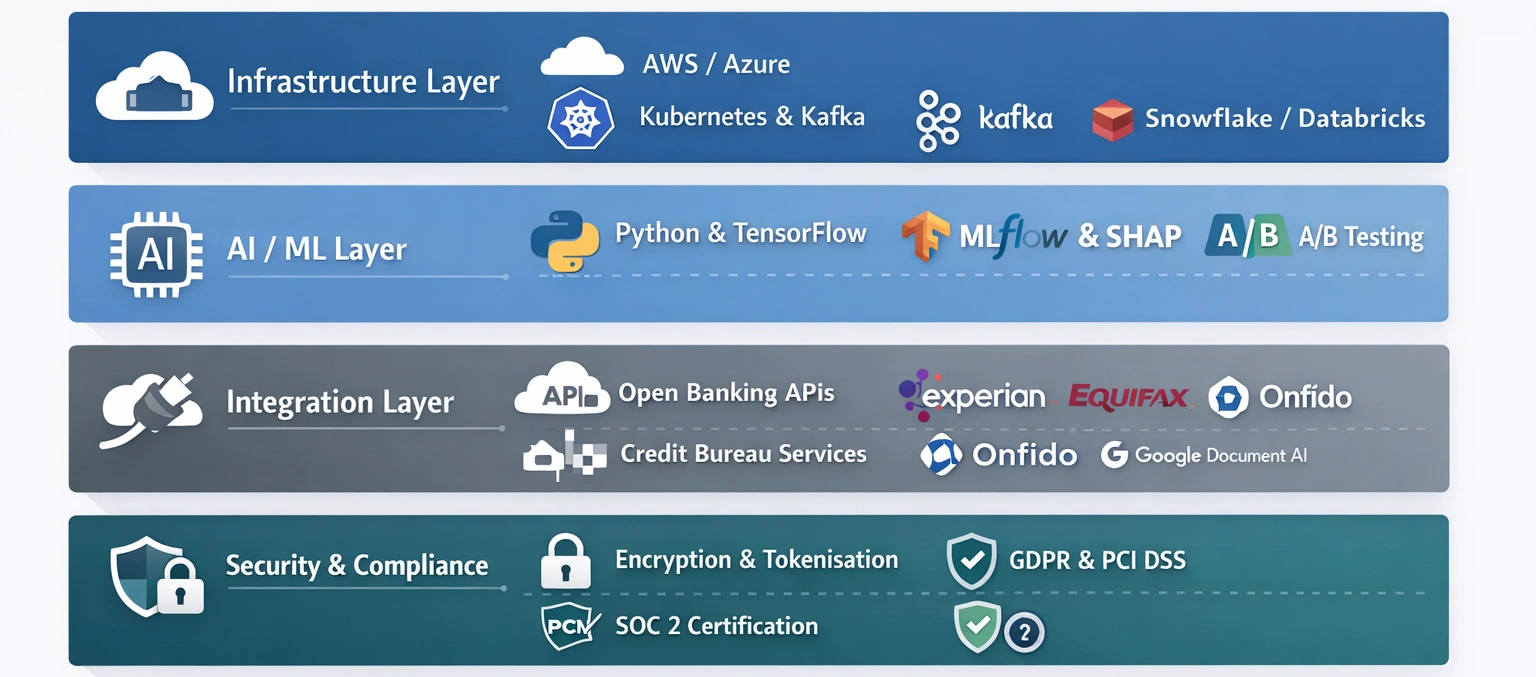
The Tech Stack Powering This Revolution

The Tech Stack Powering This Revolution

I am text block. Click edit button to change this text. Lorem ipsum dolor sit amet, consectetur adipiscing elit. Ut elit tellus, luctus nec ullamcorper mattis, pulvinar dapibus leo.

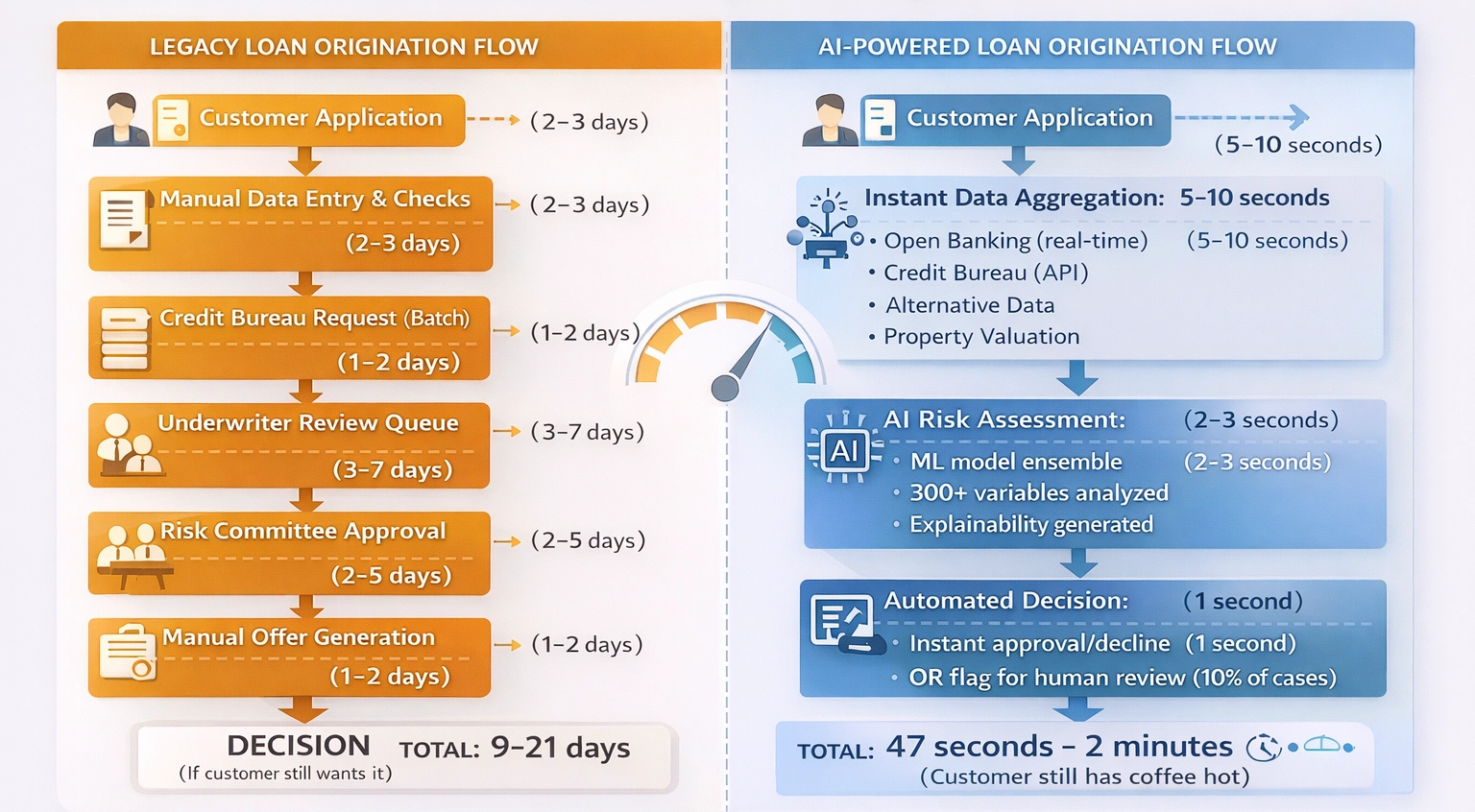
Visualising the Transformation: Before vs After

Visualising the Transformation Before vs After

This visual comparison makes the difference impossible to ignore. A legacy loan origination system UK depends on sequential handoffs, manual checks, batch credit pulls and multiple approval layers, each adding friction, delay and operational cost.

What stretches to 9–21 days in a traditional setup collapses into seconds inside an AI-powered architecture. With real-time data aggregation, AI credit underwriting UK models analysing hundreds of variables simultaneously, and automated decision engines generating instant explanations, the entire process shifts from queue-based processing to intelligent orchestration.

The result is not just speed, it is structural efficiency, lower risk, reduced cost per application, and a dramatically improved borrower experience.

Building vs Buying: The £10 Million Question

Every lender modernising their loan origination system UK eventually faces the same strategic decision:

Do we build our own AI-powered platform?
Do we buy a commercial solution?
Or do we partner and white-label?

This is not just a technology decision.
It is a capital, control, and risk decision.

Below is a practical comparison framework.

Strategic Comparison

Build vs Buy vs Partner – AI Lending Strategy
Approach
Advantages
Limitations
Best For
Build In-House Full control
Deep customisation
Strong differentiation
£8–15m investment
24–36 months timeline
High talent dependency
Large Tier-1 banks with mature AI teams
Buy Commercial Platform 4–8 month implementation
Proven technology
Lower upfront cost
Limited flexibility
Vendor lock-in risk
Roadmap constraints
Regional banks & building societies
Partner / White-Label Fastest launch (8–16 weeks)
Lowest initial cost
No technical debt
Limited differentiation
Revenue sharing
Dependency on partner
New entrants & niche lenders
Build with Azilen (Hybrid Model) Custom AI underwriting
Faster than in-house build
Lower cost than full internal team
Scalable architecture ownership
Requires strategic collaboration
Defined roadmap alignment needed
Lenders seeking control without £10m risk

Building in-house gives full ownership, but demands £8–15 million, 24–36 months, and deep AI talent.

Buying a commercial mortgage origination software UK platform accelerates deployment, but limits flexibility and long-term differentiation.

White-labelling reduces upfront cost, but sacrifices control and strategic IP. The emerging model among forward-thinking lenders is hybrid:

→ Retain architectural ownership
→ Deploy modern AI credit underwriting UK capability
→ Avoid the £10m internal build risk

That is where strategic technology partners like Azilen step in, combining custom AI development, scalable cloud architecture, and faster execution without locking lenders into rigid vendor platforms.

In a market moving this fast, the smartest strategy is not build or buy.

It is build smart.

The Azilen Technologies Perspective

At Azilen Technologies, a Digital Transformative Company, we help UK lenders modernise their loan origination system UK infrastructure with scalable AI credit underwriting UK capabilities, without disrupting existing core systems.

How We Approach AI Lending Transformation

AI-Driven Underwriting by Design: Custom ML models, explainability frameworks, and FCA-aligned decision transparency built into every mortgage origination software UK deployment.

Seamless Legacy Modernisation: API-led integration, phased migration, and zero-downtime transformation of core banking environments.

Compliance & Governance Ready: SHAP-based explanations, automated audit trails, bias monitoring, and Consumer Duty-aligned reporting embedded from day one.

Scalable Cloud Architecture: Secure, UK-compliant infrastructure built for growth, speed, and continuous model improvement.

FAQs: AI in UK Lending & Loan Origination

1. What is a modern loan origination system UK and how is it different from legacy systems?

A modern loan origination system UK uses real-time data integration, AI-powered risk assessment, and automated decision engines to streamline the entire lending journey. Unlike legacy systems that rely on manual reviews and batch credit checks, modern platforms use API-driven architecture, Open Banking data, and explainable AI to deliver faster approvals, lower processing costs, and improved regulatory compliance.

2. How does AI credit underwriting UK improve risk assessment accuracy?

AI credit underwriting UK analyses hundreds of behavioural, transactional, and macroeconomic variables simultaneously using machine learning models. Instead of relying on fixed scoring formulas, AI models continuously learn from loan outcomes, improving default prediction accuracy, reducing false declines, and enabling more inclusive lending decisions.

3. Is AI-powered mortgage origination software UK compliant with FCA regulations?

Yes, modern mortgage origination software UK platforms are built with compliance by design. They include explainability tools such as SHAP-based decision breakdowns, automated audit trails, and Consumer Duty reporting frameworks. This allows lenders to justify every decision transparently to regulators and customers.

4. Should UK lenders build or buy an AI lending platform?

The decision depends on asset size, technical maturity, and risk appetite. Building offers full control but requires significant investment and time. Buying accelerates deployment but limits flexibility. Many lenders now adopt a hybrid approach, combining custom AI credit underwriting UK models with scalable cloud infrastructure to balance ownership and speed.

5. How long does it take to modernise a loan origination system UK?

Implementation timelines vary by approach. Commercial platforms may deploy in 4–8 months, while full in-house builds can take 24–36 months. With structured migration strategies and API-led integration, lenders can modernise core components of their loan origination system UK within 6–9 months without operational disruption.

Glossary

Loan Origination System(LOS): A digital platform that manages the full lending journey, from application and underwriting to approval and disbursement.

AI Credit Underwriting: The use of machine learning models to assess borrower risk using behavioural, transactional, and financial data.

Mortgage Origination Software: Specialised software designed to process, assess, and approve UK residential and buy-to-let mortgage applications.

Open Banking: Secure API-based access to customer banking data (with consent) for real-time affordability and income analysis.

Explainable AI (XAI): Technology that provides transparent reasoning behind automated credit decisions.

SHAP Values: A method that shows which factors influenced an AI-driven approval or decline decision.

Consumer Duty (FCA): UK regulation requiring lenders to demonstrate fair, transparent, and customer-focused outcomes.

Kulmohan Makhija
Kulmohan Makhija
VP - Growth

Kulmohan Makhija writes at the intersection of technology and business, with a strong Europe-focused enterprise lens. His work covers digital transformation, product engineering, and applied AI, with attention to regulatory, cultural, and operational realities across European markets. He explores how complex organizations modernize core systems without disrupting what already works. His perspective balances innovation with pragmatism, shaped by how transformation actually plays out on the ground

Related Insights