Skip to content

Loan Origination Software UK: The Smarter Way to Manage End-to-End Lending

Featured Image

TL;DR

Loan origination software UK lenders rely on has moved beyond a simple back-office system into a core growth engine. It manages the full lending journey, from application and KYC to underwriting, compliance, and disbursement within one platform. With FCA Consumer Duty, rising rates, and fintech pressure, adoption has become strategically essential.

Loan origination software UK institutions adopt improves efficiency, reduces costs by up to 72%, and speeds approvals from weeks to minutes. It ensures real-time compliance and faster decision-making. This guide explores use cases, AI underwriting, system architecture, ROI impact, and how Azilen builds tailored solutions for UK lenders to stay competitive.

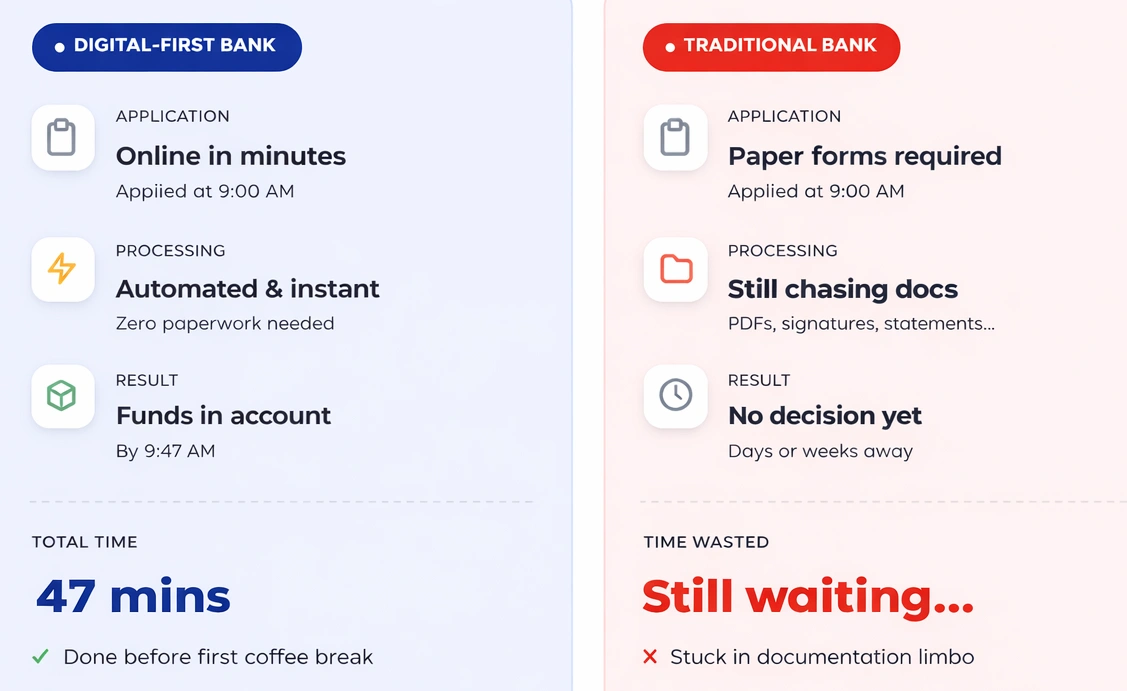
A borrower in Manchester submits a £25,000 business loan application at 9am.

By 9:47am, the funds are already in their account.

Just two miles away, another lender is still chasing documents, stuck in manual checks and delays.

That 47-minute gap decides who wins the customer.

This shift is exactly why loan origination software UK lenders adopt has become critical.

It replaces slow, fragmented processes with fast, automated workflows that improve decisions, reduce costs, and ensure compliance.

In today’s competitive UK lending market, speed and efficiency are no longer advantages, they are expectations.

The 47-Minute Gap, Solved

The 47-Minute Gap Illustration

That 47-minute gap isn’t magic.

It’s loan origination software UK lenders have deployed to systematically eliminate every manual bottleneck in their pipeline.

And right now, that gap is widening fast.

The UK lending market is under enormous pressure. Outstanding residential mortgage loans hit £1,734 billion by early 2026, according to the latest FCA data.

Interest rates have held firm at 4%. The FCA’s Consumer Duty framework demands demonstrable, auditable good outcomes for every customer.

Additionally, legacy systems built before broadband internet was commonplace simply cannot keep up with these demands.

Meanwhile, fintech challenger lenders, Zopa, Funding Circle, Iwoca, have collectively originated over £12 billion using AI-powered systems, and they are actively taking market share from traditional institutions.

Why Loan Origination Software Matters Urgently Right Now

The cost of inaction is now measurable. Manual loan processing in the UK costs lenders an estimated £800 to £1,400 per application when you factor in staff time, error correction, compliance reviews, and delayed time-to-funding.

Modern loan origination software UK platforms bring that cost down to £200–£380 per application. A reduction of 55–72%.

Multiply that across 5,000 applications per year, and you’re looking at savings of £3–5 million annually for a mid-sized lender. F

urthermore, speed has become a fundamental differentiator. Borrowers today compare their lender not to other banks, they compare them to Amazon, Revolut, and Netflix.

Consequently, modern loan origination software UK providers have built exactly the instant, transparent experience those borrowers expect.

£1.73T

Outstanding UK residential mortgage loans

72%

Max cost reduction per application with modern LOS

£12B+

Loans originated by UK fintechs
using AI

$7.8B

Global LOS market projected value by 2031

From Click to Cash (Watch This)

This video walks you through how a modern loan origination software UK platform actually works in a live environment.

From borrower application and Open Banking data flow to AI underwriting and FCA-compliant decisioning, it breaks down the entire journey in a simple, visual way.

What Exactly is Loan Origination Software Used For?

Let’s be precise. Loan origination software (LOS) is a digital platform that manages and automates every stage of the loan application lifecycle, from the moment a borrower submits their first detail to the moment funds are disbursed and beyond.

It is distinct from a loan management system (LMS), which handles servicing after origination, though the best modern platforms cover both.

For UK-based lenders, loan origination software typically includes several functional layers working in concert: digital application capture via web and mobile interfaces; automated KYC, AML, and identity verification integrated with agencies like Equifax, Experian, and TransUnion. AI-powered credit scoring and underwriting; automated Open Banking data retrieval. FCA-compliant decision documentation and audit trails. e-signature and digital documentation workflows, and disbursement trigger systems connected to core banking platforms.

Manual Lending vs. Loan Origination Software UK: The Complete Comparison

To understand the true value of loan origination software UK, look at a simple feature-by-feature comparison. These numbers come from real industry benchmarks relevant to the UK market in 2026 and show the clear difference between manual and automated processes.

Legacy vs Modern LOS (UK)
Criterion
Manual / Legacy Process
Modern LOS (UK)
Impact
Application time 3–15 days end-to-end 30 minutes – 4 hours ↑ Speed +95%
Cost per application £800 – £1,400 £200 – £380 ↓ Cost 55–72%
FCA Consumer Duty audit trail Manual documentation, fragmented Auto-generated, real-time Compliance ✓
Credit decisioning Human underwriter, 1–3 days AI model, seconds to minutes ↑ Accuracy +30%
Document verification Manual check of physical/emailed docs IDP + OCR, auto-validated ↓ Errors 80%
Open Banking integration Not available Real-time bank feeds via API Richer data
Scalability Linear: more loans = more staff Elastic: no staffing bottleneck ↑ Capacity unlimited
Borrower experience Branch visits, paper, phone calls Mobile-first, 24/7 self-service NPS +45 pts avg
GDPR / data governance Manual controls, high breach risk Encrypted, role-based, auditable ISO 27001 ready
Default risk detection Reactive, post-disbursement Predictive analytics pre-approval ↓ Defaults 20–35%

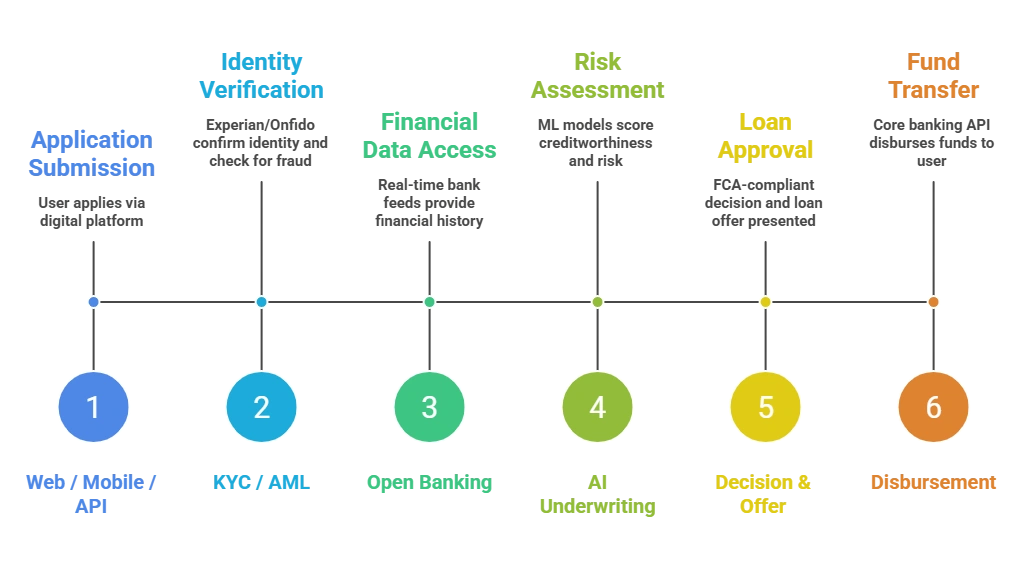
The End-to-End Journey Inside Loan Origination Software UK Platforms

Understanding the architecture of modern loan origination software UK systems means following the complete loan lifecycle, not just the application stage. Here’s how data flows intelligently through each layer of the platform.

Six-step horizontal workflow diagram with steps 1 through 6, each in a colored circle and connected by a line, depicting an approval process from initial input to final decision.

Stages 1 and 2: Intake and identity verification

The journey starts with a fully digital application through web or mobile. This is where Digital Onboarding & KYC Automation comes into play.

As soon as details are submitted, the system instantly verifies identity using KYC and AML checks through providers like Experian or Onfido. Everything runs in the background within seconds, making the process fast, secure, and frictionless.

Stages 3 and 4: Data enrichment and AI underwriting

Modern Loan Origination & Credit Platforms go beyond manual document collection. Instead of waiting for uploads, the system pulls real-time financial data using Open Banking.

This enables smarter, AI-driven underwriting that analyses income, spending behaviour, and risk patterns. The result is faster, more accurate decisions with significantly lower default rates.

Stages 5 and 6: Decision, offer, and disbursement

At this stage, the platform ensures full Regulatory Compliance Enablement by generating clear, auditable decision records aligned with FCA Consumer Duty. Once approved, the borrower receives a digital offer with e-signature.

After acceptance, funds are released instantly through seamless Core Banking Integrations, completing the journey in minutes instead of days.

The Real Cost of Not Using Loan Origination Software

Theory is fine, but UK lenders are numbers-driven businesses.

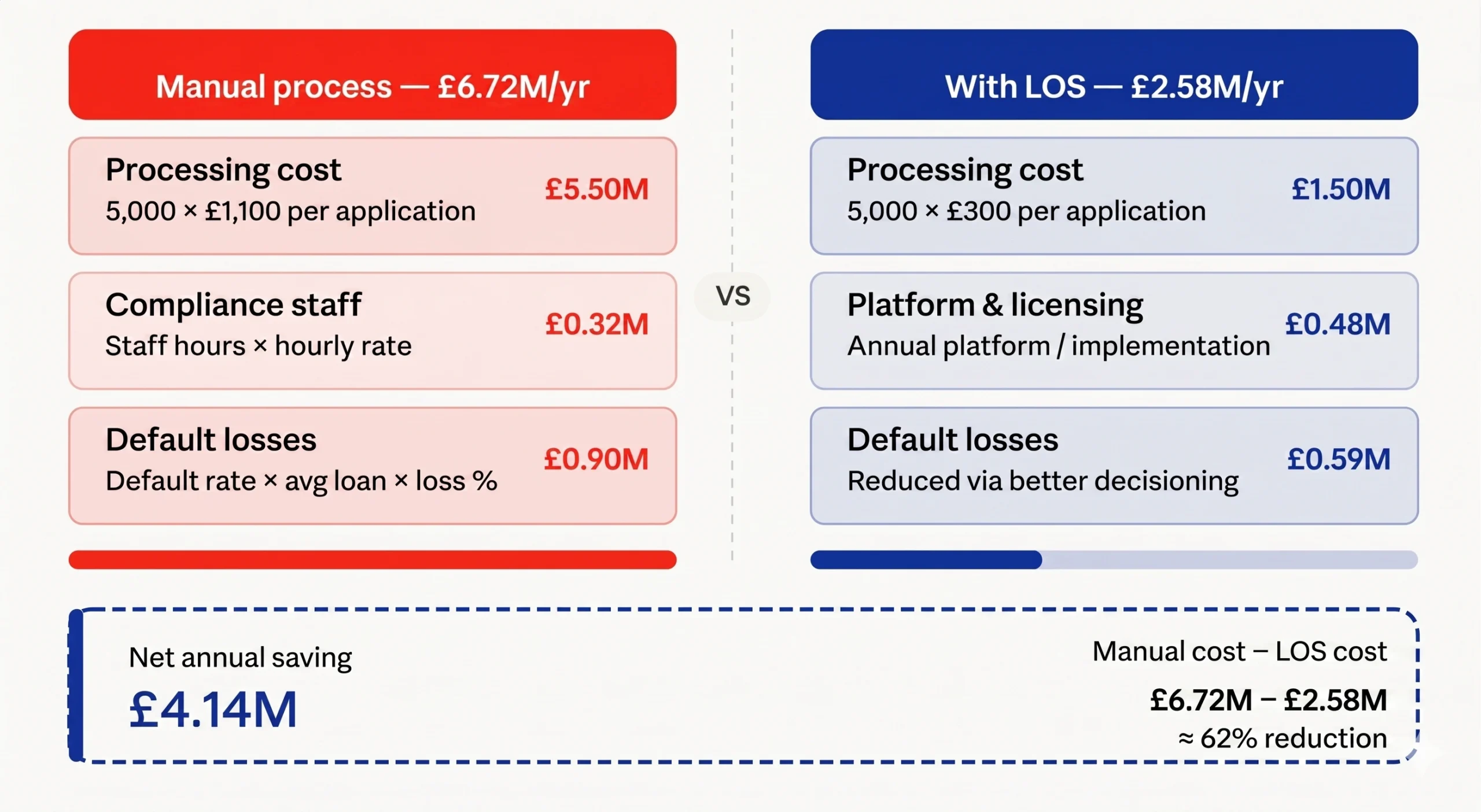
So let’s make this concrete. Below is a cost model that any lending institution can apply directly to calculate the ROI of switching to modern loan origination software UK.

Loan Origination Software cost saving

These figures are conservative estimates based on UK industry benchmarks.

Actual savings depend on loan volumes, existing infrastructure costs, and the sophistication of the LOS chosen.

Nevertheless, the directional truth is consistent: loan origination software UK deploy typically pays for itself within 6-12 months, even at modest volumes, and continues compounding ROI at scale.

What the UK Fintech Industry is Saying Right Now

The shift toward modern loan origination software UK is not just a vendor narrative. The industry is actively debating it, and the conversation is pointed. The following captures the sentiment shaping UK lending technology decisions in 2026.

The growing demand for loan origination software UK reflects a wider global shift towards faster, digital-first lending.

Market research projections highlight steady growth through 2029, driven by rising compliance needs, AI adoption, and customer expectations for instant approvals. For UK lenders, this signals a clear direction, modern platforms are becoming a necessity, not a choice.

Real-World Loan Origination Software UK Success Stories

The proof is not in the slides. So let’s look at what UK lenders and fintechs have actually achieved after deploying modern loan origination software.

These are documented, verifiable outcomes from institutions operating in the UK market today.

SME Lending at Scale with AI-Powered Decisioning

Funding Circle, one of the UK’s leading SME lenders, replaced its manual underwriting pipeline with an AI-powered loan origination system integrating Open Banking, Companies House data, and proprietary credit models.

The platform assesses thousands of variables per application, from cash flow patterns to industry-specific risk profiles, and delivers a credit decision in under 10 minutes.

This capability continues to evolve, with innovations like Funding Circle launches new embedded finance solution, further expanding access to credit through integrated ecosystems.

Additionally, the system is fully FCA-compliant, with every decision automatically documented and explainable under Consumer Duty. As a result, Funding Circle scaled to over £1 billion in annual originations without proportional headcount growth, clearly demonstrating how modern loan origination software UK platforms enable scale and efficiency.

For a deeper look at how AI-driven platforms are replacing legacy systems across the UK lending landscape, explore our detailed guide on Reimagining Loan Origination in the UK: AI-Driven Credit Platforms Replacing Legacy Lending Systems.

£1B+

Annual
Originations

<10 min

Decision
Time

FCA ✓

Consumer Duty Aligned

Lean

Team vs.
Volume

Who Benefits Most From Loan Origination Software UK?

Loan origination software UK serves virtually every category of UK lender, though the specific configuration and priorities differ. Here is how the technology maps to specific use cases across the UK lending industry.

Banks

Helps banks manage the full loan journey from application to approval and payout. Connects with existing systems, handles large volumes, reduces manual work, and ensures faster decisions with proper compliance and reporting.

Mortgage Providers

Makes mortgage process smooth start to finish. Automates approvals, property checks, and legal steps. Reduces delays while helping brokers, lenders, and partners stay connected and work efficiently.

Business Lenders

Supports lending to small and medium businesses using real financial data. Uses Open Banking and records to speed decisions, assess cash flow, and understand risk for better, more confident loan approvals.

Specialist Lenders

Designed for complex loans like property or short-term finance. Handles different assets, uses external data for evaluation, and allows flexible decisions for higher-risk cases while keeping the process structured and manageable.

Consumer Finance

Built for fast, high-volume lending like buy now, pay later. Uses real-time data for instant decisions, reduces manual checks, and ensures a smooth, quick experience while staying aligned with financial rules.

Credit Unions

Supports community lenders with faster, modern processes. Combines digital tools with personal decision-making, helping them serve members better, respond quickly, stay competitive, and maintain trust and strong relationships within their communities.

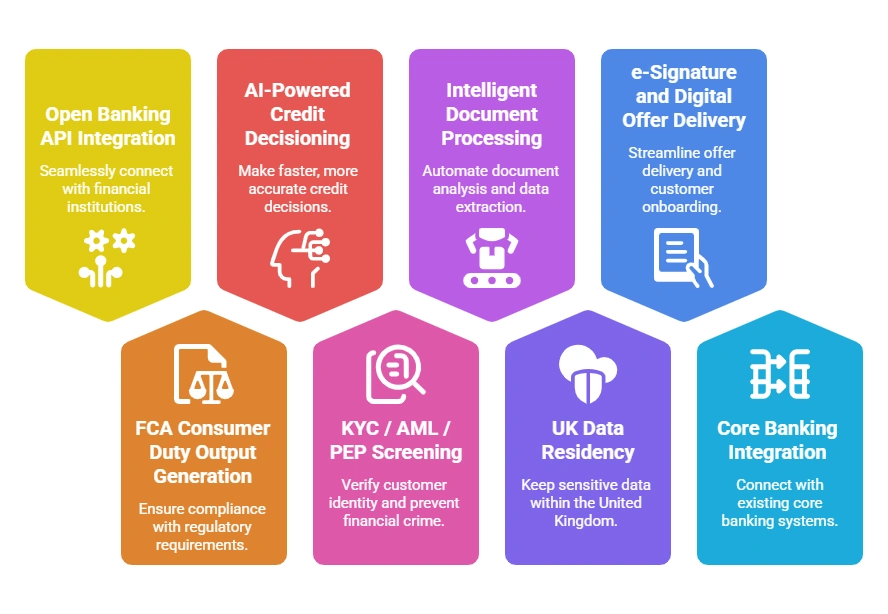
The Must-Have Features in Any Loan Origination Software UK Evaluation

If you are evaluating loan origination software UK providers right now, use the following as your non-negotiable checklist. Every item on this list is essential for serious UK lenders operating in the current regulatory and competitive environment.

use case Loan Origination Software

Open Banking API integration: direct connectivity to UK bank feeds via TrueLayer, Plaid, or equivalent. Non-optional in 2026 for any lender serious about affordability accuracy.

FCA Consumer Duty output generation: automated, auditable outcome records for every lending decision as a standard workflow output, not a separate compliance report.

AI-powered credit decisioning with SHAP explainability: not just a risk score, but an explainable, consumer-readable rationale that satisfies FCA scrutiny.

KYC / AML / PEP screening: real-time integration with identity verification providers and global sanctions databases, with configurable risk thresholds.

Intelligent Document Processing (IDP): goes beyond OCR to contextual understanding and cross-validation of documents against Open Banking and bureau data.

UK data residency: all personal data processed and stored within UK/EEA boundaries per GDPR and FCA data localisation expectations.

e-Signature and digital offer delivery: FCA-compliant electronic agreements with qualified electronic signature (QES) support for binding origination documentation.

Core banking integration: bi-directional APIs to major UK core banking platforms including Temenos, Finastra, Thought Machine, and Mambu.

Why Azilen Stands Out in Loan Origination Software UK Transformation

Loan origination software UK implementation is not just a technology upgrade. It is a complete shift across data, decisioning, compliance, and operations. Missing even one layer leads to slower approvals, compliance risks, and poor borrower experience.

Azilen is a digital transformation company that takes a structured, long-term approach to building modern loan origination ecosystems. Recognised among the Top Digital Transformation Companies in the UK, it focuses on creating scalable, compliant platforms that evolve with changing FCA regulations and market demands.

Instead of just deploying software, Azilen ensures that loan origination systems are fully embedded into daily lending operations. This means faster adoption, better decision-making, and continuous improvement over time.

Strong Data Foundation: Builds structured data systems that power accurate underwriting, real-time insights, and better credit decisioning across the entire lending lifecycle.

Seamless System Integration: Connects LOS with core banking, Open Banking APIs, credit bureaus, and third-party services to create a unified lending ecosystem.

Process-Driven Implementation: Aligns technology with real lending workflows, ensuring smooth operations from application to disbursement without friction or manual gaps.

Built-in Compliance Framework: Embeds FCA Consumer Duty requirements directly into workflows, ensuring every decision is auditable, explainable, and regulation-ready.

Intelligent Automation: Reduces manual intervention through AI-driven underwriting, document processing, and automated decisioning, improving speed and accuracy.

Scalable Lending Architecture: Supports phased growth, enabling lenders to handle increasing volumes, new products, and evolving market needs without rebuilding systems.

Azilen focuses on making loan origination transformation sustainable, not temporary, helping UK lenders move beyond implementation and build platforms that continuously adapt, scale, and deliver measurable business outcomes.

FAQs: Loan Origination Software UK Journey

1. What is loan origination software UK and how does it work?

Loan origination software UK is a digital platform that manages the full lending journey, from application and identity verification to underwriting, approval, and disbursement.

It automates manual tasks, integrates with Open Banking and credit bureaus, and ensures FCA-compliant decisioning. This helps lenders process applications faster, reduce errors, and deliver a smoother borrower experience across all lending products.

2. Why is loan origination software important for UK lenders today?

Loan origination software UK has become essential due to rising regulatory pressure, high interest rates, and increasing competition from fintech lenders. It enables faster approvals, improves compliance with FCA Consumer Duty, and reduces operational costs.

Without automation, lenders struggle to meet customer expectations for speed, transparency, and digital-first experiences in today’s evolving UK lending market.

3. How does loan origination software improve compliance in the UK?

Loan origination software UK embeds FCA compliance directly into workflows. It automatically generates audit trails, records decision logic, and ensures fair customer outcomes as required by Consumer Duty.

By integrating KYC, AML, and affordability checks, it reduces compliance risks and ensures every lending decision is traceable, explainable, and aligned with UK regulatory standards.

4. What features should you look for in loan origination software UK?

Key features in loan origination software UK include Open Banking integration, AI-driven underwriting, automated KYC and AML checks, digital onboarding, and core banking integration.

It should also support real-time analytics, compliance reporting, and low-code configuration. These features ensure scalability, faster processing, and the ability to adapt to changing regulatory and market requirements.

5. How much ROI can UK lenders expect from loan origination software?

Loan origination software UK can deliver significant ROI by reducing processing costs, lowering default rates, and speeding up approvals. Many lenders report cost reductions of up to 60–70% and faster decision times from days to minutes.

The platform improves efficiency, increases conversion rates, and enables scalable growth without increasing operational costs proportionally.

Glossary

Loan Origination Software UK: A digital platform that manages the complete loan lifecycle, from application and verification to underwriting, approval, and disbursement within a single, integrated system.

Loan Origination System (LOS): Software used by lenders to automate and manage the loan application process before disbursement, improving speed, accuracy, and compliance.

Loan Management System (LMS): A system that handles post-disbursement activities such as repayments, interest calculations, and loan servicing throughout the loan lifecycle.

Digital Onboarding: The process of collecting and verifying borrower information online through web or mobile interfaces without requiring physical paperwork or manual intervention.

KYC (Know Your Customer): A regulatory process used to verify the identity of borrowers to prevent fraud, money laundering, and financial crimes.

AML (Anti-Money Laundering): A set of regulations and checks designed to detect and prevent illegal financial activities such as money laundering and terrorist financing.

PEP Screening: The process of identifying Politically Exposed Persons who may pose higher financial risk due to their public position or influence.

Open Banking: A system that allows secure access to a borrower’s financial data from banks via APIs, enabling real-time income and affordability checks.

API (Application Programming Interface): A technology that allows different software systems to communicate and exchange data seamlessly in real time.

AI-Powered Underwriting: The use of artificial intelligence and machine learning to assess creditworthiness based on real-time financial behaviour and risk patterns.

Credit Decisioning: The process of evaluating a borrower’s application and determining approval, rejection, or loan terms based on risk analysis.

SHAP Explainability: A method used in AI models to explain how each factor influences a credit decision, making outcomes transparent and regulator-friendly.

FCA Consumer Duty: A UK regulatory framework requiring lenders to deliver fair, transparent, and positive outcomes for customers, with full accountability.

Compliance Reporting: The process of documenting and maintaining records of lending decisions to meet regulatory requirements and audits.

Core Banking System: The central system used by financial institutions to manage accounts, transactions, and financial operations.

Core Banking Integration: The connection between loan origination software and core banking systems to enable seamless data flow and automated disbursement.

e-Signature: A digital method of signing documents electronically, making agreements legally binding without physical paperwork.

Intelligent Document Processing (IDP): Technology that extracts, understands, and validates data from documents using AI, going beyond basic OCR capabilities.

OCR (Optical Character Recognition): A technology that converts scanned documents or images into readable and editable digital text.

Affordability Assessment: The process of evaluating whether a borrower can repay a loan based on income, expenses, and financial behaviour.
Kulmohan Makhija
Kulmohan Makhija
Vice President – Growth & Enterprise Strategy

Kulmohan Makhija is an enterprise technology and business strategy writer with over 12 years of experience analyzing digital transformation across global and European markets. His work focuses on applied artificial intelligence, product engineering, enterprise architecture, and large-scale legacy modernization. He explores how complex organizations modernize core systems, adopt AI responsibly, and align innovation with regulatory, cultural, and operational realities — particularly within the UK and broader European technology landscape. With a pragmatic enterprise perspective, Kulmohan emphasizes transformation that delivers measurable impact without disrupting mission-critical operations. His writing bridges executive strategy with technical depth, providing clarity for technology leaders, product teams, and decision-makers navigating modernization journeys.

Related Insights