Digital Product Passport
Azilen Technologies helps UK manufacturers design, build, and manage Digital Product Passport (DPP) systems that meet EU requirements. From structuring fragmented data to ERP integration and supplier onboarding, we deliver end-to-end DPP implementation with GS1-aligned architecture, ensuring compliance, traceability, and readiness for evolving ESPR regulations.
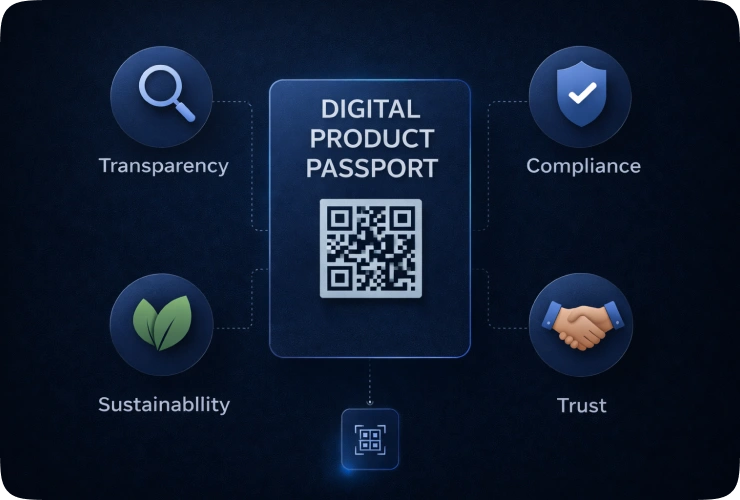

We assess your product data against ESPR requirements, mapping attributes, missing fields, and supplier data dependencies. The output is a sequenced remediation plan aligned to product categories, regulatory timelines, and system-level constraints.
- ESPR mapping
- Attribute gaps
- Supplier dependencies
- Timeline alignment

We define canonical data models aligned to GS1 and Asset Administration Shell, establish ownership at attribute level, and implement validation rules so product, material, and lifecycle data remains consistent across systems and exchanges.
- Canonical models
- AAS schemas
- Attribute ownership
- Validation rules

We deploy structured data capture workflows for suppliers, including schema-aligned templates, document ingestion, and validation pipelines. Evidence is linked to attributes, ensuring traceable, verifiable inputs across Tier 1 and Tier 2 supplier ecosystems.
- Structured templates
- Document ingestion
- Validation pipelines
- Evidence linking

We implement the DPP architecture using GTIN-based identifiers, GS1 Digital Link carriers, EPCIS event streams, and API integrations with ERP, PLM, and MES systems to automate lifecycle data capture and synchronisation.
- GTIN identifiers
- Digital Link
- EPCIS events
- API integrations

We build access-controlled passport services with role-based data exposure, linking public and restricted attributes. Audit logs, versioning, and data lineage tracking ensure every data point is traceable, regulator-ready, and securely governed.
- Role access
- Data lineage
- Audit logs
- Version control

We apply AI for document parsing, attribute extraction, anomaly detection, and rule-based validation. Outputs are human-reviewed and logged, ensuring every automated decision remains explainable, traceable, and compliant with audit and regulatory expectations.
- Document parsing
- Attribute extraction
- Anomaly detection
- Rule validation
We maintain DPP compliance by tracking delegated acts, updating schemas, and revalidating data against evolving rules. Scheduled audits, version updates, and impact assessments ensure passports remain aligned with changing EU regulatory requirements.
- Regulatory change monitoring
- Passport lifecycle updates
- Quarterly compliance audits
- Long-term managed service
Our Digital Product Passport Services for UK Enterprises
Your products are already excellent, the EU just needs proof. Let's build that proof before the deadline.
How Does DPP Power the Circular Economy?
A Digital Product Passport powers the circular economy by structuring and connecting lifecycle data that already exists but sits fragmented across systems.
Once standardised and governed, each product becomes traceable and information-rich, enabling repair, reuse, and recycling. Stakeholders access accurate data when needed, while businesses gain visibility to optimise decisions across the entire product lifecycle.
Why UK Manufacturers Cannot Afford to Wait on DPP
Battery passports are confirmed law. ESPR is expanding. The data gap is already widening.
- Only 16% of exporters feel prepared for DPP compliance today
- Battery passports are a confirmed legal requirement from 2027
- Without compliant DPP, shipments risk being blocked
- EU digital registry launches 2026, making DPP urgent for businesses
Key Insights on Digital Product Passports
What every organisation should understand about DPP, from compliance foundations to long-term competitive value.
DPP Is a Product Data Strategy, Not just an IT Project
The organisations that extract the greatest value from DPP treat it as a strategic transformation in how their products are documented, tracked, and managed. Compliance is the baseline.
The greater opportunity lies in product intelligence, lifecycle visibility, supply chain transparency, and data assets that support smarter decisions at every stage from sourcing to disposal..
Supplier Data Is the Most Critical Variable
A passport is only as accurate as the data behind it. For most manufacturers, the most difficult data to collect is not internal, it is the material, chemical, and sustainability data held by Tier 1 and Tier 2 suppliers.
Without a structured onboarding and validation framework, this data gap undermines the entire programme.
Role of GS1 Standards in Interoperable DPP
GS1 standards, GTIN, EPCIS, and Digital Link are the common language that makes passport data readable and verifiable across organisations and borders.
They are not optional enhancements. They are the structural foundation that determines whether your passport works within the wider EU ecosystem or only within your own systems.
Consistent Lifecycle Data Remains Operationally Difficult
Most organisations face the same core challenges: fragmented systems that do not communicate, inconsistent data standards across departments, and unclear ownership of product data once it leaves the manufacturer.
Resolving these at an architectural level is the work that determines whether DPP delivers long-term value or simply achieves surface-level compliance.
Difference Between Compliance and Competitive Advantage
Audit-ready passports meet the minimum requirement. Genuinely intelligent passports, with clean lifecycle data, integrated supply chain records, and AI-assisted anomaly detection, become a commercial asset.
They reduce warranty costs, support circular economy commitments, and provide the transparency that increasingly matters to EU buyers and procurement teams.
AI in DPP: Where It Adds Value and Where It Does Not
AI is genuinely valuable in DPP programmes when applied to document extraction, data anomaly detection, and rule-based compliance checking. It reduces manual effort and improves data accuracy at scale.
It is not a replacement for human validation, governance frameworks, or clear data ownership. Every AI component in an Azilen DPP programme operates within an auditable, human-validated workflow.
Continuous Support for Your Digital Product Passport
EU regulations evolve. We provide managed services ensuring your digital product passports stay accurate, compliant, scalable, and audit-ready as requirements change.
- Passport schema updates as data requirements are revised
- Quarterly compliance audits and reporting
- Scalable infrastructure as your product portfolio expands
- Extended documentation and knowledge transfer

What Real Digital Product Passport UK Implementation Actually Looks Like
GS1 Standards Power Our Digital Product Passport (DPP) Solutions
We implement GS1 standards as the core layer of every Digital Product Passport, ensuring seamless integration, regulatory compliance, traceability, and consistent lifecycle data accuracy across systems.
Your Digital Product Passport stays adaptable, scalable, and compliant with evolving EU regulations and systems.






What Makes Azilen a Trusted DPP Partner

The Spirit Behind Our DPP Work


Turning "We're Not Ready" Into "We're Fully Compliant"
| The Azilen Promise | Upheld |
| End-to-End DPP Delivery |  |
| EU ESPR-Aligned Systems | |
| Future-Proof Data Architecture | |
| Enterprise ERP Integration | |
| AI-Powered Automation | |
| Scalable Cloud Infrastructure | |
| Long-Term Compliance Partnership | |

Frequently Asked Questions (FAQ's)
A Digital Product Passport is a digital record linked to a physical product, storing data on its materials, origin, environmental impact, and lifecycle. If you sell into the EU market, yes, you will need one. The first deadlines hit in 2027 for textiles, batteries, and steel. UK exporters who aren’t compliant risk having shipments blocked at the EU border.
Batteries fall under a separate EU Battery Regulation with a 2027 passport deadline, while textiles, footwear, iron, steel, aluminium, furniture, tyres, chemicals, and consumer electronics all follow under ESPR, with requirements rolling out annually through 2030. If your products land in any of these categories and you sell into Europe, the clock is already ticking.
We map your current data flows first, what lives in SAP, Oracle, Dynamics, or your PLM, then build direct connectors that pull product data automatically into your DPP system. No manual exports, no duplicate entry. When your product data updates in your ERP, your passport updates too. We’ve done this for complex enterprise environments and know exactly where the integration pain points sit before we even start.
It depends on your starting point. A Readiness Assessment takes 2–3 weeks. A full custom DPP platform build with ERP integration typically runs 3–6 months for an enterprise. If you’re starting from a clean data foundation, it’s faster. If your product data is scattered across legacy systems, we factor that into the plan upfront, no surprises mid-project. Most clients go from first conversation to passport-live within 4 months.
The value of accurate primary product data to fuel AI and drive greater efficiencies across operations is significant, and that works both ways. Our AI agents scan your documents, supplier data sheets, and system records to automatically extract and structure the product information your passport needs. It also runs continuous compliance checks, flagging gaps, outdated data, or fields that don’t meet the latest EU standards. Your team stops chasing data manually and starts managing by exception.
The EU’s DPP requirements evolve through 2033, with increasingly detailed lifecycle data required at each stage. We monitor every regulatory update across all relevant product categories and push changes to your passport system before deadlines hit. Our managed service clients get quarterly compliance health checks, proactive update alerts, and a dedicated account manager who knows your product portfolio, so nothing slips through the cracks.