Skip to content

What Digital Transformation in the Insurance Industry Looks Like Beyond Portals

Featured Image

TL;DR:

Digital Transformation in the Insurance Industry goes far beyond portals and apps. While digital interfaces improve access, they rarely change core operations. For UK insurers, real transformation means modernising core systems, unifying data, embedding intelligence into underwriting and claims, and automating decisions.

This article explains how insurers move beyond portals to build faster, smarter, and more resilient operating models.

In This Article, You’ll Learn

→ Why portal-led digital transformation in the insurance industry reaches a structural limit
→ What “beyond portals” actually means at a systems and architecture level
→ How UK insurers are transforming underwriting, claims, and compliance internally
→ Which technologies enable intelligent, explainable insurance operations
→ How transformation shifts insurance from reactive processing to adaptive decisioning

This is a deep dive into how insurance truly works when transformed.

A Hard Truth Worth Acknowledging Early

Despite years of digital investment, a significant portion of insurance operations still rely on manual processes and legacy systems. Industry research shows that digital channels have expanded faster than core modernisation. Many insurers look digital on the surface. Very few have truly digital operations underneath.

Now, let’s understand why this gap still exists.

Why Digital Transformation in the Insurance Industry Has Reached an Inflection Point

Insurance organisations were built for predictability, not speed. Processes prioritised risk minimisation, systems were designed for longevity, and change was intentionally cautious. That operating model delivered stability for years, until market dynamics, regulation, and technology began to move faster than insurance could follow.

In the UK market today, insurers face simultaneous pressure from multiple directions:

→ Over the last 5–7 years, regulatory expectations have increased significantly in complexity and scrutiny

→ Customers now expect near-instant service, shaped by real-time digital experiences that have become the norm over the past 10 years

→ Data volumes have grown multiple times compared to a decade ago, yet insight extraction and decision-making remain slow

→ Digital-native insurers, many launched within the last 8–10 years, operate without legacy constraints and scale far faster

In response, many insurers invested in digital channels. Portals became the visible symbol of transformation. Yet behind those portals, the same constraints remained.

This mismatch between digital experience and operational reality is now the central transformation challenge.

Why Digital Transformation in the Insurance Industry Still Underperforms

Many insurers assumed that digital interfaces would unlock operational efficiency. Research and industry experience show that experience-led transformation delivers diminishing returns. The early focus was logical:

→ Digitise customer interactions
→ Reduce call centre load
→ Improve transparency
→ Enable self-service

Despite digital channels handling over 70% of customer interactions, many insurers still rely on manual, fragmented operations, creating a growing disconnect between digital experiences and how insurance work is actually executed.

→ Customers interact digitally through portals, apps, and self-service journeys
→ Operations still depend heavily on manual effort, with claims and endorsements often touching 5–10 internal systems
→ Decisions continue to rely on fragmented data spread across underwriting, claims, and third-party platforms
→ Compliance still interrupts workflows, adding review cycles and rework

Even large insurers such as Aviva and AXA UK have publicly acknowledged the complexity of modernising legacy-heavy operating models at scale. This is not a tooling problem. It is an architectural one. When experience evolves faster than execution, digital debt accumulates silently, until it becomes impossible to ignore.

What Digital Transformation in the Insurance Industry Really Means at an Operational Level

Growth of Digital Transformation in the Insurance Industry

True digital transformation in the insurance industry is not defined by channels. It is defined by how decisions are made and executed. At an operational level, transformation introduces four fundamental shifts:

→ From process-led to decision-led operations: UK insurers like Aviva have reduced manual underwriting steps by embedding automated triage, cutting decision turnaround from days to hours

→ From static rules to adaptive intelligence: insurers such as AXA UK now use model-driven risk scoring instead of fixed rules, improving pricing accuracy as data evolves

→ From siloed systems to integrated platforms: legacy handoffs across policy, claims, and billing are replaced by unified platforms, reducing rework and operational cost

→ From episodic change to continuous evolution: Insurers like Admiral Group continuously refine pricing and risk models using live data signals, enabling faster adaptation to market and claims trends

These shifts require deep changes across systems, data, and governance, not cosmetic digital upgrades.

The Portal Plateau: Why Interface-Led Transformation Runs Out of Value

Portals act as orchestration points between users and internal systems. Their effectiveness depends entirely on the quality of what they orchestrate.
When portals sit on top of:

→ Monolithic policy administration systems
→ Batch-driven claims engines
→ Fragmented customer and risk datasets
→ Manual underwriting workflows

They surface inefficiencies rather than eliminating them. As volume increases, these inefficiencies compound. Claims queues grow, exception handling explodes, and operational cost curves steepen. This is why many insurers experience diminishing returns after initial digital success.

Digital Transformation in the Insurance Industry Beyond Portals: The Real Building Blocks

1. Core System Re-Architecture, Not Just Modernisation

Modernising insurance core systems is often framed as a technology upgrade. In reality, it is a business capability redesign. Transformation-ready cores are:

→ Modular rather than monolithic
→ API-first rather than interface-bound
→ Event-driven rather than batch-oriented

This architecture enables faster product launches, allows policy, claims, and billing systems to evolve independently without disrupting operations, and supports real-time responsiveness to emerging risk events. Without this foundational shift, higher-level digital transformation initiatives remain constrained, limiting agility and long-term scalability.

2. Enterprise Data Unification and Governance

Insurance generates vast amounts of data across underwriting, claims, customer experience portals, and third-party sources. Yet most insurers struggle to convert data into real-time intelligence.

True digital transformation requires:

→ A unified enterprise data model
→ Real-time ingestion and processing
→ Strong lineage, governance, and auditability

For UK insurers, this is critical not only for insight but for regulatory compliance, explainability, and reporting integrity. Data becomes powerful only when it is trusted, timely, and actionable.

Zurich Insurance Data & Underwriting Case Study (2024) – From Fragmented Data to Underwriting Intelligence

Zurich Insurance underwriting transformation using unified data intelligence for smarter risk decisions

Zurich Insurance Group consolidated diverse internal and external datasets to build an underwriting platform that delivers richer, faster risk insight. In 2024 Zurich combined large external geospatial datasets (including national LIDAR) with internal policy and claims data, then processed them in a high-performance cloud data environment to produce high-granularity risk indicators.

The platform reduced manual reconciliation, enabled automated pre-assessments, and fed underwriters with contextual risk scores and visualisations, cutting assessment time while improving price accuracy for complex commercial risks. Parallel projects to simplify global underwriting workflows also consolidated multiple tools into a single decision surface, reducing throughput time and improving quality.

Key takeaway: Digital transformation in the insurance industry becomes tangible when data stops being fragmented and starts driving decisions.

3. Decision Intelligence as a Core Capability

Traditional insurance systems treat data, business rules, and decisions as separate layers, creating delays and inconsistencies across underwriting and claims. Modern digital insurance platforms integrate these elements into a unified decision layer. Decision intelligence introduces:

→ Predictive models for underwriting and pricing
→ Risk scoring engines that evolve continuously with data
Underwriting Decision Engines that combine rules, models, and policy logic into a single, explainable decision framework
→ Explainable AI to support regulatory transparency

This shift enables insurers to move from manual judgement toward assisted and automated decisioning at scale, while maintaining governance, auditability, and accountability across the entire decision lifecycle.

4. Intelligent Automation Across the Insurance Value Chain

Automation beyond portals is not about eliminating humans. It is about optimising where human judgement adds value.

Modern automation combines:

→ RPA for repetitive operational tasks
→ Workflow orchestration across systems
→ AI-driven triage and prioritisation

Simple cases flow straight through. Complex cases are routed intelligently. This dramatically improves speed while preserving quality.

Direct Line Insurance Group compliance transformation: When Compliance Stops Slowing Down Decisions

Direct Line Insurance Group compliance transformation enabling faster, automated decision-making across UK insurance operations

A prominent UK insurer such as Direct Line Insurance Group (one of the UK’s largest general insurers with several key brand portfolios including Direct Line and Churchill) historically treated regulatory compliance as a checkpoint at the end of its decision process, especially in underwriting and policy pricing. Under that model, compliance reviews followed initial decisions, leading to rework loops, delayed policy issuance, and inconsistent outcomes, particularly during peak volume periods such as motor and home insurance renewals.

To address this, the insurer moved toward embedded regulatory logic within its decision engines, automating compliance checks as part of every decision. Regulatory rules, internal guidelines, and audit requirements were codified into automated workflows, and every decision generated a real-time audit trail of data inputs, rule evaluations, and outcomes. This approach enabled compliance to be continuous rather than disruptive, accelerating underwriting and pricing decisions while strengthening regulatory confidence and transparency.

5. Compliance-by-Design Operating Models

In the UK market, compliance is not optional, but it does not need to be disruptive.

Digitally transformed insurers embed compliance directly into:

→ Decision logic
→ Process flows
→ Data validation layers

This reduces post-hoc checks and enables regulators to see transparency by design rather than after the fact.

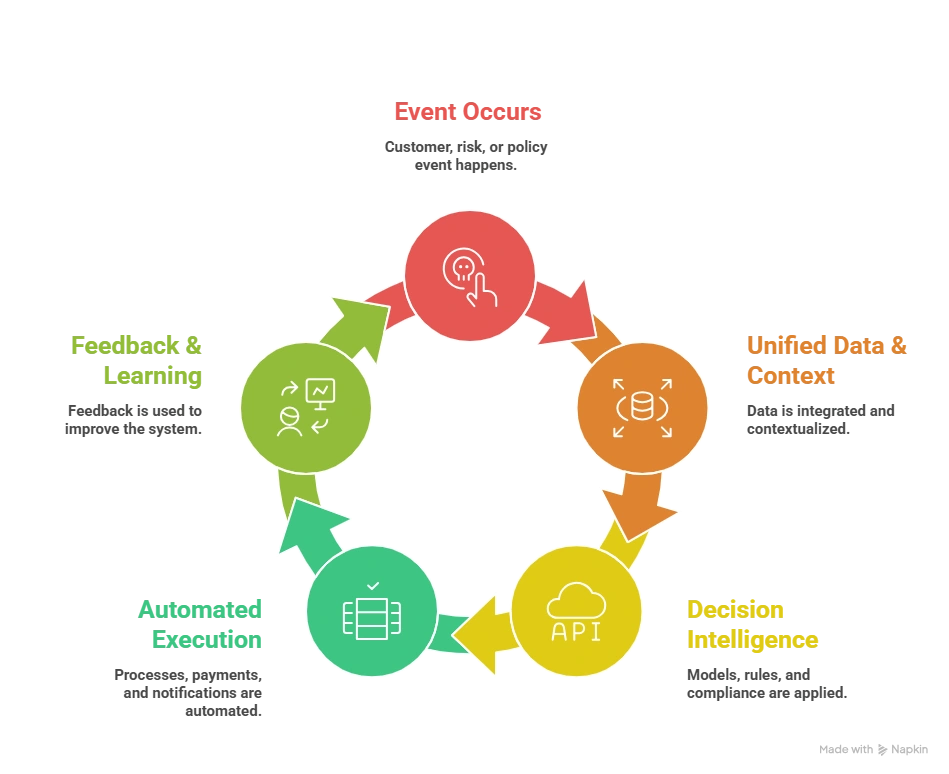
Flow: How Digital Transformation in the Insurance Industry Actually Operates

This architecture allows insurance operations to learn continuously, rather than operate on fixed assumptions.

Deep-Dive Use Cases Enabled by Transformation Beyond Portals

Claims: From Processing to Resolution

UK insurers are leveraging AI to accelerate claims outcomes. According to industry analysis, automation can reduce the claims lifecycle by up to 30% through AI-enabled triage. Routine claims processing times have fallen from a typical 7–10 days to as little as 24–48 hours with AI and automation.

Underwriting: From Risk Classification to Risk Intelligence

Modern underwriting platforms integrate data and models, enabling faster, more accurate risk assessments.

Pricing: From Annual Reviews to Continuous Optimisation

Pricing engines that react to real-time risk and claims data deliver stronger margin control.

Customer Engagement: From Reactive to Preventive

Insurers with high digital adoption report that 90% of new business is transacted digitally, reflecting broader shift to preventive, data-driven engagement.

Business Outcomes of Digital Transformation in the Insurance Industry

HTML Table Generator
Dimension
Traditional Model
Transformed Model
Decision speed Slow, manual Near real-time
Risk accuracy Historical Predictive
Cost structure Labour-heavy Automation-led
Compliance Reactive Embedded
Agility Low High

These outcomes compound over time, creating structural advantage rather than incremental improvement.

The Role of the Right Transformation Partner

Executing digital transformation in the insurance industry requires more than implementation capability. It demands:

• Deep insurance domain understanding: Knowing how underwriting, claims, and pricing actually work, and why small changes impact loss ratios and regulatory outcomes
• Systems thinking across architecture and data: Understanding how policy, claims, billing, and data platforms interact, avoiding fragmented solutions
• Experience balancing innovation with regulation: Enabling AI and automation while ensuring explainability, auditability, and regulatory confidence
• Long-term platform mindset: Building adaptable platforms that evolve with products, regulation, and market change

This is where specialised digital engineering partners add disproportionate value.

How Azilen Technologies Supports Transformation Beyond Portals

Azilen Technologies works with UK insurers to architect and engineer intelligent insurance operating platforms, not merely digital touchpoints. As a Digital Transformation Company and trusted insurance technology partner in the UK market, Azilen drives deep, outcome-focused change across core operations and enterprise systems.

✅ Core system re-architecture to modernise legacy policy, claims, and underwriting systems for scalability and regulatory readiness
✅ Enterprise data and intelligence platforms that unify siloed data and enable real-time insights for better decision-making
✅ Decision automation and AI integration, including Claims Processing Automation, to support straight-through settlements, faster turnaround times, and reduced operational costs

This approach helps UK insurers move beyond surface-level digitisation to true, sustainable transformation.

Final Perspective: The Future of Insurance Is Engineered, Not Displayed

The most important changes in digital transformation in the insurance industry do not appear on screens.

They appear in:

• Faster, fairer decisions
• Smarter risk management
• Embedded compliance
• Resilient operations

Portals make insurance visible. Transformation makes it work. For UK insurers, the next era of competitiveness will be defined not by what customers see, but by how intelligently the system behind the scenes operates.

FAQs: AI in Insurance Decision-Making

1. What does digital transformation in insurance mean beyond customer portals?

Digital transformation beyond portals focuses on how insurance decisions are made, executed, and governed internally. For UK insurers, this means automating underwriting, claims, and compliance decisions using data and AI, modernising core systems, and integrating platforms end to end. Portals improve access, but real transformation improves speed, accuracy, cost efficiency, and regulatory confidence across operations.

2. Why are portals not enough for insurance digital transformation?

Portals digitise the front end but leave legacy processes, manual decisions, and siloed systems untouched. UK insurers still face slow underwriting, rework in claims, and compliance bottlenecks when transformation stops at channels. True digital transformation requires decision automation, unified data platforms, and core system modernisation to deliver measurable operational impact.

3. How does decision automation transform underwriting and claims operations?

Decision automation replaces manual reviews with data-driven, rules-plus-AI decisioning. In underwriting, it enables faster risk assessment and pricing accuracy. In claims, it supports straight-through processing for low-risk cases. For UK insurers, this reduces turnaround time, operational cost, and dependency on manual interventions while maintaining regulatory controls.

4. What role does data integration play in insurance transformation?

Integrated data platforms unify policy, claims, billing, and external data sources into a single operational view. This eliminates handoffs, reduces duplication, and enables real-time decisioning. UK insurers use integrated data to improve underwriting intelligence, detect fraud earlier, and continuously refine pricing and risk models as market conditions change.

5. How can UK insurers achieve transformation beyond cosmetic digital upgrades?

UK insurers achieve meaningful transformation by re-architecting core systems, embedding AI into decision workflows, modernising data foundations, and strengthening governance. Working with partners like Azilen Technologies helps insurers move beyond surface-level digitisation to scalable, compliant, and intelligence-driven insurance operations.

Glossary

Digital Transformation (Insurance): The redesign of insurance operations using data, automation, and modern platforms to improve how underwriting, claims, and compliance decisions are made and executed.

Decision-Led Operations: An operating model where automated decisions drive workflows, replacing manual, process-heavy insurance operations.

Decision Automation: The use of rules, analytics, and AI to automate underwriting, claims, and compliance decisions with speed and consistency.

Underwriting Intelligence: Data-driven risk assessment that uses integrated data and models to improve pricing accuracy and approval speed.

Claims Processing Automation: Automation of low-risk and standard claims to enable straight-through settlements with minimal human intervention.

Core Insurance Systems: Foundational systems handling policy administration, claims, billing, and underwriting in an insurance organisation.

Legacy Systems: Older insurance platforms that rely on manual processes, siloed data, and limited integration, slowing decision-making.

Integrated Insurance Platforms: Unified platforms connecting policy, claims, billing, and data to reduce handoffs and operational inefficiencies.


Kulmohan Makhija
Kulmohan Makhija
VP - Growth

Kulmohan Makhija writes at the intersection of technology and business, with a strong Europe-focused enterprise lens. His work covers digital transformation, product engineering, and applied AI, with attention to regulatory, cultural, and operational realities across European markets. He explores how complex organizations modernize core systems without disrupting what already works. His perspective balances innovation with pragmatism, shaped by how transformation actually plays out on the ground

Related Insights