





Skip to content

FCA-Ready Digital Onboarding: How UK Banks Are Automating KYC and AML at Scale

Featured Image

TL;DR:

UK banks paid £176 million in FCA fines in 2024 alone. Names like Barclays, Metro Bank, TSB, and Starling Bank prove that weak KYC and AML controls are no longer small mistakes, they are expensive failures. Compliance is no longer a back-office task. It is now a board-level risk.

At the same time, a shift is happening. AI-powered digital onboarding systems are processing applications in minutes. Real-time credit underwriting and automated identity verification are turning compliance from a cost centre into a competitive advantage.

By 2026, more than 70% of KYC onboarding will rely on biometric and AI-driven verification. The FCA is supporting responsible innovation through initiatives like the Digital Securities Sandbox. The direction is clear: tech-enabled compliance is the future.

This blog explains how UK banks are scaling automated KYC and AML using modern loan origination, credit underwriting, and mortgage origination systems, meeting FCA standards while improving speed, efficiency, and profitability.

In This Blog, You’ll Learn

→ Why traditional KYC models fail under modern FCA scrutiny
→ How UK banks are automating identity verification, AML screening, and affordability checks
→ What an AI-driven loan origination and underwriting stack actually looks like
→ How Open Banking and real-time risk monitoring transform compliance from static to dynamic
→ Where automation reduces cost, false positives, and regulatory exposure
→ What separates technology-led compliance leaders from banks still relying on manual workflows

This is a practical deep dive into how FCA-ready digital onboarding truly works, from the moment a customer submits an application to continuous risk monitoring long after funds are disbursed.

Picture this: August 2025. Barclays receives a £42 million FCA fine, not for a cyberattack or mis-selling, but for failing to ask the right questions during customer onboarding. Between 2015 and 2016, £46.8 million in suspicious payments moved through accounts that should have triggered red flags. The issue was simple but costly: KYC was treated as a tick-box task, not an intelligent, ongoing process.

Now look at the other side of the market. Digital-first UK banks onboard customers in under 10 minutes while running deeper, AI-driven compliance checks in the background. Real-time credit underwriting, automated AML monitoring, and connected mortgage origination platforms are redefining what “FCA-ready” looks like. The question is no longer whether to automate, but how quickly you scale before regulators or competitors move first.

Compliance has shifted from reactive control to strategic infrastructure. Banks that redesign onboarding as a continuous, data-driven ecosystem are not just reducing risk, they are building faster growth, stronger trust, and long-term resilience.

The Regulatory Landscape: What the FCA Actually Wants

What the FCA Actually Wants

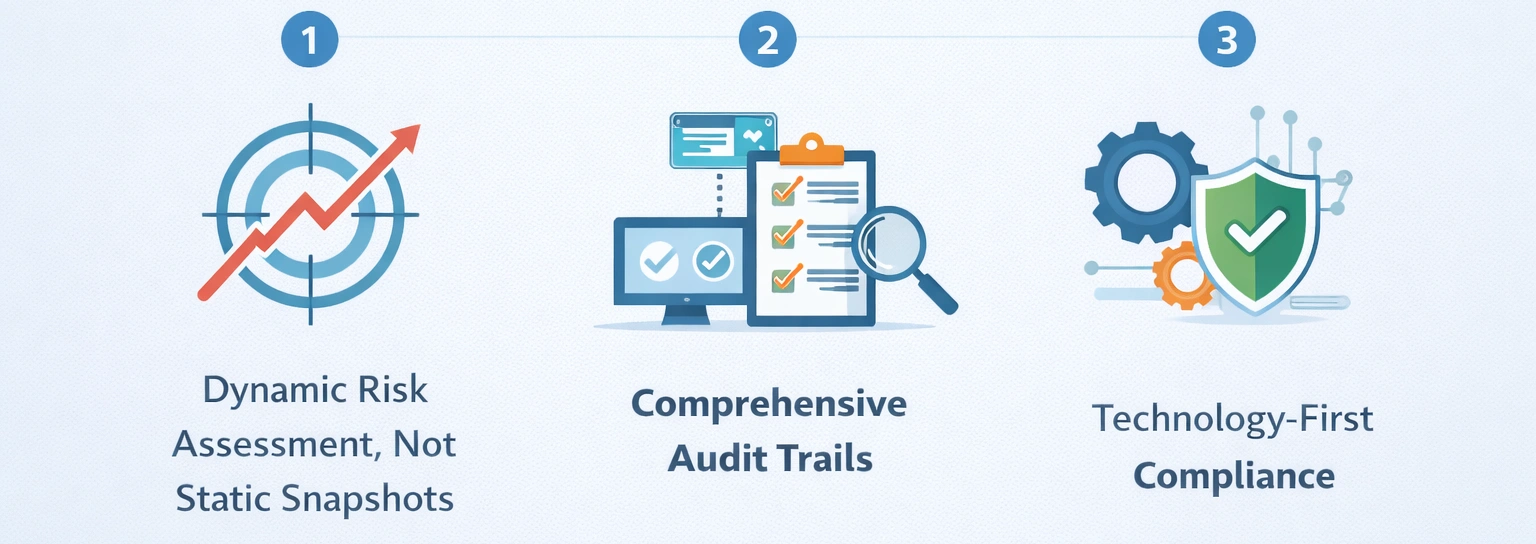
Let’s cut through the regulatory jargon. The FCA isn’t asking for perfection, they’re asking for three things:

1. Dynamic Risk Assessment, Not Static Snapshots

The Barclays case made this painfully clear. A customer that starts as “low risk” can become high risk within months. The FCA expects your systems to spot this shift automatically. This means:

→ Continuous monitoring of transaction patterns
→ Automatic escalation when risk profiles change
→ Real-time screening against sanctions lists and PEPs
→ Behavioural analytics that detect anomalies before they become scandals

2. Comprehensive Audit Trails

In 2025, the FCA introduced stricter requirements for “transparent and immutable audit trails.” Every KYC decision, every document upload, every risk assessment must be traceable. No exceptions.

3. Technology-First Compliance

Here’s what most banks miss: The FCA actively encourages automation. Their Digital Securities Sandbox initiative, launched in late 2024, exists specifically to help firms test new technology safely. The message is clear, innovate or fall behind.

FCA KYC/AML Requirements vs. Automated Capabilities

FCA Requirements: Traditional vs Automated Compliance
FCA Requirement
Traditional Process
Automated Solution
Impact
Customer Due Diligence (CDD) Manual document collection (5–10 days) AI-powered document verification with OCR (2–5 minutes) 95% faster onboarding
Enhanced Due Diligence (EDD) Manual analyst review (weeks) Automated risk scoring + human review for edge cases (hours) 70% reduction in false positives
Ongoing Monitoring Quarterly or annual reviews Real-time transaction monitoring with ML anomaly detection Continuous compliance
PEP Screening Manual database checks API-integrated screening against global watchlists (seconds) 100% coverage, zero delays
Beneficial Ownership Manual corporate registry searches Automated UBO verification with 160+ country support 85% faster verification
Audit Trail Scattered documents across systems Blockchain-backed immutable records 100% regulatory transparency
Source of Funds Email exchanges and phone calls Open Banking integration with instant bank verification From days to minutes

Real-World UK Examples: Who’s Getting It Right (And Wrong)?

Case Study 1: Starling Bank – AI-Driven Digital Onboarding at Scale

Starling Bank is widely recognised as one of the UK’s most advanced mobile-first banks. Built entirely without physical branches, its onboarding, identity verification, and transaction monitoring processes are deeply technology-led.

What Sets Them Apart: Starling uses biometric identity verification, automated fraud detection, and API-driven integrations to streamline customer onboarding while maintaining strict compliance standards. Their infrastructure is designed for real-time monitoring rather than periodic review cycles.

Why This Matters: By embedding AI-driven checks into the onboarding flow, Starling reduces friction without weakening controls. Risk scoring, transaction monitoring, and identity verification operate simultaneously.

How Azilen Supports This Model → Digital Onboarding & KYC Automation

We help financial institutions build biometric-enabled, API-first onboarding ecosystems that scale securely while meeting FCA expectations.

Case Study 2: Monzo – Real-Time Risk & Core Banking Innovation

Monzo operates on a modern cloud-native core banking infrastructure that enables real-time fraud monitoring and dynamic risk assessment.

What Sets Them Apart: Monzo integrates behavioural analytics, automated AML screening, and continuous transaction monitoring directly into its core banking architecture. This allows the bank to detect suspicious patterns instantly rather than during quarterly reviews.

Why This Matters: Technology-first compliance allows Monzo to maintain high customer growth while managing financial crime risk proactively.

How Azilen Supports This Model → Core Banking Integrations

We design API-driven architectures that connect onboarding, underwriting, AML engines, and servicing into one intelligent compliance framework.

Case Study 3: NatWest – A £264.8M AML Wake-Up Call

In 2021, NatWest was fined £264.8 million by the Financial Conduct Authority after pleading guilty to AML failures, the first criminal prosecution of a UK bank under money laundering regulations.

→ Failure to properly monitor suspicious cash deposits
→ Weak escalation of internal compliance warnings
→ Inadequate ongoing transaction monitoring controls
→ Insufficient risk reassessment mechanisms

The fine was not caused by lack of technology alone. It exposed gaps in escalation logic, monitoring configuration, and governance frameworks.

Modern Loan Origination & Credit Platforms must integrate real-time KYC, AML monitoring, and automated escalation workflows, because automation without enforcement logic increases regulatory risk.

The Future of Digital Banking

The future of digital banking is not just faster apps or smoother interfaces, it is intelligent, invisible infrastructure working in the background. What you just saw is where compliance, credit, and customer experience operate in real time, not in silos. AI-driven underwriting, biometric verification, Open Banking data, and automated AML monitoring are no longer experimental, they are becoming the baseline.

For UK banks, the shift is clear: digital onboarding must evolve from a process into a continuously learning, FCA-ready ecosystem.

Three High-Impact Automation Scenarios in UK Banking

Consumer Lending at Scale

High-volume personal lending requires processing thousands of applications monthly while maintaining strict FCA affordability and AML standards. Manual underwriting models struggle with speed, consistency, and audit defensibility.

AI-led automation enables banks to assess risk, affordability, and fraud exposure simultaneously. The result is faster decisions without weakening compliance controls.

→ AI-powered credit underwriting analysing 200+ structured and alternative data points
→ Open Banking–based automated affordability verification
→ Real-time behavioural fraud detection embedded in onboarding

Consumer Lending at Scale

Buy-to-Let Mortgage Automation

Buy-to-let lending involves layered affordability rules, landlord portfolio analysis, and property-level risk assessment. Traditional workflows rely heavily on spreadsheets and manual registry checks, slowing approvals and increasing operational risk.

Integrated mortgage origination platforms streamline underwriting while maintaining regulatory traceability. Automation transforms complex mortgage journeys into structured, scalable processes.

→ Mortgage origination software with automated valuation API integration
→ Digital landlord registry and portfolio exposure checks
→ Rule-driven affordability stress testing and compliance validation

Buy-to-Let Mortgage Automation

SME & Commercial Lending Modernisation

SME onboarding requires verifying business legitimacy, identifying UBOs, and assessing financial health under AML regulations. Manual KYB checks often create delays and high false-positive rates.

Automated systems integrate corporate registry data, financial analytics, and risk scoring into one decision framework. This enables faster onboarding with stronger regulatory defensibility.

→ Companies House API integration for real-time entity verification
→ AI-driven financial statement analysis for risk profiling
→ Risk-based KYB workflows with automated escalation triggers

SME & Commercial Lending Modernisation

The Technology Stack: What You Actually Need

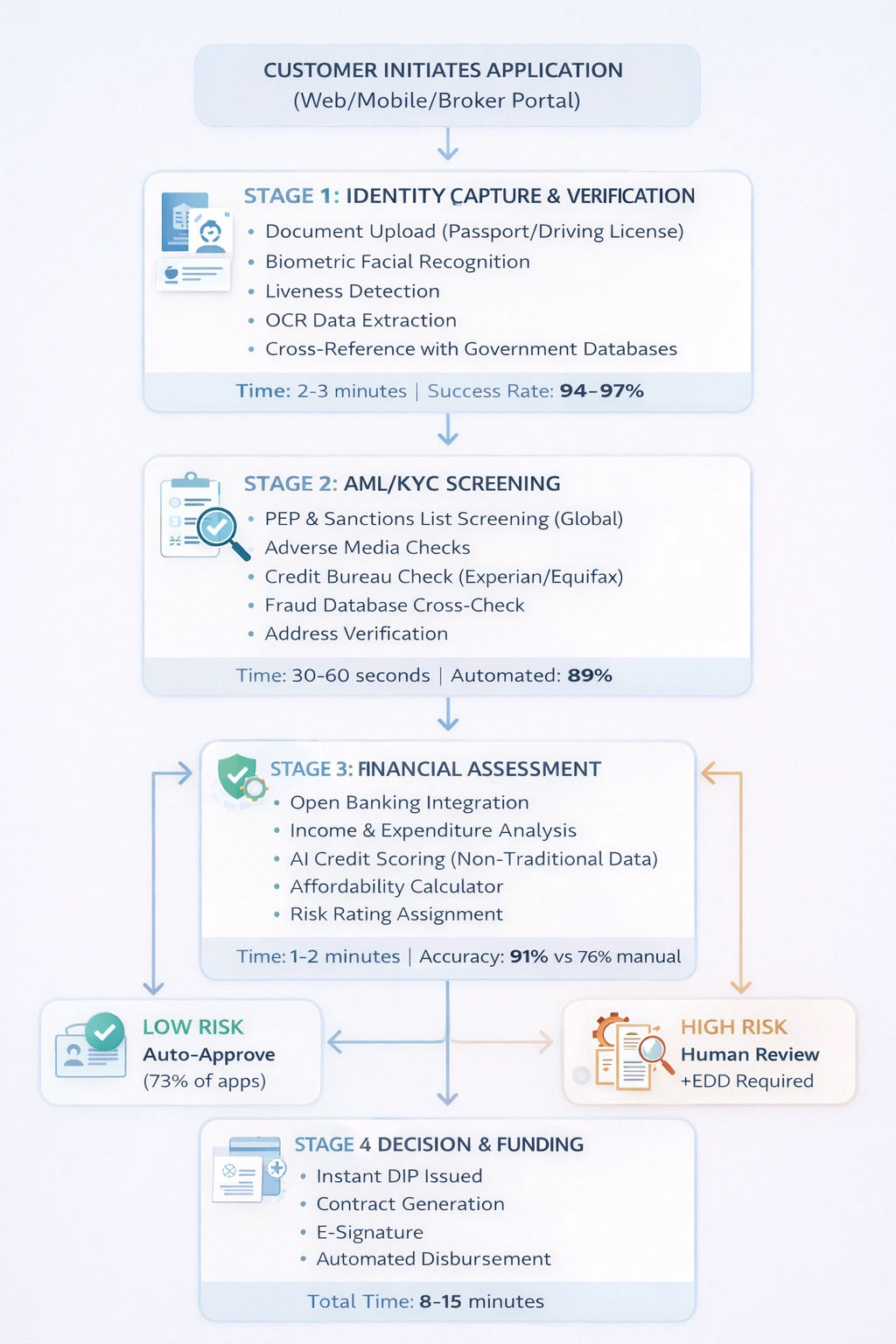
What technologies You Actually Need for better bank functionaing

This workflow shows how modern UK banks transform compliance from a manual checkpoint into a fully automated, intelligent decision engine. Identity verification, AML screening, financial assessment, and risk segmentation operate in parallel, reducing total onboarding time to minutes instead of days.

Low-risk applicants move seamlessly through automated approval, while higher-risk cases are intelligently escalated for enhanced due diligence. The result is not just faster lending, but stronger audit trails, dynamic risk monitoring, and FCA-ready compliance built directly into the customer journey.

The Azilen Approach: Engineering FCA-Ready Digital Onboarding at Scale

Azilen is a Digital Transformative Company that helps UK financial institutions move from reactive compliance to intelligent, scalable infrastructure. We do not treat FCA readiness as a final checkpoint, we engineer it directly into the architecture from day one.

What We Build

Intelligent Loan Origination Systems: FCA-ready and future-proof platforms with real-time KYC/AML screening, automated affordability checks, AI-driven decisioning, and seamless core banking integration.

AI Credit Underwriting Engines: Advanced underwriting models that combine traditional bureau data with alternative signals like Open Banking and rental history, improving approval rates while maintaining explainable, regulator-aligned decision logic.

Mortgage Origination Platforms: Purpose-built systems supporting residential, buy-to-let, and specialist lending with automated valuation APIs, broker connectivity, and structured regulatory reporting.

With Azilen, compliance is not a bottleneck. It becomes the engine powering speed, scale, and sustainable growth.

FAQs: Loan Origination System UK

1. What does FCA-ready digital onboarding mean?

FCA-ready digital onboarding refers to customer onboarding systems designed to meet Financial Conduct Authority requirements for KYC, AML, affordability, and ongoing monitoring. It combines biometric identity verification, automated sanctions screening, risk-based due diligence, and real-time transaction monitoring to ensure regulatory compliance while maintaining a fast and seamless customer experience.

2. How are UK banks automating KYC and AML processes?

UK banks are using AI-powered document verification, biometric facial recognition, Open Banking integrations, automated PEP and sanctions screening, and machine learning-based transaction monitoring. These systems replace manual document checks and periodic reviews with real-time risk analysis and continuous monitoring aligned with FCA financial crime expectations.

3. Is automated onboarding compliant with FCA regulations?

Yes, when properly implemented. The FCA encourages technology-led compliance provided firms maintain auditability, explainable decision models, and risk-based controls. Automated systems must support clear documentation, transparent decision logic, and continuous monitoring to meet regulatory standards under the Money Laundering Regulations and Consumer Duty framework.

4. What are the main benefits of AI-driven digital onboarding for banks?

AI-driven onboarding reduces decision times from days to minutes, lowers operational costs, improves fraud detection accuracy, and reduces false positives in AML alerts. It also enhances customer experience by eliminating paperwork and branch visits while maintaining strong regulatory defensibility during FCA audits and reviews.

5. How does Open Banking improve KYC and affordability checks?

Open Banking enables secure, real-time access to customer bank transaction data. This allows lenders to verify income, analyse spending behaviour, and assess affordability without relying on manual payslip uploads. The result is faster underwriting decisions with stronger evidence trails to support FCA responsible lending requirements.

Glossary

FCA (Financial Conduct Authority): The UK regulatory body responsible for supervising financial services firms, ensuring consumer protection, market integrity, and financial crime prevention.

KYC (Know Your Customer): A regulatory process requiring banks to verify the identity of customers before and during the relationship to prevent fraud, money laundering, and terrorist financing.

AML (Anti-Money Laundering): A framework of laws, regulations, and procedures designed to detect and prevent financial crime, including money laundering and illicit fund transfers.

CDD (Customer Due Diligence): The process of collecting and verifying customer information at onboarding to assess risk level and ensure compliance with AML regulations.

EDD (Enhanced Due Diligence): Additional checks applied to higher-risk customers, such as politically exposed persons (PEPs) or complex corporate structures.

PEP (Politically Exposed Person): An individual who holds or has held a prominent public position and may present higher financial crime risk due to influence or access to funds.

KYB (Know Your Business): The corporate equivalent of KYC, requiring verification of a company’s registration, ownership structure, and beneficial owners.

UBO (Ultimate Beneficial Owner): The individual who ultimately owns or controls a business entity, even if ownership is layered through multiple companies.

Open Banking: A UK regulatory initiative that allows secure sharing of financial data between banks and authorised third-party providers through APIs, with customer consent.

OCR (Optical Character Recognition): Technology that converts scanned documents or images into machine-readable text for automated identity and document verification.

Kulmohan Makhija
Kulmohan Makhija
VP - Growth

Kulmohan Makhija writes at the intersection of technology and business, with a strong Europe-focused enterprise lens. His work covers digital transformation, product engineering, and applied AI, with attention to regulatory, cultural, and operational realities across European markets. He explores how complex organizations modernize core systems without disrupting what already works. His perspective balances innovation with pragmatism, shaped by how transformation actually plays out on the ground

Related Insights