

Skip to content

The Connected Insurance Customer Journey with ID4 Implementation Services

Featured Image

Executive Summary

For modern insurance enterprises, digital friction rarely stems from a lack of web portals. It originates from disconnected back-office architectures. When front-end customer experience initiatives operate independently from compliance engines and core databases, drop-off rates surge and operational overhead spikes.

• The Problem: Disjointed identity checks, siloed KYC compliance, and manual data re-entry interrupt customer acquisition and servicing.

• The Root Cause: Legacy core systems treat risk, onboarding, compliance, and policy administration as separate operational silos rather than a unified lifecycle.

• The Solution: Unifying identity, compliance, and core data via ID4 implementation services.

• The Outcome: Accelerated policy binding, perpetual compliance readiness, and dramatic operational cost reductions.

Industry Reality Check

WHERE ONBOARDING BREAKS DOWN

Industry Reality Check

47%

of insurance applicants abandon digital applications due to manual document checks and friction.

90%

of enterprises lose prospective customers during inefficient digital onboarding workflows.

50%

cite application length and dynamic re-keying of data as their primary reason for drop-off.

20–40%

reduction in total onboarding costs achieved through end-to-end digital workflow automation.

Sources: industry onboarding & digital friction benchmarks like researches from TransUnion, ABBYY, etc.

Why Is Legacy Insurance Architecture Fracturing the Customer Journey?

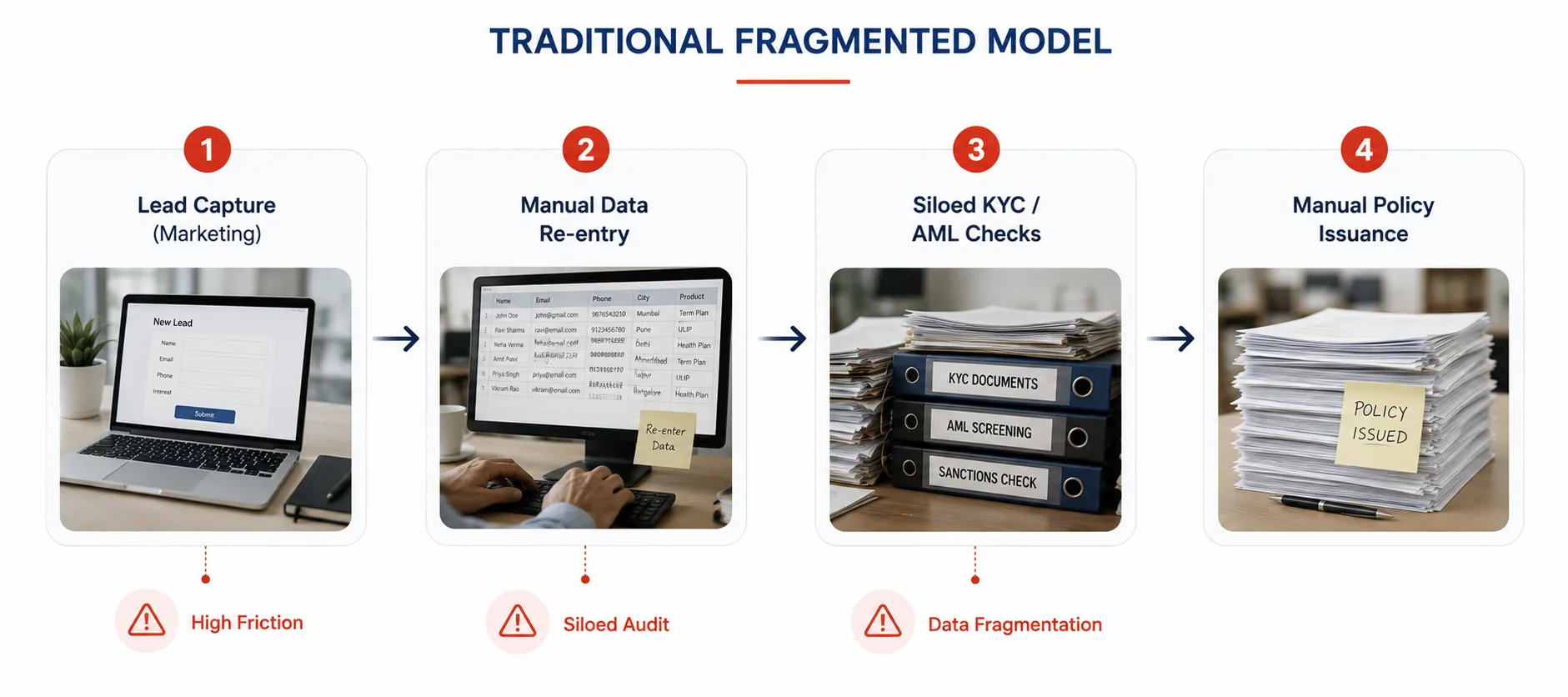
Historically, insurance operations treat the policyholder journey as a sequence of distinct handoffs between specialized internal units. Marketing captures the lead, Underwriting evaluates risk, Compliance performs anti-money laundering (AML) and identity checks, and Policy Servicing handles post-issuance maintenance.

This structural division creates three operational bottlenecks:

  1. Redundant Data Collection: Policyholders are repeatedly asked to submit identity documents across inception, claims, and mid-term adjustments (MTAs).

  2. Compliance Latency: Manual Customer Due Diligence (CDD) and Enhanced Due Diligence (EDD) delay policy issuance, inflating acquisition costs and lowering conversion rates.

  3. Data Stagnation: Risk records become static after policy issuance. Changes in Politically Exposed Person (PEP) status or sanction list updates fail to synchronize continuously with core policy administration systems (PAS).

What is the Primary Operational Pain Point of Insurers?

The core vulnerability in modern insurance journeys is Data Disconnect at Transition Points. Front-end customer experience platforms gather data seamlessly, but legacy back-office core applications (PAS, CRM, and compliance engines) operate in isolated siloes. This forces insurers to re-collect data, trigger redundant verification checks, and stall policy binding—turning what should be a minutes-long digital experience into a days-long operational friction point.

Key Areas Targeted & Solved by ID4

ID4 × AZILEN

Key Areas Targeted & Solved by ID4

Where legacy identity and compliance workflows break down — and how the integration closes the gap.

01

Frictionless Remote Identity & Verification (ID&V)

The Target

Drop-offs caused by cumbersome document uploads, physical identity verification, and manual signature collection during digital policy initiation.

How ID4 & Azilen Solve It

ID4 provides dynamic online identity checks, biometric liveness validation, and embedded e-signature workflows. Azilen integrates these verification endpoints directly into web portals and mobile apps, enabling instantaneous identity verification and dynamic booklet generation right at the point of sale.

02

Perpetual KYC & Continuous AML Screening

The Target

Static, point-in-time Customer Due Diligence (CDD) that leaves carriers vulnerable to risk changes between annual policy reviews.

How ID4 & Azilen Solve It

ID4 automates Customer Due Diligence (CDD) and Enhanced Due Diligence (EDD) while continuously monitoring global Sanctions, Politically Exposed Persons (PEP), and adverse media lists in real time. Azilen connects these continuous monitoring feeds to underwriting and compliance engines so risk alerts trigger automatically without disrupting compliant policyholders.

03

Single-View Client Data & Document Lifecycle Management

The Target

Scattered, duplicate, and decaying customer data sitting across disjointed legacy systems, leading to high audit risk and operational errors.

How ID4 & Azilen Solve It

ID4 acts as a centralized repository for client profiles, tasks, and historical compliance records. Azilen constructs high-throughput data pipelines that clean, map, and synchronize client records between legacy Policy Administration Systems (PAS) and ID4, delivering an audit-ready, single source of truth.

04

Frictionless Self-Service & Automated Policy Servicing

The Target

Operational latency during Mid-Term Adjustments (MTAs), beneficiary updates, policy additions, or endorsements that require manual re-verification.

How ID4 & Azilen Solve It

ID4 enables dynamic document exchanges and automated task workflows for routine post-issuance servicing. Azilen maps custom regulatory and operational rules into ID4 so routine policy updates process automatically without triggering unnecessary compliance re-checks.

05

Accelerated Multi-Jurisdictional Onboarding & Scalability

The Target

Slow time-to-market when adapting compliance workflows to changing local regulations or expanding into new product lines.

How ID4 & Azilen Solve It

ID4 features a modular, API-first architecture designed to adapt dynamically to distinct regulatory requirements across regions. Azilen customizes ID4 modules and UI/UX flows to match regional risk matrices, allowing enterprise carriers to scale onboarding volume seamlessly without adding operational headcount.

How Does the ID4 + Azilen Ecosystem Help Insurers with Seamless Customer Journey?

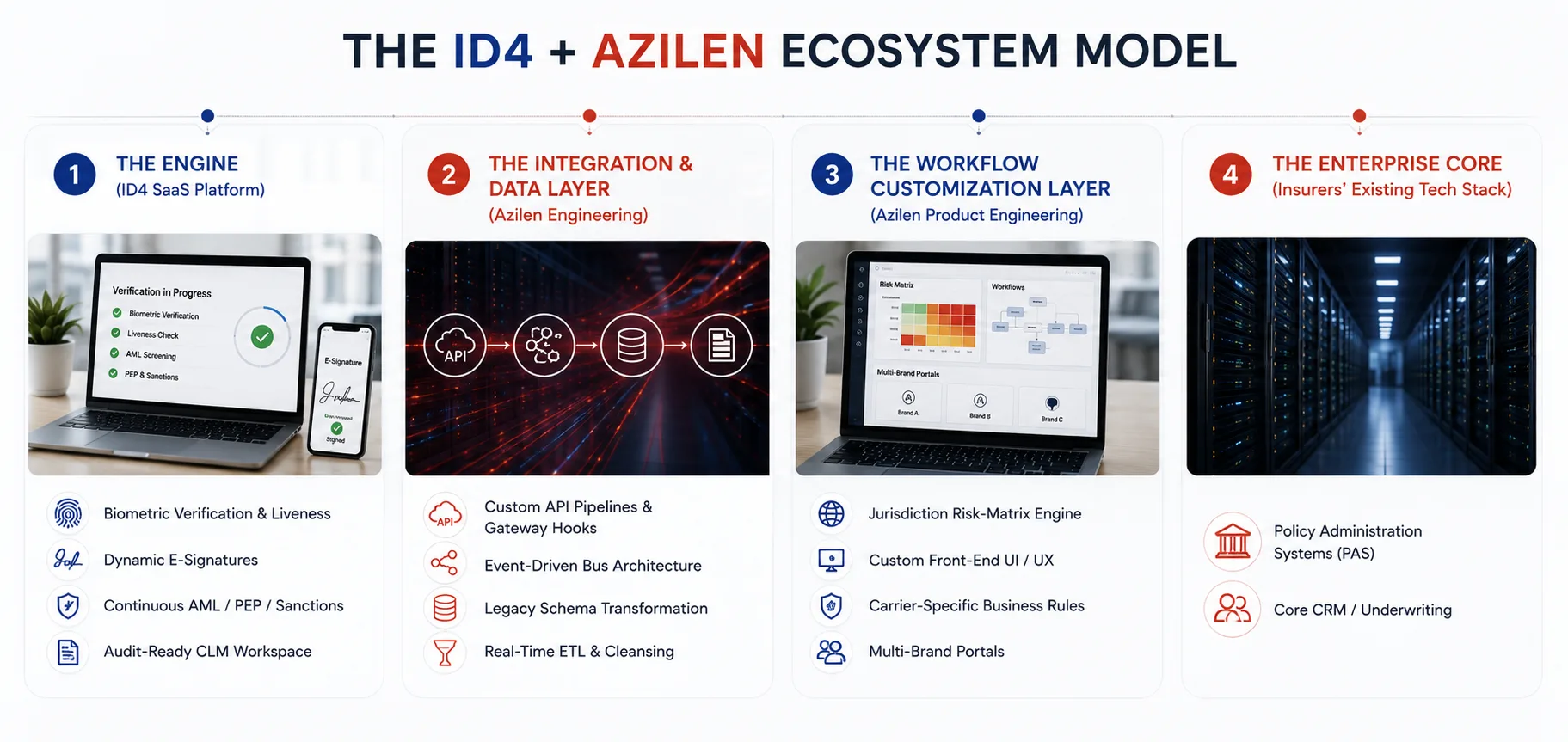
The ID4 + Azilen Ecosystem operates through a simple division of labor: ID4 provides the domain-specific SaaS RegTech platform, while Azilen acts as the engineering powerhouse that weaves that platform directly into an enterprise insurer’s technology stack.

Without ID4, insurers must build compliance logic from scratch. Without Azilen, ID4 remains an isolated software platform unable to communicate with legacy Policy Administration Systems (PAS) or enterprise CRMs.

Together, they form a co-dependent ecosystem across four operational layers.

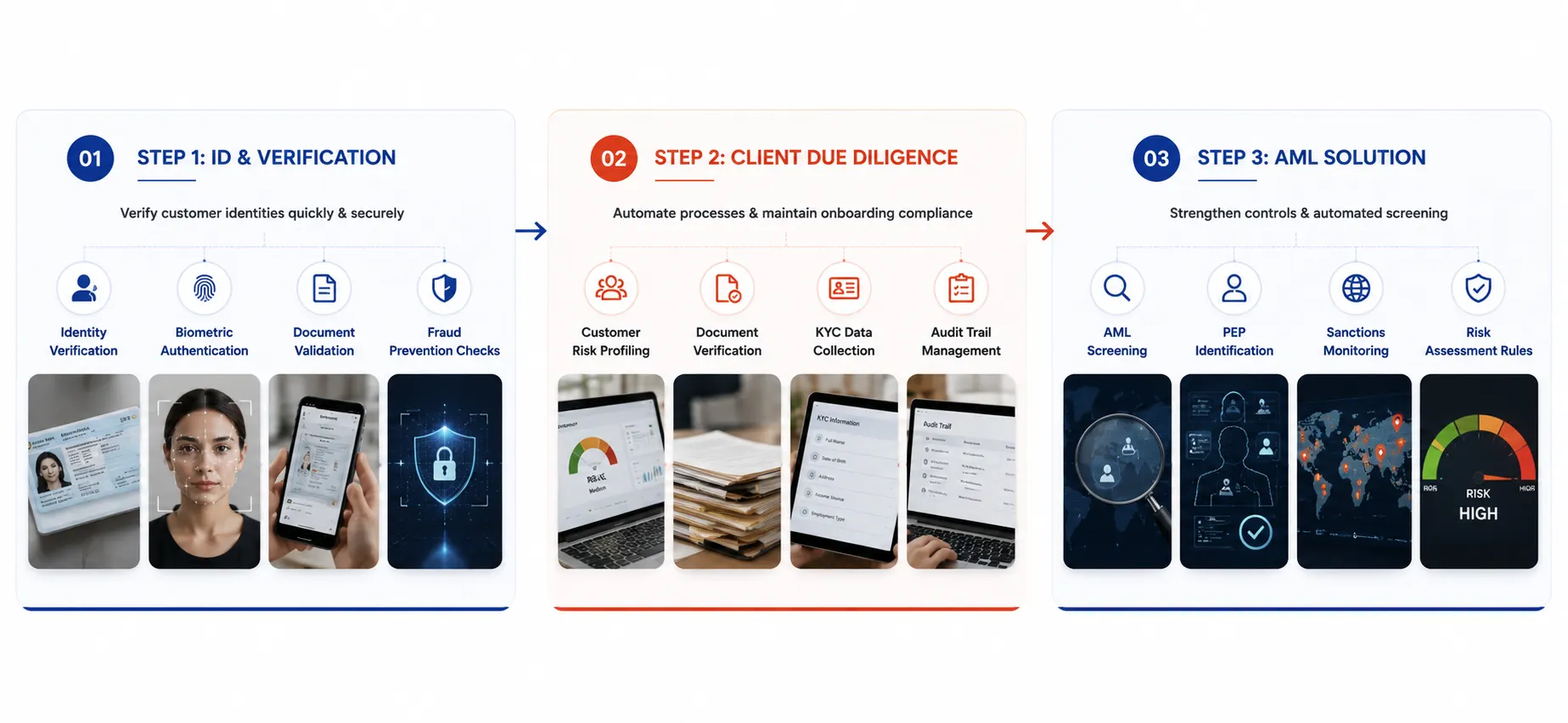
How the Ecosystem Functions Step-by-Step

• Step 1: ID & Verification — Captures the policyholder at point-of-sale using biometric authentication, official document validation, identity verification, and dynamic fraud prevention checks.

• Step 2: Client Due Diligence — Collects structured KYC data, verifies supporting documents, executes dynamic customer risk profiling, and creates an audit-ready trail.

• Step 3: AML Solution — Runs continuous background AML screening, monitors sanctions, flags PEP identification, and enforces enterprise risk assessment rules.

• Operational ExecutionAzilen integrates these three compliance engines into legacy policy administration systems, ensuring data flows end-to-end without manual intervention.

The Ecosystem Synergy

ID4 × AZILEN

The Ecosystem Synergy

Two distinct roles, one seamless capability: the product ID4 delivers, and the implementation Azilen builds around it.

Capability What ID4 Delivers The Product What Azilen Delivers The Implementation
Identity & Onboarding SaaS verification engine, biometrics, e-sign Native integration into mobile, web, and broker channels
Compliance & AML Pre-configured PEP/sanctions screening logic Custom business rules, risk thresholds, and localized workflows
Data Orchestration Standardized CLM schema and audit logs ETL data pipelines, legacy PAS integration, API management
Policy Servicing Dynamic document exchange and booklet generation Automated workflow triggers across claims, CRM, and underwriting engines

Executive Perspective: From Regulatory Friction to Growth Engine

“Compliance was once about control; operational intelligence is about acceleration. Modern insurance architectures no longer treat identity and verification as static checkpoints. They transform continuous compliance into a catalyst for fluid client relationships. By orchestrating real-time data, automated risk screening, and unified identity, we shift from managing policy administration to anticipating client lifetime needs. It is where regulatory duty ceases to be friction, and becomes the very engine of trust.” – Kulmohan Makhija, VP

Engineer the Connected Future of Insurance

Operational efficiency and customer satisfaction are not mutually exclusive goals. Transforming the customer experience requires resolving the backend compliance, identity, and data integration bottlenecks that delay core processes.

By combining ID4’s financial compliance orchestration platform with Azilen’s enterprise implementation services, insurance carriers can eliminate operational friction, automate compliance, and deliver unified client journeys.

Choose Azilen Technologies for ID4 Implementation Services

As an official ID4 implementation partner, Azilen delivers enterprise-grade software engineering to integrate the ID4 platform directly into existing legacy core systems. Azilen handles end-to-end data pipeline creation, system configuration, and custom workflow mapping, enabling insurers to deploy continuous compliance and automated onboarding with zero disruption to core operations.

Custom Enterprise Integration: Azilen builds high-throughput API pipelines connecting ID4 directly into core policy administration software, custom CRMs, claims management systems, and third-party underwriting portals.

→ End-to-End Compliance & Data Pipeline Mapping: Azilen designs data pipelines that extract, cleanse, map, and synchronize legacy client records into ID4, maintaining audit consistency across systems.

→ Tailored Workflow Customization: Azilen configures ID4’s modular components to match specific operational roles, risk thresholds, and jurisdiction-specific regulatory requirements.

→ Accelerated Time-to-Market: Leveraging expertise in InsurTech and software engineering, Azilen accelerates deployment cycles, enabling carriers to scale digital onboarding capabilities efficiently.

FAQs: ID4 Implementation Services

1. What is Client Lifecycle Management (CLM) in insurance operations?

Client Lifecycle Management (CLM) is the unified orchestration of policyholder data and operational workflows across the entire customer relationship. It spans digital identity verification, onboarding, KYC/AML screening, policy servicing, continuous risk monitoring, and renewals. Unlike traditional CRM software, a dedicated CLM system manages compliance requirements and regulatory audit trails continuously.

2. How does continuous PEP and sanctions screening differ from periodic KYC reviews?

Periodic KYC reviews evaluate customer risk at set intervals (e.g., annually or upon policy renewal), leaving insurers exposed to risk changes in the interim. Continuous screening continuously checks policyholder records against global sanctions, PEP, and adverse media databases, immediately raising alerts when a status change occurs without requiring customer re-intervention.

3. Can ID4 integrate with legacy Policy Administration Systems (PAS) without requiring a core system replacement?

Yes. Modern RegTech solutions like ID4 feature API-first architectures built for integration. Systems integration specialists like Azilen build enterprise middleware connectors and data pipelines that securely link ID4 to legacy PAS back-ends, ensuring real-time data synchronization without replacing core IT infrastructure.

4. What primary factors cause drop-offs during digital insurance onboarding?

Drop-offs are primarily caused by operational friction: excessive manual data entry, physical document requests, redundant identity checks, and prolonged waiting times for underwriting or compliance approval. Automating verification and pre-populating verified identity data removes these obstacles, improving completion rates.

5. How does automating compliance workflows impact operational expenditure (OpEx)?

Automating compliance workflows reduces operational costs by eliminating manual data entry, physical document processing, and redundant reviews. Insurers implementing orchestrated CLM technology report up to a 92% reduction in manual processing tasks and up to a 70% reduction in screening triage time, allowing operations to scale efficiently without proportional headcount growth.

Kulmohan Makhija
Kulmohan Makhija
Vice President – Growth & Enterprise Strategy

Kulmohan Makhija is an enterprise technology and business strategy writer with over 12 years of experience analyzing digital transformation across global and European markets. His work focuses on applied artificial intelligence, product engineering, enterprise architecture, and large-scale legacy modernization. He explores how complex organizations modernize core systems, adopt AI responsibly, and align innovation with regulatory, cultural, and operational realities — particularly within the UK and broader European technology landscape. With a pragmatic enterprise perspective, Kulmohan emphasizes transformation that delivers measurable impact without disrupting mission-critical operations. His writing bridges executive strategy with technical depth, providing clarity for technology leaders, product teams, and decision-makers navigating modernization journeys.

Related Insights