Skip to content

Brownfield Software Development: The Smart Alternative to Replacing Legacy Systems

Featured Image

TL;DR

Brownfield Software Development focuses on improving and modernising existing software systems instead of replacing them completely. Many businesses rely on legacy applications that still support critical operations but struggle to keep up with changing customer expectations, security requirements, and digital transformation goals.

Through Brownfield Software Development, organisations can upgrade existing platforms, integrate modern technologies such as AI, cloud, and IoT, and reduce technical debt without disrupting day-to-day operations. This approach lowers costs, accelerates time-to-value, and helps businesses extend the life of their software investments while preparing for future growth.

Most businesses do not struggle because their software suddenly stops working. The challenge grows quietly over time. Systems become slower, data gets trapped in silos, and integrating new technologies becomes increasingly difficult. As a result, teams spend more time maintaining legacy systems than driving innovation.

“The biggest risk isn’t an outdated system, it’s waiting too long to modernise it.”

This is where Brownfield Software Development creates value. Instead of replacing everything, businesses modernise existing software, preserving what works while upgrading what limits growth.

By integrating cloud, AI, IoT, and modern architectures into legacy platforms, organisations can reduce technical debt, improve agility, and stay competitive without disrupting day-to-day operations.

In this blog, we’ll explore how Brownfield Software Development helps UK enterprises transform legacy software from a business constraint into a long-term competitive advantage.

The Scale of the Problem – In Numbers

Before we get into the use case, it helps to understand what is really at stake. These figures are not projections. They are latest data points.

61B

Days of technical debt repair time globally in 2025

45%

Of the world’s code is classified as fragile today

£50K

Cost per hour of unplanned downtime

$27B

Legacy software modernisation market (2029)

These are not abstract figures. If you are operating a manufacturing site, a financial services platform, or a supply chain operation in the UK, these numbers are directly relevant to your balance sheet.

What Problems Does Brownfield Software Development Actually Solve?

Most enterprises do not replace legacy systems because they are working. The challenge is that they no longer work efficiently. Every new integration takes longer, reporting requires manual effort, data lives in silos, and innovation gets delayed by ageing architecture.

Brownfield Software Development addresses these challenges by modernising existing systems while preserving the business processes that already work.

Turn Disconnected Systems into a Connected Ecosystem

Disconnected Systems into a Connected Ecosystem
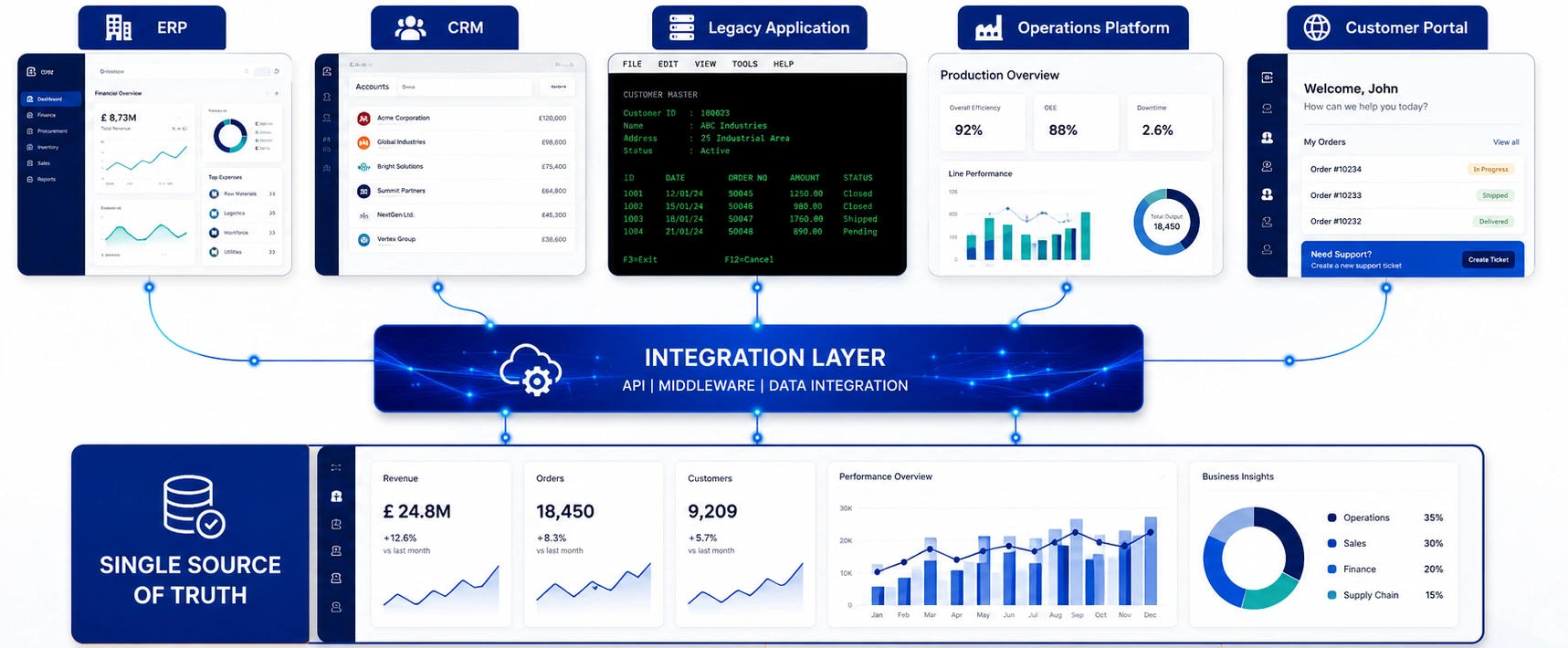
Many enterprises operate multiple applications that do not communicate effectively with each other. Brownfield modernisation introduces APIs, middleware, and integration layers that connect ERP, CRM, operational, and customer-facing systems into a unified environment.

→ Eliminates data silos across departments and business functions.
→ Creates a single source of truth for business decisions.
→ Reduces manual data transfer and reporting efforts.

Make Legacy Systems AI and Data Ready

Legacy Systems AI and Data Ready

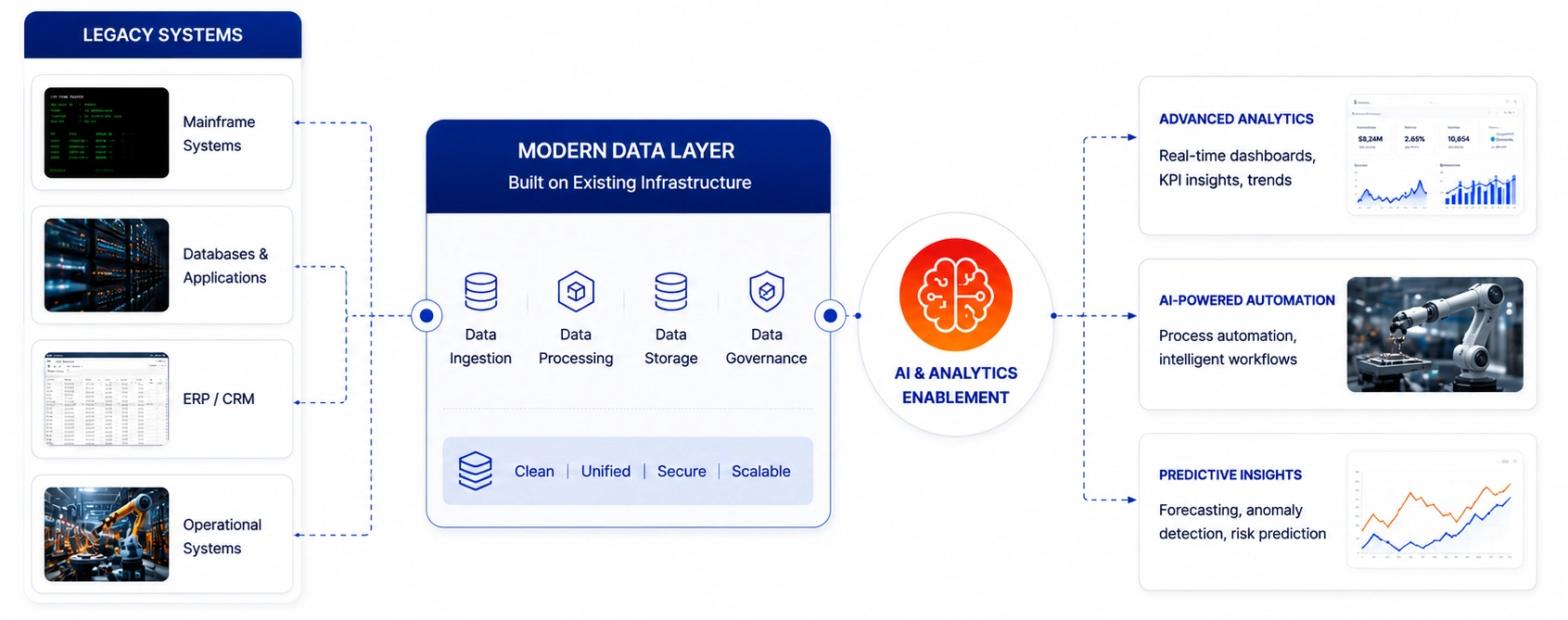
Most legacy platforms were never designed for AI, analytics, or real-time decision-making. Brownfield development creates modern data layers without replacing core systems.

→ Enables advanced analytics using existing operational data.
→ Supports AI-powered automation and predictive insights.
→ Unlocks business value from previously inaccessible information.

Extend the Life of Existing Technology Investments

Extend the Life of Existing Technology Investments

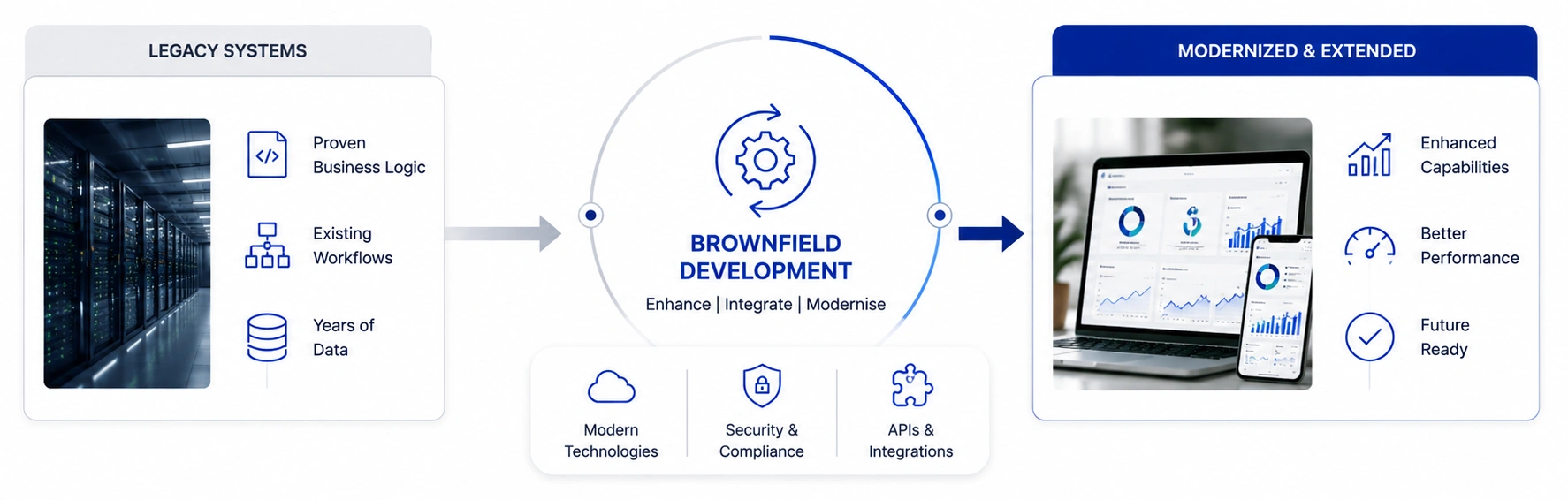
Replacing an entire technology stack is expensive, disruptive, and risky. Brownfield development preserves valuable business logic while removing technical limitations.

→ Retains years of proven workflows and business processes.
→ Avoids costly full-platform replacement projects.
→ Delivers modern capabilities without disrupting operations.

Enable IoT, Cloud, and Modern Integrations

Enable IoT, Cloud, and Modern Integrations

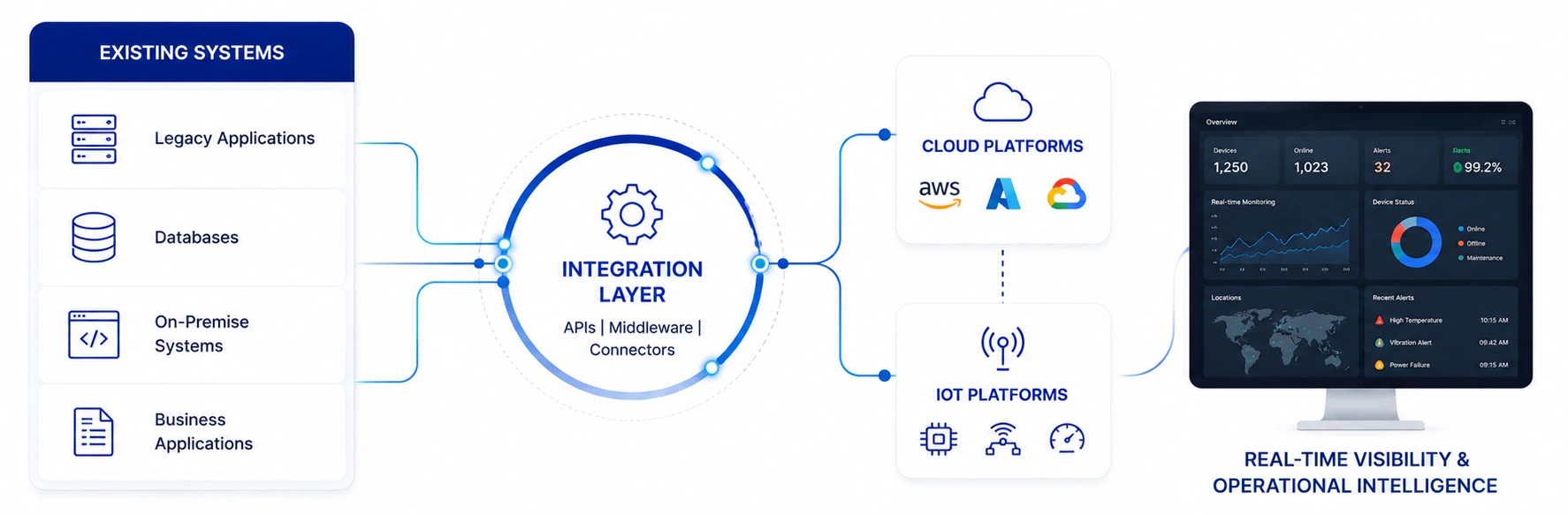
Many organisations want to adopt IoT, cloud platforms, and digital services but struggle with legacy infrastructure constraints.

→ Connects existing systems with cloud and IoT platforms.
→ Supports real-time monitoring and operational visibility.
→ Creates a scalable foundation for future innovation.

Improve Development Speed and Business Agility

Improve Development Speed and Business Agility

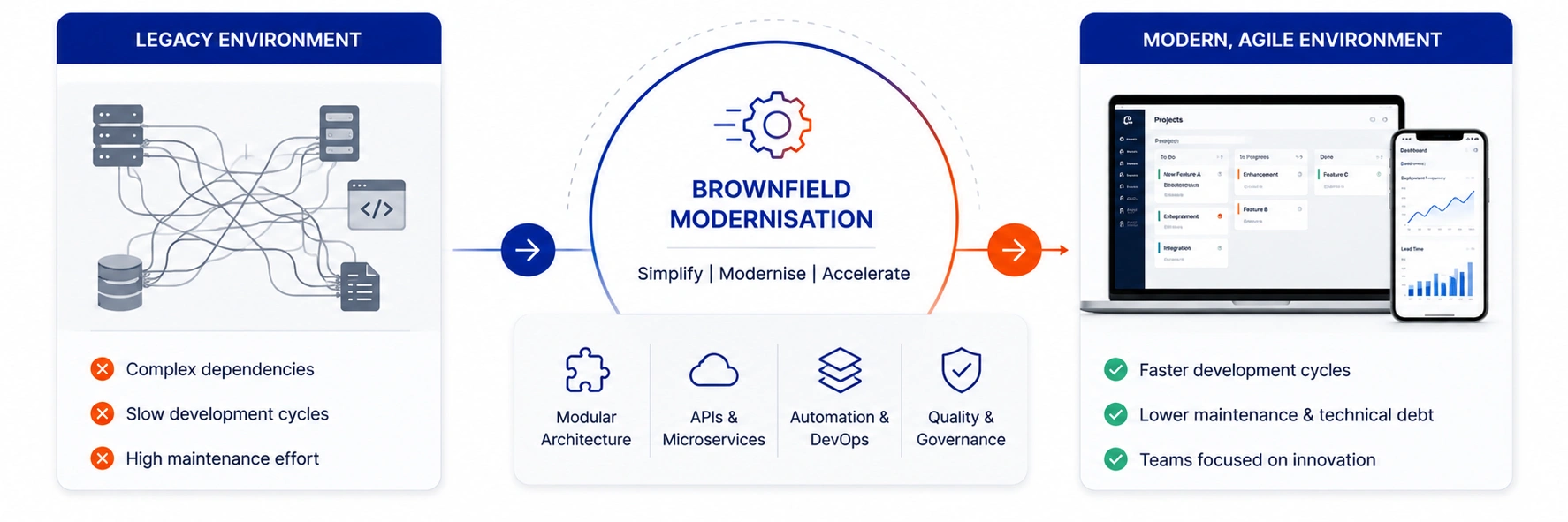
Legacy environments often slow down every technology initiative. Brownfield modernisation simplifies architecture and reduces dependency bottlenecks.

→ Accelerates new feature and product development cycles.
→ Reduces maintenance effort and technical debt accumulation.
→ Helps teams focus on innovation instead of system upkeep.

For CEOs and CTOs, the goal is not simply modernising software.

The goal is creating a technology foundation that supports growth, improves operational efficiency, and enables AI, data, and digital transformation initiatives without putting existing business operations at risk.

Brownfield vs. Greenfield: The Decision That Defines Your Next 5 Years

The choice between brownfield modernisation and greenfield development is not just a technical decision. Therefore, it deserves to be evaluated at the board level.

Brownfield Development vs Greenfield Build
Factor
Brownfield Development
Greenfield Build
Time to first value 6–16 weeks (incremental) 12–24+ months
Cost 60–70% lower Full rebuild investment
Business continuity risk Low — live systems stay running High — migration window required
Institutional knowledge Preserved in existing code Often lost in rebuild
IoT & AI readiness Achievable incrementally Achievable — but later
Regulatory compliance Easier — existing audit trails kept Must be rebuilt from scratch

For most UK enterprises, particularly in manufacturing, FinTech, and supply chain, brownfield is not the compromise option. Rather, it is the strategically superior choice.

A Real-World Brownfield Use Case: UK Manufacturing Meets IoT & AI

Let us get specific. The following scenario is representative of engagements Azilen has delivered within legacy-heavy operational environments.

A UK-based mid-market manufacturer operating 4 production facilities was running a 12-year-old MES (Manufacturing Execution System).

The system was deeply embedded across operations, connected to ERP, shift scheduling, and quality tracking. Replacing it entirely would have taken 18 months and risked significant operational disruption.

However, the existing system had a critical gap: it produced data but could not act on it. Engineers were manually reviewing reports, catching equipment anomalies too late, and unable to predict maintenance needs with any reliability. Furthermore, unplanned downtime was costing the business approximately £40,000 per incident, and incidents were occurring roughly twice per quarter.

The business needed reliability, not a rebuild.

The Challenge

12-year-old MES system, ~£320K annual downtime cost, manual processes, no predictive capability — but a full rebuild was not feasible.

How Azilen Approached the Brownfield Modernisation

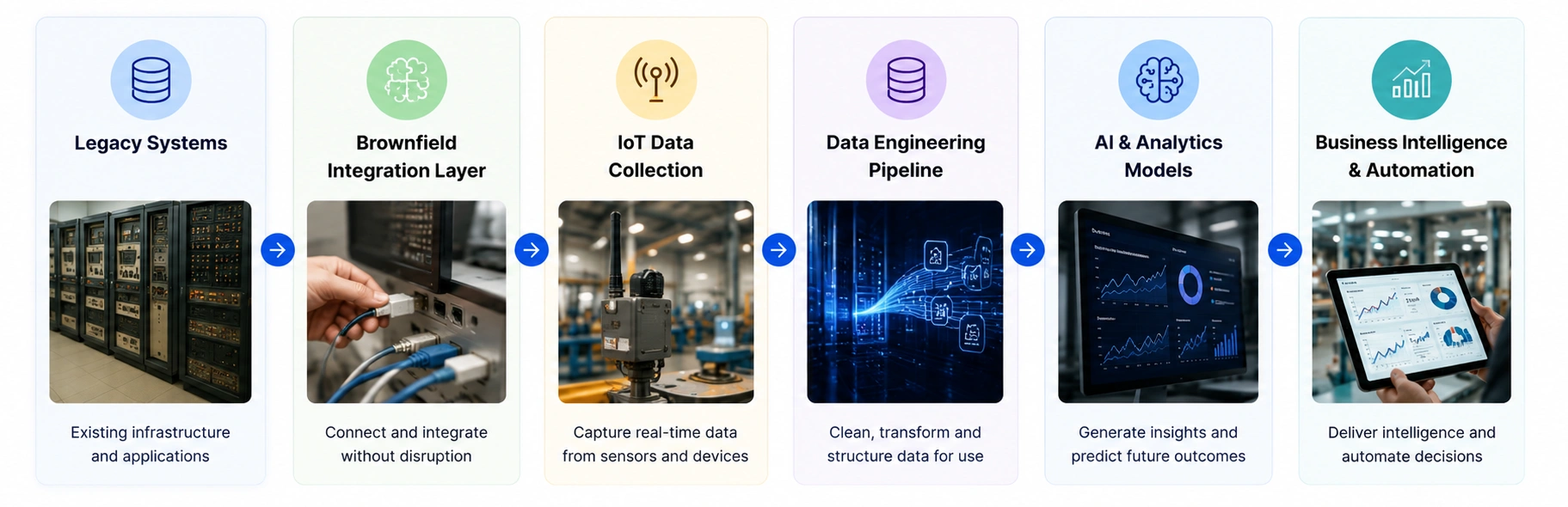
Legacy System Assessment: Mapped existing applications, integrations, and business workflows to create a low-risk modernisation roadmap.

IoT Integration Layer: Connected sensors and legacy equipment through a lightweight IoT architecture without replacing core systems.

Data Engineering Foundation: Built real-time data pipelines that transformed fragmented operational data into trusted insights.

AI-Powered Predictive Intelligence: Developed machine learning models that identified potential equipment issues before failures occurred.

Unified Visibility & Alerts: Delivered dashboards, alerts, and operational insights directly within existing business applications.

The Result – 9 Months Post-Deployment

87%

Reduction in unplanned downtime incidents

£280K

Estimated annual savings from avoided downtime

4 mo

Time to first production deployment of the AI model

The existing MES was not replaced. Instead, it became significantly more powerful.

Furthermore, because the architecture was modular, the client subsequently added demand forecasting and quality inspection AI, both built on the same data engineering foundation Azilen had laid.

Why Brownfield Software Development, IoT, and AI Work Best Together

Most organisations invest in IoT or AI expecting immediate value. The reality is that neither delivers results without the right data foundation. Brownfield Software Development provides the missing layer that connects legacy systems, operational data, and modern intelligence.

Digital Transformation Stack
Layer
Business Purpose
Outcome
Brownfield Modernisation Connect and modernise existing systems without disruption Lower risk and faster transformation
IoT Integration Capture real-time operational and machine data Complete operational visibility
Data Engineering Clean, structure, and govern data across systems Trusted, analytics-ready data
AI & Advanced Analytics Generate predictions, automation, and insights Smarter business decisions
Business Applications Deliver intelligence to users and workflows Measurable operational impact

How the Value Flows

Brownfield Software Development Value

Business Impact

→ Transform legacy systems into intelligent business platforms.

→ Enable AI without replacing core operational systems.

→ Create a trusted foundation for real-time decision-making.

→ Accelerate digital transformation while preserving existing investments.

→ Improve governance, compliance, and long-term scalability.

Why Azilen Technologies Stands Out in Brownfield Software Development

For most enterprises, the challenge is not building new software. It is modernising existing systems without disrupting business operations. This is where Brownfield Software Development creates the greatest value—and where Azilen Technologies brings a distinct advantage.

Azilen does not approach modernisation as a system replacement exercise. Instead, it helps organisations unlock more value from existing technology investments by integrating modern capabilities such as IoT, Data Engineering, AI, Cloud, and Automation into legacy environments.

As an Enterprise AI Development Company, Azilen focuses on creating connected, intelligent, and future-ready technology ecosystems while preserving the systems businesses already depend on.

Legacy System Modernisation: Modernises ageing applications and infrastructure without disrupting day-to-day business operations.

IoT & Enterprise Integration: Connects existing systems with IoT devices, cloud platforms, and third-party applications seamlessly.

Data Engineering Services: Builds scalable data pipelines that transform fragmented operational data into trusted business intelligence.

Enterprise AI Development Services: Enables predictive analytics, intelligent automation, and AI-powered decision-making on top of existing systems.

Scalable Architecture Design: Creates flexible, future-ready technology foundations that support business growth and innovation.

Governance & Compliance Alignment: Preserves security, auditability, and regulatory requirements throughout the modernisation journey.

Azilen helps organisations move beyond legacy constraints by turning existing technology environments into connected, intelligent, and scalable business platforms. The result is faster innovation, lower modernisation risk, and higher returns from technology investments.

FAQs: Brownfield Software Development

1. What is Brownfield Software Development?

Brownfield Software Development is the process of modernising existing software systems instead of replacing them completely. Businesses upgrade legacy applications, integrate modern technologies, and improve performance while keeping critical operations running. This approach reduces risk, lowers costs, and delivers faster results than building entirely new systems from scratch.

2. What are the benefits of Brownfield Software Development?

Brownfield Software Development helps organisations reduce technical debt, improve system performance, and integrate modern technologies such as AI, cloud, and IoT. It allows businesses to modernise existing systems without disrupting operations, making digital transformation faster, more cost-effective, and less risky than a complete software replacement.

3. How is Brownfield Software Development different from Greenfield Development?

Greenfield Development involves building a completely new system from the ground up. Brownfield Software Development improves and extends existing systems while preserving valuable business processes and data. For many enterprises, brownfield modernisation offers a faster path to innovation because core operations continue running during the transformation process.

4. Can Brownfield Software Development support AI, Cloud, and IoT integration?

Yes. One of the biggest advantages of Brownfield Software Development is the ability to integrate AI, cloud platforms, IoT devices, and modern data solutions with existing systems. This enables organisations to unlock new capabilities and business value without replacing their entire technology infrastructure.

5. When should a business choose Brownfield Software Development?

A business should consider Brownfield Software Development when legacy systems still support important operations but limit growth, innovation, or integration capabilities. It is ideal for organisations looking to modernise technology, improve agility, reduce maintenance costs, and adopt AI-driven solutions without the risks of a full system replacement.

Glossary

Brownfield Software Development: The practice of modernising existing software systems without replacing the entire technology environment.

Legacy System: An older software application or infrastructure that continues to support critical business operations.

Technical Debt: The long-term cost and complexity created by outdated code, architecture, or technology decisions.

System Modernisation: The process of upgrading existing applications, infrastructure, and workflows to improve performance and scalability.

API Integration: A method that allows different software systems and applications to communicate and exchange data seamlessly.

Data Engineering: The practice of collecting, cleaning, transforming, and organising data for analytics, AI, and business intelligence.

IoT Integration: Connecting sensors, devices, and machines to software platforms for real-time data collection and monitoring.

Enterprise AI: Artificial intelligence solutions designed to automate processes, generate insights, and improve business decision-making.

Cloud Migration: Moving applications, data, or workloads from on-premise environments to cloud-based infrastructure and services.

Digital Transformation: The adoption of modern technologies to improve business operations, customer experiences, and organisational agility.
Kulmohan Makhija
Kulmohan Makhija
Vice President – Growth & Enterprise Strategy

Kulmohan Makhija is an enterprise technology and business strategy writer with over 12 years of experience analyzing digital transformation across global and European markets. His work focuses on applied artificial intelligence, product engineering, enterprise architecture, and large-scale legacy modernization. He explores how complex organizations modernize core systems, adopt AI responsibly, and align innovation with regulatory, cultural, and operational realities — particularly within the UK and broader European technology landscape. With a pragmatic enterprise perspective, Kulmohan emphasizes transformation that delivers measurable impact without disrupting mission-critical operations. His writing bridges executive strategy with technical depth, providing clarity for technology leaders, product teams, and decision-makers navigating modernization journeys.

Related Insights