
Skip to content

Cloud Migration for SaaS Companies: A UK CTO’s Playbook (2026)

Featured Image

Executive Summary

Are your cloud infrastructure costs scaling faster than your SaaS ARR, or is technical debt slowing down your engineering velocity?

For UK companies, cloud migration for SaaS has become fundamental business driver that dictates gross margins, system uptime, and feature velocity. Yet, moving live multi-tenant workloads while handling active user traffic presents major technical and operational risks.

This playbook provides UK CTOs, VPs of Engineering, and technical founders with an execution framework for cloud migration. By applying the 7 Rs migration framework, enforcing strict UK GDPR data sovereignty, deploying Change Data Capture (CDC) pipelines for zero-downtime database cutovers, and establishing granular FinOps cost tagging, engineering leaders can modernize legacy platforms without service disruptions or revenue loss.

For CTOs, few initiatives carry as much operational weight as migrating a core multi-tenant platform. Your infrastructure directly impacts your unit economics, deployment speed, customer retention, and valuation.

In the UK market, engineering leaders face a distinct set of operational demands. Enterprise buyers expect strict adherence to UK GDPR and local data sovereignty guidelines. Meanwhile, board members demand improved software margins alongside AI capability integration.

A successful cloud migration for SaaS is not a simple “lift-and-shift” task. It requires an execution strategy that preserves service continuity for existing users while laying down an agile, cloud-native foundation.

Cloud Migration

Know What You're Moving

Before writing infrastructure code or provisioning cloud resources, engineering leaders must audit existing software dependencies and catalog system interactions.

• System Performance KPIs: Establish baseline metrics for latency targets, API response rates, and 99.99% availability SLAs.

• Unit Economics Baselines: Calculate current infrastructure cost-per-tenant to set clear targets for gross margin improvement.

• Workload Dependency Mapping: Isolate stateless application logic from stateful background queues, blob storage, and database nodes.

• Tenant Isolation Audits: Evaluate whether your architecture operates shared multi-tenant databases, schema-per-tenant, or isolated database instances per enterprise account.

Decide What Should Move (Applying the 7 Rs)

Not every component of your application stack requires the same migration strategy. Evaluating your architecture through the 7 Rs framework ensures engineering capital goes where it yields the highest operational return.

The financial trap of cloud migration isn’t always the sticker price—it’s the unseen architectural dependencies. As highlighted in the industry perspective below, unmanaged migration risks often freeze engineering leaders in place.

THE 7 Rs SAAS MIGRATION FRAMEWORK
MIGRATION MODEL
SAAS APPLICATION CONTEXT
Rehost Lift-and-shift VMs as-is. Useful for rapid moves but rarely lowers long-term cloud costs.
Replatform Move to managed services (e.g., self-hosted Postgres Move to managed services (e.g., self-hosted Postgres
Refactor Re-architect legacy monoliths into cloud-native, containerized microservices or serverless tools.
Repurchase Replace custom internal tools (e.g., billing engine) with third-party SaaS alternatives (e.g., Stripe).
Relocate Hypervisor-level moves (e.g., on-premise VMware to VMware Cloud on AWS/Azure) preserving IP layouts.
Retain Keep compliance-heavy, stable legacy components on premise or in hybrid environments temporarily.
Retire Decommission obsolete tenant data stores, unlinked feature branches, and unused API endpoints.

Design for Compliance

For UK-based SaaS providers, cloud architecture decisions must incorporate legal compliance and security frameworks from the start.

Regulatory, Security & UK Sovereignty Frameworks

Data Sovereignty & Regional Hosting

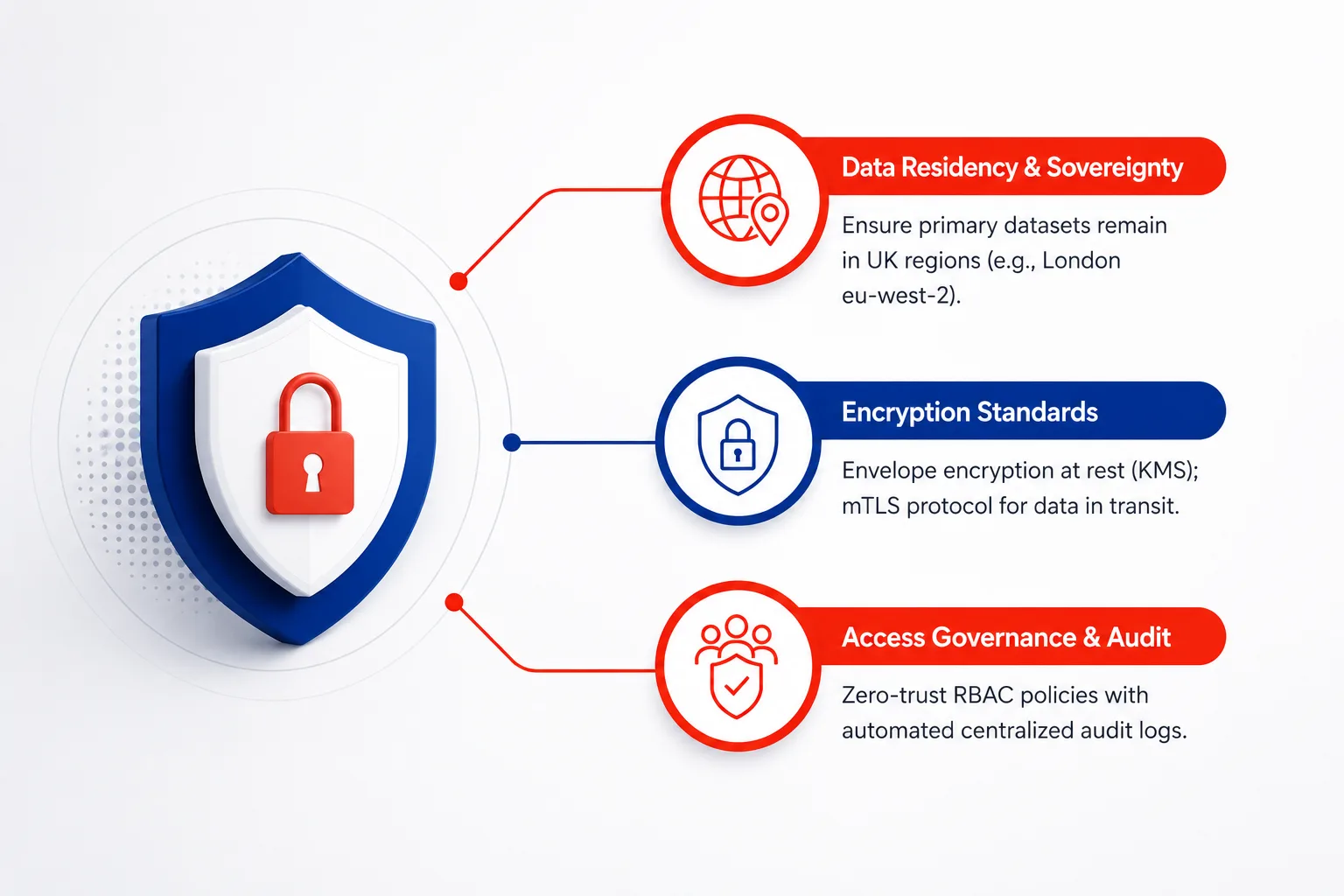
• UK Data Regions: Host primary customer data, backups, and staging environments in UK cloud regions (such as AWS London eu-west-2 or Azure UK South) to ensure compliance with UK GDPR requirements.

• Cross-Border Transfers: Define strict data transfer protocols and legal safeguards if data flows between UK and non-UK regions.

Security Architecture by Design

• Zero-Trust Access: Implement granular Role-Based Access Control (RBAC) and least-privilege policies across all cloud resources.

• Data Encryption: Enforce envelope encryption using Key Management Services (KMS) for data at rest, alongside mutual TLS (mTLS) for all internal microservice communications.

• Audit & Governance: Centralize log collection to maintain compliance trails for Cyber Essentials Plus, ISO 27001, and SOC 2 audits.

Move Without Breaking Production

Executing a cloud migration without causing service disruptions requires dual-run infrastructure patterns that keep databases synchronized during the transition.

Execution Architecture & Dual-Run Strategies

Change Data Capture (CDC) & Dual-Write Pipelines

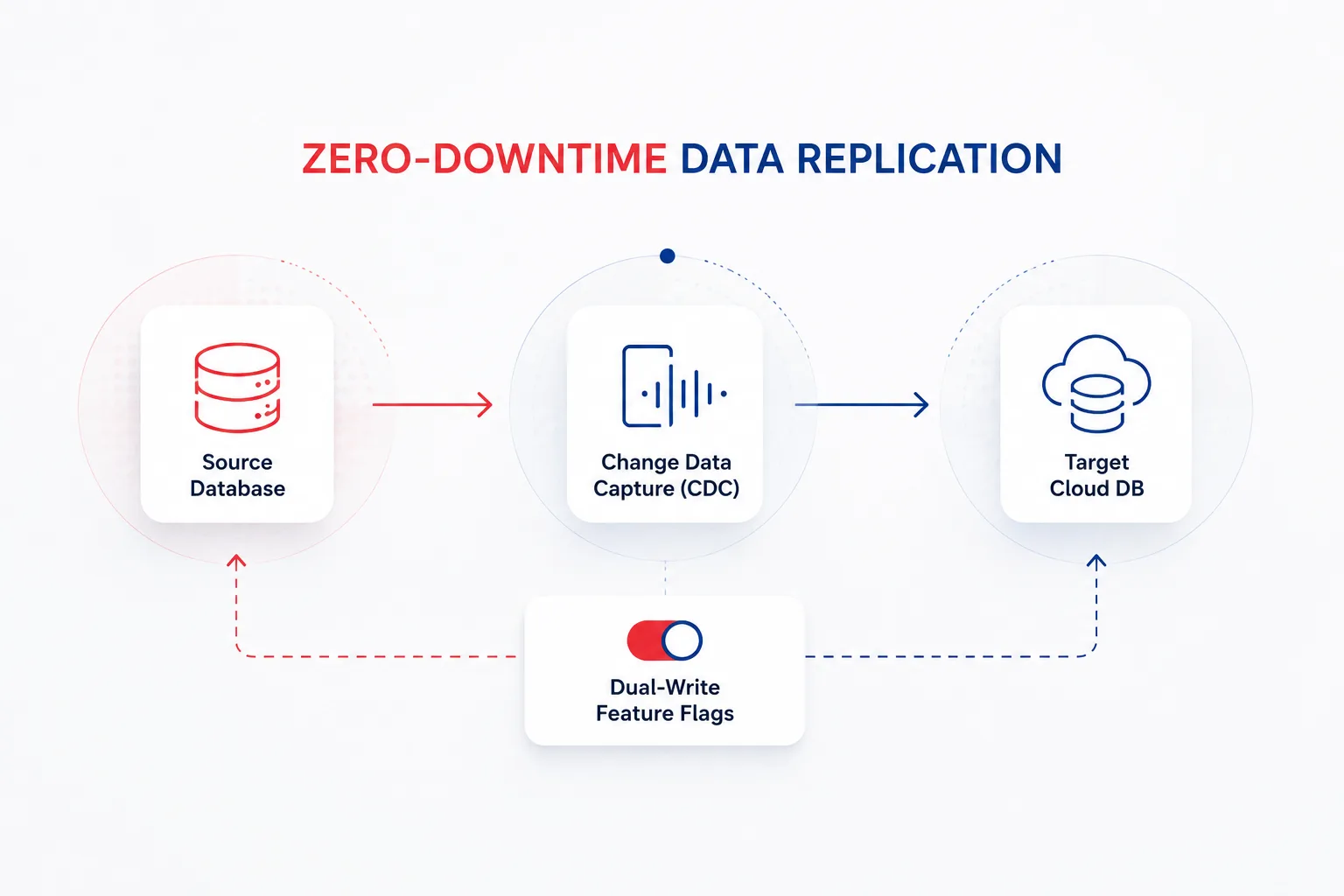
Instead of taking long maintenance windows to export and import static databases, deploy real-time Change Data Capture (CDC) streaming pipelines.

  1. Initial Snapshot: Establish an initial database snapshot in the target cloud environment.

  2. Continuous CDC Synchronization: Stream transactional changes continuously from your primary database to the cloud database using CDC tools.

  3. Dual-Write Validation: Use application feature flags to perform dual-writes, validating read/write consistency against the cloud database under production traffic.

Tenant-Aware Rollout Waves

Avoid migrating all platform tenants simultaneously. Instead, group customer accounts into phased migration waves:

• Wave 1: Internal Dev / Staging Environments
• Wave 2: Beta Opt-In Customers & Non-Critical Tenants
• Wave 3: Mid-Tier Standard SaaS Subscriptions
• Wave 4: High-ARR Mission-Critical Enterprise Accounts

Cutover with a Rollback Plan

The cutover phase requires clear operational coordination across engineering, database, and platform operations teams.

The Cutover Runbook

Maintain an hour-by-hour operational runbook detailing:

• Step-by-step responsibilities for platform, database, and network engineers.

• Pre-cutover validation scripts and health check checks.

• Automated rollback triggers with defined operational thresholds (such as elevated error rates or latencies).

Observability & Synthetic Monitoring

• Deploy unified observability tools across application performance monitoring (APM), log management, and distributed tracing.

• Run synthetic transaction monitors to track critical tenant workflows, ensuring immediate visibility into platform performance.

Prove the Migration Paid Off

Once your SaaS platform is fully operational in the cloud, focus shifts to financial governance and ongoing system refinement.

Cloud FinOps for SaaS Margins

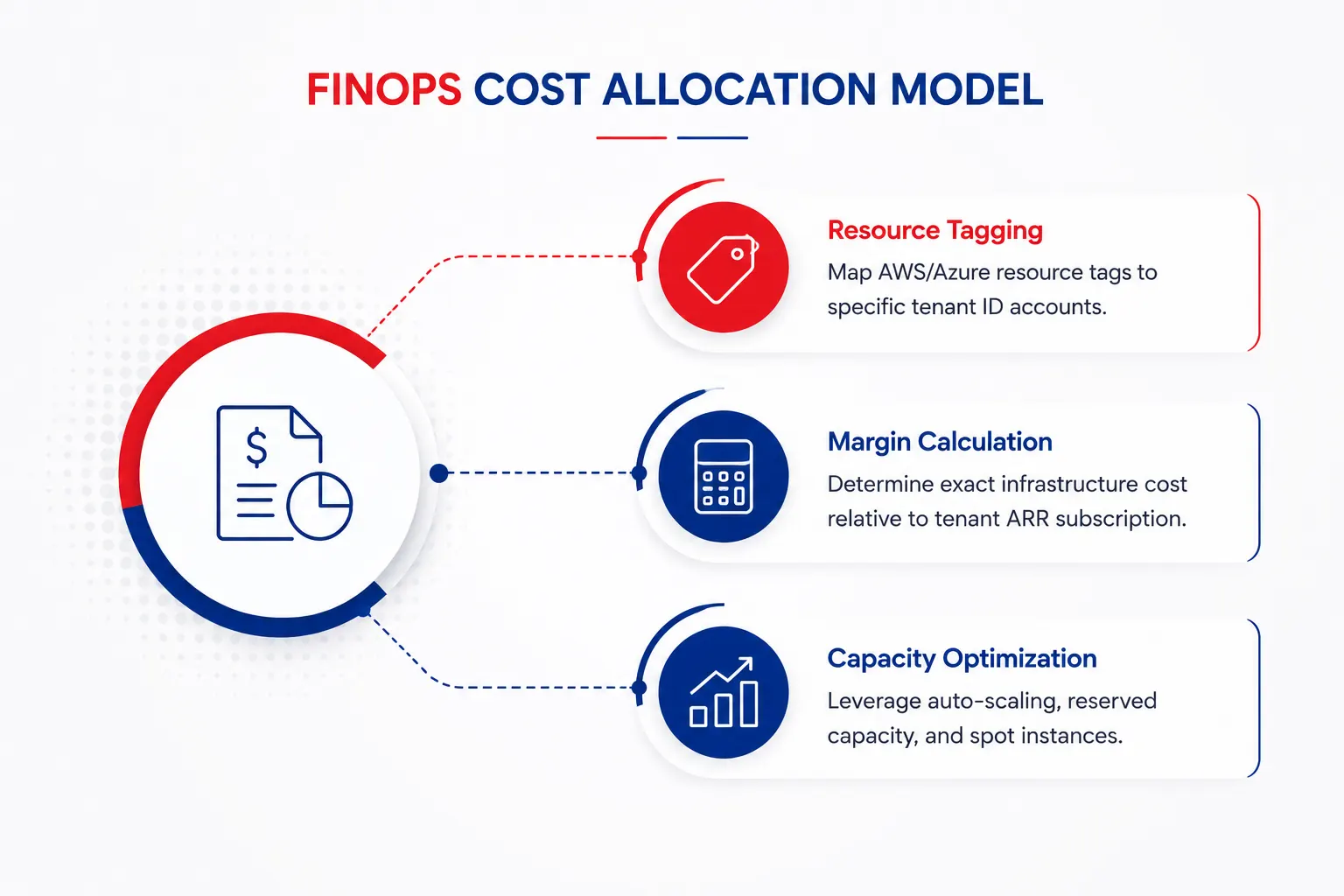
Unmanaged cloud infrastructure can quickly erode software gross margins. Implementing granular FinOps practices ensures financial accountability:

• Tenant-Level Cost Allocation: Apply tenant tracking tags to cloud compute, storage, and networking resources to calculate your exact gross margin per customer.

• Capacity Management: Utilize auto-scaling policies, reserved instances, and savings plans to match resource allocation with real user demand.

AI & Continuous Modernization

A modern cloud foundation gives you access to native AI/ML services, vector databases, and managed pipelines, allowing your product team to integrate artificial intelligence features into your SaaS platform safely.

Thought Leadership: Architectural Discipline in SaaS Migration

“Cloud migration is rarely an infrastructure challenge; it is an architectural and operational discipline test. SaaS leaders who treat migration as a raw server shift end up paying twice: first for the migration, and second for the refactoring needed to fix broken unit economics. True migration success happens when you decouple core services, automate compliance boundaries, and build observability into every step of your delivery pipeline.” – Kulmohan Makhija, Vice President – Sales

The Success Story: Netflix’s Multi-Year Cloud Transformation

When Netflix’s primary monolithic database suffered a major corruption in 2008, halting DVD shipments, leadership realized their data centers could not scale for global streaming. Rather than rushing an emergency move, Netflix executed a 7-year cloud migration to AWS built on structural re-architecture.

What They Did Right (The Architectural Blueprint)

• Eliminated the “Lift-and-Shift” Trap: Netflix avoided moving legacy monolithic code straight into cloud virtual machines. Instead, they decoupled application logic into hundreds of independently scalable microservices.

• Decoupled Stateless & Stateful Layers: Stateless compute (like recommendations or user search) was isolated from data storage. They moved away from single relational databases, adopting NoSQL (Apache Cassandra) for global metadata and AWS S3 for binary storage.

• Institutionalized Chaos Engineering: To guarantee high availability, Netflix built Chaos Monkey—an automated system that randomly shuts down production cloud instances during business hours. This forced engineers to design every microservice with built-in fallbacks, circuit breakers, and graceful degradation.

• Phased, Risk-Based Waves: Core user-facing stateless features were migrated first. High-risk, complex stateful services like billing were held back for the final wave until cloud ops maturity was reached.

The $100M+ Cloud Repatriation Wave (e.g., DHH / Basecamp & Ahrefs)

• What Happened: While not a project lawsuit, platforms like Basecamp (37signals) and Ahrefs executed full cloud migrations, only to publicly repatriate back to on-premise hardware after cloud costs spiraled out of control.

• The Failure Point: Unoptimized “lift-and-shift” migrations without tenant-level FinOps tagging or auto-scaling design. Basecamp was paying over $3.2M per year in AWS fees for predictable, steady-state workloads that ran significantly cheaper on owned hardware.

• CTO Takeaway: Migrating to the cloud without refactoring for cloud-native pricing (Spot instances, serverless, automated shutdown of idle environments) converts fixed CapEx into an unmanageable, variable OpEx trap.

How We Do It at Azilen: An Engineering-First Narrative

A successful SaaS cloud migration demands specialized product engineering expertise, architectural discipline, and deep integration capabilities. This is rarely achieved through a generic IT approach.

At Azilen, we don’t treat cloud migration as a static service offering or a quick system handoff. We approach migration as an engineering discipline, embedding directly alongside your core platform team to refactor, migrate, and modernize your SaaS application without breaking production.

▶ Deep-Dive Audit: Deconstructing dependency graphs, database lineage, and code-level bottlenecks before touching cloud IaC.

▶ Decoupled Strangling: Building lightweight API middleware and microservice boundaries around monoliths using the Strangler Pattern.

▶ CDC Data Pipelines: Engineering real-time CDC streams (Debezium/Kafka) to run parallel validation without data loss.

▶ Infrastructure as Code: Codifying zero-trust networks, automated FinOps tags, and UK GDPR boundaries in Terraform/OpenTofu.

The Strategic Advantages of Cloud Migration for SaaS Companies

• Cost Optimization: Shifts fixed infrastructure spend to elastic, pay-as-you-go capacity while eliminating on-premise hardware maintenance overhead.

• Improved Productivity: Frees engineering teams from manual infrastructure management so they can focus on shipping core software features faster.

• Enhanced Disaster Recovery and Business Continuity: Ensures high platform uptime and rapid data recovery using automated, geo-redundant cloud backup systems.

• Advanced Security and Regulatory Compliance: Strengthens your security posture with built-in zero-trust controls, automated threat monitoring, and regional data sovereignty compliance.

• Access to Cutting-Edge Technologies: Instantly unlocks native cloud innovation, including managed AI/ML pipelines, vector databases, and serverless architectures.

The financial trap of cloud migration isn’t always the sticker price—it’s the unseen architectural dependencies. As highlighted in the industry perspective below, unmanaged migration risks often freeze engineering leaders in place:

Achieve Operational Excellence with Cloud Migration for SaaS

Cloud migration is no longer an optional innovation project for British SaaS companies. It is a critical operational milestone that dictates platform gross margins, engineering velocity, and long-term valuation.

Moving live multi-tenant workloads while handling active user traffic requires a structured execution playbook. By adopting the 7 Rs framework, enforcing rigid data sovereignty, deploying zero-downtime data replication pipelines, and establishing granular FinOps controls, engineering leaders can turn legacy technology debt into a durable digital asset.

SaaS modernization requires experienced architectural discipline. Careful planning, phased execution, and specialized cloud engineering support are essential to minimize technical risk and ensure your platform is optimized for the demands of the 2026 market.

Choose Azilen Technologies for Your Cloud Migration Journey

With 17+ years of experience delivering enterprise Cloud Migration solutions, Azilen Technologies helps organizations build the data, integration, and traceability capabilities needed for sustainable growth and emerging regulatory demands, such as Digital Product Passport (DPP) implementations.

Digital Strategy & Architecture Consulting: Aligning technology choices with long-term business goals. Azilen conducts comprehensive architecture audits and risk-driven roadmap planning to ensure every project deliverable ties directly to measurable business outcomes.

→ Process Digitisation & Intelligent Automation: Transforming manual, paper-heavy workflows into automated, AI-driven processes. Azilen builds custom software capabilities that optimize operations, eliminate error rates, and streamline team efficiency.

→ Legacy System Modernisation: Upgrading brittle monolithic platforms into agile, cloud-native microservices architectures. Using a decoupled, API-first approach, Azilen modernizes legacy systems without disrupting live operations.

→ Customer Experience Transformation: Engineering intuitive, omnichannel digital portals backed by unified data architecture, enabling real-time personalization and higher customer retention.

→ Innovation As A Service: Providing ongoing engineering capability to prototype, test, and deploy emerging technologies, including enterprise AI tools and automated data pipelines.

FAQs: Cloud Migration for SaaS Companies

1. What is the typical timeline for a SaaS cloud migration?

Depending on platform complexity and legacy software debt, a SaaS cloud migration typically spans 3 to 9 months. Taking a phased, wave-based migration strategy enables initial production environments to go live within 8 to 12 weeks.

2. How do you prevent system downtime during database migration?

Zero-downtime database migrations rely on Change Data Capture (CDC) pipelines. CDC streams transactional changes in real time from the source database to the target cloud database, ensuring full data synchronization before switching DNS routing.

3. What are the key UK GDPR rules for cloud migrations?

Under UK GDPR guidelines, SaaS platforms must ensure customer personal data remains protected during storage and transit. This includes hosting data within approved UK cloud regions, implementing encryption standards, maintaining audit logs, and managing third-party data processor agreements.

4. Which of the 7 Rs is best for a SaaS company?

Most enterprise SaaS migrations combine Replatforming (moving databases to managed cloud services) and Refactoring (re-architecting monolithic services into microservices). Non-core tools are often Repurchased, while legacy components are Retired.

5. How can engineering leaders control cloud cost overruns post-migration?

Managing post-migration costs requires establishing Cloud FinOps practices. By tagging resources by tenant ID, setting automated budget alerts, right-sizing workloads, and utilizing reserved capacity, engineering teams can maintain healthy gross margins.

Kulmohan Makhija
Kulmohan Makhija
Vice President – Growth & Enterprise Strategy

Kulmohan Makhija is an enterprise technology and business strategy writer with over 12 years of experience analyzing digital transformation across global and European markets. His work focuses on applied artificial intelligence, product engineering, enterprise architecture, and large-scale legacy modernization. He explores how complex organizations modernize core systems, adopt AI responsibly, and align innovation with regulatory, cultural, and operational realities — particularly within the UK and broader European technology landscape. With a pragmatic enterprise perspective, Kulmohan emphasizes transformation that delivers measurable impact without disrupting mission-critical operations. His writing bridges executive strategy with technical depth, providing clarity for technology leaders, product teams, and decision-makers navigating modernization journeys.

Related Insights