

Skip to content

Modern Core Banking Integration in the UK: API-First Strategies for Legacy System Transformation

Featured Image

TL;DR:

The UK banking system still runs largely on ageing COBOL-based cores, creating structural banking challenges around scalability, innovation speed, compliance reporting, and real-time digital experiences. Large-scale “rip-and-replace” projects have historically failed due to operational risk, runaway costs, and the complexity of migrating decades of transactional data.

This blog explains how core banking integration UK strategies are evolving toward API-first architecture to enable controlled legacy system Trasformation. It explores the sidecar/strangler model, abstraction layers, microservices, event-driven APIs, regulatory drivers like PSD2 and Open Banking, and how banks modernise incrementally without disrupting mission-critical operations.

In This Blog, You’ll Learn

→ What core banking integration UK really means in practical, architectural terms
→ Why legacy cores create persistent banking challenges in resilience, scalability, and API performance
→ How API-first design, abstraction layers, and event-driven systems enable controlled legacy system Trasformation
→ Why “big bang” replacements fail, and how the sidecar/strangler approach reduces operational risk
→ How regulatory pressure, Open Banking growth, and future digital infrastructure are accelerating modernisation

This is a practical deep dive into how modern core transformation actually works, from integration strategy to phased execution, inside one of the world’s most regulated banking environments.

Imagine. A banking system built in the 1980s. Code written in languages most engineers no longer use. Billions of pounds moving every single day.

That is the hidden reality behind core banking integration UK.

On the surface, everything looks modern, sleek apps, instant transfers, digital onboarding. Underneath? Ageing core systems carrying enormous load. Recent outages across major UK banks exposed serious banking challenges, freezing payments for millions and highlighting how fragile the foundation really is. These cores were never designed for API ecosystems, Open Banking mandates, or real-time customer expectations.

Here’s the twist. UK banks spend nearly 78% of IT budgets just keeping old systems alive. Innovation fights for the remaining 22%. Meanwhile, cloud-native challengers move faster, release features weekly, and scale without dragging decades of technical debt behind them.

Blowing everything up does not work. It has been tried. It has failed.

The real shift? Progressive legacy system Trasformation, API-first architecture layered around existing cores. Modern on the outside. Stable at the centre. Evolving without collapsing the structure.

That is the future of core banking integration UK.

Legacy vs. Modern Core Banking: The Architecture Gap

The difference between legacy cores and modern platforms is not cosmetic, it is structural. Understanding this gap is central to solving today’s banking challenges and planning sustainable legacy system Trasformation.

For anyone evaluating core banking integration UK, this comparison shows exactly why API-first strategies are reshaping the industry.

Legacy vs Modern Core Banking Architecture
Feature
Legacy Core Banking System
Modern API-First Core
Architecture Monolithic, tightly coupled Microservices, loosely coupled
Programming Language COBOL, PL/I, Assembler Java, Python, Node.js, Go
Processing Model Batch processing (overnight jobs) Real-time, event-driven
Integration Method File transfers, ESB, point-to-point REST APIs, GraphQL, gRPC, Webhooks
Deployment On-premise mainframes Cloud-native (AWS, Azure, GCP)
Scalability Vertical scaling (larger servers) Horizontal scaling (containers & orchestration)
Time to Launch New Product 6–18 months 2–6 weeks
Downtime Risk High (single point of failure) Low (distributed, fault-tolerant)

The message is clear. Legacy cores were designed for stability in a closed banking era. Modern API-first platforms are designed for speed, ecosystem integration, and regulatory agility.

For UK banks navigating increasing competitive pressure, the shift is not optional, it is foundational to long-term resilience and innovation.

Understanding the UK’s Unique Context: Why This Matters Right Now

Understanding the uk banking

Open Banking Was Born in the UK

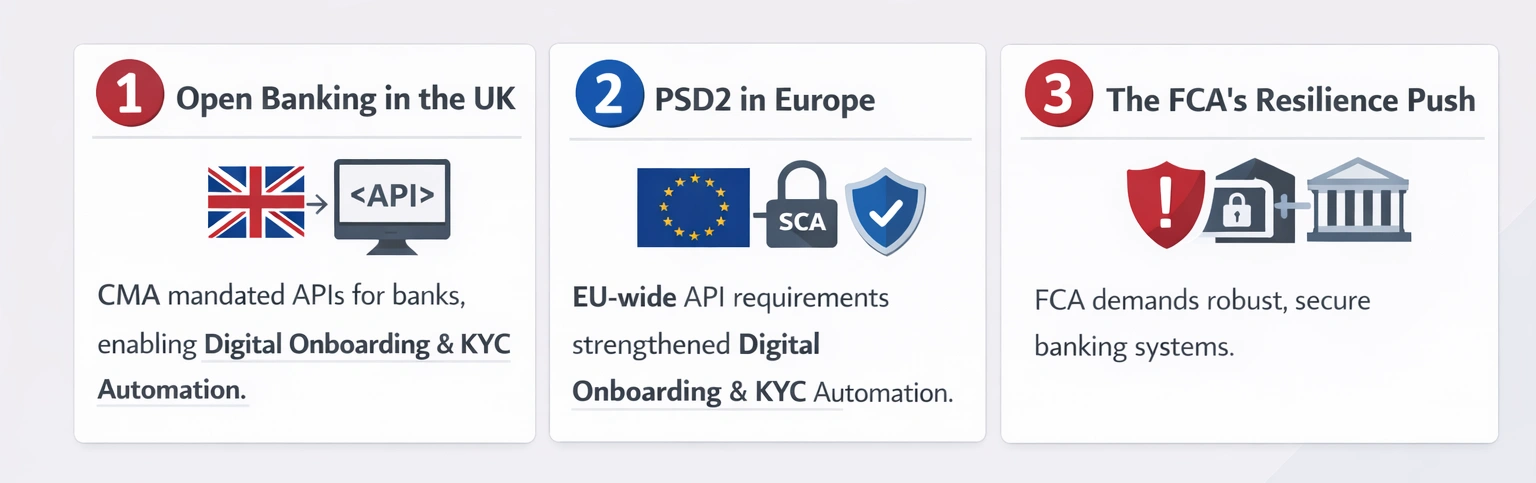
In 2017, the Competition and Markets Authority (CMA) required the UK’s nine largest banks to publish open APIs, allowing licensed third parties to access customer data with consent. This move fundamentally reshaped the market and accelerated core banking integration UK efforts, exposing structural banking challenges within legacy infrastructure.

PSD2 Extended This Across Europe

The Revised Payment Services Directive (PSD2) expanded open API requirements across the EU, mandating Strong Customer Authentication and secure third-party access. This regulation intensified the need for scalable legacy system Trasformation, pushing banks toward API-first models rather than patchwork integrations.

The FCA’s Operational Resilience Push

The Financial Conduct Authority (FCA) now demands stronger operational resilience from UK banks. Institutions must prove their systems can withstand outages and disruptions, something ageing monolithic cores struggle to deliver, making modern core banking integration UK strategies, including resilient Digital Onboarding & KYC Automation frameworks, increasingly urgent.

The API-First Transformation Flowchart

Understanding the process is as important as understanding the why. Here is the step-by-step flow of how a UK bank executes an API-first legacy transformation:

PHASE 0: ASSESSMENT 

│ ➜ TCO analysis of legacy system
│ ➜ Document all integrations (typically 70-200+)
│ ➜ Map data flows and dependencies
│ ➜ Identify regulatory compliance gaps

PHASE 1: API ABSTRACTION LAYER

│ ➜ Build API Gateway (Kong, AWS API Gateway, MuleSoft)
│ ➜ Create service mesh over legacy core
│ ➜ Expose standardised REST/GraphQL APIs externally
│ ➜ Implement OAuth 2.0 / OpenID Connect for auth
│ ➜ Legacy system untouched — just wrapped

PHASE 3: STRANGLER FIG MIGRATION

│ ➜ Migrate product-by-product (e.g., current accounts first) │
│ ➜ Each migrated product: decommission from legacy
│ ➜ API layer routes traffic dynamically between cores
│ ➜ 90-day delivery cycles with measurable business value

PHASE 4: OPEN BANKING ECOSYSTEM

│ ➜ Publish APIs to FCA-registered TPPs (Third-Party Providers)
│ ➜ Connect to fintech partners via marketplace
│ ➜ Enable PSD2/Open Banking real-time data sharing
│ ➜ Launch new digital products in weeks, not months

PHASE 5: LEGACY DECOMMISSION

│ ➜ Final products migrated; mainframe switched off
│ ➜ 47%+ TCO reduction achieved
│ ➜ IT budget rebalanced toward innovation
│ ➜ Full cloud-native, API-first banking achieved

The Abstraction Layer: The Translator Between Worlds

Abstraction Layer uk banking

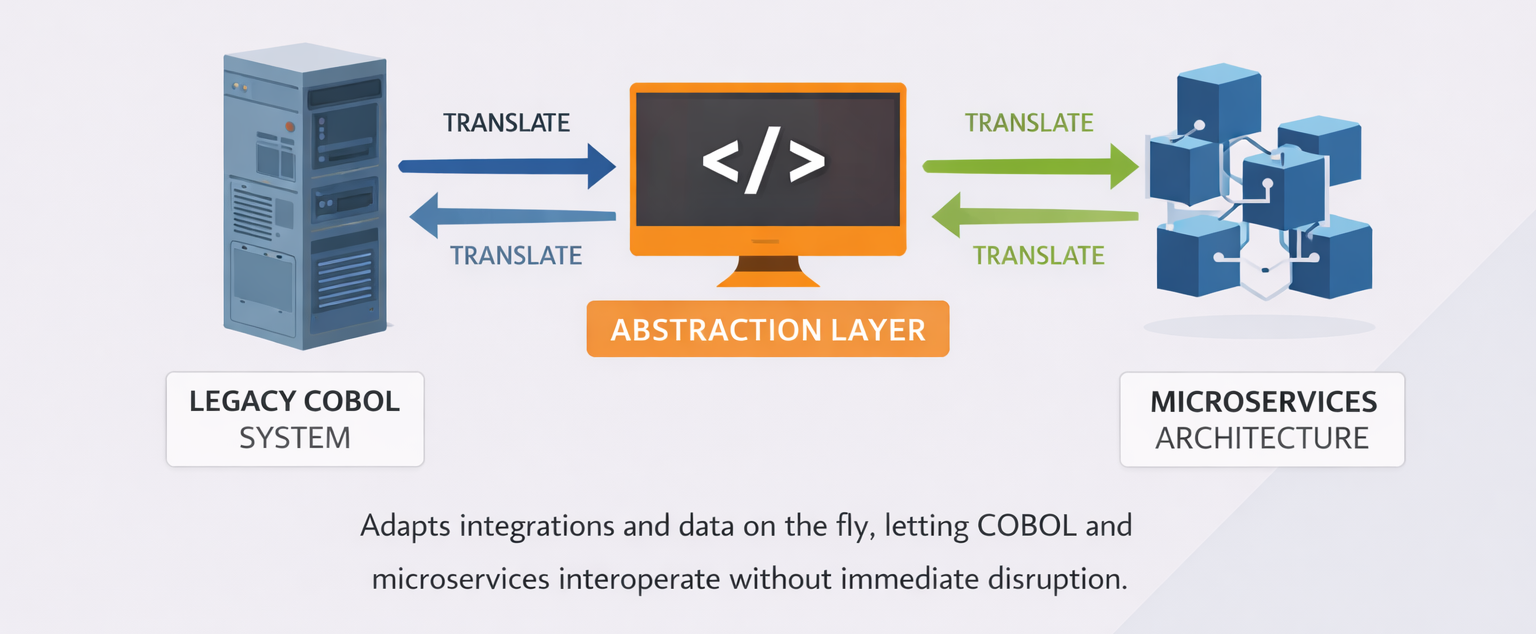
Here’s a concept that’s underappreciated: the abstraction layer enables banks to bridge technical gaps identified when migrating to a new core, such as differences in integration patterns and data transformation.

It serves as the ‘translator’ to minimize impact on operations during the transition period.

Think of it like a universal adapter. Your legacy COBOL system speaks one language. Your new microservices architecture speaks another. The abstraction layer translates, in real time, so neither side needs to be ripped out immediately.

Infrastructure First: Why Architecture Defines the Future of Financial Intelligence

AI in finance sounds transformative, but without modern architecture, it remains constrained. Legacy cores built on batch processing and fragmented data flows limit speed, visibility, and decision quality.

In the context of core banking integration UK, the real shift is structural. Intelligent automation only works when supported by real-time APIs, scalable infrastructure, and controlled legacy system Trasformation. Innovation begins at the foundation, not at the algorithm.

2 Real-World Use Cases from the UK Market

Below are real UK examples where progressive core banking integration UK strategies solved tangible banking challenges. Each case reflects structured legacy system Trasformation, not theory, but execution backed by public disclosures and regulatory reporting.

Use Case 1: Multi-Brand, Multi-Core Simplification – Lloyds Banking Group

Following multiple acquisitions (including HBOS), Lloyds operated several legacy platforms across brands. Integration complexity slowed innovation and increased operational cost. Rather than immediate replacement, Lloyds adopted a phased modernisation and platform simplification strategy aligned with API-enabled transformation.

A report by the National Audit Office titled “The return of Lloyds Banking Group to private ownership” published in 2018 highlights the scale of restructuring complexity, integration challenges, and transformation costs following the financial crisis and subsequent acquisitions.

Structured Approach:
➜ Built standardised integration layers across brands
➜ Rationalised overlapping core systems gradually
➜ Introduced API-enabled services to unify digital channels
➜ Migrated products in controlled waves

Outcome: This phased strategy reduced duplication, improved digital consistency across brands, and strengthened operational resilience, a practical example of legacy system Trasformation within core banking integration UK.

Use Case 2: Digital-Only Core Pilot – Nationwide & Mambu

Nationwide partnered with Mambu to test modern cloud-native core capabilities in a controlled environment before large-scale migration. Instead of moving all customers immediately, they validated real-time processing and modular product configuration through composable architecture.

A press release by Mambu titled “Leeds Building Society partners with Mambu to modernise its core banking systems” published in April 2024 outlines how a UK building society adopted a cloud-native, API-first core to accelerate product innovation and reduce legacy dependency.

Structured Approach:
➜ Launched modular savings products via API-first core
➜ Used REST-based integrations for channel connectivity
➜ Tested performance, reporting, and compliance readiness
➜ Expanded rollout only after production validation

Outcome: Risk exposure was minimised while building confidence for broader legacy system Trasformation, directly addressing banking challenges around scale and stability.

The Tech Stack: What API-First Banking Actually Looks Like Under the Hood

Before we go deeper, watch this video. It gives a clear, visual explanation of how APIs connect banks, fintechs, and customers. Now let’s translate that high-level explanation into the real architecture powering core banking integration UK.

API Gateway Layer

Think of the API Gateway as the secured front entrance to the bank’s digital ecosystem. Platforms like Kong Enterprise, MuleSoft Anypoint, AWS API Gateway, and Azure API Management control traffic, enforce OAuth 2.0 authentication, validate JWTs, manage throttling, and monitor usage.

This layer becomes especially critical when exposing services such as Digital Onboarding & KYC Automation, where identity verification, document uploads, and consent flows must remain secure and compliant. Without a gateway, downstream systems are exposed, creating major banking challenges in both security and maintainability.

Event Streaming Layer

Real-time finance runs on event streaming. Apache Kafka is commonly used in core banking integration UK architectures to publish events such as PaymentInitiated, AccountUpdated, or CreditApproved.

This model is essential for systems like Loan Origination & Credit Platforms, where underwriting decisions, risk scoring, and approval workflows depend on instant data propagation across fraud engines, ledgers, and reporting services. Unlike legacy batch jobs, event-driven systems remove rigid dependencies and eliminate single points of failure, a core step in structured legacy system Trasformation.

Microservices Architecture

Open Banking API Standards (UK-Specific)

The UK’s Open Banking Implementation Entity (OBIE) mandates strict API specifications. Banks must expose Account Information APIs (AISP), Payment Initiation APIs (PISP), and Confirmation of Funds APIs (CBPII), all secured via OAuth 2.0 with PKCE, mutual TLS, and signed JWTs.

These standards are not just technical requirements, they are part of broader Regulatory Compliance Enablement. Meeting them ensures banks align with FCA resilience expectations and PSD2 mandates while continuing controlled legacy system Trasformation. For developers building core banking integration UK solutions, these specifications define the operating blueprint for secure, scalable modern banking.

Regulatory Reality Check: The Clock Is Ticking for UK Banks

Understanding the UK's Unique Context

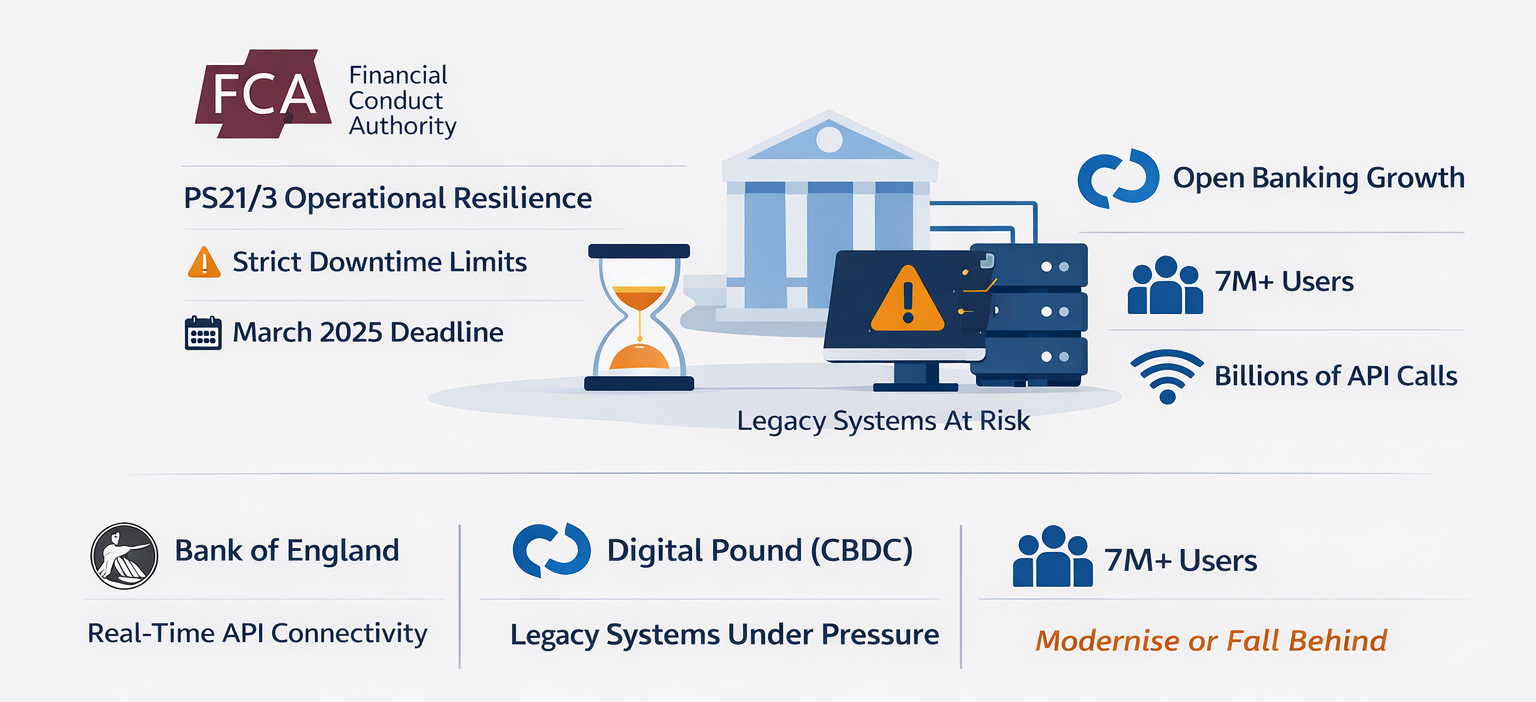
Modernisation in the UK is no longer optional — regulators are enforcing it. The FCA’s PS21/3 Operational Resilience policy requires banks to define critical services and stay within strict downtime limits by March 2025. Legacy cores with batch dependencies and periodic outages struggle to meet these standards. This regulatory push is accelerating core banking integration UK programmes. Long-standing banking challenges are now compliance risks.

The Bank of England’s proposed digital pound would require real-time API connectivity across the ecosystem. At the same time, Open Banking adoption continues to grow rapidly across the UK. Banks unable to deliver secure, low-latency APIs risk falling behind. Batch-based systems were never built for this environment. The urgency for legacy system Trasformation is now commercial as well as regulatory.

Azilen’s API-First Approach: Engineering Modern Core Banking from Day One

Azilen is a Digital Transformative Company helping UK financial institutions solve complex banking challenges through structured, API-first architecture. Instead of treating compliance and modernisation as separate initiatives, Azilen embeds resilience, scalability, and regulatory alignment directly into the foundation of core banking integration UK programmes.

Legacy system Trasformation is not approached as a risky overhaul, but as a phased, intelligent evolution designed for long-term stability.

What We Build

Intelligent Loan Origination & Credit Platforms: FCA-aligned systems supporting real-time affordability checks, Open Banking integration, AI-driven decisioning, and seamless core connectivity through abstraction layers.

Digital Onboarding & KYC Automation: Secure, modular onboarding frameworks powered by API gateways and event-driven infrastructure, enabling instant verification with full audit traceability.

Composable Mortgage & Savings Platforms: Microservices-based product architecture allowing banks to launch, scale, or modify offerings without disrupting existing operations.

Regulatory Compliance Enablement: Infrastructure engineered for operational resilience, structured reporting, and transparent API governance aligned with UK regulatory expectations.

With Azilen, compliance is not a post-build checklist. It becomes part of the system’s DNA, enabling faster innovation, controlled legacy system Trasformation, and sustainable core banking integration UK at scale.

FAQs: Loan Origination System UK

1. What is core banking integration UK and why is it important?

Core banking integration UK refers to connecting legacy banking systems with modern API-first architecture to enable real-time services, regulatory compliance, and fintech ecosystem participation. It is important because ageing cores create operational banking challenges that limit innovation, increase downtime risk, and slow product launches. Integration enables phased legacy system Trasformation without disrupting daily operations.

2. Why do “big bang” core replacements often fail?

Large-scale, full core replacements introduce high operational risk, data migration complexity, and significant cost overruns. Many UK banks have learned that shutting down and replacing everything at once creates instability. API-first integration allows gradual legacy system Trasformation, reducing disruption while maintaining service continuity.

3. What is the abstraction layer in modern banking architecture?

The abstraction layer acts as a real-time translator between legacy cores and modern microservices. It standardises APIs, transforms data formats, and shields downstream systems from core complexity. In core banking integration UK strategies, this layer enables banks to modernise progressively without immediately decommissioning existing infrastructure.

4. How does API-first architecture help with FCA compliance?

API-first architecture improves traceability, auditability, and operational resilience. By enabling structured data flows and real-time monitoring, banks can better meet FCA operational resilience requirements. It also supports structured reporting and secure third-party connectivity, reducing regulatory banking challenges during legacy system Trasformation.

5. How does Open Banking impact UK core modernisation?

Open Banking requires banks to expose secure APIs for account information and payment initiation. This mandates stable, low-latency API infrastructure. Banks relying on batch-based legacy cores struggle to meet these standards, making core banking integration UK initiatives critical for ecosystem participation.

Glossary

API (Application Programming Interface): A set of rules that allows different software systems to communicate with each other. In core banking integration UK, APIs enable secure connections between legacy cores, fintech partners, and digital channels.

API-First Architecture: A design approach where systems are built around well-defined APIs from the start. This model supports scalable legacy system Trasformation and reduces integration-related banking challenges.

Abstraction Layer: A middleware layer that translates data and requests between legacy core systems and modern microservices. It enables gradual modernisation without immediate core replacement.

Batch Processing: A legacy processing model where transactions are grouped and processed at scheduled intervals, often overnight. This model limits real-time capabilities.

Cloud-Native Architecture: Infrastructure built specifically for cloud environments using containers, microservices, and scalable orchestration platforms like Kubernetes.

Core Banking System: The central system that processes transactions, manages accounts, and records financial data for a bank.

Event-Driven Architecture: MA real-time processing model where systems react to events (such as payments or account updates) instantly, improving speed and resilience.

FCA (Financial Conduct Authority): The UK regulator responsible for overseeing financial services firms and ensuring operational resilience and compliance standards.

ISO 20022: A global financial messaging standard that enables richer, structured, and real-time payment data exchange.

Legacy System Trasformation: The phased process of modernising outdated core banking systems through integration, abstraction, and progressive migration strategies.

Microservices: An architectural style where applications are broken into small, independent services that can be deployed and scaled separately.

Open Banking: A UK regulatory initiative requiring banks to provide secure API access to third-party providers with customer consent.

Operational Resilience: A regulatory requirement mandating banks to maintain critical services during disruptions and system failures.

Kulmohan Makhija
Kulmohan Makhija
VP - Growth

Kulmohan Makhija writes at the intersection of technology and business, with a strong Europe-focused enterprise lens. His work covers digital transformation, product engineering, and applied AI, with attention to regulatory, cultural, and operational realities across European markets. He explores how complex organizations modernize core systems without disrupting what already works. His perspective balances innovation with pragmatism, shaped by how transformation actually plays out on the ground

Related Insights