



Skip to content

Top 5 Ways Digital Product Passports Create New Revenue Streams for UK Enterprises

Featured Image

TL;DR

This is a technical and strategic breakdown of how DPP compliance is quietly becoming the most underestimated growth lever for British businesses in 2025-2030.

The EU’s Ecodesign for Sustainable Products Regulation (ESPR) is mandating Digital Product Passports across nearly every product category: textiles from 2027, electronics by 2028–29, construction by 2029–30.

For UK businesses selling into the EU or supplying EU-bound components, this isn’t optional. But here’s what most businesses miss: the companies treating DPPs purely as a compliance cost are already losing to the ones treating them as a revenue engine.

This blog breaks down, in full technical and business detail, the five most powerful ways Digital Product Passports create entirely new revenue streams for UK enterprises, from circular economy models and product lifetime value doubling, to premium data monetisation and B2B supplier differentiation worth tens of millions of pounds.

Let’s start with a number that should make any UK boardroom sit up straight: £3.45 billion. That’s the projected size of the UK’s Digital Product Passport market by 2030, growing at a CAGR of 28.9%.

And right now, most UK businesses are treating this like a Brussels bureaucracy problem, something to handle “eventually”, probably by hiring a compliance consultant and ticking a box.

That thinking is going to cost them. Badly.

Here’s the uncomfortable truth: the companies who move first on Digital Product Passports aren’t doing it because they love regulation. They’re doing it because they’ve seen what happens when product data becomes a commercial asset.

Decathlon deployed item-level RFID identification, a foundational DPP technology, and watched revenue jump 11% the following year.

Nobody’s Child, a British fashion brand you’ve probably seen at M&S and John Lewis, paired DPP with blockchain and NFT technology and is now redefining what post-purchase brand engagement looks like.

Bain & Company’s research suggests DPPs could double the lifetime value of a product. Double. Not grow it by 10%. Double.

£3.45B

UK DPP market projected growth by 2030 (CAGR 28.9%)

2027

First wave of mandatory DPPs rollout (textiles, batteries)

71%

Global consumers willing to pay a premium for verified sustainability

2x

Potential product lifetime value increase (Bain & Co. research)

So why are we framing this as a revenue conversation and not a compliance conversation?

Because compliance is the floor, not the ceiling. Every UK enterprise that sells into the EU, or supplies components to manufacturers that do, will eventually need a Digital Product Passports.

The regulation under ESPR (Regulation (EU) 2024/1781) is enacted into EU Law. It’s not a proposal. It’s not a consultation. It’s law, with phased implementation starting 2027.

The question isn’t whether you’ll build a DPP system. The question is what you’ll do with it once it’s live. This blog exists to answer that question with the rigour it deserves.

DPP Timeline: What UK Enterprises Face and When

The ESPR Working Plan 2025-2030, adopted on 16th April 2025, is the most concrete timeline we have. Here’s what matters to UK businesses:

DPP Create New Revenue

2024 (DONE)

ESPR Enacted into EU Law: Regulation (EU) 2024/1781 officially in force. No immediate requirements yet, but the clock started. UK exporters should have begun data mapping.

Dec 2025 (Done)

Harmonised DPP Technical Standards Published: European standards organisations (CEN & CENELEC) publish the harmonised standards. Technical specifications become locked in.

Jan 2026

Textiles Delegated Act Published: Detailed requirements for textile DPPs formally published, giving industry 18 months to implement before enforcement. Iron and steel delegated acts follow.

July 2026

EU Central Digital Registry Goes Live: The EU establishes its central DPP registry. All DPP systems must be interoperable with this infrastructure from day one of enforcement.

2027

ENFORCEMENT BEGINS: Textiles, Tyres, Footwear, Detergents, Iron & Steel, Aluminium: This is the point of no return for textiles and fashion. EV and industrial battery passports also mandatory from February 2027 (Battery Regulation 2023/1542).

Products without DPPs will not be allowed into the EU market, with GS1 standards playing a critical role in enabling globally interoperable identification and data exchange.

2028

Electronics Repairability Rules & Furniture: Electronics repairability requirements with DPP mandated. Furniture sector comes into scope. Deep technical data requirements around component sourcing.

2029-2033

Full Circular DPP Rollout: Mattresses, electronics full coverage, construction products. By 2033, fully circular DPPs with complete lifecycle data, reuse and recycling routes required.

How DPPs Generate Revenue: The Full Flow

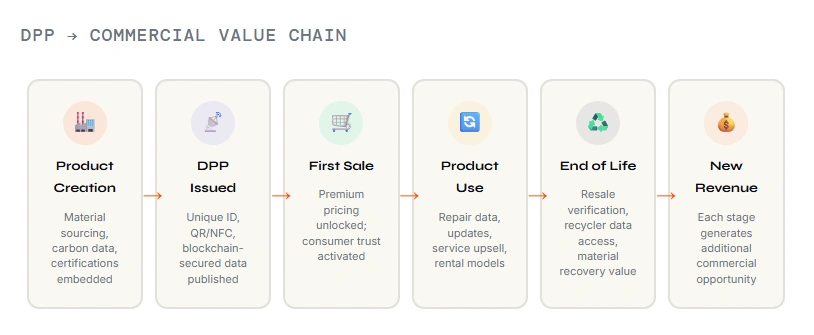
Before we go deep on each revenue stream, here’s how the data flow creates commercial value across the product lifecycle:

Digital Product Passports Create New Revenue

The crucial insight here is that traditional product commerce ends at “First Sale.”

DPP fundamentally extends the commercial relationship across the entire lifecycle, turning a one-time transaction into a multi-touch revenue engine.

Now let’s go deep on each stream.

Revenue Stream 1: The Circular Economy Revenue Model (Product Lifetime Value)

Top Revenue Stream from DPP

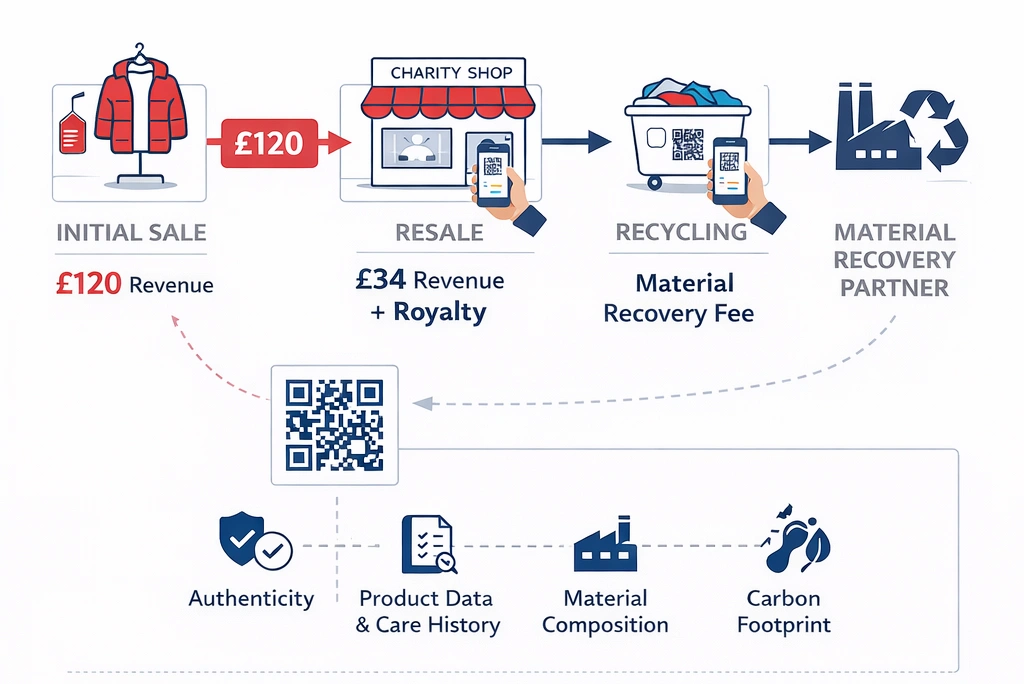
Here’s a thought experiment. You sell a £120 jacket. The customer wears it for two years, then it sits at the back of a wardrobe for three more, then goes to a charity shop where it sells for £8. You’ve seen £120 from that jacket. Total. Forever.

Now imagine the same jacket has a DPP. The customer scans the QR code at the charity shop. The DPP validates authenticity, shows full care history, material composition, and carbon footprint.

If you want to understand why this shift is becoming a competitive advantage, it’s worth exploring why UK manufacturers who adopt DPP early will dominate EU markets by 2027.

The pre-loved market price is now £34, not £8. Your brand gets a small royalty on that resale. The buyer trusts the provenance. They scan again at end-of-life and route it to a recycling partner, who pays a material recovery fee because they know exactly what’s inside.

You’ve now touched that jacket commercially four times. Not once.

Bain & Company’s research puts real numbers on this: DPPs have the potential to double a product’s lifetime value. Not by increasing the first-sale price, but by capturing value at every subsequent touchpoint the traditional model ignores entirely.

Formula: Product Lifetime Value (PLV) with DPP

PLV = P₁ + (Σ Rₙ × Bᵣ) + (Sᵥ × Bₛ) + Mᵣ

P₁ = First sale price
Rₙ = nth resale price | Bᵣ = Brand royalty rate (typically 2–8%)
Sᵥ = Service/repair transaction value | Bₛ = Brand service margin
Mᵣ = Material recovery value at end-of-life

For a UK mid-market fashion brand selling a £120 product, the maths looks like this:

£120

Initial sale (traditional endpoint)

+£18

Repair service transactions

+£8

3% royalty on £270

+£4

Material recovery at end-of-life

£150

Total PLV, 25% uplift from same product

Scale that across 500,000 annual units and you’re looking at £15 million in additional revenue annually, from products you’ve already sold.

UK Case: Nobody’s Child & PANGAIA (Circular Fashion Revenue)

Nobody’s Child, the British women’s brand available at M&S, John Lewis, and ASOS, launched DPPs on their Fearne Cotton collaboration using Fabacus’s Xelacore technology.

Each QR code tracks over 100 data points, from raw material processing through yarn mills to garment factories. Crucially, the DPP links directly to circular service partners: repair and alterations, rental, and pre-loved resale.

Similarly, PANGAIA, the UK-based materials science brand, deployed DPP through EON’s digital ID technology and launched ReWear, a DPP-enabled peer-to-peer resale platform. When a customer scans their PANGAIA item, the DPP automatically populates the resale listing.

One-click resale. The brand stays in the commercial loop across every subsequent sale of that item.

Revenue Stream 2: Data Monetisation & Supply Chain Intelligence

Best Revenue Stream from DPP

Here’s where things get genuinely interesting from a technology perspective.

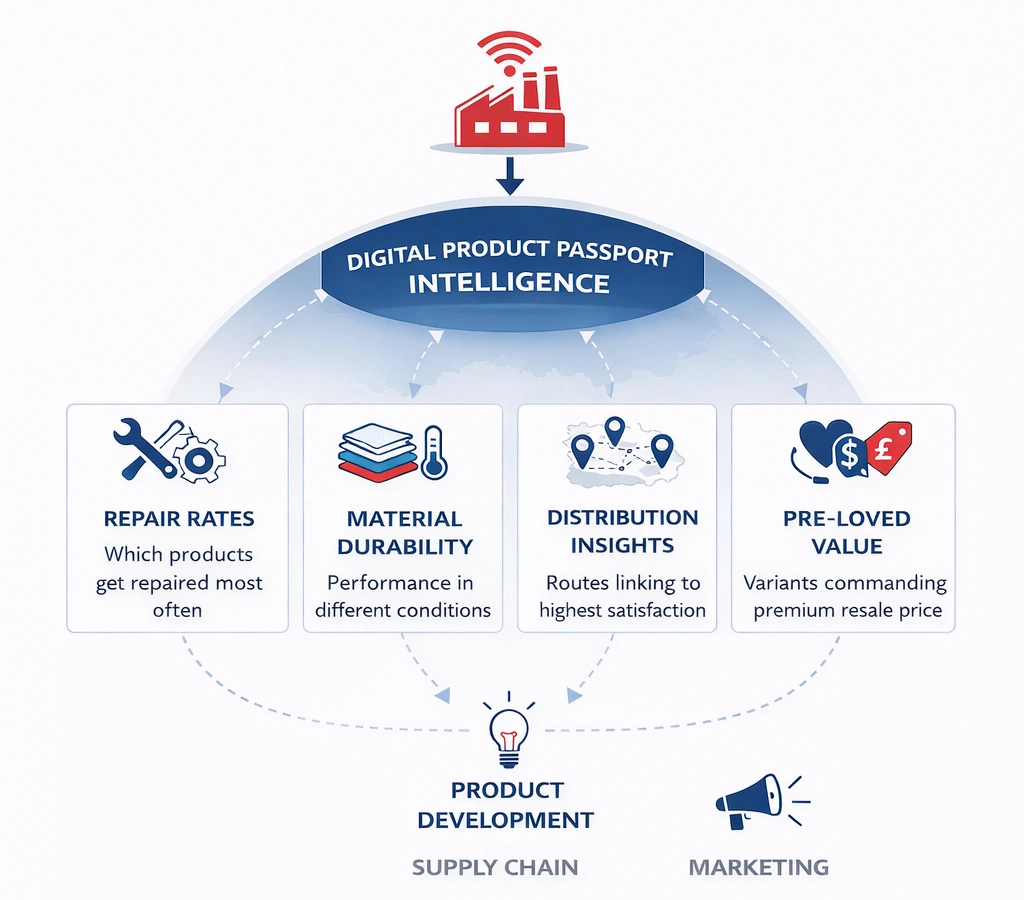
A DPP isn’t just a regulatory filing. It’s a continuous data collection mechanism that generates intelligence about how your products actually behave in the real world, at a granularity no previous system has ever achieved.

Think about what a mature DPP ecosystem knows: which products get repaired most often, and at what point in their lifecycle.

Which material combinations hold up best in which climate conditions.

Which distribution routes correlate with highest consumer satisfaction scores.

Which product variants are most likely to enter the pre-loved market at premium prices.

This is data that your product development, supply chain, and marketing teams have never had access to, and it’s commercially extraordinarily valuable.

Data Monetisation Vectors
Data Type
Source in DPP
Commercial Application
Typical Value
Complexity
Product Performance Data Scan events, repair logs, service interactions via DPP data carrier R&D investment prioritisation, warranty optimisation, design improvements £500K–£5M saved annually in improved product design ROI Medium
Consumer Behaviour Intelligence Post-purchase scan rates, resale marketplace data, care instruction engagement Personalised marketing, resale programme participation, retention campaigns 15–25% improvement in customer lifetime value metrics Medium
Supply Chain Transparency Data Supplier-contributed data: material origins, processing methods, certifications Approved spare parts sales, remanufacturing intelligence, B2B data licensing New revenue line: £50K–£2M for data access subscriptions High
Compliance & ESG Reporting Data Aggregated DPP data across product portfolio CSRD reporting automation, investor ESG disclosures, green finance access £200K–£800K saved in annual compliance reporting costs Low–Medium

Insights from the role of digital product passports in improving the UK’s remanufacturing opportunity show how DPP enables better lifecycle visibility and supports circular manufacturing.

The DPP captures structured data on materials, components, and product history, making it easier to assess products when they return for reuse or remanufacturing.

The impact is practical: manufacturers reduce uncertainty, speed up remanufacturing decisions, and recover more value from used products instead of treating them as waste.

This shifts DPP from a compliance requirement to an operational advantage, enabling longer product lifecycles, reduced waste, and new value recovery opportunities across the supply chain.

This is what DPP as a remanufacturing enabler looks like in practice.

Revenue Stream 3: Charging More Because You Can Prove It (Sustainability Premium)

For years, sustainability marketing has had a credibility problem. Brands claimed their products were ethically sourced, carbon-neutral, or sustainably manufactured.

Consumers were sceptical. Greenwashing accusations flew. And because there was no verifiable, standardised mechanism to prove claims, premium sustainability pricing was always fighting an uphill battle of trust.

DPPs change this fundamentally. They transform sustainability claims from marketing copy into verifiable, blockchain-secured, regulatory-grade data.

To understand how this is evolving further with automation, it’s worth exploring AI and Digital Product Passport: How UK Manufacturers Are Using AI DPP to Automate Compliance in 2026.

And the market is ready to pay for that. A PwC 2024 global consumer survey found that over 80% of consumers are willing to pay more for sustainably produced goods, with an average premium of nearly 10%.

Formula: Sustainability Premium ROI

Net Premium Revenue = (Pₛ − Pₛₜ) × Qₛ − C_dpp

Pₛ = Sustainable product price (DPP-verified) | Pₛₜ = Standard product price
Qₛ = Quantity of products sold with DPP premium positioning
C_dpp = Annual DPP system cost (£15,000–£500,000 depending on scale)

Example: 10% premium on £80 product × 200,000 units = £1.6M gross premium – £80K system cost = £1.52M net

The critical insight is that the premium doesn’t need to be large to be profitable.

A 7–12% price premium on mid-market goods, when supported by DPP-verified data, is consistently achievable. Research from 42T’s Consumer Sustainability Report found that 57% of consumers believe sustainability gives brands a clear edge.

In a market where DPP data becomes standardised and searchable via the EU Commission’s public web portal, brands that can’t prove their claims will simply stop competing at premium price points.

Revenue Stream 4: B2B Supplier Differentiation & Retained Market Access

Digital Product Passports for UK Exporters

Let’s talk about a revenue stream that doesn’t look like revenue at first glance, but absolutely is: retained contracts.

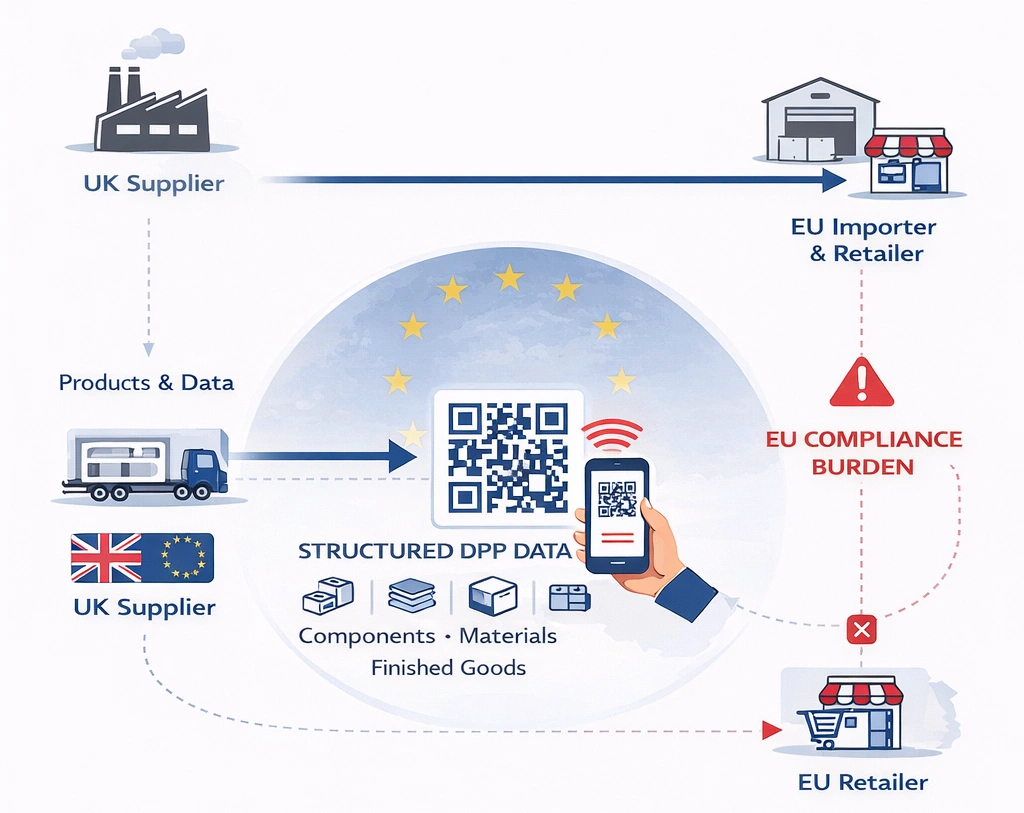
If your business supplies components, materials, or finished goods to manufacturers or retailers who sell into the EU market, your DPP capability is about to become a commercial threshold requirement, not a nice-to-have.

Here’s the supply chain reality: EU-based importers legally carry the DPP compliance burden. But they can’t complete a DPP without accurate data from their upstream suppliers.

That means every UK supplier who cannot provide structured, verifiable, DPP-compatible product data is a liability to their EU customers. And EU buyers will switch to suppliers who can provide it. Not because they want to. Because they have to.

The Supplier Premium Model

But there’s an upside beyond retention. Suppliers who can provide richer, more granular, verifiable DPP data than competitors gain a genuine pricing advantage.

When your material data is structured, certified, blockchain-secured, and API-accessible, vs. your competitor’s manually-compiled PDF certificate, you can charge more for that data quality. Data quality becomes a product feature with a price tag.

Formula: B2B DPP Supplier Premium Value

Annual Value = (Rₖ × Δp) + (Nₙ × Vc) − C_impl

Rₖ = Revenue from retained key accounts | Δp = Supplier data premium per unit (typically £0.50–£3.00)
Nₙ = New contracts won vs. non-DPP-ready competitors | Vc = Average contract value
C_impl = DPP implementation and running costs

Example: £8M retained contract × 1 at-risk account + £1.20 data premium × 500K units = £8.6M protected/created value

UK Sector DPP Revenue Table
UK Sector
DPP Data Advantage
B2B Premium Mechanism
Revenue Potential
Automotive Parts Component-level provenance, material safety data, recycled content % Subscription access for authorised repairers; premium for EV battery data £500K–£5M/year
Textiles & Apparel Fibre composition, dyeing chemicals, factory certifications, carbon footprint Premium supplier tier for EU fashion brands; resale authentication data £100K–£2M/year
Electronics Manufacturing PCB composition, conflict minerals, battery chemistry, repair schematics Licensed repair data subscriptions; recycler access fees for e-waste £1M–£10M/year
Construction Materials Embodied carbon, recyclability, fire safety data, material passports Building information modelling (BIM) integration; property developer premiums £200K–£3M/year

Revenue Stream 5: DPP-as-a-Service

This is the most sophisticated revenue stream, and potentially the largest. It requires a mindset shift from thinking of DPP as something you build for your products, to thinking of it as a platform capability you can sell to others.

The logic is straightforward: DPP implementation is complex. It requires data architecture expertise, supply chain data integration, blockchain or distributed ledger infrastructure, regulatory knowledge across multiple ESPR delegated acts, and ongoing maintenance for years or decades.

Most UK enterprises don’t have these capabilities in-house. The ones that build this capability properly, especially technology companies and digital transformation firms, can monetise it as a service.

This is exactly the model emerging in the market. Labels & Labeling industry analysis identified this clearly: “The DPP transition offers companies an opportunity to evolve from commodity suppliers to strategic service partners, offering DPP as a Service (DPaaS) to strengthen client relationships, secure relevance in the value chain, and unlock profitable new revenue streams.

The DPPaaS Business Model Architecture

DPPaaS Service Tiers
Service Tier
What It Includes
Target Customer
Pricing Model
Annual Revenue Range
Starter DPPaaS DPP data schema setup, QR generation, basic lifecycle data hosting, EU registry integration UK SMEs with <500 SKUs selling into EU £5,000–£15,000/year subscription Entry market
Professional DPPaaS Full supply chain data integration, blockchain-secured records, consumer-facing passport UX, compliance reporting Mid-market UK manufacturers and retailers £25,000–£100,000/year + usage fees Scale market
Enterprise DPPaaS Custom ERP/PLM integration, AI-powered data validation, multi-market compliance (ESPR + CSRD + Battery Regulation), white-label consumer experience Large UK enterprises, multinationals with EU supply chains £150,000–£500,000/year + SLA premium Premium market
Ecosystem DPPaaS Industry-wide DPP platform, multi-stakeholder data marketplace, recycler/remanufacturer API access, interoperability hub Industry bodies, sector consortia, large platform players Revenue share + platform licensing Platform economy

The global Digital Product Passport market is growing at a CAGR of 34.9%, projected to reach $1.23 billion by 2030. The services segment is the fastest-growing component.

UK technology companies that build DPPaaS platforms now are building a recurring revenue business on top of a regulatory mandate that will affect every manufacturer and retailer that sells into the EU. That’s a very good place to be.

The Ultimate DPP Revenue Streams Comparison

Here’s everything in one view, your board-ready summary of all five revenue streams:

DPP Revenue Streams
#
Revenue Stream
Mechanism
Time to Revenue
Investment Required
UK Sectors
Potential
01 Circular Economy & PLV Resale royalties, repair services, rental models, material recovery 12–24 months Medium (DPP + circular platform integration) Fashion, furniture, electronics, automotive High (2× PLV)
02 Sustainability Premium Verified claims enabling 7–15% price premium at point of sale 6–12 months Low–Medium (DPP deployment + marketing) Fashion, FMCG, consumer goods, food High (immediate)
03 Data Monetisation Product intelligence, B2B data subscriptions, CSRD automation savings 18–36 months High (data infrastructure, analytics platform) Manufacturing, automotive, electronics Very High
04 B2B Supplier Differentiation Retained EU supplier contracts, data quality premiums, new contract wins 0–18 months Medium (DPP + supply chain data integration) All B2B exporters to EU market Critical (defensive)
05 DPP-as-a-Service Platform business built on DPP infrastructure, sold to other enterprises 24–48 months High (platform engineering, regulatory expertise) Tech companies, consultancies, SaaS providers Very High (platform scale)

The Bottom Line: DPP Is a Revenue Decision, Not Just a Compliance Decision

If there’s one thing to take from this entire guide, it’s this: the framing matters enormously. UK enterprises that approach Digital Product Passport as a compliance cost will build the minimum viable system to satisfy regulators and call it done. They’ll spend money, see no commercial return, and wonder why they did it.

UK enterprises that approach DPP as a data infrastructure investment, one that generates premium pricing power, circular economy revenue, supply chain intelligence, B2B contract security, and platform business opportunities, will build something fundamentally different.

And they’ll start generating returns before the regulation even becomes mandatory.

The market data is unambiguous. The regulatory timeline is locked in. The technology exists.

The question is not whether your business will have a Digital Product Passport. The question is whether your Digital Product Passport will have a business model.

Azilen’s Strategic Approach: Engineering Digital Product Passports for Revenue, Not Just Compliance

Digital Product Passports do not generate value on their own. Value is created when product data is structured, connected, and activated across the entire lifecycle.

Azilen is a Digital Transformative Company working with UK enterprises to design DPP ecosystems that move beyond regulatory fulfilment and operate as revenue-generating infrastructure. The focus is clear: build systems where compliance becomes the baseline, and commercial value becomes the outcome.

Rather than treating DPP as a standalone requirement, Azilen embeds it into the core digital architecture, enabling businesses to unlock revenue across circular models, data intelligence, and supply chain advantage.

Lifecycle-Centric Data Architecture: DPP systems are designed to capture product, usage, and post-sale data across every stage of the lifecycle. This enables businesses to monetise beyond first sale through resale, repair, and material recovery models.

Integrated Consumer Interaction Layers: QR-enabled digital passports connect directly with end users, enabling verified product experiences, resale authentication, and sustained brand engagement across multiple ownership cycles.

Aftermarket Revenue Enablement: Systems are built to track product condition and service history, allowing businesses to introduce paid services such as maintenance, upgrades, and extended lifecycle support.

Circular Economy Monetisation Infrastructure: Platforms support resale, refurbishment, and recycling ecosystems with verified data, increasing trust and enabling participation in secondary markets with premium pricing.

Supply Chain Data Advantage: Structured, verifiable DPP data improves supplier positioning, enabling UK enterprises to retain EU contracts and command pricing premiums based on data quality and transparency.

Intelligence-Driven Decision Systems: Real-time integration with ERP, PLM, and analytics platforms enables better forecasting, pricing strategies, and product design improvements driven by actual product usage data.

Azilen positions Digital Product Passports not as a regulatory endpoint, but as a long-term data infrastructure investment, one that drives continuous revenue expansion, operational efficiency, and competitive advantage in EU-facing markets.

FAQs: DPP Early Adopter Advantage for UK Manufacturers

1. What is a Digital Product Passport (DPP) and why is it important for UK businesses?

A Digital Product Passport (DPP) is a digital record that stores key product data such as materials, lifecycle history, and sustainability information. For UK businesses selling into the EU, DPP is becoming mandatory under ESPR regulations. Beyond compliance, it helps companies improve transparency, build trust, and unlock new revenue streams through resale, repair services, and better product lifecycle management.

2. How do Digital Product Passports create new revenue streams?

DPPs extend the value of a product beyond the first sale. Businesses earn through resale royalties, repair services, recycling value, and data monetisation. They also enable premium pricing by proving sustainability claims. Instead of one-time revenue, companies generate income at multiple stages of the product lifecycle, increasing overall product lifetime value.

3. When will Digital Product Passports become mandatory in the EU?

Digital Product Passports will be introduced in phases under the ESPR regulation. Textiles and batteries are expected to require DPPs from 2027, followed by electronics, construction materials, and other sectors by 2030–2033. UK businesses exporting to the EU must prepare early, as products without DPP compliance may not be allowed in the EU market.

4. Can Digital Product Passports help increase product lifetime value?

Yes, DPPs significantly increase product lifetime value by enabling multiple revenue touchpoints. These include resale, repair services, upgrades, and material recovery. Instead of earning once from a product, businesses continue generating revenue throughout its lifecycle. Research shows DPPs have the potential to double a product’s lifetime value when fully utilised.

5. How can UK manufacturers prepare for Digital Product Passport implementation?

UK manufacturers should start by mapping product data, upgrading systems like ERP and PLM, and ensuring supply chain data is structured and traceable. Partnering with a digital transformation provider helps in building scalable DPP systems. Early adoption not only ensures compliance but also provides a competitive advantage in EU markets through better data, pricing power, and customer trust.

Glossary

Digital Product Passport (DPP): A digital record storing product materials, lifecycle data, sustainability details, accessible via QR code for transparency.

ESPR (Ecodesign for Sustainable Products Regulation): EU regulation mandating sustainable product design and Digital Product Passports across industries to improve transparency.

Product Lifetime Value (PLV): Total revenue generated from a product across sales, resale, repairs, services, and end-of-life recovery stages.

Circular Economy: An economic model focused on reusing, repairing, refurbishing, and recycling products to maximise long-term value.

DPP Data Carrier (QR Code): A scannable code linking physical products to digital passports containing lifecycle, material, and sustainability information.

Data Monetisation: Using collected product and customer data to generate revenue, improve decisions, and create new business models.

Remanufacturing: Process of restoring used products to like-new condition using detailed product data and original component specifications.

B2B Supplier Differentiation: Competitive advantage gained by providing high-quality, verifiable product data to win contracts and premium pricing.

DPP-as-a-Service (DPPaaS): Offering Digital Product Passport platforms as subscription-based services for businesses needing compliance and data infrastructure.

Sustainability Premium: Higher price customers pay for products with verified environmental claims supported by transparent, traceable data.

Supply Chain Transparency: Visibility into sourcing, materials, and production processes across the entire product lifecycle for accountability.

Lifecycle Data: Information collected at every stage of a product’s journey, from manufacturing to reuse, resale, or recycling.

Resale Economy: Market where used products are sold again, enabled by trust, verification, and product history through DPP.

Material Recovery Value: Revenue generated by extracting reusable materials from products at end-of-life using accurate product composition data.

Compliance Automation: Using digital systems to automatically manage regulatory requirements, reporting, and documentation with minimal manual effort.

Kulmohan Makhija
Kulmohan Makhija
Vice President – Growth & Enterprise Strategy

Kulmohan Makhija is an enterprise technology and business strategy writer with over 12 years of experience analyzing digital transformation across global and European markets. His work focuses on applied artificial intelligence, product engineering, enterprise architecture, and large-scale legacy modernization. He explores how complex organizations modernize core systems, adopt AI responsibly, and align innovation with regulatory, cultural, and operational realities — particularly within the UK and broader European technology landscape. With a pragmatic enterprise perspective, Kulmohan emphasizes transformation that delivers measurable impact without disrupting mission-critical operations. His writing bridges executive strategy with technical depth, providing clarity for technology leaders, product teams, and decision-makers navigating modernization journeys.

Related Insights