Skip to content

AI and Digital Product Passport: How UK Manufacturers Are Using AI DPP to Automate Compliance in 2026

Featured Image

TL;DR

Every UK manufacturer exporting to the EU is staring down a hard deadline: the Ecodesign for Sustainable Products Regulation (ESPR) mandates Digital Product Passports (DPPs) across product categories from 2026–2027. That means every product needs a machine-readable record of its material composition, carbon footprint, supply-chain traceability, and recycling instructions, accessible via a QR code, NFC chip, or RFID tag.

Manually building and maintaining these passports across thousands of SKUs? Economically and operationally impossible at scale.

This blog is for the engineers, compliance leads, and operations directors asking the real question: “How do we actually automate this?” We break down exactly which AI technologies are doing the heavy lifting, from NLP-powered data extraction and computer vision scanning supplier documents, to ML models validating compliance gaps in real time, to AI agents auto-generating DPP records and linking them to GS1 Digital Link QR codes.

With real UK examples, cost formulas, and implementation use cases, this is your technical and strategic playbook for AI DPP for UK manufacturers.

“We have 4,300 SKUs. Each one needs a unique DPP. We have 14 tier-2 suppliers who can barely send us a PDF on time. The EU auditor is coming in 2027. And my compliance team is three people.”

That’s not a hypothetical. That’s a near-verbatim quote from a manufacturing compliance officer at a mid-size Birmingham-based electronics firm, shared in an industry webinar hosted by the Chartered Institute of Export & International Trade in January 2025. And they’re not alone.

The EU’s Digital Product Passport mandate, part of Regulation (EU) 2024/1781, is real, it’s phased, and for UK manufacturers who sell into Europe, it is entirely unavoidable. Nearly half of UK machinery exports, more than half of electronics exports, and roughly £20 billion in automotive parts depend on EU buyers.

No DPP? No market access. Full stop.

A 2025 UK industry report found that 61% of SMEs had only limited awareness of Digital Product Passport (DPP) requirements, while over a quarter had not yet begun preparing, highlighting a significant readiness gap.

Here’s the brutal maths: a single DPP requires data from across the product lifecycle, materials, substances of concern (REACH), energy performance, carbon footprint, recyclability, safety documentation, and full supply-chain traceability down to tier-3 suppliers.

Manually gathering, validating, and updating this data for even 500 products requires hundreds of person-hours per SKU per year. Multiply that by your catalogue size, and you’re looking at an impossible operational burden, unless AI digital product passport automation steps in.

The good news? AI DPP solutions are not science fiction. UK manufacturers who are already adopting AI for supply chain and compliance are finding that the same infrastructure that powers predictive maintenance and procurement analytics can be extended, with relatively modest integration effort, to automate DPP data pipelines entirely. This blog shows you precisely how.

The DPP Data Problem: 16 Categories, 40+ Suppliers, and One QR Code

DPP Data Product

A compliant DPP under ESPR is not a simple label, it is a structured, machine-readable, dynamically updated data record that must cover:

DPP Data + AI Table
DPP Data Category
Data Source
Manual Approach
AI Approach
Material composition Supplier declarations, lab tests Manual entry from PDFs AI NLP extraction from documents
Substances of concern (REACH) Chemical databases, SDS sheets Manual cross-check with regulation lists AI automated flagging against REACH/SVHC lists
Carbon footprint / LCA data ERP, MES, emission factors Consultant-led lifecycle assessments AI real-time LCA models fed from IoT + ERP
Supply chain traceability Tier-1/2/3 supplier data Email/spreadsheet chains AI ML-powered supplier graph + predictive risk scoring
Recycling / end-of-life instructions Design, R&D, regulatory docs Manual authoring AI generative AI drafts from design specs
Energy use / repairability score Product testing data Manual calculation AI automated scoring from sensor/test data
Compliance certificates Notified bodies, internal QC Manual filing and date tracking AI OCR + expiry monitoring with alerts
Unique product identifier (GS1) Internal product catalogue Manual GS1 registration AI automated GS1 Digital Link generation + QR embedding

Inside the AI DPP Engine: The Technologies Actually Doing the Work

AI DPP Engine

Layer 1: OCR + IDP

Intelligent Document Processing reads supplier PDFs, SDS sheets, and test reports, extracting structured data with up to 99.9% accuracy, 10× faster than manual entry.

Layer 2: NLP / NER

Named Entity Recognition identifies material names, chemical substances, supplier identifiers, dates, and compliance clauses from unstructured text, across multiple languages.

Layer 3: ML Validation

Machine learning models cross-check extracted data against REACH SVHC lists, ESPR thresholds, and regulatory databases, flagging anomalies before they become audit failures.

Layer 4: Generative AI

LLMs draft end-of-life instructions, repairability descriptions, and user safety information directly from product design specs, reducing manual authoring time by 70 – 80%.

Layer 5: ERP / PLM Integration

AI middleware connects SAP, Oracle, or Microsoft Dynamics to the DPP data layer, pulling live carbon data, production records, and material bills automatically.

Layer 6: GS1 + QR Generation

Automated GS1 Digital Link registration and QR/NFC/RFID code generation, linking the physical product to its live, cloud-hosted DPP record with full ISO/IEC 15459 compliance.

Let’s make this concrete. When a UK automotive parts supplier receives a new material certificate from a Portuguese steel supplier, a 12-page PDF with tables, handwritten annotations, and chemical data, an AI-powered IDP system doesn’t just “read” it.

It classifies the document type, extracts every relevant data point using NLP, identifies substances against the SVHC candidate list, and pushes a structured JSON record into the DPP data layer, all within seconds. What used to take a compliance analyst two hours now takes 8 seconds.

The AI-Powered DPP Pipeline: From Raw Data to QR Code

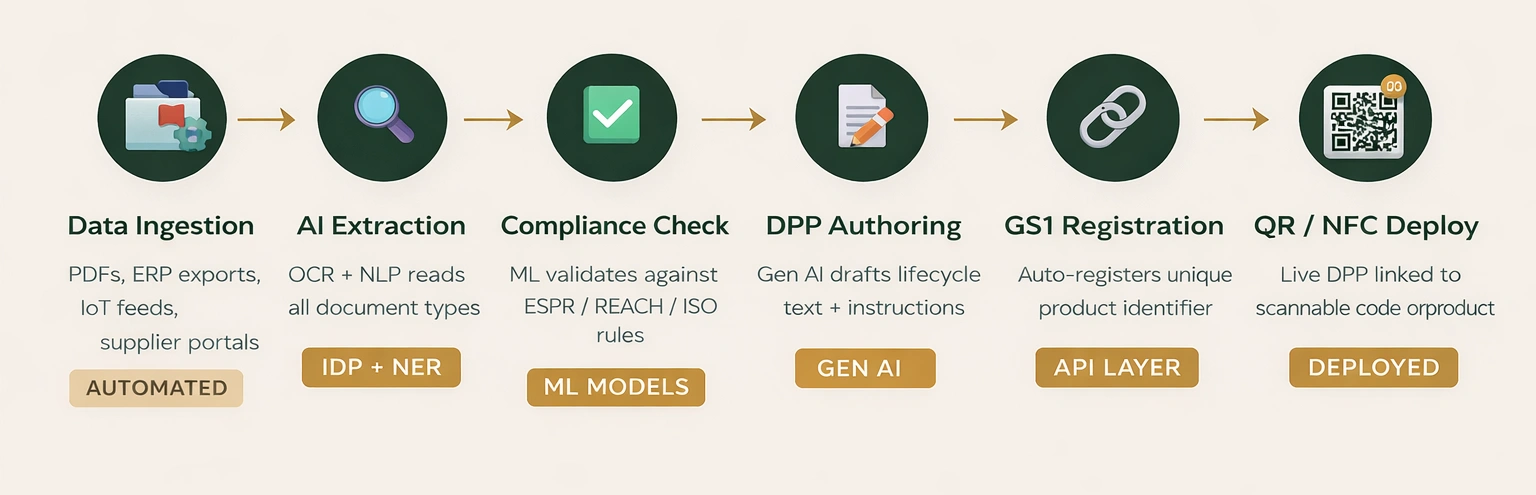
Here’s how an end-to-end AI digital product passport UK pipeline actually flows, from fragmented supplier data to a live, scannable DPP on the factory floor:

AI-Powered DPP Pipeline

The key architectural insight is this: the DPP is not a one-time document, it’s a living data asset. When a supplier changes, when a material is substituted, when a certificate expires, the AI pipeline detects the change and triggers an automatic update to the DPP. No manual re-entry. No version control nightmares. No audit risk from stale data.

What’s Behind the QR Code? The DPP’s Invisible Intelligence

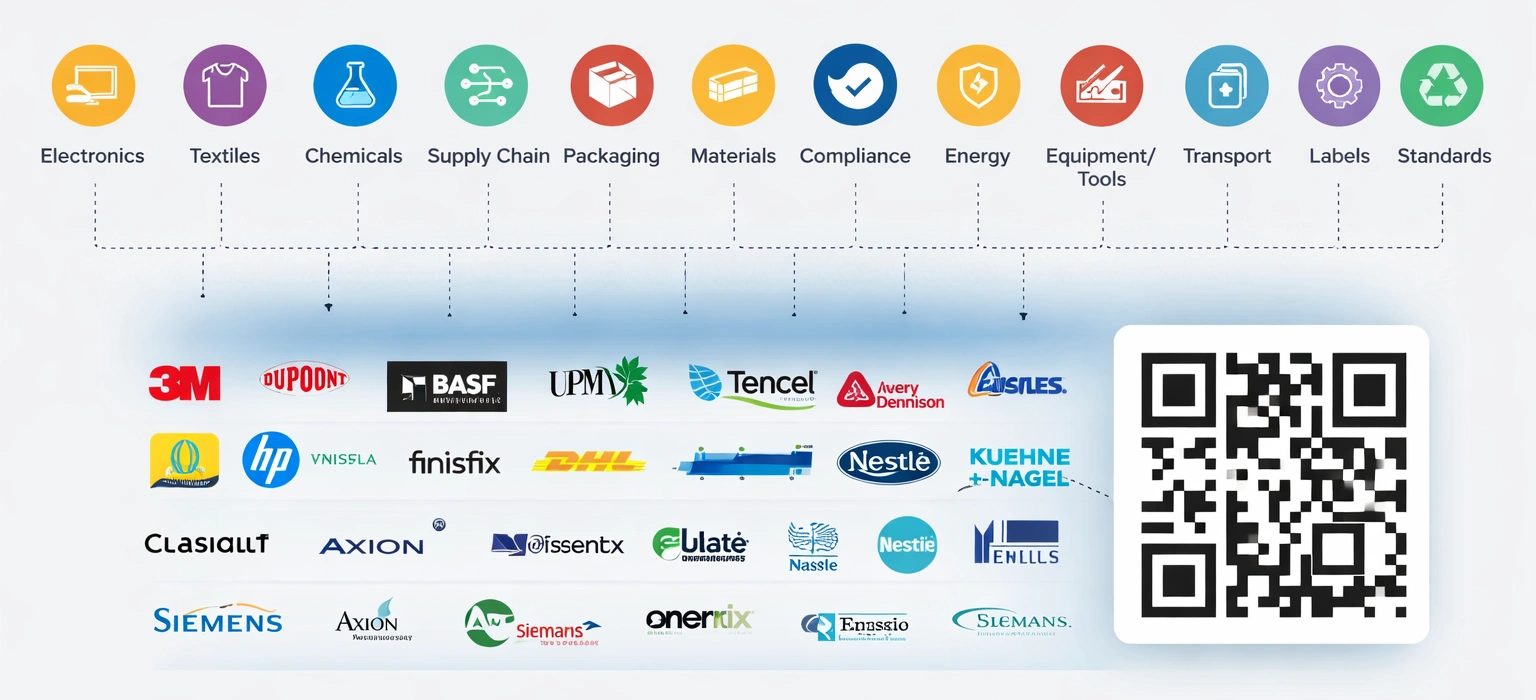
This is what the auditor sees when they scan your product. And every single data point above, maintained in real time, across thousands of products, is what AI automation makes possible. Without it, you’d need an army of data managers refreshing spreadsheets around the clock.

The GS1 Digital Link standard is what makes this scan work globally. Think of it as a URL structure that encodes the product’s GTIN (Global Trade Item Number) directly into the QR code, so any authorised system, a customs officer’s scanner in Rotterdam, a recycler’s app in Düsseldorf, a consumer’s iPhone in London, resolves to the same live DPP record. AI manages the data behind that URL. GS1 manages the address.

What UK Manufacturers Are Actually Doing – Real Examples

The UK sits in a unique position: while the government has not adopted its own domestic DPP framework, UK manufacturers exporting to the EU have no choice but to comply with ESPR. The forward-thinking ones aren’t waiting for 2027, they’re building the AI infrastructure now.

Jaguar Land Rover – AI at Scale Across 128 Sites

JLR’s ongoing Reimagine transformation is 100% underpinned by digital infrastructure that directly enables DPP-readiness. The company uses AI-powered analytics across 128 production sites to spot production anomalies in real time, and critically, this same sensor and data infrastructure feeds the carbon footprint and materials traceability data that a DPP requires.

JLR invested approximately £500 million to upgrade its Halewood plant into an all-electric facility with AI-powered operations, resulting in a daily reduction of 2.4 tonnes of CO₂, data that can be directly fed into vehicle-level DPPs.

Their commitment to zero supply chain emissions by 2039 requires exactly the kind of granular, supplier-level traceability that DPP mandates.

128

AI-monitored sites

2.4t

CO₂ saved/day at Halewood

2039

Net-zero target (supply chain)

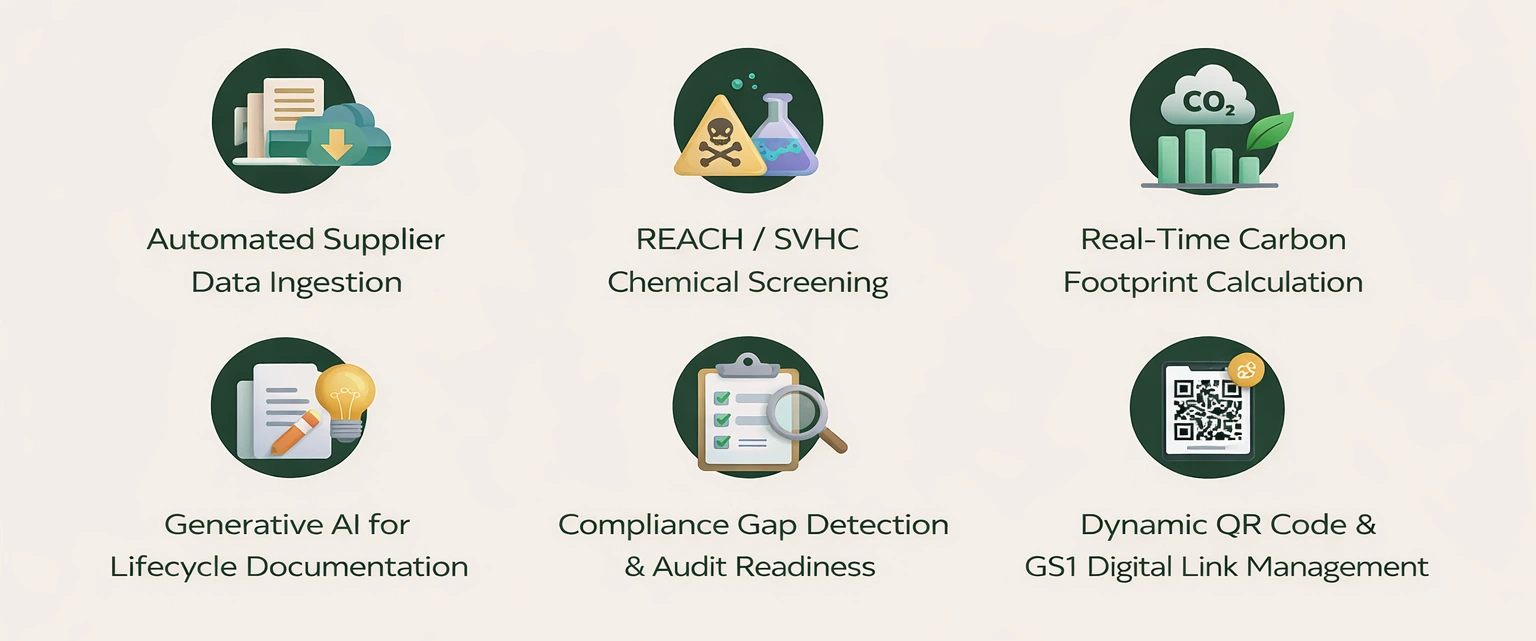
6 AI Use Cases Transforming DPP Compliance for UK Manufacturers

6 AI Use Cases Transforming DPP Compliance

Automated Supplier Data Ingestion

AI agents connect with supplier portals, email systems, and ERPs to automatically pull updated certificates, SDS sheets, and material data in real time. This removes manual follow-ups and ensures DPP data stays accurate and up to date.

This is what gives UK manufacturers who adopt DPP early a clear advantage in EU markets, as explained in Why UK Manufacturers Who Adopt DPP Early Will Dominate EU Markets by 2027.

REACH / SVHC Chemical Screening

Every material composition extracted from supplier documents is automatically cross-checked against the ECHA SVHC candidate list and REACH Annex XIV. Any substance of concern triggers an immediate alert, before it becomes a compliance violation.

Real-Time Carbon Footprint Calculation

AI models pull energy consumption data from IoT sensors and MES systems, combine with emission factors and transport data from your ERP, and calculate a product-level carbon footprint per batch, automatically feeding the DPP’s environmental data fields.

Generative AI for Lifecycle Documentation

LLMs trained on product specs, design documents, and regulatory templates automatically draft recycling instructions, repairability guides, and end-of-life handling documentation in all 24 EU languages, eliminating weeks of manual effort per product category.

This ensures that every Digital Product Passport is consistently structured, compliant, and ready for seamless sharing across regulators, partners, and markets.

Compliance Gap Detection & Audit Readiness

ML models continuously scan your DPP data layer for missing fields, expired certificates, batch-number mismatches, and data quality issues, surfacing gaps before an EU regulator does. Think of it as a 24/7 internal compliance auditor that never sleeps.

Dynamic QR Code & GS1 Digital Link Management

When any underlying DPP data changes, a supplier update, a material substitution, a new test result, AI automatically updates the linked DPP record and validates that the QR/NFC code still resolves correctly. No downtime, no reprint, no compliance gap.


From Regulation to Reinvention: Why DPP Changes Everything

Digital Product Passports are not just another compliance requirement. They are quietly reshaping how products are created, tracked, and experienced across their entire lifecycle. What once stayed hidden inside supply chains is now becoming visible, structured, and continuously updated.

For UK manufacturers and global brands, this shift means moving from static product information to living, data-driven assets. Every product starts carrying its own history, from raw materials to repairs, ownership, and sustainability impact. This is where compliance turns into opportunity.

The Tier-2 Supplier Problem: Why AI Is the Only Scalable Answer

“The DPP is only as good as its weakest supply chain link. If your tier-3 cotton supplier can’t tell you the pesticide residue levels, your DPP is non-compliant, no matter how sophisticated your internal systems are.”

This is the part that keeps operations directors up at night. DPP requires transparency not just within your four walls, but across your entire supply chain, including suppliers who may be operating in regions with limited digital infrastructure, who communicate in different languages, and who have never heard of ESPR.

AI doesn’t make your suppliers more sophisticated. But it does make extracting usable compliance data from imperfect supplier inputs dramatically more robust. Here’s specifically how:

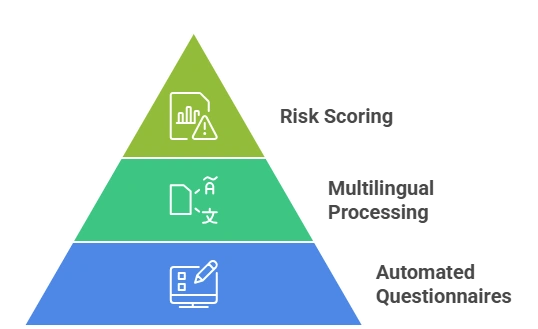
AI-Powered Supplier Onboarding for DPP

Automated questionnaire generation: AI systems analyse the Digital Product Passport requirements for each product category and auto-generate supplier-specific data collection forms, asking only the questions relevant to that supplier’s tier and material contribution. This dramatically reduces the burden on small suppliers while ensuring DPP-relevant data is captured.

Multilingual document processing: If your Portuguese steel supplier sends you a material declaration in Portuguese, your Vietnamese electronics sub-assembler sends a certificate in Vietnamese, and your Yorkshire machinist sends a handwritten note, modern IDP systems handle all three, extracting structured data regardless of language or format. The IDP market is growing at a 28.9% CAGR precisely because this capability is mature and commercially viable.

AI-driven supplier risk scoring: ML models continuously monitor supplier performance against DPP data obligations, tracking on-time data delivery rates, data quality scores, and compliance gap frequencies. High-risk suppliers are flagged proactively, so your compliance team focuses intervention where it’s needed rather than managing the noise across 200+ supplier relationships.

17% of DataMatrix codes failed to scan under normal conditions in EU pilot programmes

EU pilots across Germany, Denmark, and Belgium in 2024–2025 found that batch-number mismatches occurred in 8% of cases. The EU threshold for readability is 98%. AI-powered label verification and inline scanning systems are critical to meeting this bar.

A Practical AI DPP Implementation Roadmap for UK Manufacturers

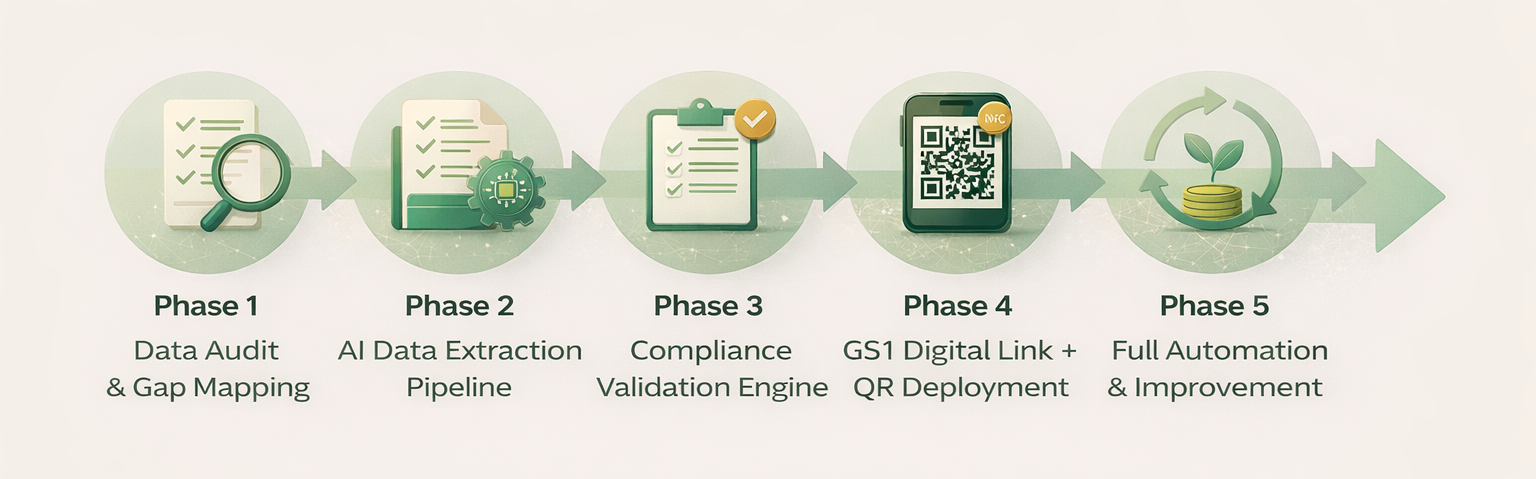
The complexity of full DPP automation can feel overwhelming, especially for SMEs. But the right approach is phased, building capability incrementally while delivering early compliance wins:

Phase 1: Data Audit and Gap Mapping

Before any AI tooling, you need to know what DPP data you already have, where it lives, and what’s missing. Conduct a data audit across your ERP, PLM, MES, and supplier records. Map each DPP required field to its current data source.

Quantify the gaps. This phase should involve your engineering, procurement, and compliance teams together, and it will almost certainly reveal that you already have 60–70% of the required data, just in non-standardised formats that AI can normalise.

Phase 2: AI Data Extraction Pipeline 

Deploy an IDP layer, typically integrated with your existing document management system — to begin ingesting and extracting structured data from supplier documents. Prioritise your highest-volume, highest-risk product categories first.

Configure NLP models to recognise the specific material, chemical, and certification terminology relevant to your sector. Validate accuracy against a set of manually verified test documents before full deployment.

Phase 3: Compliance Validation Engine 

Integrate ML validation models against ESPR requirements, REACH databases, and your product-specific regulatory obligations. Configure automated gap alerts. Begin populating DPP records for pilot products and test with a small subset of EU buyers or regulatory simulators.

Phase 4: GS1 Digital Link + QR Deployment 

Register products with GS1 and generate DPP-linked QR / NFC codes. Integrate QR verification into your production line. Deploy consumer-facing DPP viewer for pilot products. Test resolution across multiple device types and markets.

Phase 5: Full Automation + Continuous Improvement 

Scale across full product catalogue. Integrate generative AI for automated DPP text authoring. Connect DPP data layer to CSRD and ESG reporting workflows. Begin exploring circular economy monetisation models enabled by DPP data richness.

Azilen’s Engineering Blueprint: Turning DPP Compliance Into Competitive Advantage

Digital Product Passport gaps rarely happen due to lack of intent. They happen because compliance is treated as a final layer, added onto systems that were never designed for structured product data, traceability, or real-time visibility.

For UK manufacturers exporting to the EU, this creates a clear risk. DPP is not a document to generate at the end. It is a system-level capability that must exist from the start.

Azilen approaches DPP differently.

As a digital transformation partner, Azilen works with manufacturers, retailers, and consumer brands to build technology foundations that align with Digital Product Passport requirements from day one. The focus remains clear, design systems that support compliance, scalability, and EU readiness without repeated fixes or rework.

Instead of reacting to regulation, Azilen enables businesses to build the DPP early adopter advantage UK directly into their core systems.

🔧 How Azilen Engineers DPP-Ready Systems

DPP-Aligned Data Architecture: Product, material, and lifecycle data is structured at the source. This creates a strong foundation for EU compliance while ensuring consistency and scalability across all product lines.

Digital Passport Platform Development: A centralised platform is built to manage, store, and share Digital Product Passport data through QR codes and digital links, ensuring seamless access for regulators, partners, and customers.

ERP, PLM, and Supply Chain Integration: Existing systems are connected to enable real-time data flow. This removes manual dependency and ensures product data remains accurate and continuously updated.

AI-Driven Data and Compliance Automation: AI workflows extract, validate, and update product data from multiple sources. This reduces operational effort, improves accuracy, and supports continuous compliance.

Lifecycle Traceability Enablement: Systems are designed to capture full lifecycle data—from production to repair, reuse, and recycling, supporting circular economy requirements and emerging business models.

EU-Ready Infrastructure and Regulatory Alignment: Platforms are built to align with EU data, hosting, and regulatory frameworks, ensuring long-term compliance as requirements evolve.

DPP is not an add-on. With the right engineering approach, it becomes the foundation for scalable compliance, operational efficiency, and long-term success in the EU market.

FAQs: Building AI DPP Solutions for UK Manufacturers

1. What is a Digital Product Passport (DPP) and why is it important for UK manufacturers?

A Digital Product Passport (DPP) is a digital record that stores detailed information about a product’s materials, lifecycle, sustainability, and compliance. For UK manufacturers exporting to the EU, DPP is becoming mandatory under upcoming regulations.

It helps improve traceability, transparency, and sustainability reporting, while also enabling better supply chain visibility and long-term compliance with evolving EU requirements.

2. How is AI used in Digital Product Passport (DPP) compliance?

AI helps automate key parts of DPP compliance by extracting product data from documents, validating it against regulations, and continuously updating it across systems. It reduces manual effort, improves accuracy, and ensures real-time compliance.

AI also supports predictive insights, such as identifying compliance risks or missing data, making DPP management faster, scalable, and more reliable for manufacturers.

3. When will Digital Product Passports become mandatory in the UK and EU?

Digital Product Passports are expected to roll out across the EU starting from 2026–2027 under the Ecodesign for Sustainable Products Regulation (ESPR). While the UK may follow its own timeline, manufacturers exporting to the EU must comply with these requirements.

Preparing early helps businesses avoid disruption, ensure smooth market access, and stay ahead of regulatory changes.

4. What challenges do UK manufacturers face in implementing DPP?

The biggest challenge is managing complex and scattered product data across multiple systems and suppliers. Many manufacturers rely on manual processes, disconnected ERP or supply chain systems, and unstructured documents.

This makes it difficult to ensure accuracy, traceability, and compliance. Without the right digital infrastructure, DPP implementation becomes time-consuming, error-prone, and difficult to scale.

5. How can UK manufacturers prepare for Digital Product Passport compliance?

Preparation starts with building a strong data foundation. Manufacturers should structure product and supply chain data, integrate existing systems, and adopt AI-driven automation for data extraction and validation.

Investing in a centralised Digital Product Passport platform helps manage compliance efficiently. Starting early allows businesses to reduce risk, improve operational efficiency, and gain a competitive advantage in the EU market.

Glossary

Digital Product Passport (DPP): A digital record that stores detailed product data such as materials, lifecycle, sustainability, and compliance information, accessible through a QR code or digital link.

Artificial Intelligence (AI): Technology that enables systems to analyse data, automate processes, and make decisions, helping manufacturers manage DPP compliance more efficiently.

Ecodesign for Sustainable Products Regulation (ESPR): An EU regulation that introduces Digital Product Passports and sets sustainability and data requirements for products sold in the European market.

Supply Chain Traceability: The ability to track and verify product data across all stages of the supply chain, from raw materials to final delivery.

Lifecycle Data: Information related to a product’s entire journey, including production, usage, repair, reuse, and end-of-life processes.

GS1 Digital Link: A standard that connects physical products to digital information through QR codes, enabling access to DPP data.

QR Code (Quick Response Code): A scannable code placed on a product that links to its Digital Product Passport and other digital information.

REACH Regulation: An EU regulation that controls the use of chemicals and ensures safety by tracking substances of concern in products.

SVHC (Substances of Very High Concern): Hazardous chemicals identified under REACH that require monitoring and disclosure in product data.

Carbon Footprint: The total greenhouse gas emissions associated with a product across its lifecycle, used for sustainability reporting.

Lifecycle Assessment (LCA): A method used to measure the environmental impact of a product from raw material extraction to disposal.

ERP (Enterprise Resource Planning): Software systems used by manufacturers to manage business processes such as inventory, production, and finance.

PLM (Product Lifecycle Management): Systems used to manage product data, design, and lifecycle information from development to disposal.

IoT (Internet of Things): Connected devices and sensors that collect real-time data from machines and processes, supporting accurate DPP data.

Data Ingestion: The process of collecting and importing data from multiple sources into a central system for analysis and use.

Compliance Automation: The use of AI and digital systems to automatically manage, validate, and update regulatory requirements.

Digital Twin: A virtual representation of a physical product that tracks its data, performance, and lifecycle in real time.

Circular Economy Compliance: Ensuring products meet sustainability requirements related to reuse, recycling, and reduced environmental impact.

Kulmohan Makhija
Kulmohan Makhija
Vice President – Growth & Enterprise Strategy

Kulmohan Makhija is an enterprise technology and business strategy writer with over 12 years of experience analyzing digital transformation across global and European markets. His work focuses on applied artificial intelligence, product engineering, enterprise architecture, and large-scale legacy modernization. He explores how complex organizations modernize core systems, adopt AI responsibly, and align innovation with regulatory, cultural, and operational realities — particularly within the UK and broader European technology landscape. With a pragmatic enterprise perspective, Kulmohan emphasizes transformation that delivers measurable impact without disrupting mission-critical operations. His writing bridges executive strategy with technical depth, providing clarity for technology leaders, product teams, and decision-makers navigating modernization journeys.

Related Insights