

Skip to content

How to Turn Compliance into UK Customer Loyalty with DPP Integration Services

Featured Image

Executive Summary

The impending roll-out of the EU and UK Digital Product Passport (DPP) regulations presents a critical strategic fork in the road for enterprise leaders. Treating DPP as a standard regulatory checkbox creates a permanent cost center that strains existing ERP, PLM, and supply chain management systems. Conversely, viewing the passport as a direct, unmediated communication channel with the end consumer transforms a legal requirement into a distinct competitive advantage.

This deep-dive blog outlines how dedicated DPP integration services bridge the gap between fragmented back-end operational data and front-end consumer experiences. By harmonizing raw material provenance, carbon footprint tracking, and circular economy lifecycles into accessible customer touchpoints, businesses can systematically cultivate trust and lifetime brand loyalty. We explore the architectural mechanics of these integration services, quantify the commercial benefits of data transparency, and provide a clear roadmap for UK brands looking to turn compliance liabilities into highly qualified growth opportunities.

Right now, in boardrooms across the UK, compliance teams are staring down a logistical nightmare. The European Union’s Ecodesign for Sustainable Products Regulation (ESPR) is moving from policy draft to concrete enforcement. For any UK business that manufactures, sells, or exports goods into Europe, the mandate is clear: you must soon provide a Digital Product Passport (DPP) for every product you place on the market.

The immediate reaction from most operations leaders is pure frustration. It feels like yet another expensive, bureaucratic hurdle dropped onto an already strained supply chain. To comply, your teams have to track down raw material origins from uncooperative tier-two suppliers, extract carbon data from siloed legacy systems, and figure out how to securely store and share hundreds of data points per item.

“Businesses shouldn’t think about digital product passports as a legal requirement, even if it is. Translate legal language into information that customers can understand and appreciate. Think of it as an extension of your marketing.” – Shep Hyken, Customer Service & Experience Expert, Author

If you treat this strictly as an administrative box to check, it will be exactly that: a permanent cost center that drains your resources without adding a single penny to your bottom line. You will spend months stitching together fragmented data pools just to print a sterile barcode on a label that your customers will completely ignore.

But there is a much smarter way to play this hand.

The exact same infrastructure required to satisfy a regulatory inspector can be leveraged to build the most impactful customer loyalty engine your brand has seen in a decade. By utilizing professional DPP integration services, you can transform a forced regulatory burden into a transparent, interactive experience that captures customer trust and drives repeat business.

Why is Your Product Data Trapped in Silos?

The real pain of DPP compliance isn’t the regulation itself; it’s the chaotic state of modern enterprise data. Your sustainability metrics live in a spreadsheet owned by an outsourced consultant. Your raw material origins sit in a vendor’s legacy ERP system. Your logistics and shipping data are locked inside a third-party warehouse management platform.

Trying to manually compile this information for thousands of SKUs is a recipe for operational gridlock. This is where specialized DPP integration services become essential. They act as the intelligent connective tissue that unifies these isolated systems, pulling data smoothly into a single, compliant source of truth.

“Brands that start preparing now will define the future of compliance and circularity. By the time regulations go live, it will be too late to build the digital backbone needed to comply and compete.” – Shameek Ghosh, Co-Founder & CEO, TrusTrace

89%

of operations leaders admit their tech ROI haven’t fully delivered

87%

explicitly blame poor data quality and fragmentation for stalling their digital initiatives

70%

of firms cite supplier data silos as their top barrier to compliance

92%

of supply chain stakeholders have fundamentally insufficient or inaccessible data

Sources: Surveys by PwC, KPMG, and CIRPASS-2 Consortium

DPP integration services - Talk to our Experts

How DPP Integration Services Turn Raw Data into Loyalty

When you bridge those data gaps, something powerful happens. The passport ceases to be a dry compliance document and becomes a direct, unmediated communication channel with your customer.

Modern UK consumers are deeply cynical about corporate sustainability. Vague marketing buzzwords like “eco-friendly” or “responsibly sourced” no longer move the needle; in fact, they often trigger skepticism. According to data from Deloitte, nearly a third of consumers have actively walked away from brands due to ethical or environmental doubts. They want proof.

An integrated DPP gives them that proof instantly. When a customer scans your product in a retail aisle or at home, they shouldn’t just see a government compliance checklist. They should see an elegant, branded interface that tells the true story of that specific item:

• Verifiable Provenance: Show them the exact, certified facility where the fabric was woven or the components were assembled.

• Interactive Impact Metrics: Translate dry carbon calculations into clear, relatable data points showing the resources saved during production.

• Circular Lifecycle Guides: Give them hyper-local instructions on how to repair, upgrade, or eventually trade the item back to you for store credit.

This level of radical transparency dismantles consumer skepticism. It transforms a routine purchase into an active partnership built on verifiable trust.

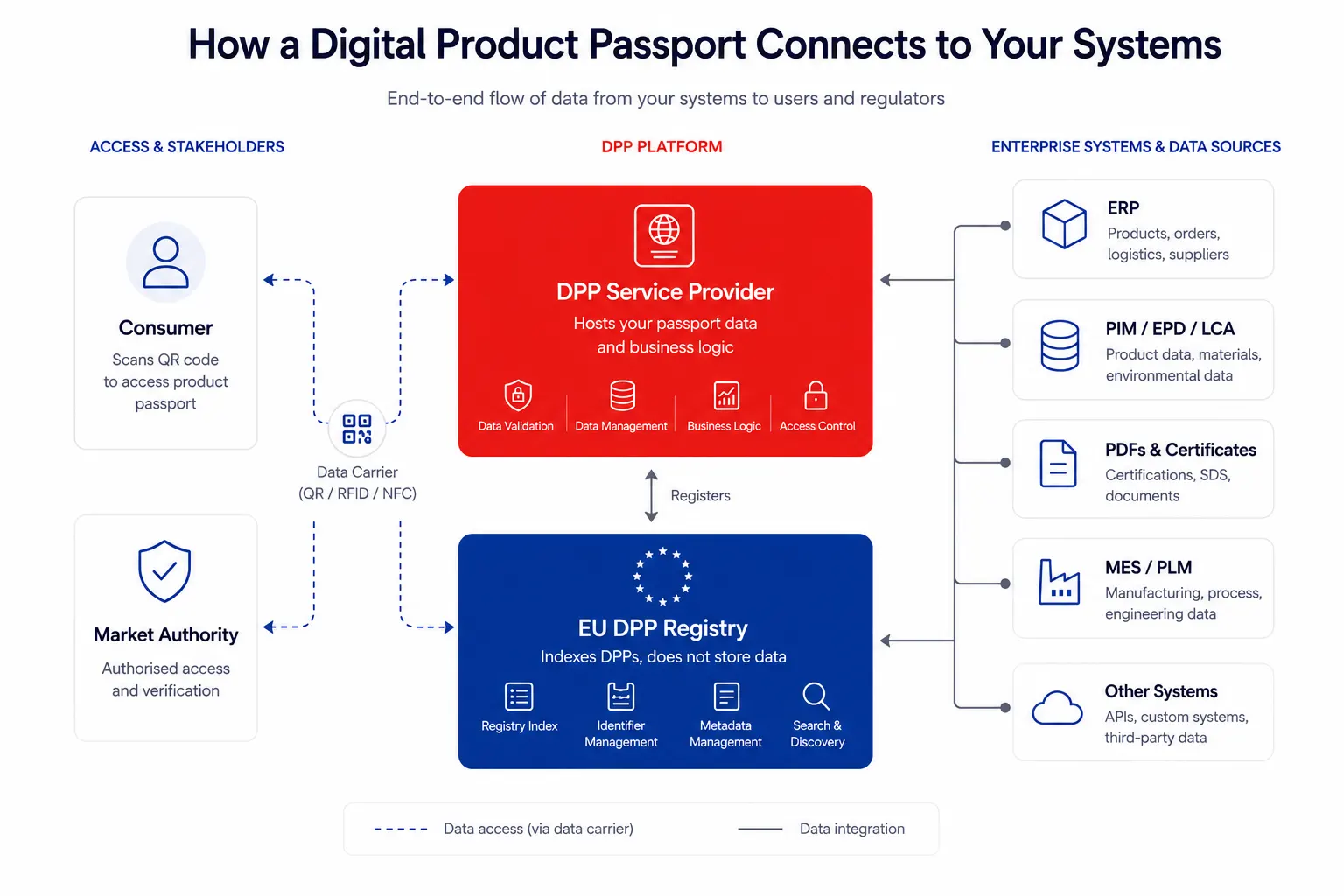
DPP integration services - system connectors

The Structural Anatomy of a DPP Integration Solution

A professional integration service does not require you to rip out and replace your existing software stack. Instead, it deploys a specialized middleware layer designed to handle the heavy lifting:

  1. Automated Extraction: Secure APIs connect directly to your existing ERP, PLM, and SCM software to pull relevant data automatically, eliminating manual entry errors.

  2. Harmonisation: The system cleanses and structures inconsistent data formats sent by global suppliers, ensuring everything aligns with official regulatory standards.

  3. Dynamic Publishing: Rather than creating a static, unchangeable file, the platform generates a dynamic digital twin for each product batch, allowing updates if a recycling partner changes or a warranty is extended.

  4. Experience Delivery: The validated data is pushed directly to a mobile-optimized web application, ready for the consumer the moment they scan the product’s QR code or NFC tag.

From Compliance Expense to Revenue Generator

By treating the DPP as a core customer touchpoint, you turn a regulatory mandate into a highly effective lead-generation and retention tool. The digital passport app becomes the perfect place to embed strategic calls to action.

Once a customer scans the code and confirms the product’s authentic, sustainable origins, you have their undivided attention. Right there in the interface, you can allow them to register their product warranty with a single click, opt-in to your brand’s insider loyalty program, or discover complementary accessories.

The businesses that scramble at the last minute will end up paying the full price of compliance without getting any of the business benefits. The brands that invest early in robust integration services will build a foundation that satisfies regulators, streamlines operations, and locks in long-term customer loyalty.

What is the Cost of Inaction vs. Early Adoption?

Enterprise leaders rarely buy enterprise software just to be green; they buy it to manage structural risk or unlock market share. When evaluating DPP integration services, the financial delta between waiting until the final regulatory deadline and moving early is stark.

DPP cost comparison
Strategic Metric
The Inaction / Panic Approach (2027 Deadline)
The Early Adopter Approach (Immediate Deployment)
Implementation Cost Premium implementation fees driven by rushed engineering timelines, emergency consulting, and chaotic legacy system patches. Phased, cost-optimized deployment spread across standard IT roadmaps with room for iterations.
B2B Procurement Advantage Disqualification from European and Tier 1 UK enterprise supply chains that demand upfront sustainability criteria. Preferred vendor status. Ability to leverage certified, ready-to-go DPP data to win high-value commercial tenders right now.
Market Position Defensive. Scrambling to catch up with industry leaders while trying to navigate sudden operational gridlocks. Offensive. Reaping the rewards of data transparency and capturing customer loyalty long before competitors launch their portals.

For most UK enterprises, particularly in manufacturing, FinTech, and supply chain, brownfield is not the compromise option. Rather, it is the strategically superior choice.

What are Some of the Real-World Blueprints for DPP Integration in Action?

To understand how this looks in practice, we must look beyond abstract code and look at actual industry applications. Different sectors face unique data bottlenecks, but professional integration services unlock tailored commercial opportunities for each.

A premium UK apparel brand faces immense pressure to prove its supply chain ethics. Their data challenges are deep, spanning raw cotton fields, spinning mills, dye houses, and garment factories.

  • The Integration Solution: APIs automatically aggregate Tier 4 agricultural certificates and Tier 2 chemical compliance records from fragmented overseas suppliers into a single middleware layer.

  • The Loyalty Play: When a customer scans a coat’s interior QR code, they unlock an interactive map tracing the garment’s journey from an ethical farm in Peru to a solar-powered mill in Italy. Right below the map, a secondary CTA invites the user to register for the brand’s circular “Take-Back & Repair” program, offering a 15% discount on their next purchase if they return the coat for recycling years later.

An electronics manufacturer needs to trace battery origins, rare earth minerals, and hardware components while adhering to strict right-to-repair frameworks.

  • The Integration Solution: The platform connects directly to the Product Lifecycle Management (PLM) system and dynamically generates a unique serial-number-level digital twin for every single device.

  • The Loyalty Play: Five years after purchase, a consumer scans the device’s laser-etched ID code. Instead of generic regulatory warnings, the interface displays the real-time degradation status of the internal components and provides authorized DIY repair guides. If the user decides to upgrade, an embedded button lets them instantly trade the old device back to the manufacturer, keeping the customer locked inside the brand’s product ecosystem.

How has Azilen Delivered Proven DPP Success in Production?

Deploying a real-world, scalable DPP framework requires deep expertise in system data models, enterprise systems, and interoperability layers. Here is how Azilen successfully architected and implemented enterprise-grade solutions for market leaders:

Scaling End-to-End Circular Traceability for a Netherlands Textile Manufacturer

A large European textile manufacturer needed full lifecycle traceability for recycled fabrics while adhering to strict circular economy mandates. Their operational data was heavily fragmented across processing plants and international distribution hubs.

The Integration Strategy: Azilen deployed an automated data ingestion and validation layer built on Node.js and PostgreSQL. This engine seamlessly integrated with their core legacy environment and premier supply chain management systems, including Blue Yonder (WMS) and Manhattan Associates (WMS). To guarantee an unalterable, audit-ready data lineage, a distributed ledger layer was established using Hyperledger Fabric.

The Business Impact: The system successfully unified over 60 recycling and supply chain partners into a single source of truth. It generated unique product identifiers at the source via a custom mobile app, creating automated compliance tracking for more than 1.2 million textile products annually while driving $15M+ in operational savings through optimized circular logistics.

Al-Enabled Compliance & Storefront Integration for a UK Fashion Retailer

A prominent UK-based fashion brand wanted to elevate its digital storefront by embedding verified sustainability credentials and interactive product passports directly into the customer buying journey.

The Integration Strategy: Azilen engineered a high-performance integration sitting directly on top of the client’s Salesforce Commerce Cloud (SFCC) ecosystem. Utilizing B2C Commerce APIs and OCAPI, the solution enabled a real-time data sync with the master product catalog. Behind the scenes, MuleSoft and Salesforce CRM orchestrated complex supplier attestation feeds and automated compliance verification workflows for incoming partner data.

The Business Impact: This architecture automated real-time compliance validation across a complex catalog of over 6,500+ active SKUs. The storefront dynamically deployed more than 203,000+ certified digital product passports directly to consumers, achieving an outstanding 98% compliance accuracy rate for automated, SKU-level regulatory audits.

Why Azilen Technologies Stands Out DPP Integration Serivces

As an AI-first digital transformation company in the UK, Azilen focuses on creating connected, intelligent, and future-ready technology ecosystems while preserving the systems businesses already depend on. We help organizations move beyond legacy constraints by turning existing environments into scalable, compliant infrastructure through core engineering capabilities:

Proven DPP Delivery at Scale: Brings real production experience to every engagement — from unifying 60+ recycling partners for a European textile manufacturer to deploying 203,000+ certified digital passports for a UK fashion retailer at 98% compliance accuracy.

Brownfield-First Integration: Deploys a clean middleware layer on top of your existing ERP, PLM, and SCM systems — no rip-and-replace, no operational disruption, just compliant data flowing where it needs to go.

Compliance-Grade Data Architecture: Builds verifiable, auditable, SKU-level data infrastructure that satisfies regulators today and unlocks circular business models tomorrow — from authenticated resale to warranty loyalty programs.

Regulation-Ready Adaptability: Designs rule-based data mapping schemas that evolve with ESPR delegated acts — so as mandates expand across textiles, electronics, and packaging, your integration architecture is already built to flex.

FAQs: DPP Integration Services

1. What are the concrete timelines for Digital Product Passport mandates affecting UK businesses?

Under the EU’s Ecodesign for Sustainable Products Regulation (ESPR), framework laws entered into force in mid-2024. The earliest specific product mandates, starting with industrial and electric vehicle batteries, take effect in 2027. This is followed closely by apparel, textiles, and consumer electronics by 2028-2030. Because UK enterprises exporting to the European single market must fully comply to maintain market access, implementation of data architecture updates must begin immediately.

2. How do DPP integration services handle sensitive or proprietary supplier information?

Enterprise-grade DPP integration solutions employ granular, multi-tiered data access control models. The architecture separates internal master operational data from public-facing transparency data. While regulators see verified, unredacted certifications and full supply chain links via secure keys, end consumers interact with a curated, user-friendly interface that protects proprietary supplier identities and commercial trade secrets.

3. Will implementing a DPP system require us to completely replace our legacy ERP or PLM software?

No. Professional integration services are explicitly engineered to sit on top of your existing software ecosystem. They use secure APIs, middleware connectors, and web services to systematically aggregate, extract, and format data from existing platforms like SAP, Oracle, or PTC Windchill without requiring expensive, high-risk core system replacements.

4. How can a business measure the direct ROI of an integrated, customer-facing product passport?

ROI is quantified across three primary streams: operational cost reduction, compliance penalty mitigation, and marketing performance. On the commercial side, companies track unique scan rates, session duration on the passport web app, subsequent conversion rates into warranty registrations, and repeat purchase metrics via embedded loyalty links compared to baseline non-scanning consumer segments.

5. What unique requirements do UK regulations place on digital passports compared to the EU ESPR?

While the UK continues to align closely with international eco-design standards to maintain frictionless trade with Europe, independent frameworks like the UK’s own developing circular economy and resource strategies are monitored carefully. DPP integration services utilize flexible, rule-based data mapping schemas to ensure that a single product passport can seamlessly adapt its data presentation to meet both UK and EU regulatory requirements simultaneously.

Kulmohan Makhija
Kulmohan Makhija
Vice President – Growth & Enterprise Strategy

Kulmohan Makhija is an enterprise technology and business strategy writer with over 12 years of experience analyzing digital transformation across global and European markets. His work focuses on applied artificial intelligence, product engineering, enterprise architecture, and large-scale legacy modernization. He explores how complex organizations modernize core systems, adopt AI responsibly, and align innovation with regulatory, cultural, and operational realities — particularly within the UK and broader European technology landscape. With a pragmatic enterprise perspective, Kulmohan emphasizes transformation that delivers measurable impact without disrupting mission-critical operations. His writing bridges executive strategy with technical depth, providing clarity for technology leaders, product teams, and decision-makers navigating modernization journeys.

Related Insights