


Skip to content

Digital Transformation Roadmap for 2026: 5 Easy Implementation Steps

Featured Image

Executive Summary

Are you getting a measurable return on your digital transformation spend, or are you just funding expensive software upgrades?

Most enterprise modernizations fall flat. The problem is rarely broken code or faulty software. Projects fail because leadership treats digital transformation as a simple IT installation instead of a fundamental shift in how the business operates.

This guide breaks down the real reasons digital transformation projects stall and presents a practical, 5-step execution roadmap for 2026. By aligning executive strategy, decoupling legacy architectures, automating core processes, prioritizing customer touchpoints, and embedding continuous innovation, UK enterprises can replace costly technical debt with high-yielding digital assets.

Every boardroom presentation in 2026 includes a slide on digital acceleration. Technology budgets are expanding, cloud migration is nearly universal, and artificial intelligence dominates executive agendas. Yet, behind the polished strategy decks lies an uncomfortable operational truth: most digital initiatives bleed capital without changing how the business actually performs.

For UK small and mid-sized enterprises (SMEs), transformation is a heavy lift. It typically spans 1 to 3 years and demands an investment equal to 4% to 6% of annual revenue. That represents a massive commitment of operational capital.

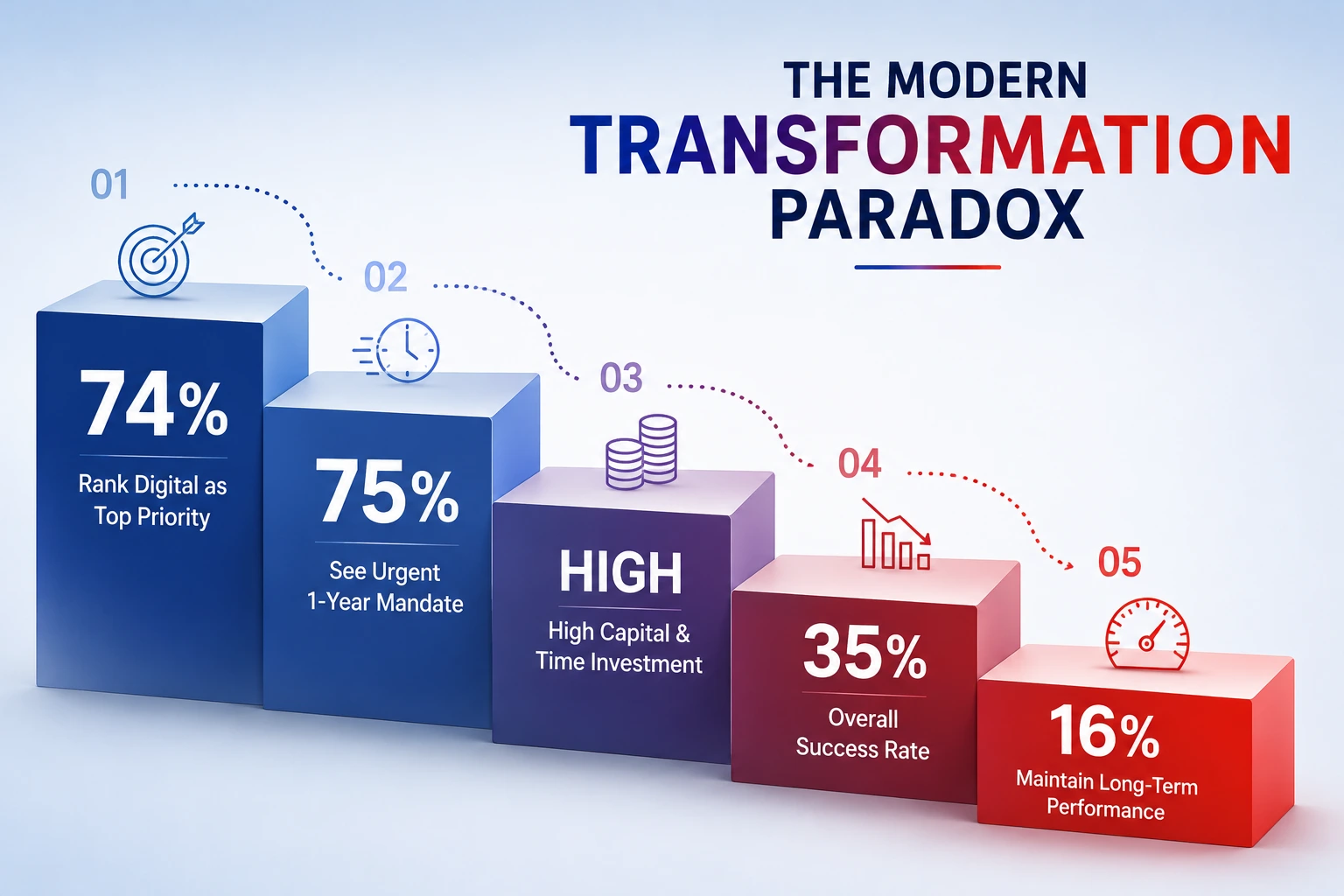
Across the global market, 74% of organizations now rank digital transformation among their top strategic priorities. Furthermore, 75% of business leaders believe that investing in digital transformation is essential within the next year to remain competitive, according to research by PwC.
Why, then, do so many enterprise projects collapse under their own weight?

The Root Cause: Why Enterprise Digital Initiatives Stall

Despite soaring adoption rates, market statistics paint a sobering picture. Only 35% of digital transformation initiatives achieve true success, and a mere 16% of organizations report sustained performance improvements afterward, according to research from Market.us.

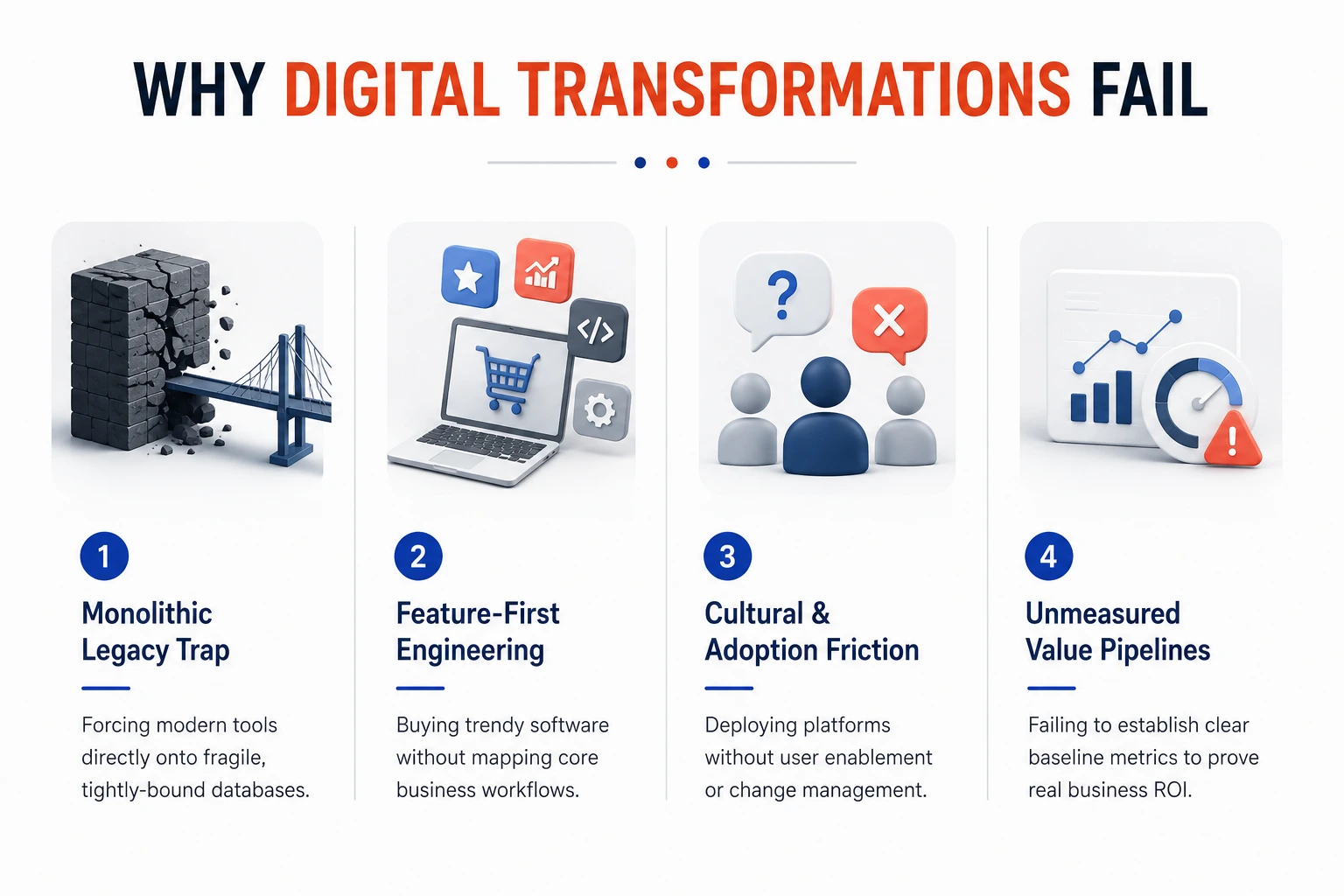
This struggle is structural. McKinsey & Company notes that only 30% of transformation efforts succeed overall, observing that digital transformations are inherently harder to execute than traditional organizational change.Why digital transformation fail

When projects break down, leaders often point fingers at vendor selection or software bugs. In reality, modernizations hit walls because enterprises force shiny digital interfaces directly on top of brittle legacy backends, creating complex integration bottlenecks.

To break this pattern, forward-thinking UK companies are abandoning broad “rip-and-replace” overhauls in favor of a structured, phased methodology.

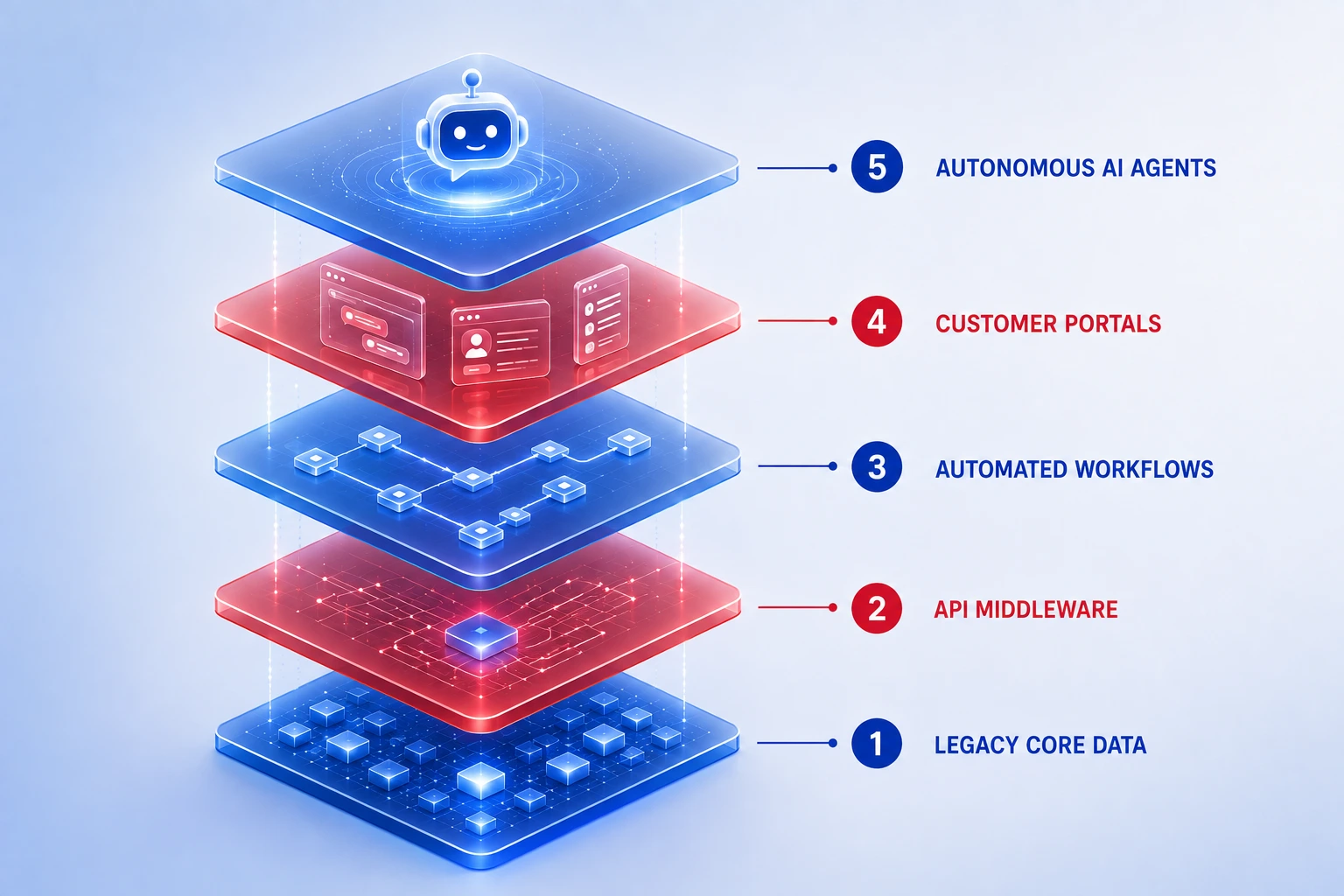
Visualizing the 2026 Transformation Architecture

Rather than treating modern software deployment as a simple linear pipeline, resilient organizations build a layered, interconnected digital engine where every operational component reinforces the next.


5 Execution Steps for a Successful Digital Roadmap

Achieving measurable value requires systematically de-risking your technology investment. Here is how leading enterprise engineering teams structure their digital transformation programs.

Step 1: Digital Strategy & Executive Alignment

A digital roadmap should never begin with software features. It starts with clear operational outcomes.

Before committing engineering resources, leadership must define the specific operational bottlenecks to solve, whether that means cutting customer onboarding times by half or reducing manual data entry costs across supply chains.

• Audit Core Capabilities: Map existing software assets, data pipelines, and technical debt before writing new code.

• Prioritize High-Yield Use Cases: Focus capital on digital workflows that directly drive EBITDA or lower operating overhead.

• Define Value Metrics: Establish quantifiable metrics (such as order processing speed or error reductions) to assess progress continuously.

Step 2: Decoupled Legacy System Modernization

Attempts to replace core enterprise platforms in a single “big bang” release carry unacceptable risk. Modern engineering relies on legacy decoupling.

By using lightweight API middleware, organizations extract data from legacy ERPs, MES logs, and mainframes without taking core systems offline.

• Abstract Core Data: Build secure API adapters around legacy databases to expose critical records without changing underlying base code.

• Migrate to Cloud Microservices: Gradually transition isolated business functions into scalable, cloud-native services.

• Protect Commercial Logic: Retain validated business rules while creating flexible modern frontends around them.

Step 3: Process Digitization & Workflow Automation

Once legacy databases are safely accessible via APIs, focus shifts to streamlining manual internal operations.

In many UK mid-market firms, operational speed stalls when staff spend hours copying data across disconnected spreadsheets, PDF invoices, and email threads.

• Automate Manual Touchpoints: Deploy intelligent document processing (IDP) and automated data pipelines to eliminate administrative overhead.

• Break Down Operational Silos: Connect disparate department platforms so data flows seamlessly between sales, operations, and finance teams.

• Implement Role-Based Controls: Enforce security policies and access rules across all automated workflows.

Step 4: Customer-Centric Experience Transformation

Internal efficiency sets the baseline, but market growth comes from delivering exceptional, friction-free experiences to your customers.

Modern customer portals and mobile applications must pull real-time data directly from your digitized back-end systems to provide transparent, self-service capabilities.

• Unify Customer Data: Consolidate customer records into a single, real-time repository to power personalized interactions.

• Build Intuitive Portals: Design responsive, accessible web and mobile portals tailored to user needs.

• Shorten Service Cycles: Empower end users to resolve queries, update accounts, and complete transactions independently.

Step 5: Innovation as a Service (AI & Advanced Analytics)

• Deploy Context-Aware AI Agents: Implement intelligent software agents that handle routine support requests, forecast demand, and flag operational anomalies.

• Unlocks Predictive Insights: Shift from historical reporting to forward-looking predictive analytics that guide strategic decision-making.

• Maintain Continuous Delivery: Treat digital transformation as an ongoing, evolving capability rather than a static project with an end date.

Thought Leadership: What the Experts Say

“The primary differentiator between successful digital initiatives and failed software investments is architectural discipline. Companies that decouple their legacy platforms before scaling modern applications achieve far higher operational efficiency.”

Gartner Research Insights on Enterprise Architecture

“Digital transformation is not a technical upgrade; it is an operating model transformation. Organizations that align culture, process engineering, and API integration see significantly higher returns on their technology spend.”

Deloitte Insights on Technology Leadership

Choose Azilen Technologies for Your Digital Product Passport Journey

With 17+ years of experience delivering enterprise digital transformation solutions, Azilen Technologies helps tyre manufacturers build the data, integration, and traceability capabilities needed for successful Digital Product Passport (DPP) implementation.

Digital Strategy & Consulting: Aligning business goals with viable technical roadmaps, evaluating architectural health, and defining clear ROI frameworks.

→ Legacy System Modernization: Refactoring monolithic systems into modern microservices, protecting core business logic, and eliminating technical debt without operational downtime.

→ Process Digitization: Automating complex, document-heavy workflows with custom middleware and intelligent data pipelines.

→ Customer-Centric Transformation: Designing experience-led web and mobile platforms powered by unified, real-time back-end data architectures.

→ Innovation as a Service: Helping enterprise teams safely prototype, test, and deploy enterprise AI capabilities, autonomous agents, and predictive analytics.

FAQs: Digital Transformation Costs

1. How long does a typical digital transformation take for a UK business?

For most UK mid-market firms and SMEs, a comprehensive digital transformation spans 1 to 3 years. However, taking an agile, phased approach yields initial production releases and measurable operational value within 3 to 6 months.

2. Why do 70% of digital transformation projects fail to hit their goals?

Transformations stall when companies treat software upgrades as quick IT projects rather than fundamental business shifts. Common failure drivers include attempting high-risk system overhauls all at once, ignoring legacy technical debt, and neglecting organizational change management.

3. How much should a UK business budget for digital transformation?

Industry benchmarks show that UK SMEs typically invest 4% to 6% of annual revenue into transformation initiatives over a multi-year roadmap. Budget allocations should be divided across software engineering, legacy data integration, change enablement, and security governance.

4. What is legacy decoupling, and why is it important?

Legacy decoupling involves placing a modern API middleware layer between old core databases (like mainframes or custom ERPs) and modern cloud applications. This allows companies to build fast, modern interfaces and automate workflows without undergoing expensive, risky system replacements.

5. How does Azilen ensure digital transformation projects deliver ROI?

Azilen applies an outcome-focused, risk-mitigated delivery model. By conducting thorough architectural audits, deploying decoupled integration middleware, and executing in transparent 90-day sprints, we keep projects on schedule, within budget, and aligned with measurable business metrics.

Kulmohan Makhija
Kulmohan Makhija
Vice President – Growth & Enterprise Strategy

Kulmohan Makhija is an enterprise technology and business strategy writer with over 12 years of experience analyzing digital transformation across global and European markets. His work focuses on applied artificial intelligence, product engineering, enterprise architecture, and large-scale legacy modernization. He explores how complex organizations modernize core systems, adopt AI responsibly, and align innovation with regulatory, cultural, and operational realities — particularly within the UK and broader European technology landscape. With a pragmatic enterprise perspective, Kulmohan emphasizes transformation that delivers measurable impact without disrupting mission-critical operations. His writing bridges executive strategy with technical depth, providing clarity for technology leaders, product teams, and decision-makers navigating modernization journeys.

Related Insights