
Skip to content

How Do You Build an Evidence Trail for Every Sustainability Claim with a Digital Product Passport?

Featured Image

Executive Summary

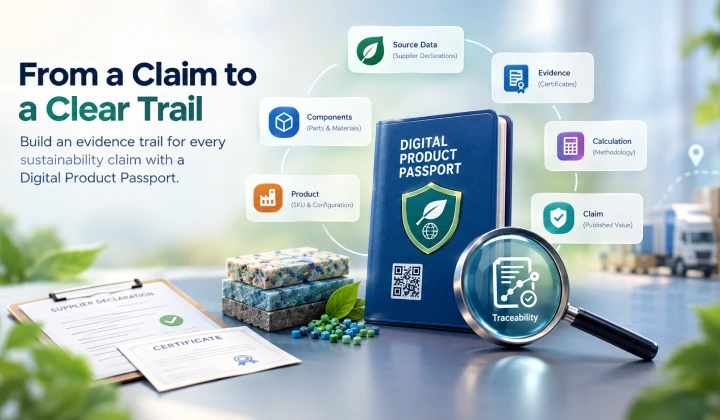
A Digital Product Passport (DPP) can create an evidence trail for sustainability claims by connecting each claim to its underlying product data, source information, supporting evidence, calculations, and verification records. This creates a traceable link between a product’s sustainability attributes and the data used to substantiate them.

For manufacturers, this evidence trail makes sustainability claims easier to validate, monitor, and update across the product lifecycle. It also helps organizations trace changes in supplier data, product composition, certifications, or calculations back to the claims and products they affect.

A Digital Product Passport can tell you that a product contains 40% recycled material.

But can it tell you why?

That distinction is becoming increasingly important for manufacturers.
Environmental claims are no longer something businesses can treat as isolated statements in product descriptions or marketing systems. The UK’s Competition and Markets Authority’s January 2026 guidance makes clear that environmental claims need to be accurate and supported by appropriate evidence, and that businesses may need to obtain information from other organizations across the supply chain to verify those claims.

At the same time, the UK government is exploring Digital Product Records as a potential way to improve how product and sustainability information moves across supply chains. Its 2026 call for evidence identifies transparency, traceability and improved access to product information as potential benefits, although the government has not yet determined a domestic DPR framework for Great Britain.

Publishing a sustainability claim is a data-output problem. Defending it is a data-lineage problem. That is where DPP implementation becomes more than creating a digital record for a product. It becomes a question of how the product data and evidence behind that record are structured, connected and governed.

Watch: An in-depth discussion on why data lineage and provenance are critical for compliance, auditability, and defending claims across complex data pipelines.

The “40%” Is Not a Data Field
One of the easiest mistakes in a DPP project is to treat a sustainability claim as another product attribute. For manufacturers, already working on DPP implementation, This raise a more practical question: What happens when a sustainability claim needs to be proven and not simply published?

Take a claim such as “40% recycled material.”

The DPP may display one number. Behind that number, however, could sit supplier declarations, material composition data, certificates, component relationships, production records and calculation logic.

If one of those inputs changes, can you identify the affected products?

If a certificate expires, can you identify the claims that depend on it?

If a customer, auditor or regulator challenges the claim, can you trace it back to its source?

Publishing a sustainability claim is a data-output problem. Defending it is a data-lineage problem.

That is where DPP implementation becomes more than creating a digital record. It becomes a question of how product data, evidence and dependencies are structured and maintained.

The “40%” Is Not a Data Field

One of the easiest mistakes in a DPP project is to treat a sustainability claim as another product attribute.

That 40% may have been calculated from several components. Those components may come from different suppliers. Supplier declarations may be supported by certificates. The certificates may have expiry dates. The calculation may depend on material composition data held in another system.

So instead of treating the claim as an isolated value, the DPP needs to understand the relationships behind it.

Data Lineage & Provenance Context

Standard Product Record

  • Product Name: Recycled Polymer Casing
  • Product ID: SKU-10482
  • Material: Polypropylene (PP)
  • Weight: 1.2 kg
  • Recycled Content: 40%

The Limitation: Flat data presents values as isolated facts without backing evidence.

Connected Data Graph

Recycled Content (40%) = [Supplier Batch #B820] + [Tier-2 Processing Claim] + [ISCC+ Certification #9823]

Data lineage tracks every upstream transformation, connecting raw material inputs to the final product record.

Cryptographic / System Verification

  • Timestamp: 2026-09-25T14:30:00Z
  • Issuer: TÜV SÜD Audit Verification
  • Evidence Hash: e3b0c44298fc1c149afbf4c8996fb92427ae41e4649b934ca495991b7852b855
  • Status: Verified Defensible

A DPP implementation therefore needs to distinguish between the claim that is published and the data and evidence that substantiate it.

HTML Table Generator
DPP Layer 
What It Contains
Example for A Recycled-Content Claim
Product   Product/SKU and applicable configuration  Product A, SKU 10482  
Component  Parts contributing to the product  Housing, casing, packaging  
 Material  Material composition and attributes  Recycled polymer  
 Source Data  Original operational or supplier data  Supplier declares 80% recycled content   
 Evidence  Supporting documentation or verification  Supplier certificate  
Calculation  Method used to derive the claim  Product-level recycled-content calculation  
Claim  Final value exposed through the DPP  40% recycled material  
 Status Validity and review state  Verified / review required 

This gives the DPP an evidence model rather than a collection of disconnected attributes. The important point is not that every relationship must be exposed publicly through the passport. It is that the underlying system must be capable of maintaining those relationships internally.

Make the Claim Traceable 

Once a sustainability claim is treated as a derived data point rather than static product copy, its implementation requirements become clearer.

This does not mean turning the DPP into a document repository.

It means creating enough structured relationships around the claim to make its provenance and status discoverable.

That distinction matters at scale.

Imagine a manufacturer with 8,000 SKUs and 120 suppliers. A single supplier changes the composition of a component used across several product families.

The useful DPP system is not the one that can update a field quickly.

It is the one that can identify which claims depend on that component and which DPP records need to review. 

• FRAMEWORK - VERIFICATION STANDARD
AUDIT READY

Every claim requires establishing:

7 Provenance Pillars — the operational backbone
🎯 01
What is being claimed?
📊 02
What source data produced the claim?
📄 03
What evidence supports that source data?
📦 04
What products or components does it apply to?
🧮 05
What calculation or methodology was used?
✅ 06
When was it last verified?
🔔 07
What event would require it to be reviewed?

The DPP Is the Last Mile of the Evidence Trail

The DPP is often treated as the destination for product information.

In practice, it is closer to the last mile.

The information displayed through the passport may originate across an enterprise landscape that includes:

→ ERP systems

→ PLM and PIM platforms

→ MES and manufacturing systems

→ supplier portals

→ material databases

→ testing systems

→ certification repositories

→ lifecycle assessment tools

→ spreadsheets and structured supplier submissions

The challenge is therefore not simply connecting these systems to a DPP platform.

It is deciding which system is authoritative for each data element and how that information is validated before it becomes a published product claim. 

Data Lineage Architecture

SYSTEM PIPELINE
🗄
01 / INPUT
Source Systems
Enterprise ERP, PLM & supplier databases
🛡
02 / INGESTION
Data Validation
Automated schema enforcement & audit checks
🧬
03 / STRUCTURE
Product / Material Model
Graph-linked Bill of Materials (BOM)
🧮
04 / COMPUTATION
Evidence & Calculation
Mass balance logic, LCA models & certificate linkage
✅
05 / VERIFICATION
Verified Claim
Audited and cryptographically signed data payload
📲
06 / ACCESS POINT
Digital Product Passport
Public registry interface for consumers, auditors & regulators

The implementation needs clear rules for:

→ required supplier data

→ acceptable evidence types

→ submission formats

→ validation

→ ownership

→ update frequency

→ exception handling

For example, a manufacturer could require a supplier to provide recycled-content information together with supporting evidence and an effective date.

The DPP system can then validate the submission against defined rules before the information becomes eligible for downstream product claims.

The DPP does not eliminate supplier-data problems.

It gives manufacturers a framework in which those problems can be identified, controlled and connected to the products they affect.

Automation: Reduce the Work, Not the Accountability

Evidence management becomes difficult when teams have to inspect documents, check dates and update product records manually.

Automation can handle many of the repetitive controls.

Instead of teams repeatedly checking every product, they can focus on exceptions generated by the system.

A practical workflow might be:

Exception-Based Operating Model
AUTOMATED FLAGS
System Auto-Identified Exceptions
🔍
Missing evidence
⏰
Expired certificates
📋
Incomplete supplier submissions
⚠️
Inconsistent product attributes
🚫
Unsupported claims
🔄
Changes in source data
🧩
Evidence that does not match the applicable product or component
Practical Governance Workflow
Continuous Cycle
Step 01
Capture
→
Step 02
Validate
→
Step 03
Approve
→
Step 04
Publish
→
Step 05 (Critical)
Monitor 🔔
Core Operating Shift: Instead of teams repeatedly checking every product, they focus on exceptions generated by the system. The final Monitor step ensures continuous data integrity long after publication.
CLAIM

Make Your DPP Traceable
From Claim to Source.

Build the data, integrations, validation workflows, and evidence model needed to support sustainability claims.


Reach Us →

A DPP claim is not necessarily valid forever simply because it was valid when first published.

Where AI Can Strengthen the Evidence Workflow

AI can make evidence onboarding more scalable, particularly where suppliers continue to submit information through semi-structured documents.

An AI-assisted workflow could extract fields from supplier declarations or certificates, classify documents and compare extracted values against existing product data.

For example, it could flag:

→ Certificate expiry date is missing.

→ Supplier declaration conflicts with existing material data.

→ Required evidence was not found.

→ Recycled-content value differs from the previous submission.

→ Document appears to reference a different component.

But AI should remain an assistive layer.

It can accelerate extraction, classification, comparison and exception handling. It should not become the authoritative source of the sustainability claim.

The original evidence and governed enterprise data remain the source of truth.

Start With the Claim, Not the Document

A practical way to design the evidence model is to work backwards from the sustainability claims the DPP needs to support.

Take:

“40% recycled material.”

First define the claim and metric.

This approach gives the DPP implementation a concrete starting point.

Rather than asking:

“What documents should we put into the DPP?”

the better question is:

“What claims must the DPP support, and what information is required to substantiate them?” 

Claim Substantiation Operating Framework
EXECUTABLE DATA ARCHITECTURE
❌ Document-Centric Approach
“What documents should we put into the DPP?”
🎯 Claim-Centric Approach
“What claims must the DPP support, and what information is required to substantiate them?”
📦
1. Source Data Mapping
Trace granular bill-of-materials (BOM), raw input streams, and supplier component data feeding product assertions.
Action: Define Data Lineage
📄
2. Evidence Verification
Link digital supplier declarations, lab test reports, and chain-of-custody certificates to backing entries.
Action: Bind Proof & Credentials
🧮
3. Calculation Logic
Standardize attribution models, mass balance rules, and percentage calculations across production batches.
Action: Automate Formula Rules
🛡
4. Validation Gateways
Execute automated compliance algorithms to verify thresholds, expiration dates, and data completeness.
Action: Enforce Automated Audits
🏷
5. Product Scope Binding
Map validated statements precisely to specific SKUs, product variants, batches, or global identifiers (GTINs).
Action: Target Specific Variants
⚡
6. Review Trigger Engine
Monitor real-time shifts in supplier data, certificate expirations, or recipe updates that force claim re-validation.
Action: Continuous Lifecycle Monitoring
Concrete Starting Point: Shifting to claim substantiation turns the DPP from an unstructured document repository into a continuous, audit-ready compliance system.

Design the Product Data Model for Change

The evidence model becomes especially important when products have complex bills of materials or frequent configuration changes.

A manufacturer may have one material used across:

→ Multiple components

→ Several product families

→ Regional variants

→ Different generations of a product

A change to that material should not require manual investigation across every affected DPP record.

The underlying product data model should therefore support relationships between:
📦Product
🧩Component
🧪Material
🏭Supplier
🌱Sustainability Claim
🛡Supporting evidence
The purpose is not to create another complicated data structure for its own sake. It is to make change impact visible. When the underlying product data changes, the business should be able to determine what needs to be reviewed, updated or republished. That is a practical requirement for scaling DPP across large product portfolios.

Different Products, Different Evidence Challenges 

The implementation pattern will vary by manufacturing sector.

A consumer electronics manufacturer may need to connect material composition, component suppliers, battery information and product-level sustainability data.

An automotive manufacturer may need to manage evidence across complex bills of materials and multiple supplier tiers.

A textile manufacturer may need to connect fiber composition, recycled content and certification information across large numbers of product variants.

A furniture manufacturer may need to trace timber, coatings, materials and component-level information.

The technology challenge is different in each case.

But the underlying principle is consistent:

The claim appears at product level, while the evidence often originates somewhere else.

The DPP implementation needs to connect those two layers without creating unnecessary manual work.

Sector-Specific DPP Architectures
Implementation Varies by Sector
The technology challenge is unique for each industry, but all share a single core requirement.
Consumer Electronics
High Precision
💻 Consumer Electronics
Must connect material composition, component suppliers, hazardous substance declarations, battery telemetry, and product-level sustainability data.
Battery PassportComponent SuppliersMaterial Mix
Automotive
Deep Supply Chain
🚗 Automotive
Requires managing evidence across complex multi-thousand part Bills of Materials (BOM) spanning deep, multi-tier supplier networks.
Multi-Tier BOMSupplier AuditsPart Tracing
Textiles
Variant Complexity
🧵 Textile & Apparel
Needs to link fiber composition, recycled content percentages, and mill certifications across thousands of product variants, SKUs, and colors.
Fiber CompositionRecycled ContentCertifications
Furniture
Material Traceability
🛋 Furniture & Living
Focuses on tracing sustainable timber origins, chemical coatings, upholstery materials, and component-level assembly data.
Timber Chain of CustodyCoatingsAssembly Parts
The Golden Rule
Consistent Underlying Principle
Where It Is DisplayedProduct Level Claim
←
Where It Is SourcedUpstream Evidence

The DPP implementation needs to connect those two layers without creating unnecessary manual work.

The Real Test of a DPP Isn’t “Can It Publish the Claim?”

A DPP that displays “40% recycled material” has completed the visible part of the job.

The harder questions are underneath it.

→ Where did the 40% come from?

→ What evidence supports it?

→ How was it calculated?

→ Which products depend on the underlying data?

→ What happens when the evidence expires?

→ What happens when the supplier changes the material?

→ How quickly can affected DPP records be identified?

→ And can the business demonstrate the supporting information without reconstructing the evidence manually?

These are not simply questions about the passport interface.

They are questions about product data, integrations, governance and implementation.

For manufacturers moving toward enterprise-scale Digital Product Passport adoption, that distinction matters.

The long-term value of a DPP will not come from creating another place to publish product information.

It will come from creating a product-data environment where sustainability claims can be substantiated, changes can be traced and affected products can be identified without starting the investigation from scratch.

That is what turns a Digital Product Passport from a digital record into a traceable product-data system.

Where Azilen Fits into the DPP Architecture

This is where DPP implementation becomes a technology engineering problem rather than simply a compliance exercise.

Azilen can help manufacturers design and implement the technology foundation connecting product data, supplier information and enterprise systems into a scalable DPP environment.

That can span:

→ DPP consulting — defining the data, integration and implementation approach around the organization’s products, systems and operating model.

→ DPP implementation — connecting source systems, product information, supplier data and DPP capabilities into an operational workflow.

→ DPP data management — structuring product, material, supplier and sustainability information so it can be maintained and traced across the product lifecycle.

→ DPP compliance — implementing validation, governance and monitoring capabilities around applicable requirements.

The objective is not simply to create a passport that displays information.

It is to build the underlying product-data and integration foundation that allows that information to remain accurate, traceable and scalable.

FAQs – DPP Sustainability Claim

Can AI-generated or extracted data be used as evidence for a DPP sustainability claim?

AI can help process evidence, but it should not automatically become the authority for the claim. For example, AI can extract information from supplier certificates, identify missing fields, compare documents, or flag inconsistencies. The underlying source remains the evidence, while validation and human approval should determine whether the extracted information can support a published claim.

Can a sustainability claim be supported by multiple pieces of evidence rather than one document?

Yes. In many cases, a claim depends on several evidence sources rather than a single certificate or report. A DPP evidence model should allow multiple records to be linked to the same claim, while preserving the relationship between each source, the calculation performed, and the final product-level value.

What metadata does a sustainability evidence record actually need?

At minimum, the evidence should capture its source, issuer, applicable product or material, scope, creation date, validity period, version, and relationship to the relevant claim. Depending on the use case, methodology, verification status, and approval history may also be required. The objective is to make the evidence identifiable and usable in context, rather than storing it as an isolated file.

What if two valid documents support different values for the same sustainability metric?

The existence of two valid documents does not automatically determine which value should be published. The organization needs defined rules for assessing scope, methodology, measurement date, applicability, and authority. Where the difference cannot be resolved automatically, the conflicting evidence should be routed for review with both sources retained in the audit trail.

How do you maintain evidence lineage when sustainability metrics are calculated outside the DPP platform?

The integration layer should capture the calculation’s relevant metadata alongside its result rather than importing only the final number. This can include the source datasets, calculation method, version, timestamp, and resulting metric. That allows the DPP to reference the calculation as part of the evidence chain without turning the DPP into the organization’s entire calculation engine.


Kulmohan Makhija
Kulmohan Makhija
Vice President – Growth & Enterprise Strategy

Kulmohan Makhija is an enterprise technology and business strategy writer with over 12 years of experience analyzing digital transformation across global and European markets. His work focuses on applied artificial intelligence, product engineering, enterprise architecture, and large-scale legacy modernization. He explores how complex organizations modernize core systems, adopt AI responsibly, and align innovation with regulatory, cultural, and operational realities — particularly within the UK and broader European technology landscape. With a pragmatic enterprise perspective, Kulmohan emphasizes transformation that delivers measurable impact without disrupting mission-critical operations. His writing bridges executive strategy with technical depth, providing clarity for technology leaders, product teams, and decision-makers navigating modernization journeys.

Related Insights