Skip to content

How Agentic AI in Fraud Detection Improves Real-Time Monitoring

Featured Image

TL;DR

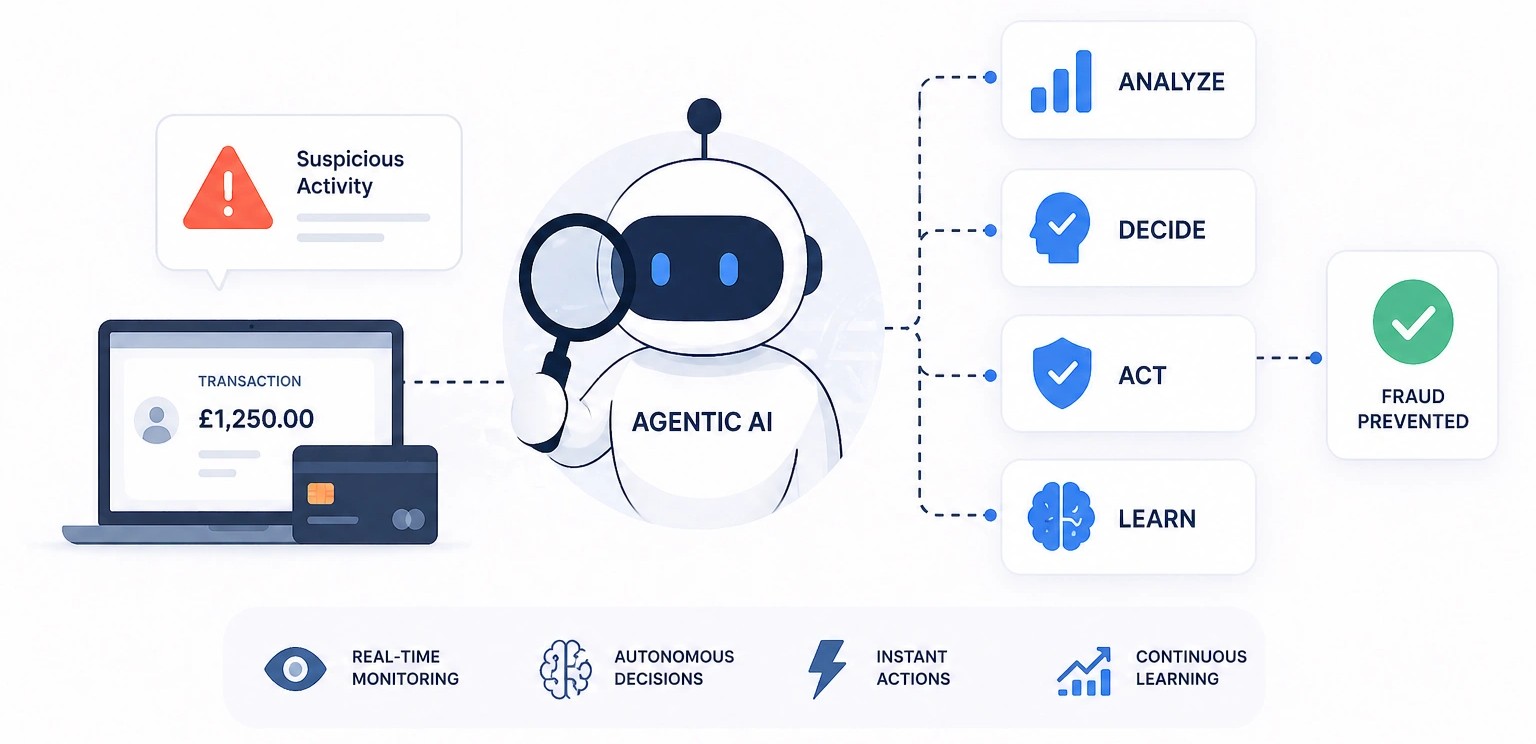
Agentic AI in fraud detection improves real-time monitoring by continuously watching transactions, learning patterns, reasoning about suspicious behaviour, and acting instantly, without waiting for a human to press a button.

Unlike rule-based systems that miss new fraud patterns, Agentic AI thinks, decides, and responds on its own. This blog explains exactly how that works, with UK examples, a visual flowchart, and a comparison of old vs new approaches.

You’ll also find out why UK banks, retailers, and fintech firms are switching to Agentic AI right now, and how tools like Azeon AI, built by Azilen Technologies, are making this practical and deployable without ripping out existing systems.

Think about this: a fraudster makes a transaction. Your old fraud system checks it against a list of known rules. The rules don’t match anything. So the transaction goes through. By the time someone flags it, the money is already gone.

That is exactly what is happening across the UK right now. In 2024 alone, fraud cost UK businesses and consumers over £1.1 billion. That’s a record. And the sad part? A huge chunk of that was preventable.

The real issue isn’t effort. Banks and retailers are spending millions on fraud prevention. The real issue is speed and intelligence. Traditional fraud monitoring systems are slow, rigid, and reactive. They wait to see a known pattern before sounding the alarm. But criminals don’t use known patterns, they evolve constantly.

So, then, the question is simple: what system can keep up with fraud that changes every day, every hour, every transaction? The answer is Agentic AI in fraud detection.

£1.1B

Total UK fraud losses in 2024 (UK Finance)

3.13M

Confirmed fraud cases in the UK in 2024

22%

Rise in remote purchase fraud cases

70%

Of APP fraud cases enabled online

UK Finance 2025 Annual Fraud Report states clearly: “Action beats reaction 100% of the time.” Agentic AI is built on exactly that principle (proactive, not reactive.)

What Is Agentic AI in Fraud Detection

Let’s keep this simple. Traditional AI in fraud detection is like a security guard with a checklist. If something matches the list, the alarm goes off. If it doesn’t, nothing happens. It’s passive. It’s fixed. And it’s easy to trick.

What Is Agentic AI in Fraud Detection Azilen Technologies

Agentic AI, on the other hand, is like hiring a brilliant investigator who never sleeps. Instead of just checking a list, this investigator watches everything in real time, thinks about what they see, asks questions, forms conclusions, and acts — all by themselves, without needing a manager to tell them what to do.

The word “agentic” comes from “agency”, meaning the ability to act independently and make decisions. So Agentic AI doesn’t just flag suspicious things. It also decides what to do about them, carries out that action, and then learns from the outcome to do better next time.

How Agentic AI in Fraud Detection Actually Improves Real-Time Monitoring

Now let’s get into the direct answer. Here are the specific, practical ways Agentic AI improves real-time fraud monitoring, not in theory, but in day-to-day operations inside UK financial systems.

1. Monitors All Transactions in Real Time

Monitors All Transactions in Real Time

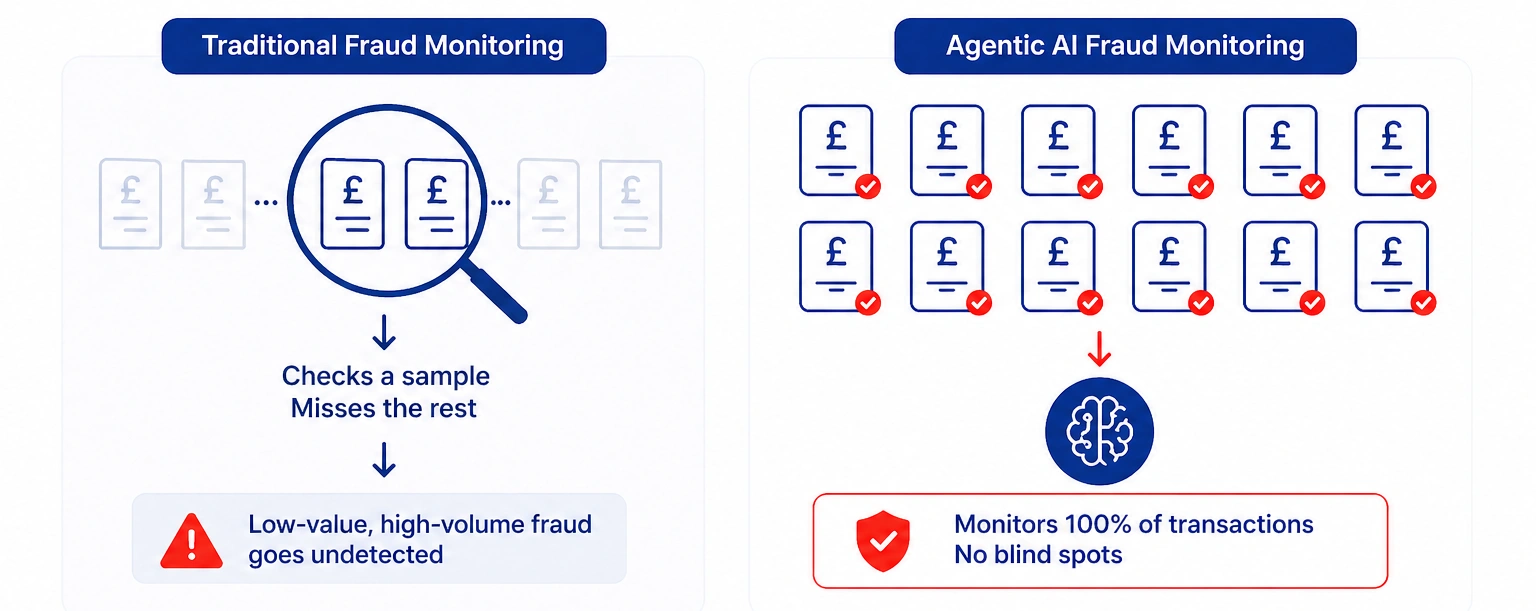
Traditional fraud systems often rely on sampling or threshold-based checks, which means only a portion of transactions are analysed. This creates blind spots, especially for low-value, high-frequency fraud that often goes unnoticed until it scales.

Agentic AI eliminates this gap by monitoring every single transaction in real time, regardless of value or frequency.

→ Every transaction is analysed continuously, not selectively, ensuring zero blind spots across the system
→ Low-value, high-volume fraud patterns are detected early before they accumulate into significant losses
→ Real-time processing ensures fraud signals are identified instantly, not after batch reviews

As a result, fraud detection becomes complete rather than partial, giving organisations full visibility and control over transaction activity.

2. Uses Context Instead of Fixed Rules

Uses Context Instead of Fixed Rules

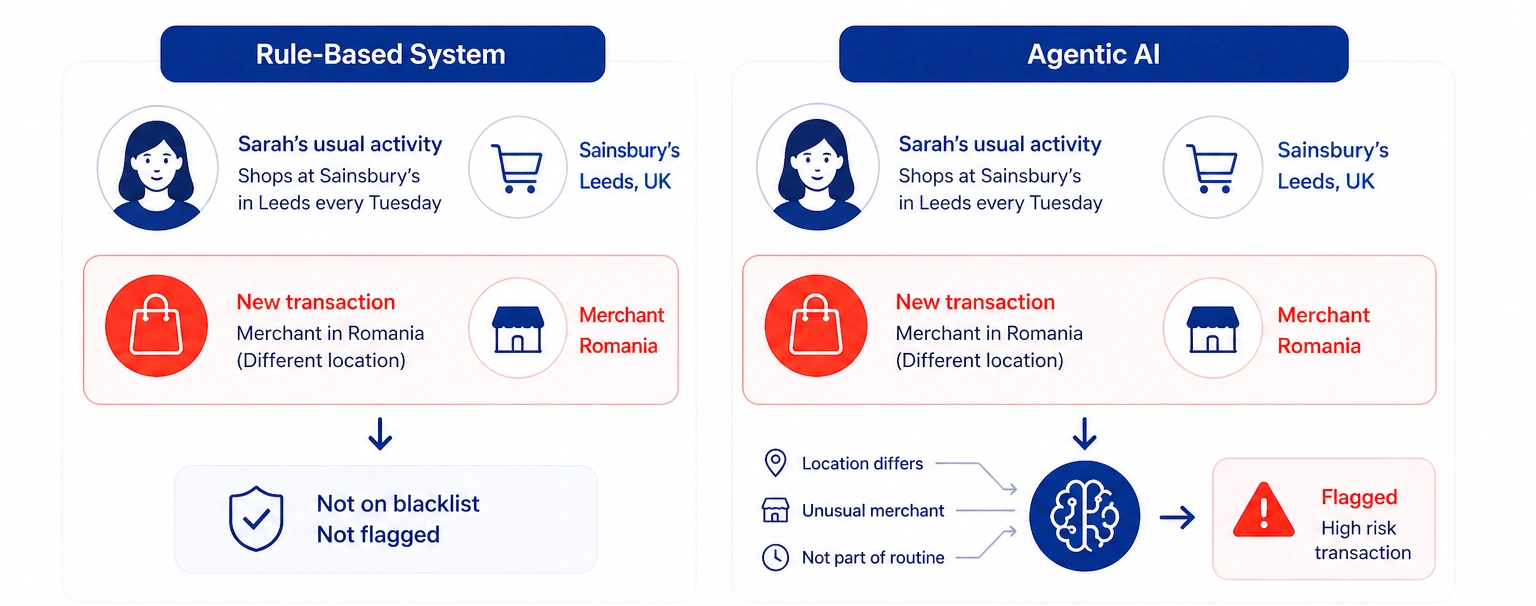
Rule-based systems operate on predefined conditions, which makes them predictable and limited. They fail when fraud does not match known patterns. Agentic AI, however, evaluates behaviour, context, and deviation from normal activity.

This shift from rules to reasoning is what makes modern fraud detection significantly more effective.

→ Behavioural analysis compares current activity with historical customer patterns to detect anomalies
→ Context-aware decisions consider location, timing, transaction type, and user behaviour together
→ Reduced false positives ensure genuine transactions are not unnecessarily blocked

Therefore, instead of reacting to known fraud, the system proactively identifies suspicious behaviour, even if it has never been seen before.

3. Acts Instantly to Prevent Fraud

Acts Instantly to Prevent Fraud

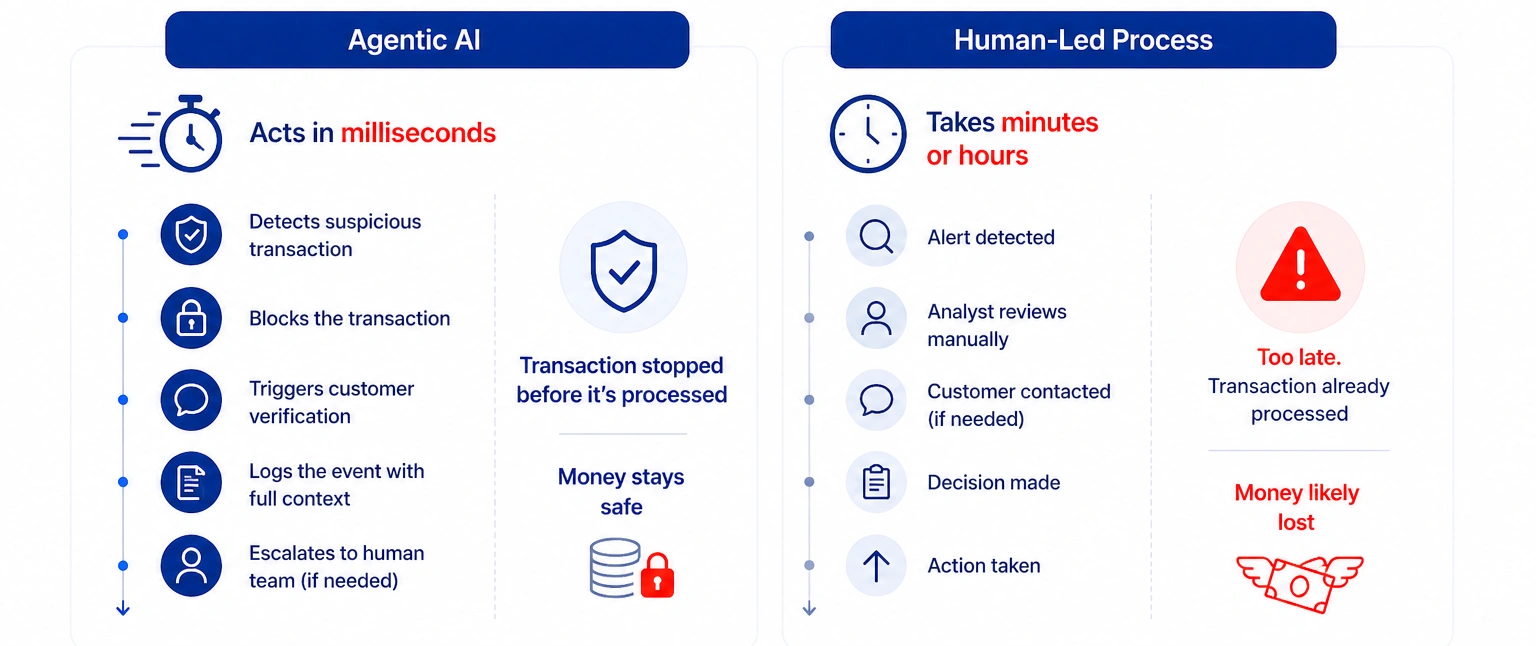
Speed is everything in fraud detection. A delay of even a few minutes can result in irreversible financial loss. Human-led processes, no matter how efficient, cannot match the speed required for real-time intervention.

Agentic AI operates at machine speed, acting instantly the moment risk is detected.

→ Suspicious transactions are blocked in milliseconds before they are completed
→ Automated workflows trigger customer verification or alerts without manual intervention
→ Full context is logged and escalated simultaneously for human review when required

As a result, fraud is prevented before funds are lost. This same real-time execution model is also used in How Agentic AI in Payment Processing Improves Transaction Speed, where instant decision-making ensures faster and more reliable transactions.

Speed matters more than you think. APP fraud, where victims are tricked into sending money. Resulted in £450 million in losses in 2024. In most of those cases, real-time intervention before the transaction completes would have stopped the loss entirely.

4. Shares Intelligence Across Systems

Shares Intelligence Across Systems

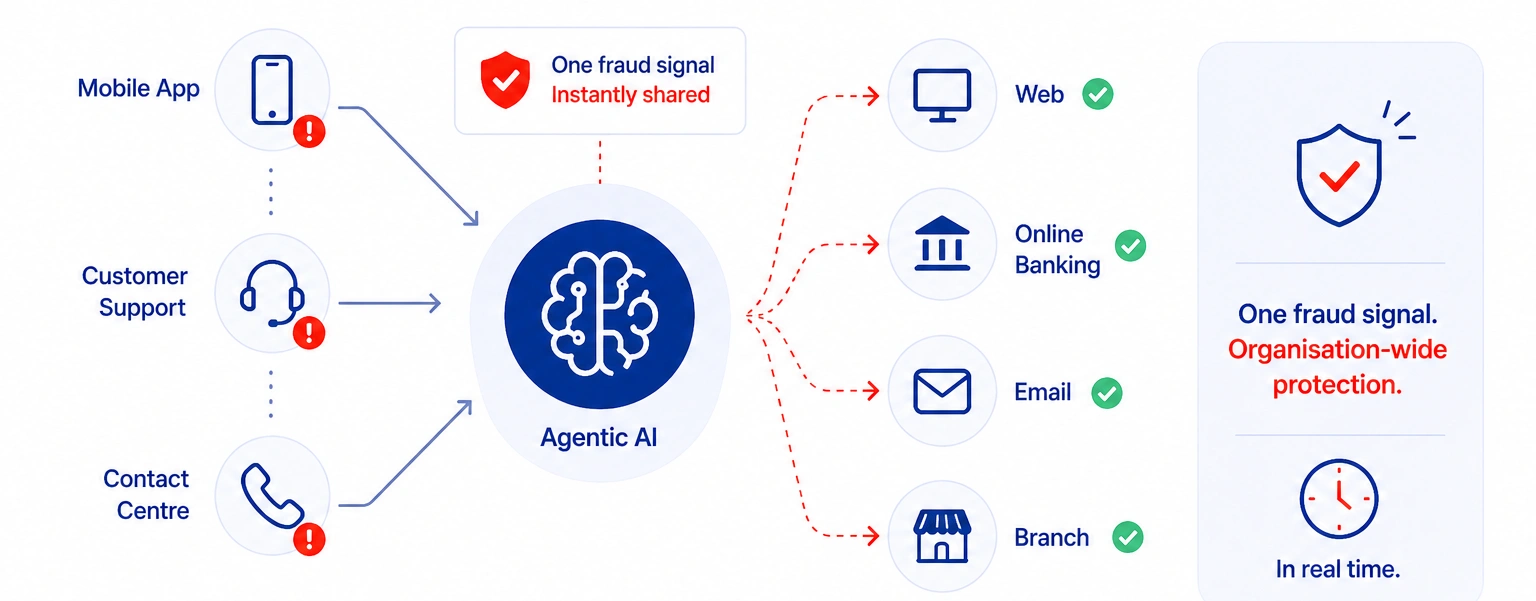
Fraud is rarely isolated to one channel. It often spans multiple touchpoints, app, web, customer support, and contact centres. Traditional systems fail because these channels operate in silos.

Agentic AI connects these dots through a unified intelligence layer.

→ Fraud signals detected in one channel are instantly shared across all other systems
→ Cross-channel visibility enables faster and more accurate decision-making
→ A single suspicious action triggers organisation-wide protection in real time

As a result, fraud detection becomes coordinated rather than fragmented, significantly reducing the chances of multi-channel fraud slipping through.

5. Continuously Learns and Improves

Continuously Learns and Improves

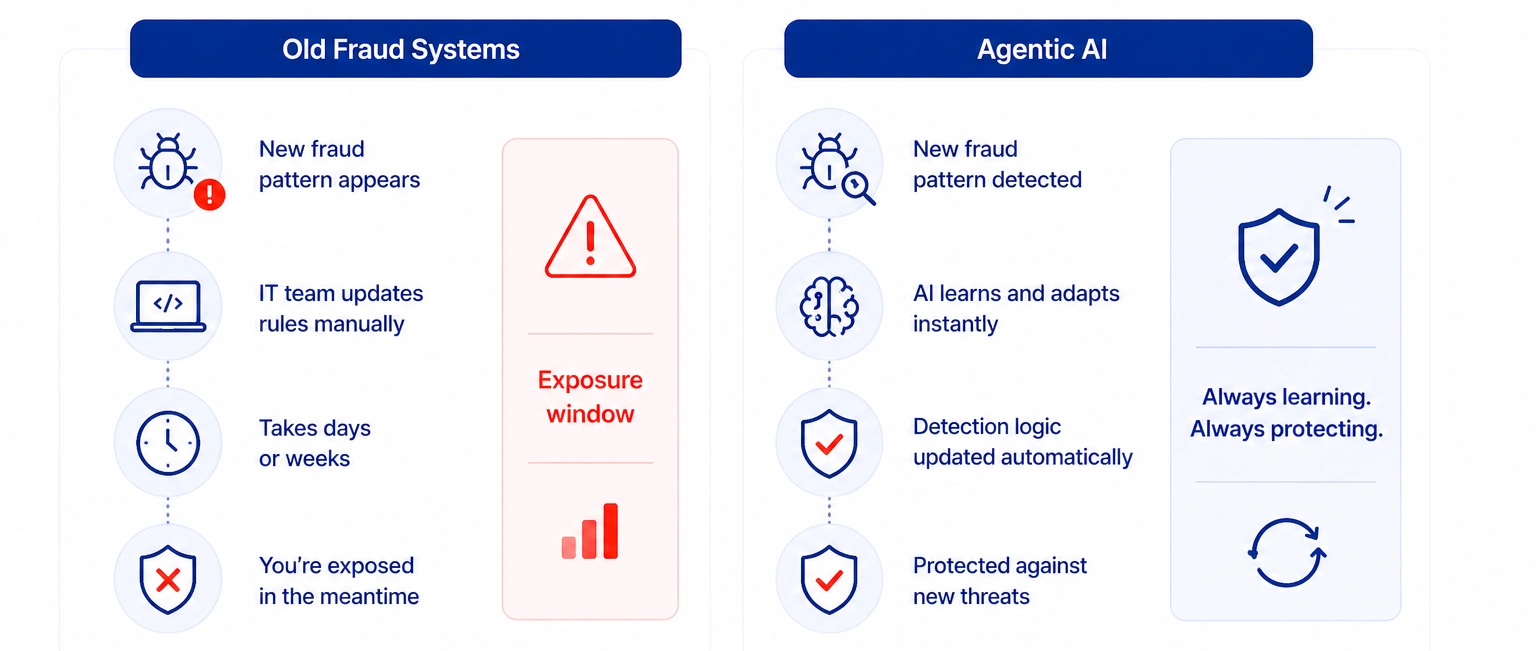
Traditional fraud systems depend on manual rule updates, which creates delays and exposure windows. By the time new rules are implemented, fraud patterns may have already evolved.

Agentic AI removes this dependency by continuously learning and adapting.

→ New fraud patterns are identified and incorporated into detection logic automatically
→ The system evolves with changing behaviour without requiring IT intervention
→ Continuous learning ensures protection improves over time instead of becoming outdated

Therefore, fraud protection becomes dynamic and future-ready. A similar adaptive intelligence approach is also applied in How Agentic AI in Loan Origination Speeds up Credit Decisions, where systems continuously refine risk assessment and decision-making.

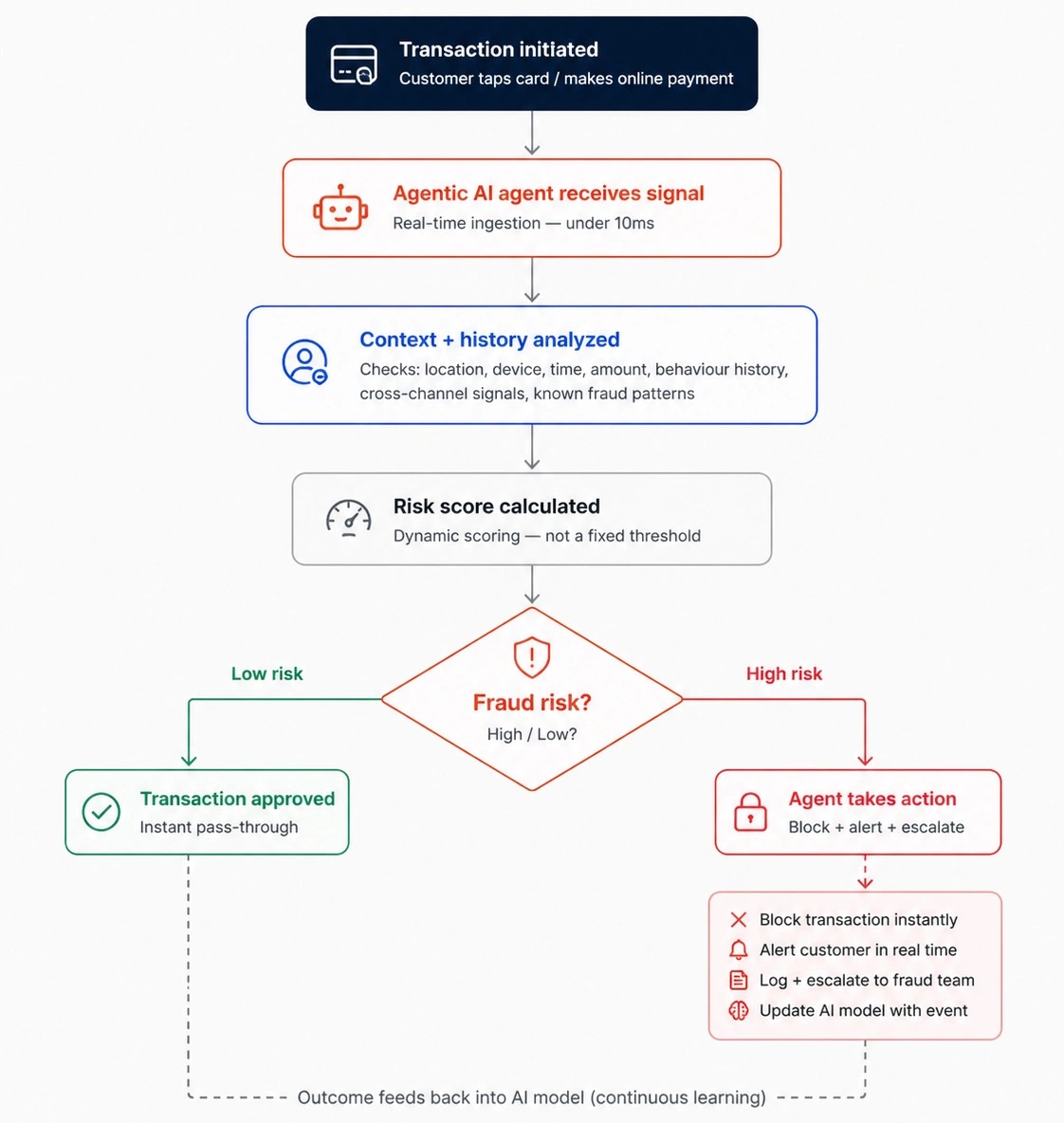
The Agentic AI Fraud Detection Flow: See It in Action

Fraud detection flow

This is how Agentic AI processes a transaction in real time, from the moment a customer taps their card to the final outcome. Every step happens in milliseconds.

Old Fraud Monitoring vs Agentic AI: The Real Difference

To truly understand the improvement, it helps to compare both approaches side by side.

Here’s the honest truth about what each system can and cannot do.

Fraud Detection: Rule-Based vs Agentic AI
Traditional Rule-Based Systems
Agentic AI Fraud Detection
✕ Only catches fraud that matches known patterns ✓ Detects never-before-seen fraud using reasoning
✕ Needs manual rule updates (takes days or weeks) ✓ Self-updating — adapts to new tactics automatically
✕ High false positive rates — blocks real customers ✓ Context-aware — fewer false positives
✕ Operates in silos — no cross-channel view ✓ Unified intelligence across every customer channel
✕ Slow to alert — often after money has moved ✓ Acts in milliseconds — before money leaves
✕ Doesn’t learn — same blind spots forever ✓ Learns from every transaction — gets smarter daily

A Real-World UK Example: What This Looks Like in Practice

A UK High Street Bank (Catching APP Fraud Before It Completes)

Authorised Push Payment (APP) fraud is one of the most damaging fraud types in the UK.

It’s when a criminal tricks someone into sending them money. In 2024, this type of fraud cost UK consumers and businesses £450 million.

Here’s how the scenario plays out without Agentic AI, and then with it.

Without Agentic AI

A customer receives a phone call from someone pretending to be their bank. The caller says there’s suspicious activity and asks the customer to transfer funds to a “safe account.”

The customer does it. The rule-based fraud system doesn’t flag it, because the customer authorised the payment. The money is gone. The bank notices the fraud days later during a review. By then, nothing can be recovered.

With Agentic AI

The customer starts the transfer. Immediately, Agentic AI notices several signals at once: this is a new payee the customer has never paid before; the amount is unusually large for this customer’s profile; the customer’s phone was recently on a call for 20 minutes; similar payment patterns have been flagged as APP fraud before.

Within milliseconds, the AI decides this is high-risk. It pauses the payment, sends a real-time alert to the customer (“Are you sure? This matches APP fraud patterns”), and notifies the fraud team for human review. The customer realises what’s happening. The payment is stopped. Zero loss.

How Azeon AI Powers Agentic Fraud Detection for UK Businesses

So far, we’ve explained the concept. Now let’s talk about the practical solution, specifically, how Azeon AI brings this to life for UK businesses.

Azeon AI is an agentic AI platform designed for high-volume customer service and operational intelligence. It’s already deployed in financial services, retail, FMCG, and SaaS environments. Critically, it doesn’t require you to rip out your existing systems, it sits on top of them as an intelligence layer.

Here’s what makes Azeon AI relevant to fraud detection in the UK

CX Brain (Reasons before acting) 

Azeon’s CX Brain understands intent, urgency, and sentiment, not just keywords. In fraud contexts, this means it can reason about why a transaction is suspicious, not just whether it matches a rule. It understands context across the full customer history.

CX Memory (Full history, always available)

Azeon’s CX Brain understands intent, urgency, and sentiment, not just keywords. In fraud contexts, this means it can reason about why a transaction is suspicious, not just whether it matches a rule. It understands context across the full customer history.

CX Veins (Context flows everywhere instantly)

Suspicious signals flow instantly to every relevant team, fraud analysts, customer support, compliance, with full context attached. No manual handoffs. No information loss. Human agents step in ready, not blind.

CX Nerve (Root cause, not just symptoms)

Rather than just blocking individual fraudulent transactions, Azeon’s CX Nerve identifies patterns across many interactions. Therefore, it can flag systemic vulnerabilities, like a phishing campaign targeting your customers, before the losses stack up.

Built for UK Compliance Requirements

Azeon AI is SOC 2 Type II certified, ISO 27001 compliant, GDPR-ready, and PCI-DSS prepared. Every customer interaction is encrypted end-to-end.

No data is stored after the session. All actions produce a full, traceable audit trail, which is essential for meeting FCA requirements and the UK’s Payment Systems Regulator (PSR) obligations.

Why Azilen Technologies Stands Out in Agentic AI for Fraud Detection

In the UK fraud landscape, detection is no longer just about flagging suspicious transactions. It is about stopping fraud in real time, reducing false positives, protecting customer experience, and operating across multiple channels at once. This is exactly where agentic AI in fraud detection improves real-time monitoring, and where Azilen Technologies brings a clear edge.

Azilen does not treat fraud detection as a rule-based system. It builds intelligent ecosystems where detection, decision-making, and action happen together in real time. This ensures that fraud is not only identified faster, but also prevented before financial loss occurs.

As a Digital Transformation Partner, Azilen focuses on building fraud detection systems that operate continuously, adapt to new threats instantly, and reduce manual intervention across the entire fraud lifecycle.

Real-Time Data Intelligence: Processes transaction, behavioural, and cross-channel data instantly to detect fraud patterns as they occur, not after

Seamless System Integration: Connects fraud detection systems with payment platforms, CRMs, customer support tools, and banking infrastructure without disruption

Context-Driven Detection Models: Uses behavioural analysis and contextual signals instead of static rules to identify both known and unknown fraud patterns

Built-in Regulatory Alignment: Aligns with UK compliance requirements such as FCA expectations and AML frameworks, ensuring audit-ready fraud controls

Intelligent Automation with Agentic AI: Enables autonomous decision-making, instant transaction blocking, and smart escalation, significantly reducing response time

Scalable, Multi-Channel Architecture: Builds systems that detect and respond to fraud across apps, web, and contact centres without increasing operational load

Azilen focuses on building fraud detection systems that do not just detect threats, but prevent them in real time and improve continuously. This approach helps UK firms reduce fraud losses, improve customer trust, and strengthen operational efficiency using agentic AI in fraud detection.

FAQs: Agentic AI for KYC Automation

1. What is Agentic AI in fraud detection?

Agentic AI in fraud detection uses autonomous AI agents to monitor transactions, analyse behaviour, and take action in real time. Unlike traditional rule-based systems, it does not rely on fixed conditions. Instead, it understands context, adapts to new fraud patterns, and makes decisions independently.

This improves real-time monitoring, reduces fraud risk, and ensures faster, more accurate detection across financial systems.

2. How does Agentic AI improve real-time fraud monitoring?

Agentic AI improves real-time fraud monitoring by analysing 100% of transactions instantly, without relying on sampling or thresholds. It evaluates behaviour, detects anomalies, and acts within milliseconds to block suspicious activity.

Additionally, it shares intelligence across systems and continuously learns from new patterns. This ensures faster detection, fewer missed fraud cases, and stronger protection compared to traditional fraud systems.

3. What is the difference between Agentic AI and rule-based fraud detection?

Rule-based fraud detection depends on predefined conditions and cannot adapt to new or unknown fraud patterns. Agentic AI, on the other hand, uses contextual understanding and behavioural analysis to detect suspicious activity.

It learns continuously and makes decisions in real time. This makes Agentic AI more accurate, scalable, and effective in reducing fraud while also lowering false positives.

4. Can Agentic AI reduce false positives in fraud detection?

Yes, Agentic AI significantly reduces false positives by understanding customer behaviour and transaction context. Instead of flagging transactions based only on rules, it evaluates patterns such as location, spending habits, and timing. This helps differentiate genuine activity from suspicious behaviour.

As a result, customers experience fewer unnecessary declines, while businesses maintain strong fraud protection and better user experience.

5. Why is Agentic AI important for UK financial services?

Agentic AI is important for UK financial services because fraud is becoming faster, more complex, and multi-channel. Traditional systems struggle to keep up with evolving threats and regulatory expectations.

Agentic AI enables real-time detection, continuous monitoring, and automated response while aligning with FCA and AML requirements. This helps firms reduce fraud losses, improve compliance, and deliver a seamless customer experience.

Glossary

Fraud Detection: The process of identifying and preventing suspicious or unauthorised financial activities in real time
Agentic AI: Autonomous AI systems that analyse, decide, and act without constant human intervention
Real-Time Monitoring: Continuous tracking of transactions and behaviour as they happen, without delays
False Positives: Legitimate transactions incorrectly flagged as fraud by detection systems
Behavioural Analysis: Studying customer patterns such as spending, location, and timing to detect anomalies
Risk Scoring: Assigning a risk level to a transaction based on multiple data signals and behaviour
Transaction Monitoring: Analysing financial transactions to identify suspicious or unusual activity
Anomaly Detection: Identifying deviations from normal behaviour that may indicate fraud
Cross-Channel Intelligence: Sharing fraud signals across systems like apps, web, and customer support
Fraud Prevention: Actions taken to stop fraudulent transactions before financial loss occurs

azilen_uk_main_admin

Azilen Technologies is an Enterprise AI development company . The company collaborates with organizations to propel their AI development journey from idea to implementation and all the way to AI success. From data & AI to Generative AI & Agentic AI, and MLOps, Azilen engages with companies to build a competitive AI advantage with the right mix of technology skills, knowledge, and experience.  

Related Insights