Skip to content

How Agentic AI for KYC Automation Reduces Compliance Workload

Featured Image

Agentic AI for KYC Automation directly reduces compliance workload by replacing slow, manual KYC tasks, like document checks, identity verification, risk scoring, and ongoing monitoring, with autonomous AI agents that work around the clock.

Instead of your team spending hours on repetitive checks, AI agents handle them in seconds, flagging only high-risk cases for human review.

The result? Fewer errors, faster onboarding, smaller compliance teams, and a much lower risk of FCA fines.

This blog covers exactly how it works: the step-by-step process, what changes with agentic AI versus old-school automation, a before-and-after comparison, a real-world UK example, and how Azeon AI — built by Azilen Technologies, fits into this picture for financial services firms in the UK.

Here’s a number that should make any UK compliance officer sit up straight: £176 million. That’s how much the FCA fined UK banks in 2024 alone, including Barclays, Metro Bank, TSB, and Starling Bank, for compliance failures tied to poor KYC and AML controls.

And yet, most UK financial firms are still running KYC processes the old way. Analysts manually reviewing passports. Risk scores calculated on spreadsheets. Ongoing monitoring done in batches once a month. It’s slow, error-prone, and frankly unsustainable given today’s regulatory pressure.

Reality Check for UK Firms

Between 2015 and 2025, the FCA issued over £1.07 billion in AML-related fines across 27 cases. The trend is getting worse, not better. Challenger banks and fintechs are now at the top of the enforcement list.

So the question is simple: how do you reduce that workload without cutting corners?

The answer is increasingly clear: agentic AI is transforming KYC automation. It goes beyond rule-based bots and basic RPA, using autonomous AI agents that reason, adapt, and act. Here’s exactly how it works.

What Is Agentic AI? (And Why It’s Different)

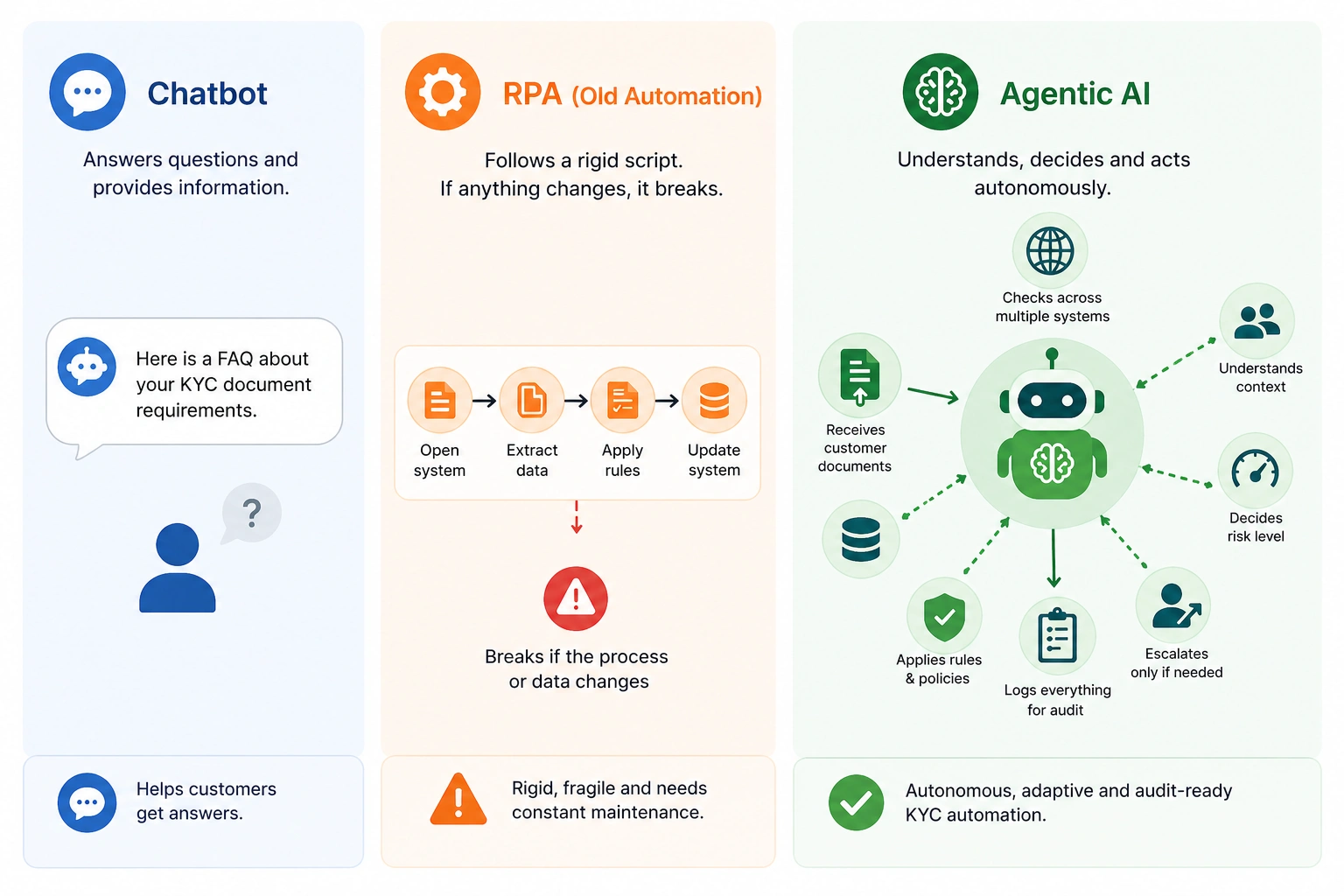
Most people have heard of chatbots. Many have used basic automation tools. But agentic AI is a different animal entirely. Think of it this way:

What Is Agentic AI Azilen technologies

The key difference is agency, the ability to make decisions, take multi-step actions, and adapt to new information without needing a human to guide every step. For KYC, this is transformational.

How Agentic AI for KYC Automation Actually Reduces Workload

Let’s be direct. Here are the six specific ways agentic AI cuts your compliance team’s workload, step by step, task by task.

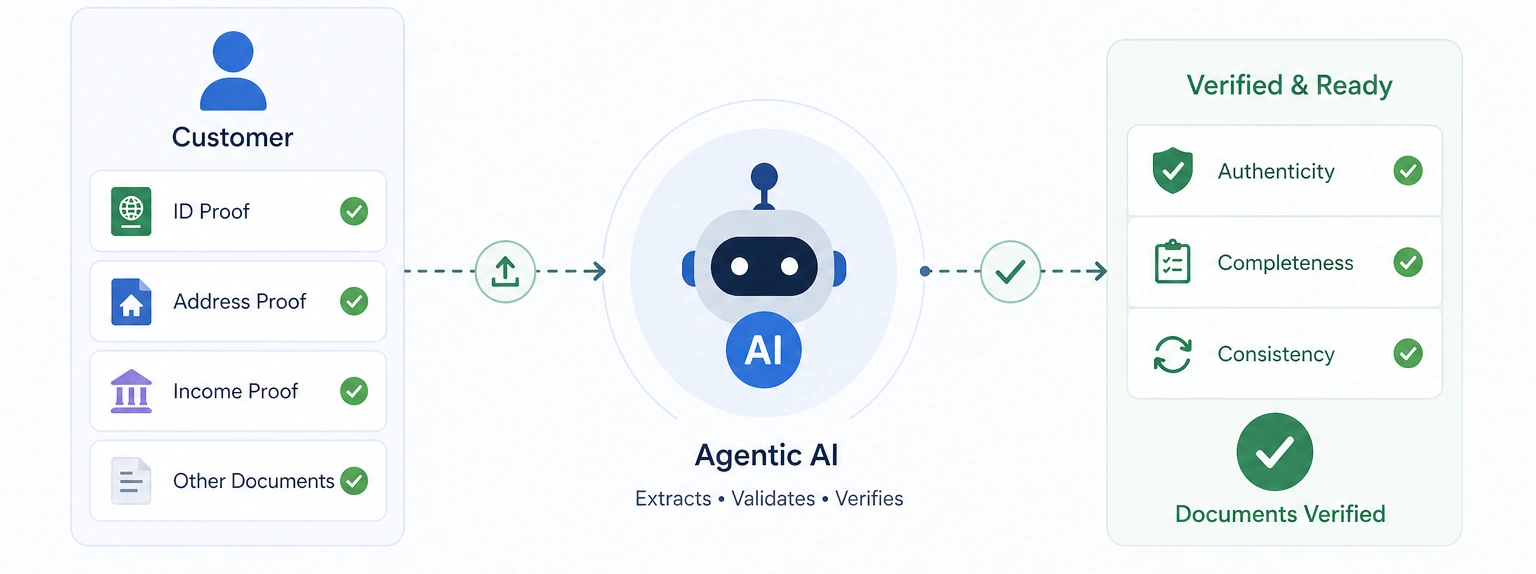
1. Automated Document Collection & Verification

1. Automated Document Collection & Verification

Instead of emailing customers asking for their passport and utility bill, then waiting days for a response, agentic AI guides customers through digital onboarding. It collects documents, checks for authenticity (holograms, fonts, pixel-level manipulation), and validates identity using biometric liveness checks, all without a human touching anything.

Moreover, it cross-references data against the FCA’s register, HMRC records, Companies House, and global sanctions lists in seconds. That entire process used to take days. Now it takes minutes.

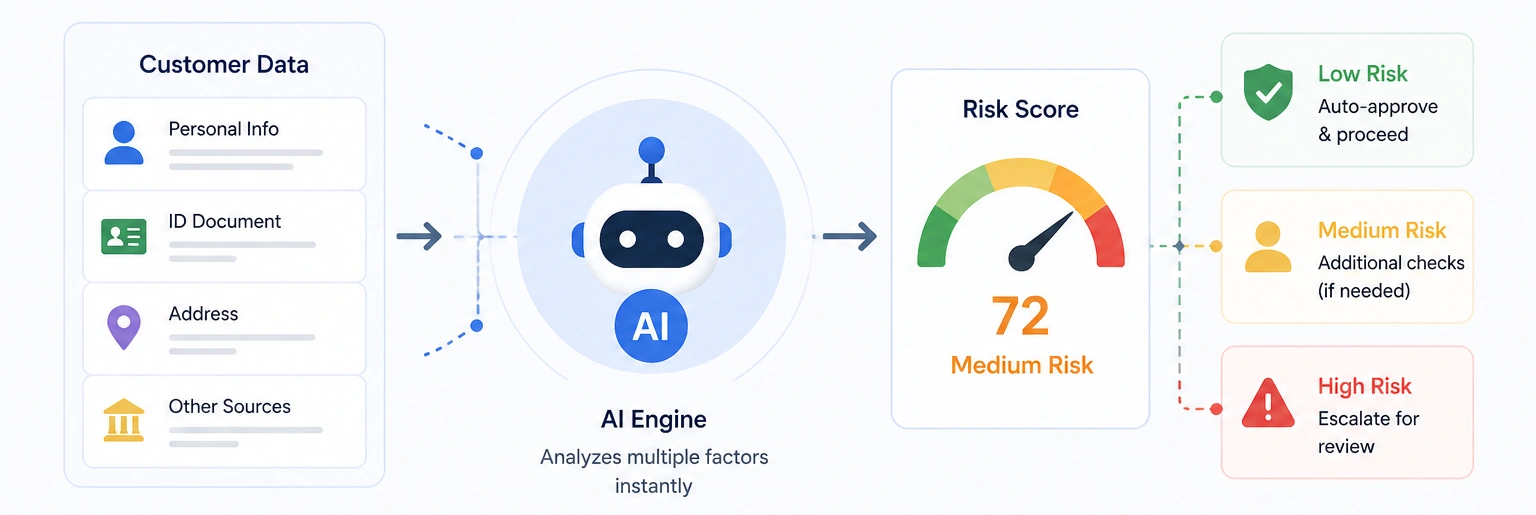
2. Real-Time Risk Scoring (No More Manual Assessment)

Real-Time Risk Scoring

Under UK’s MLR 2017, firms must apply a risk-based approach to every customer. That means assessing risk level — low, medium, or high, for every single onboarding and every review. Traditionally, a compliance analyst would do this manually, consulting checklists and making judgement calls.

Agentic AI does this in real time. It pulls transaction patterns, beneficial ownership data, PEP (Politically Exposed Person) status, geographic risk factors, and account behaviour, and generates a risk score automatically. Furthermore, it adjusts the score as new information comes in, providing ongoing risk monitoring rather than a one-time snapshot.

To see how this approach accelerates decisions beyond KYC, explore this: How Agentic AI in Loan Origination Speeds up Credit Decisions.

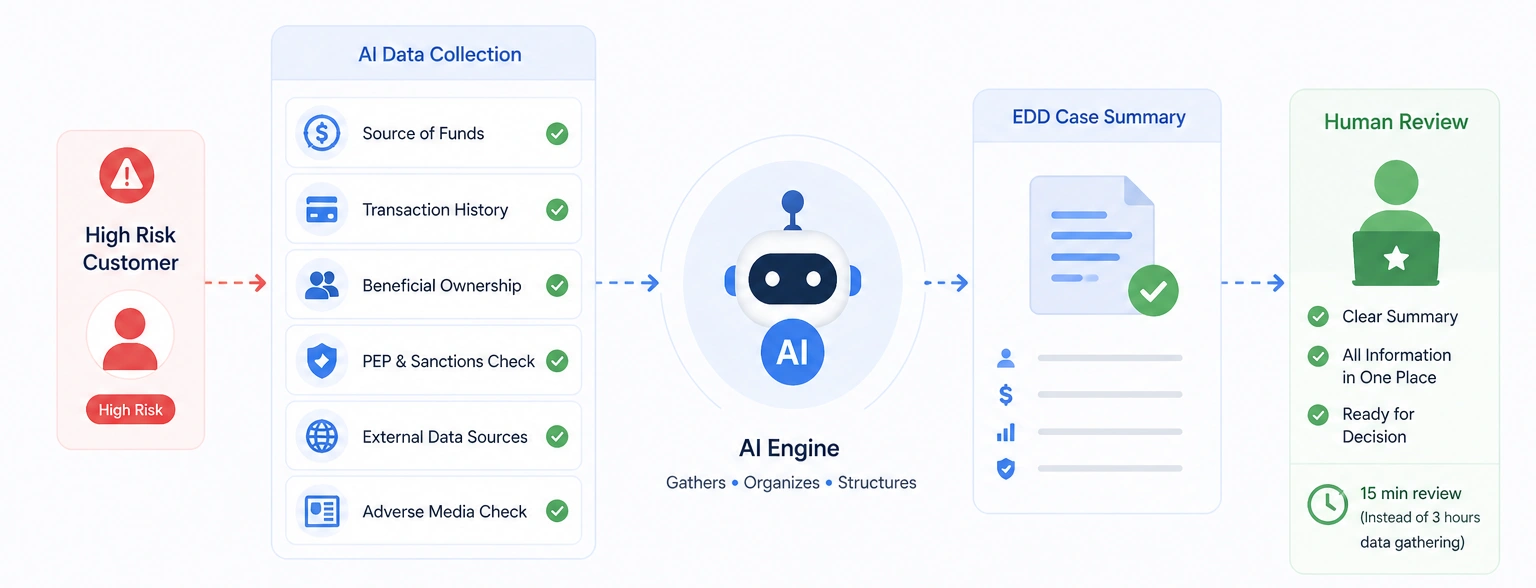
3. Enhanced Due Diligence (EDD) on Autopilot

Enhanced Due Diligence (EDD)

High-risk customers require Enhanced Due Diligence. Under the FCA’s rules, this means more information, source-of-funds verification, and senior management sign-off. For compliance teams, EDD is the most time-consuming part of KYC. Additionally, it often requires pulling together information from multiple sources, which takes analysts hours.

Agentic AI handles the data-gathering layer automatically. It collects everything needed for an EDD case, structures it cleanly, and presents it to a senior reviewer with a clear summary. The human still makes the final call, but instead of spending 3 hours gathering data, they spend 15 minutes reviewing it.

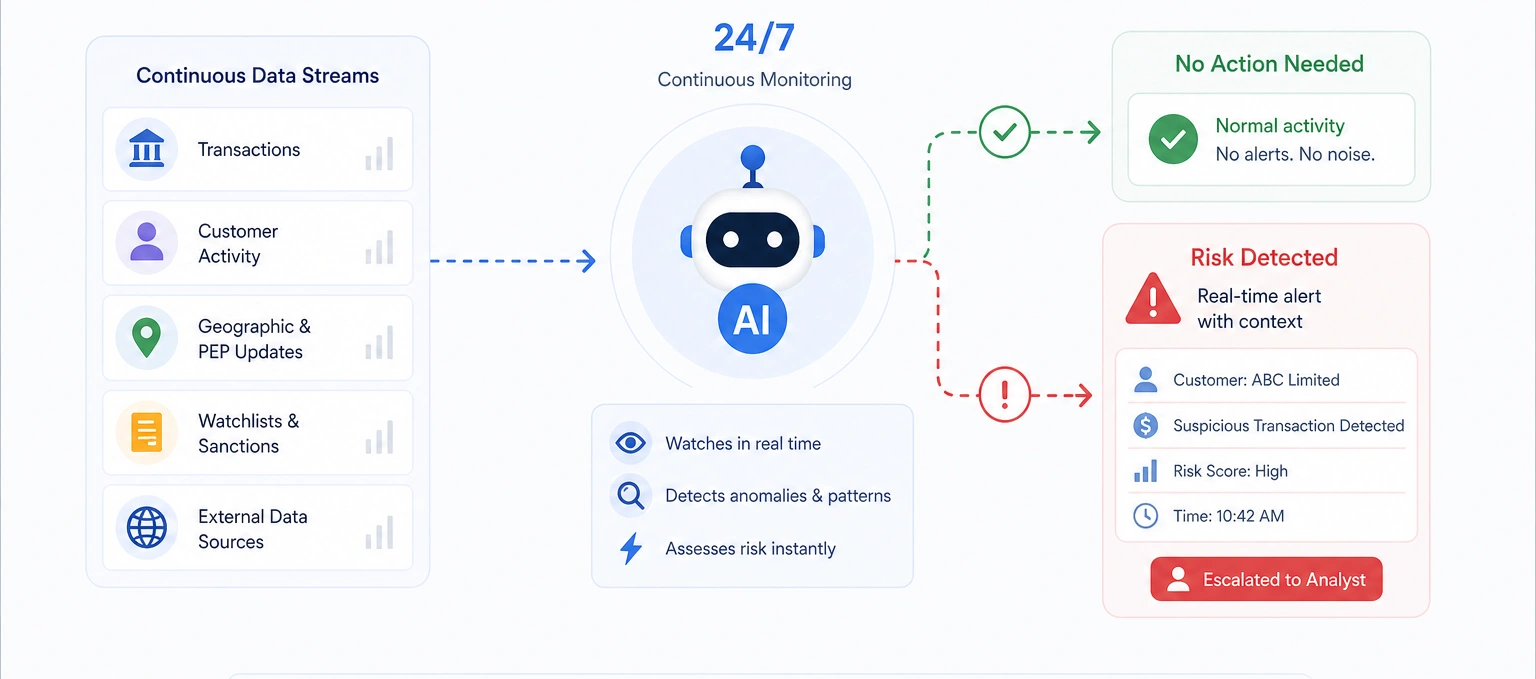
4. Ongoing Monitoring Without Ongoing Effort

Ongoing Monitoring Without Ongoing Effort

KYC is not a one-time event. The FCA requires continuous monitoring of customers and transactions. Traditionally, this is done in monthly batches, which means risks can go undetected for weeks. As a result, firms like NatWest, which was fined £264 million in 2021, often miss red flags simply because monitoring was too infrequent.

Agentic AI monitors continuously and silently. It watches transactions, flags anomalies, and escalates suspicious patterns in real time, 24 hours a day, 7 days a week, without any analyst needing to pull reports manually.

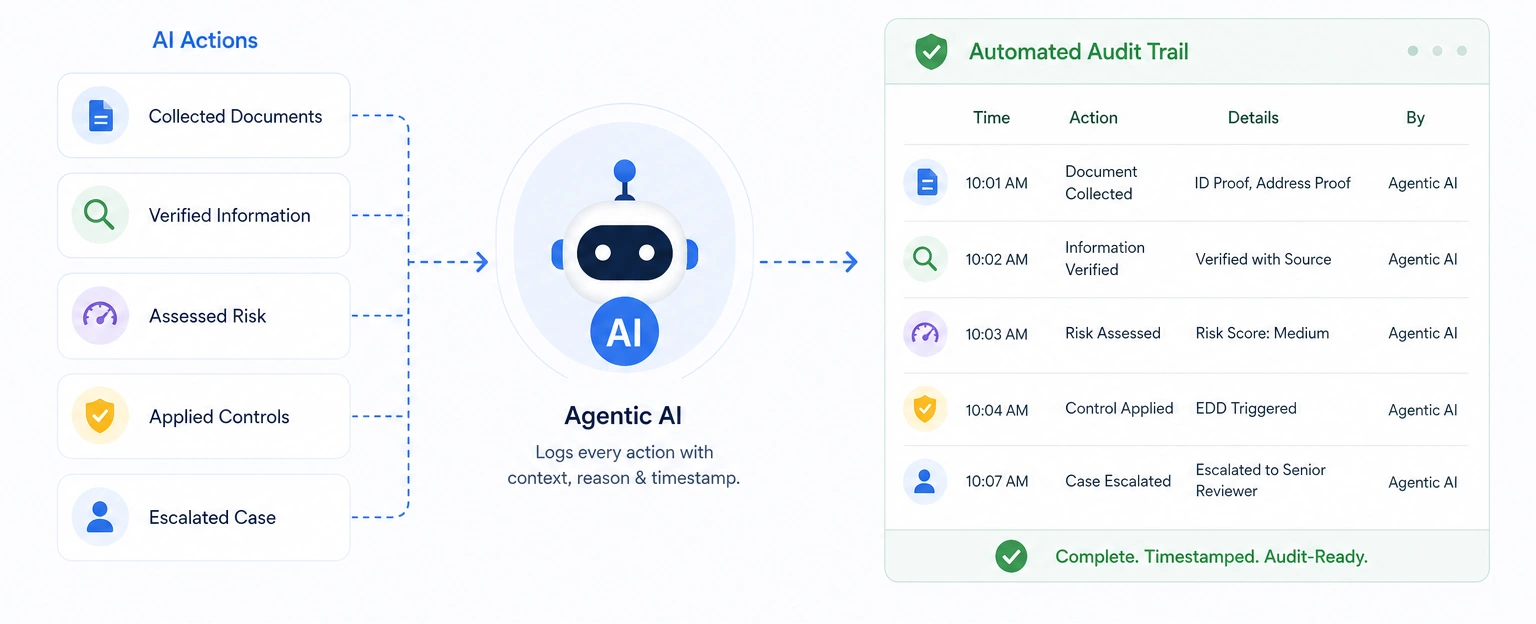
5. Audit Trail Creation (Automatically)

Audit Trail Creation

After every action, agentic AI logs what it did, why it did it, and what decision was made. This creates a clean, timestamped audit trail that satisfies FCA requirements without anyone manually updating a spreadsheet or CMS. Therefore, when regulators come knocking, your team is ready in minutes, not weeks.

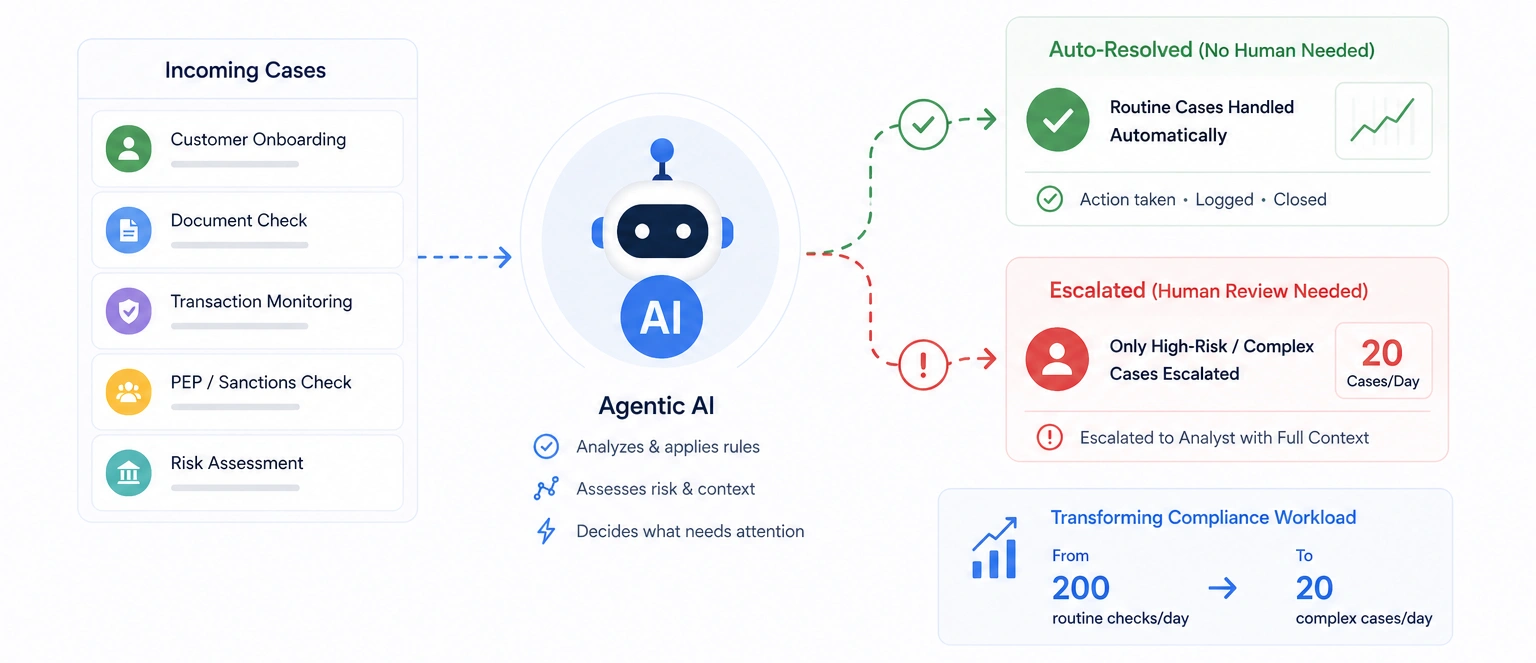
6. Intelligent Escalation (Only When Needed)

Intelligent Escalation

Perhaps the biggest time-saver: agentic AI only escalates cases that genuinely need human attention. Everything routine is handled autonomously.

As a result, your compliance analysts shift from processing 200 routine checks per day to reviewing 20 genuinely complex cases.

That’s a transformational shift in workload, and output quality.

Before vs After: The Real Difference (Agentic AI for KYC Automation)

Let’s make this concrete. Here’s what KYC looks like for a UK fintech without and with Agentic AI:

KYC: Traditional vs Agentic AI
Traditional KYC (Without AI)
Agentic AI for KYC Automation
Analysts manually review every document AI agents handle all routine document checks
3–5 day average customer onboarding time Under 10-minute onboarding for low-risk customers
Monthly batch monitoring — risks missed for weeks Continuous real-time monitoring — nothing missed
EDD takes 4–6 hours per case EDD data gathered in minutes, not hours
Audit files manually assembled before inspections Audit trail auto-generated after every action
High false positive rate in screening Smarter screening with fewer false positives
Staff burn-out from repetitive tasks Staff focus on complex, high-value cases only
Prone to human error under pressure Consistent, bias-free decisions every time

The Numbers Don’t Lie: KYC Compliance in the UK

Here’s why this conversation is urgent for UK firms right now:

£1.07B

AML-related FCA fines 2015–2025 across 27 cases

£176M

FCA fines in 2024 alone for KYC/AML failures

14 yrs

Maximum imprisonment for AML breaches under POCA

100K+

UK businesses subject to AML regulations today

Azeon Angle: Agentic AI for KYC Automation Reduces Compliance Workload

Azeon AI is an agentic AI platform originally designed for customer support automation in financial services. However, for compliance-heavy environments, its architecture maps directly onto KYC automation challenges.

Here’s what makes Azeon relevant for UK firms dealing with KYC workload:

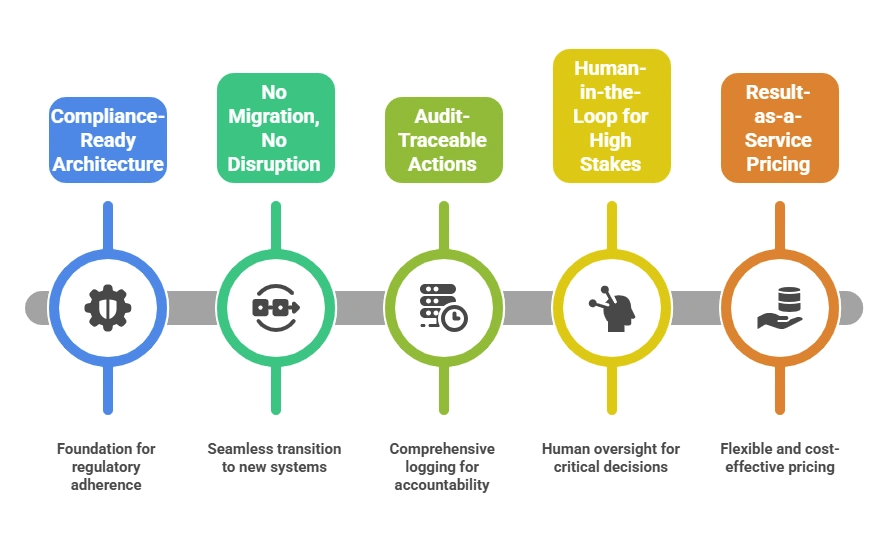
Horizontal timeline showing five milestones: Compliance-Ready Architecture; No Migration/Disruption; Audit-Traceable Actions; Human-in-the-Loop for High Stakes; Result-as-a-Service Pricing.

Compliance-Ready Architecture

Azeon is GDPR-compliant, SOC 2 certified, and ISO 27001 aligned, matching the exact standards UK financial institutions must meet under FCA regulations. Therefore, no costly retrofitting needed.

No Migration, No Disruption

Azeon slots into your existing infrastructure, your CRM, core banking system, helpdesk, as an intelligence layer on top. No rip-and-replace. No downtime. Moreover, no expensive system rebuilds.

Audit-Traceable Actions

Every action Azeon takes is logged with full context, what it did, when, and why. This satisfies the FCA’s record-keeping requirements automatically, without your team lifting a finger.

Human-in-the-Loop for High Stakes

Azeon doesn’t replace human judgement, it amplifies it. Complex or high-risk KYC cases are escalated to humans with full context already prepared, so decisions are faster and better informed.

Result-as-a-Service Pricing

Rather than paying per seat or per API call, Azeon charges per resolved outcome. For UK compliance teams watching costs closely, this model aligns perfectly with measurable ROI.

Why Azilen Technologies Stands Out in Agentic AI for KYC Automation

In the UK compliance landscape, KYC is no longer just about identity verification. It is about managing risk, meeting FCA expectations, handling scale, and reducing operational pressure, all at the same time. This is exactly where Agentic AI for KYC Automation reduces compliance workload, and where Azilen Technologies brings a clear edge.

Azilen does not treat KYC as a checklist-driven process. It builds intelligent systems where compliance, automation, and decision-making work together. This ensures that KYC is not only faster, but also more accurate, consistent, and audit-ready.

As a Digital Transformation Partner, Azilen focuses on building KYC systems that operate in real time, adapt continuously, and reduce manual effort at every stage of the compliance lifecycle.

Strong Data Foundation: Structures KYC data pipelines to enable real-time verification, faster risk scoring, and consistent decision-making across high-volume onboarding environments

Seamless System Integration: Connects KYC workflows with core banking systems, CRMs, regulatory databases, and third-party verification tools without disrupting existing infrastructure

Process-Driven Compliance Engineering: Aligns KYC workflows with FCA requirements, eliminating delays, reducing manual dependencies, and improving turnaround time

Built-in Regulatory Alignment: Embeds UK compliance standards such as GDPR and MLR 2017 directly into system design, avoiding last-minute compliance fixes

Intelligent Automation with Agentic AI: Uses agentic AI to automate document checks, risk scoring, monitoring, and escalation, significantly reducing analyst workload

Scalable Architecture Design: Builds flexible KYC systems that handle growing customer volumes without increasing compliance team size or operational complexity

Azilen focuses on building KYC systems that do not just complete compliance tasks, but optimise them continuously. This approach helps UK firms reduce workload, improve accuracy, and stay ahead of regulatory pressure using agentic AI for KYC automation.

FAQs: Agentic AI for KYC Automation

1. What is Agentic AI for KYC Automation?

Agentic AI for KYC automation uses autonomous AI agents to handle identity verification, document checks, risk scoring, and monitoring without constant human input.

Unlike rule-based systems, it adapts and makes decisions in real time. This helps financial institutions reduce compliance workload, improve accuracy, and meet FCA requirements more efficiently.

2. How does Agentic AI reduce compliance workload in KYC?

Agentic AI reduces compliance workload by automating repetitive tasks such as document verification, risk assessment, and ongoing monitoring.

It processes data instantly, flags only high-risk cases, and creates audit trails automatically. This allows compliance teams to focus on complex cases instead of routine checks, significantly improving efficiency and reducing manual effort.

3. Is Agentic AI compliant with UK regulations like FCA and MLR 2017?

Yes, Agentic AI for KYC automation aligns with UK regulations such as FCA guidelines and MLR 2017 by supporting a risk-based approach, continuous monitoring, and proper audit trails.

When built correctly, it embeds compliance into the system itself, ensuring that every action is traceable, consistent, and ready for regulatory review at any time.

4. How is Agentic AI different from RPA in KYC processes?

Agentic AI goes beyond RPA by making decisions and adapting to new data, while RPA follows fixed rules and breaks when conditions change. In KYC automation, agentic AI handles complex workflows like risk scoring and anomaly detection dynamically.

This makes it more reliable, scalable, and effective in reducing compliance workload compared to traditional automation.

5. What are the benefits of Agentic AI for KYC Automation for UK firms?

Agentic AI for KYC automation helps UK firms reduce onboarding time, lower compliance costs, and minimise human errors. It improves risk detection, ensures continuous monitoring, and creates automatic audit trails.

As a result, firms achieve faster processing, better regulatory compliance, and a significant reduction in overall compliance workload.

Glossary

KYC (Know Your Customer): The process of verifying a customer’s identity before onboarding
Agentic AI: Autonomous AI systems that make decisions, take actions, and adapt in real time
Compliance Workload: The total effort required to meet regulatory and KYC obligations
Risk Scoring: Assigning a risk level to a customer based on data and behaviour patterns
Enhanced Due Diligence (EDD): Additional checks required for high-risk customers under FCA rules
Continuous Monitoring: Ongoing tracking of customer activity to detect suspicious behaviour
Audit Trail: A recorded log of actions, decisions, and data for regulatory review
PEP (Politically Exposed Person): An individual with political influence who poses higher compliance risk
AML (Anti-Money Laundering): Regulations and processes to prevent illegal financial activities
Identity Verification: Confirming a customer’s identity using documents and biometric checks

Kulmohan Makhija
Kulmohan Makhija
Vice President – Growth & Enterprise Strategy

Kulmohan Makhija is an enterprise technology and business strategy writer with over 12 years of experience analyzing digital transformation across global and European markets. His work focuses on applied artificial intelligence, product engineering, enterprise architecture, and large-scale legacy modernization. He explores how complex organizations modernize core systems, adopt AI responsibly, and align innovation with regulatory, cultural, and operational realities — particularly within the UK and broader European technology landscape. With a pragmatic enterprise perspective, Kulmohan emphasizes transformation that delivers measurable impact without disrupting mission-critical operations. His writing bridges executive strategy with technical depth, providing clarity for technology leaders, product teams, and decision-makers navigating modernization journeys.

Related Insights