
Skip to content

Conversational AI vs Chatbots: What’s the Real Difference?

Featured Image

TL;DR

This blog explains Conversational AI vs Chatbots in a simple and easy-to-understand way. It starts by breaking down how traditional chatbots work using fixed rules, keywords, and decision trees, and why they are useful for simple, repetitive tasks but fail when conversations become complex or unpredictable. It also explains the limitations of chatbots in real-world scenarios where users ask questions in different ways.

Furthermore, it explores how conversational AI works using technologies like NLP, NLU, and machine learning to understand intent, context, and user behaviour. It covers real use cases, key differences, and business impact, including how conversational AI improves customer experience, reduces manual effort, and scales interactions. By the end, you clearly understand which solution fits your business needs and growth goals.

Conversational AI vs Chatbots (In The Simplest Way)

Chatbot: A tool that replies using fixed rules and pre-written answers
Conversational AI: A system that understands, learns, and responds like a human conversation

Now let’s understand it with a example. Your company invests ₹65 lakh (around $80,000) in a “smart chatbot” for customer support.

Six months later, the results feel… underwhelming.

→ Customers are still frustrated
→ Support tickets are still high
→ Your team is still tired

This happens more often than expected. The reason is simple, many businesses assume chatbots and conversational AI are the same thing. They are not.

What you actually needed was a chef, something that understands, adapts, and solves.
What you got instead was a vending machine, something that only gives fixed outputs.

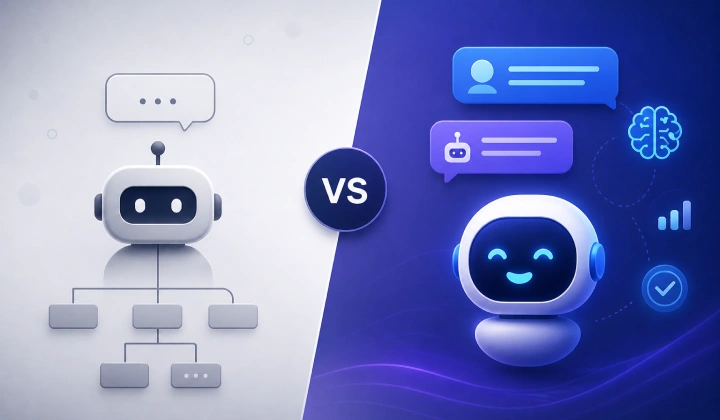
That’s the core difference in Conversational AI vs Chatbots.

$41B

Conversational AI market by 2030

3.5×

Average ROI per $1 invested in AI (IDC)

88%

People used chatbots recently

60%

Contact center cost reduction

What is a Traditional Chatbot?

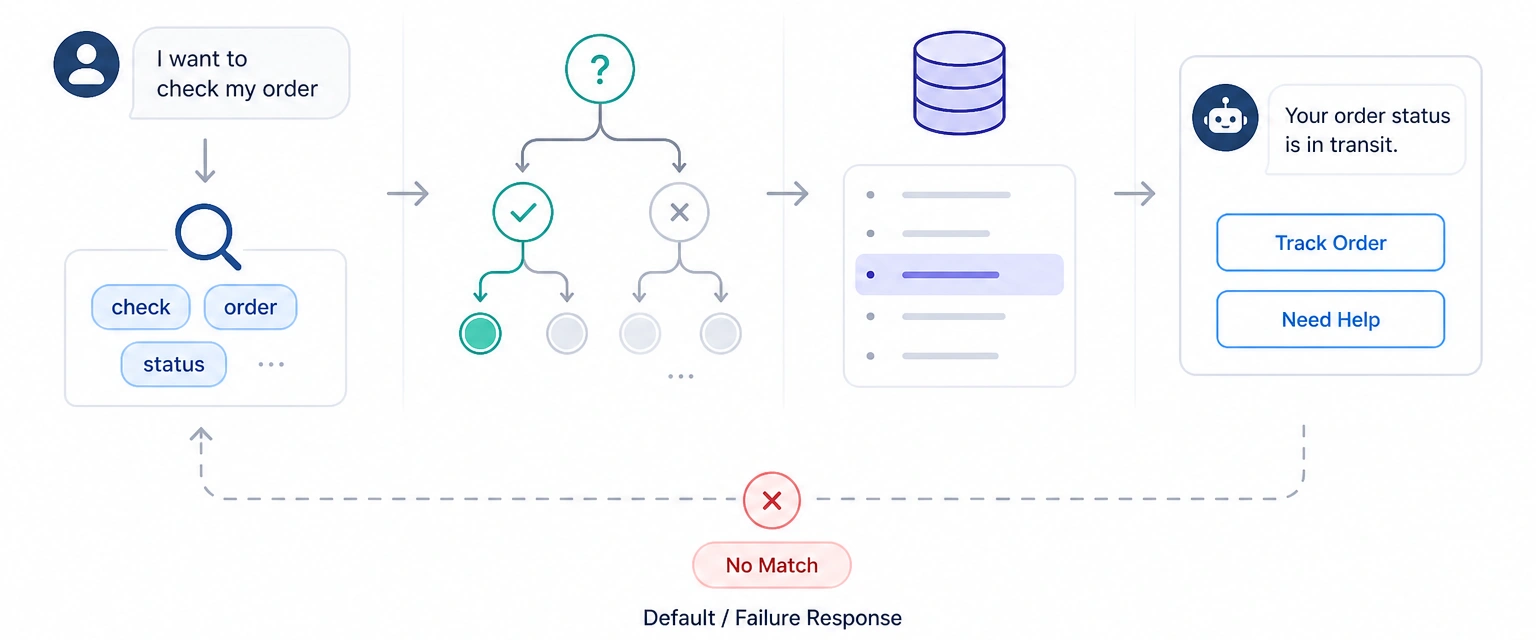
A traditional chatbot is a rule-based system designed to respond to user queries using predefined logic. It works on decision trees and pattern matching, which means it looks for specific keywords and then gives a fixed, pre-written response.

What is a Traditional Chatbot Azilen

For example, when a user types “track my order,” the chatbot matches this phrase and returns a stored answer. The process is simple, predictable, and easy to control, but also limited when the conversation becomes slightly different from what it was trained for.

Chatbots are useful in structured environments where questions are repetitive and follow a clear pattern. However, they struggle when users ask unexpected or complex questions.

Types of Chatbots in Conversational AI vs Chatbots

There are two common types of chatbots used by businesses today:

Chatbot Types Comparison
Type of Chatbot
How it Works
Best Use Cases
Limitation
Rule-based Chatbots Use if/then logic and fixed decision trees FAQs, lead capture, booking systems No understanding beyond scripts
AI-powered Chatbots Use basic NLP to identify intent Slightly flexible conversations No memory, context, or learning

Even with this upgrade, there is one important thing to understand in Conversational AI vs Chatbots.

Many so-called “AI chatbots” are still not truly intelligent. They mainly rely on keyword detection rather than real understanding.

If a user asks something in a different way or adds complexity, the chatbot often fails, either by repeating options or saying it did not understand.

What is Conversational AI?

Conversational AI is a more advanced approach that goes beyond scripts and keywords.

It combines technologies like Natural Language Processing (NLP), Natural Language Understanding (NLU), Machine Learning (ML), and Large Language Models (LLMs) to understand what a user actually means.

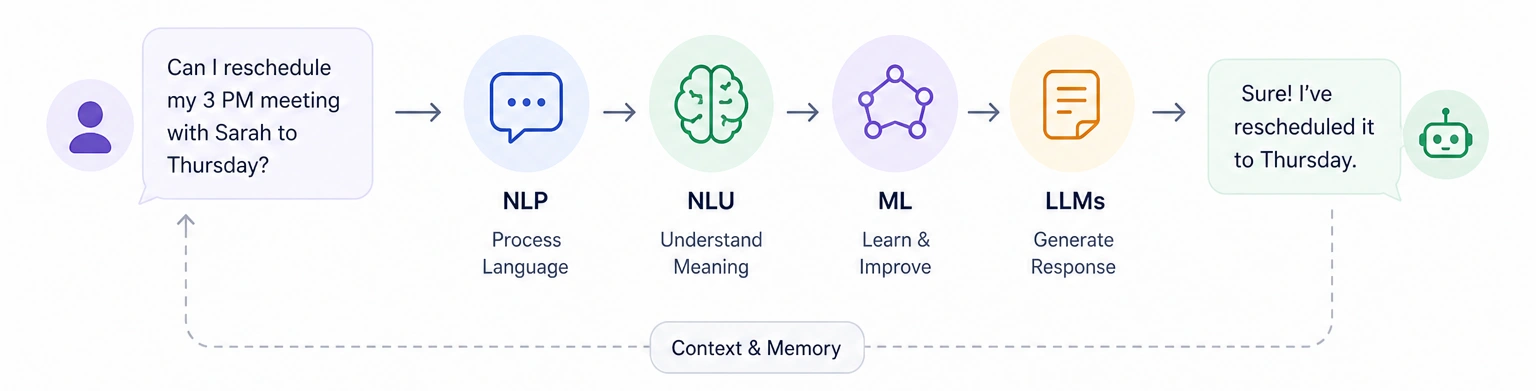
Flow diagram of an AI scheduling assistant: user asks to reschedule, then NLP/NLU/ML steps, LLMs generate a reply, and confirmation that it’s rescheduled to Thursday; context/memory loop back to the user.

This allows conversational AI systems to:

→ Understand context across multiple messages
→ Remember previous interactions within a conversation
→ Improve responses over time
→ Handle complex or unclear queries
→ Adapt tone and responses based on user input

Simple way to understand

A chatbot gives answers it already has.
Conversational AI understands the question and creates the answer.

Think of it like this:

A chatbot is like a vending machine: it gives fixed outputs.
Conversational AI is like a smart colleague: it listens, thinks, and responds.

Conversational AI vs Chatbots: Simple Comparison Table

We’ve broken this down into key differences that truly matter for both business and technical decisions. This quick table helps you clearly see how Conversational AI vs Chatbots perform in real-world use.

Traditional Chatbot vs Conversational AI
Dimension
Traditional Chatbot
Conversational AI
Verdict
Core Technology Decision trees, keyword matching, rule-based flows NLP + NLU + ML + LLMs + Deep Learning AI wins
Language Understanding Exact keyword match — typos and synonyms break it Understands intent, context, and semantic meaning AI wins
Context Memory None — every message is stateless Remembers full conversation context across turns AI wins
Learning Ability Static — requires manual updates Continuously learns from interactions via ML AI wins
Setup Complexity Low — drag-and-drop tools, fast deployment Higher — requires training data, tuning, integration Chatbot wins
Cost (Initial) $500 – $10,000 (SaaS tools) $15,000 – $200,000+ (custom build) Chatbot wins
Cost Per Interaction $0.10 – $0.50 (lower resolution rate) $0.25 – $0.50 (85–90% lower than human agents) Similar, AI ROI better
Personalization None — same response for every user Deep personalization using user history and behavior AI wins
Channel Support Typically text only (web/app) Text, voice, SMS, email, social — omnichannel AI wins
Scalability Scales easily — but quality doesn’t scale Scales both volume and quality simultaneously AI wins
Best Use Case FAQs, lead capture, appointment booking, simple flows Complex support, sales assistant, healthcare triage, HR Depends on need
Time to Value Days to weeks 3–6 months ramp-up for full returns Chatbot wins

Conversational AI vs Chatbots Explained (Watch This Quick Video)

This short video clearly explains Conversational AI vs Chatbots, how they work and where each fits. It helps you quickly understand the real difference with simple examples.

The difference between Conversational AI vs Chatbots directly affects results.

Chatbots work for simple tasks, while conversational AI handles real conversations. Choosing the right one decides whether your investment delivers value or not.

How Conversational AI and Chatbots Actually Works

Understanding how these systems work internally makes the difference in Conversational AI vs Chatbots very clear. Both may look similar from the outside, but their backend structure is completely different.

Inside a Rule-Based Chatbot (Simple Working)

Chatbot Working

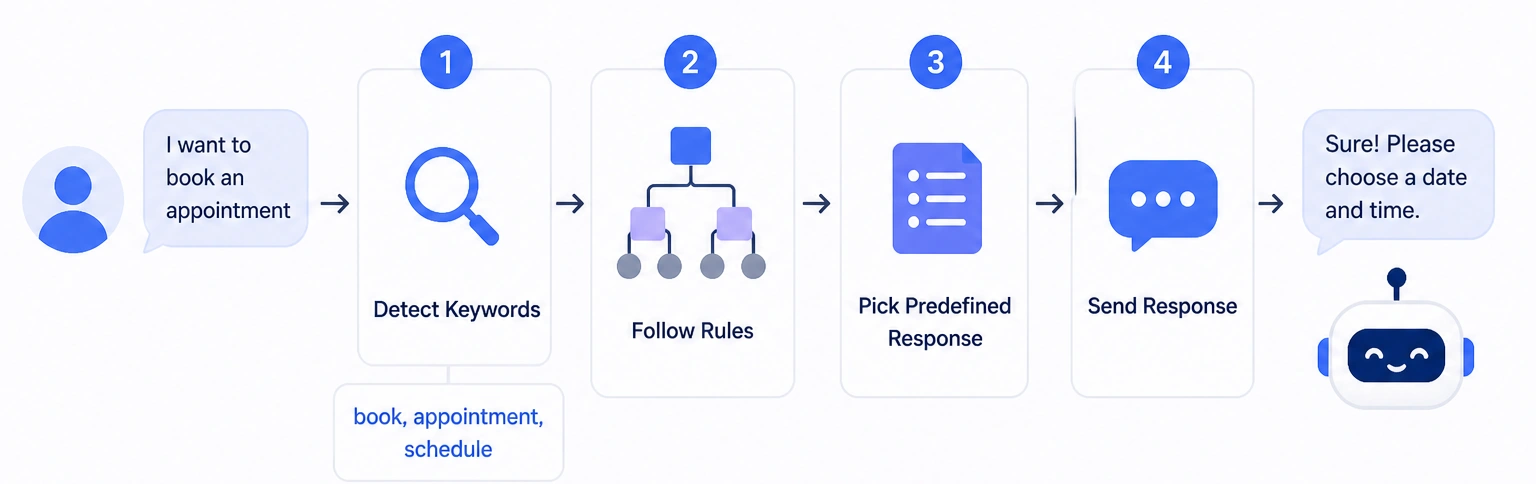
A rule-based chatbot works on a fixed structure. It follows a decision tree created by a developer, where every possible user input is mapped to a predefined response.

When a user types something like “I want to check my order,” the chatbot scans for keywords such as “check,” “order,” or “status” and then selects the closest matching path. If the input does not match any predefined rule, the chatbot simply fails or gives a default reply.

This means the chatbot only works as well as the rules written for it. And since real users ask questions in many different ways, the system often breaks outside its defined scope.

Here’s how a chatbot typically works step by step:

Layer 1 → Keyword or pattern matching
Layer 2 → Decision tree navigation
Layer 3 → Predefined response lookup
Layer 4 → Output shown as text or buttons

Inside Conversational AI (Advanced Working)

Conversational AI Working

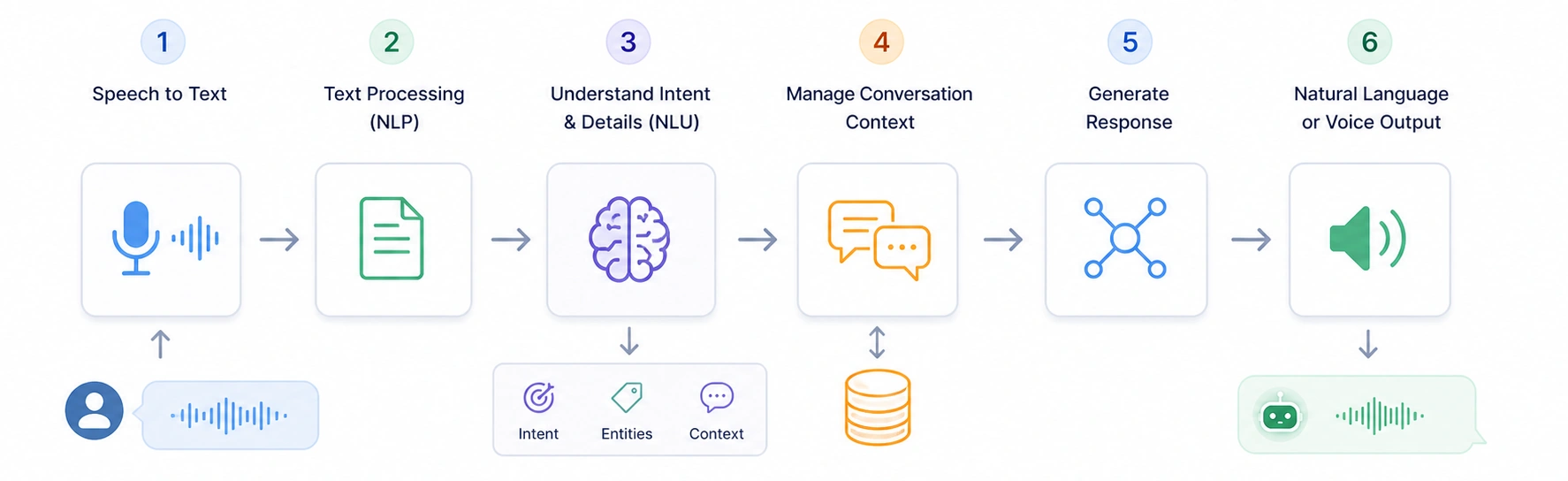
Now, looking at Conversational AI vs Chatbots, conversational AI follows a much more advanced and layered process. Instead of just matching words, it tries to understand meaning, context, and intent.

If a user says, “Can I reschedule my 3 PM meeting with Sarah to Thursday?” the system breaks this down into:

  • Intent → reschedule
  • Entities → time (3 PM), person (Sarah), day (Thursday)
  • Context → an existing meeting

This allows it to respond intelligently, not just react to keywords.

The system also remembers what was said earlier in the conversation, which helps it give more relevant answers.

Here’s how conversational AI works step by step:

Stage 1 → Speech to text (if voice input is used)
Stage 2 → Text processing and cleaning (NLP)
Stage 3 → Understanding intent and details (NLU)
Stage 4 → Managing conversation context (Dialogue Manager)
Stage 5 → Generating the response (AI model or retrieval system)
Stage 6 → Converting into natural language or voice output

Build Smarter with Azeon

Azeon Conversational AI

If your goal is to go beyond basic chatbots and build real conversations, this is where conversational AI comes in, and where Azeon fits.

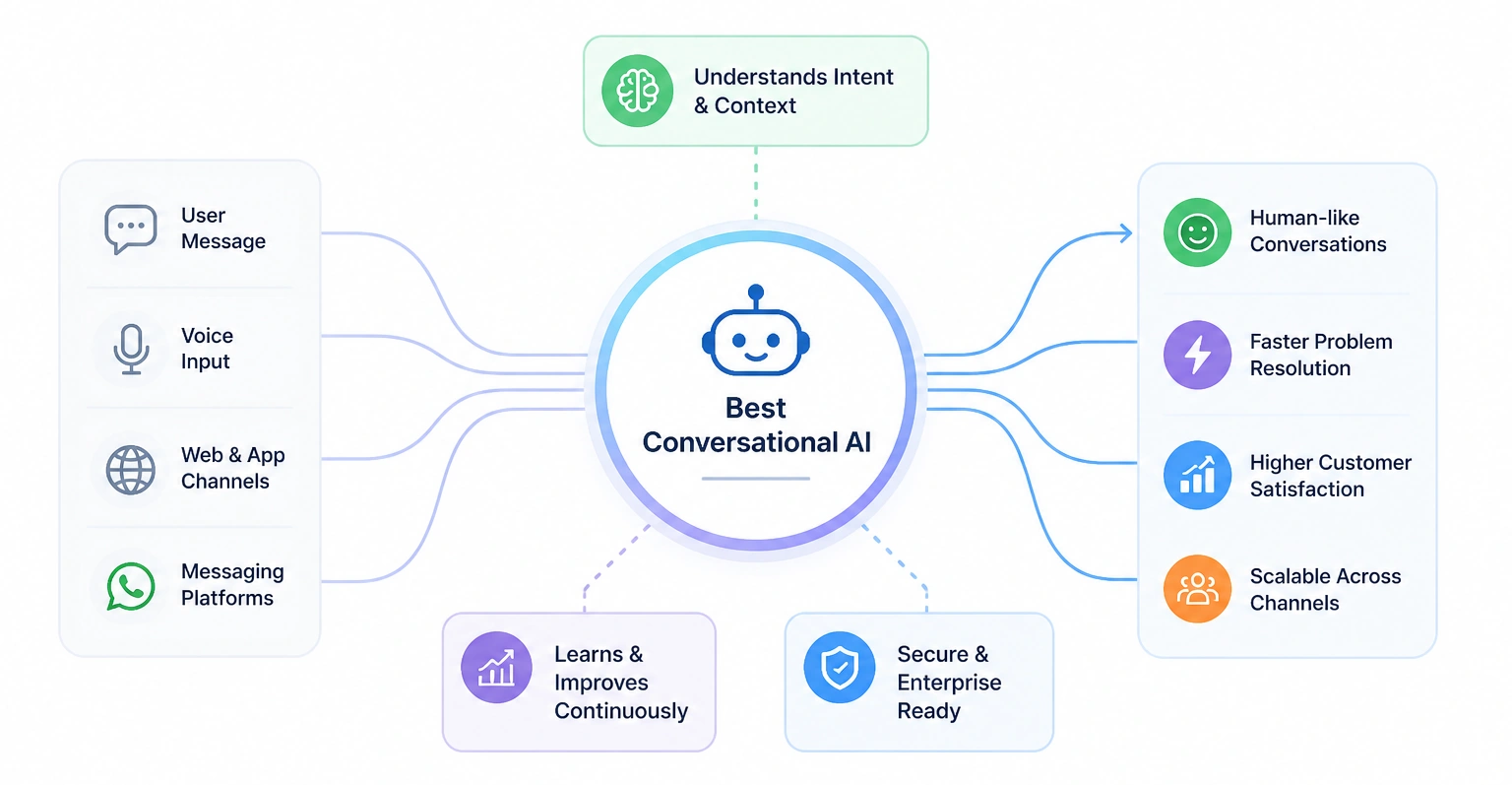
Azeon is designed for businesses that need more than fixed replies.
→ Handles complex, multi-step conversations
→ Understands intent, not just keywords
→ Maintains context across interactions
→ Learns and improves over time
→ Supports multiple channels like chat and voice

In the Conversational AI vs Chatbots journey, Azeon helps you move from simple automation to intelligent, scalable conversations that actually solve user problems.

Why Azilen Technologies Stands Out in Conversational AI

In today’s digital landscape, customer conversations are no longer simple or predictable. Businesses need systems that understand users, handle complexity, and deliver consistent experiences across channels. This is where Conversational AI vs Chatbots becomes important, and where Azilen Technologies brings a strong advantage.

Azilen does not approach conversational AI as a basic chatbot solution. It builds intelligent systems where understanding, decision-making, and response work together in real time. The focus is not just on replying, but on solving user queries effectively.

As a digital transformation partner, Azilen develops conversational AI solutions that are scalable, adaptive, and built for real business use.

Intent-Driven Conversations: Understands what users mean, not just what they type

Context-Aware Systems: Maintains conversation flow across multiple interactions

Enterprise Integration: Connects with CRMs, APIs, and existing business systems smoothly

Continuous Learning: Improves responses over time using AI and real interaction data

Automation at Scale: Handles high volumes of conversations without reducing quality

Multi-Channel Support: Delivers consistent experience across chat, voice, and messaging platforms

Azilen focuses on building conversational AI systems that move beyond scripts and fixed responses. This approach helps businesses improve customer experience, reduce manual workload, and create smarter, more efficient interactions at scale.

FAQs: Agentic AI for KYC Automation

1. What is the difference between conversational AI and chatbots?

The key difference between conversational AI and chatbots lies in intelligence and flexibility. Chatbots follow fixed rules and respond using predefined scripts, which works for simple tasks.

Conversational AI understands user intent, context, and language using technologies like NLP and machine learning, allowing it to handle complex queries and deliver more natural, human-like conversations.

2. Which is better for business: conversational AI or chatbots?

Choosing between conversational AI and chatbots depends on your business needs. Chatbots are suitable for simple, repetitive tasks like FAQs and basic support.

Conversational AI is better for handling complex queries, personalised interactions, and high-volume conversations. Businesses aiming for better customer experience and scalability usually benefit more from conversational AI solutions.

3. How does conversational AI work compared to chatbots?

Chatbots work using rule-based systems, decision trees, and keyword matching to provide fixed responses. Conversational AI uses NLP, NLU, and machine learning to understand intent, extract meaning, and respond intelligently.

It also maintains context across conversations and improves over time, making interactions more accurate and dynamic compared to traditional chatbot systems.

4. Can conversational AI replace traditional chatbots?

Conversational AI can replace traditional chatbots in many cases, especially where conversations are complex or require understanding context.

However, chatbots still serve a purpose for simple, structured tasks with predictable inputs. Many businesses start with chatbots and later upgrade to conversational AI as their needs grow and user expectations increase.

5. Is conversational AI more expensive than chatbots?

Conversational AI typically requires higher initial investment compared to chatbots due to advanced technologies and setup. However, it often delivers better long-term value by improving customer experience, reducing manual workload, and handling more interactions efficiently.

Chatbots are cost-effective for simple use cases, while conversational AI offers stronger ROI for scalable, complex applications.

Glossary

Conversational AI: Technology that understands, learns, and responds to human language in a natural way

Chatbot: A rule-based system that replies using predefined scripts and fixed logic

Natural Language Processing (NLP): The ability of machines to read, process, and understand human language

Natural Language Understanding (NLU): A part of NLP that focuses on understanding the meaning and intent behind user input

Machine Learning (ML): A method where systems learn from data and improve performance over time

Large Language Models (LLMs): Advanced AI models trained on large datasets to generate human-like responses

Intent Recognition: Identifying what the user wants to do or ask in a conversation

Context Awareness: The ability to remember and use past messages to improve current responses

Decision Tree: A rule-based flow that guides chatbots to select predefined responses

Multi-Channel Support: The ability to interact across platforms like chat, voice, apps, and messaging services

Kulmohan Makhija
Kulmohan Makhija
Vice President – Growth & Enterprise Strategy

Kulmohan Makhija is an enterprise technology and business strategy writer with over 12 years of experience analyzing digital transformation across global and European markets. His work focuses on applied artificial intelligence, product engineering, enterprise architecture, and large-scale legacy modernization. He explores how complex organizations modernize core systems, adopt AI responsibly, and align innovation with regulatory, cultural, and operational realities — particularly within the UK and broader European technology landscape. With a pragmatic enterprise perspective, Kulmohan emphasizes transformation that delivers measurable impact without disrupting mission-critical operations. His writing bridges executive strategy with technical depth, providing clarity for technology leaders, product teams, and decision-makers navigating modernization journeys.

Related Insights