Skip to content

Everything Your UK Business Needs to Get DPP-Ready: The Full Checklist

Featured Image

TL;DR

Getting DPP-ready isn’t a single task. It’s a structured transformation across six distinct pillars, your data, your technology, your people, your suppliers, your processes, and your governance.

Each pillar has its own requirements. Miss one, and your entire DPP programme is exposed. This guide breaks down every single thing a UK enterprise needs to have, build, and organise before going live with a compliant Digital Product Passport, so that nothing falls through the cracks when 2027 deadlines arrive.

Importantly, this is written from the perspective of a DPP service provider. At Azilen Technologies, we’ve worked closely with UK enterprises on digital transformation programmes, and this checklist reflects precisely what we assess when a business comes to us asking “what do we need?”

Rather than leaving you with vague advice, we’ve made this exhaustive. By the time you finish, you’ll know exactly where you stand, and exactly what still needs doing.

Here’s a stat that should stop you scroll. Only 43% of UK industrial businesses say they are ready for Digital Product Passports, according to 2025 research from Forterro.

Meanwhile, the first mandatory DPP deadline, for industrial and EV batteries, hits on 18 February 2027. That’s not a concept paper. That’s a live legal requirement with market access consequences.

Moreover, there’s a supply chain ripple effect that most businesses underestimate. Even if your product doesn’t directly need a DPP yet, if you supply components to manufacturers who sell into the EU, they’ll need your data to complete their DPP.

In other words, your customers are already starting to ask for this. As a result, UK suppliers who can’t provide structured, verified product data risk losing EU contracts well before 2027 enforcement begins.

The Numbers Are Speaking

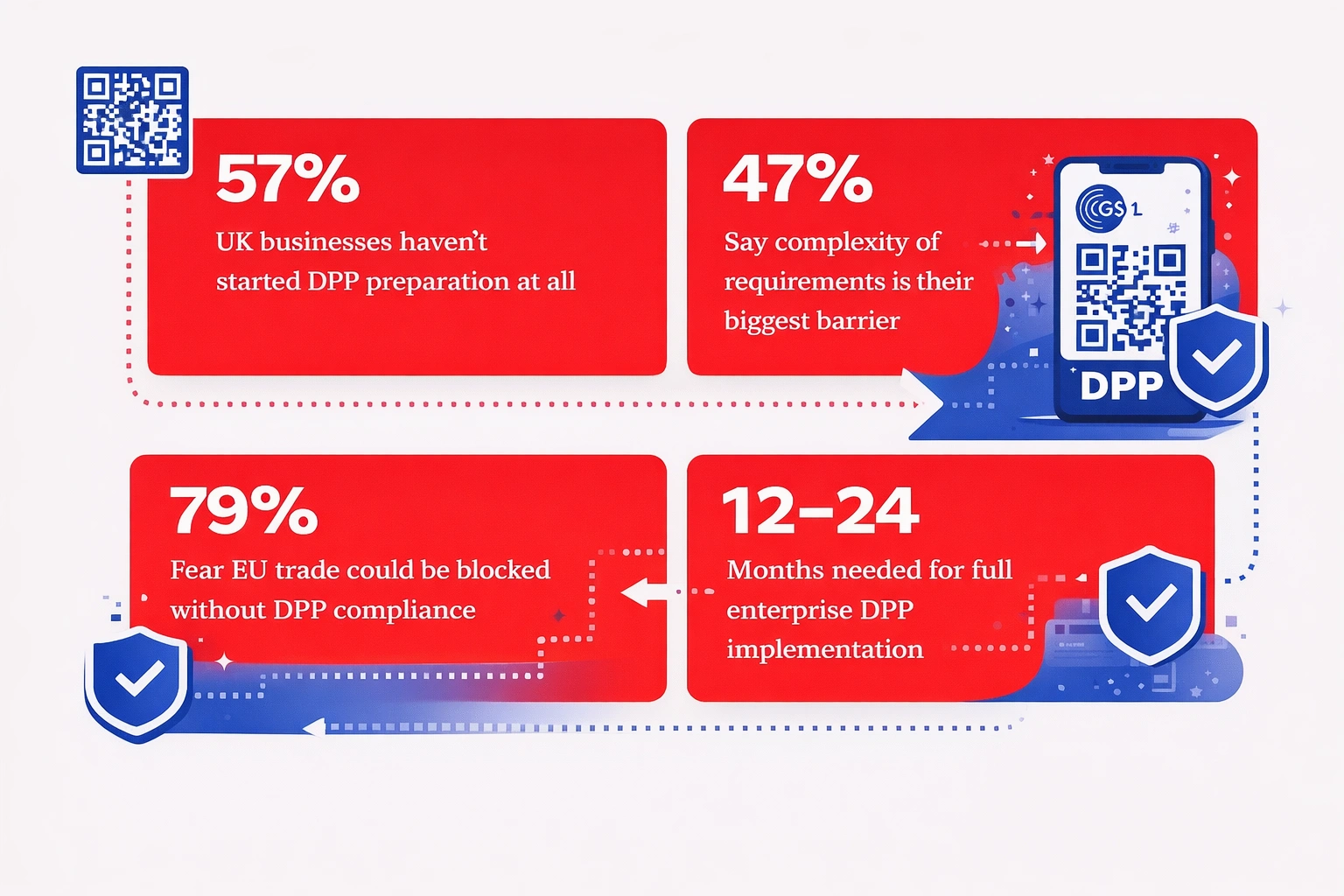
Research from GS1 UK paints a stark picture. Just 16% of UK exporters feel fully prepared for DPP regulation.

Simultaneously, 79% of businesses fear they could be blocked from EU trade if they miss the requirements. That’s not a fringe concern, that’s nearly four out of five exporters worried about losing EU market access.

DPP readiness among UK businesses

That last figure deserves special attention. A typical enterprise Digital Product Passport rollout across a full product catalogue takes 12 to 24 months.

Therefore, if your first mandatory deadline is February 2027, the clock to start was actually January 2025. At best, there’s still time, but only if you move purposefully and immediately.

The GDPR Parallel: “The Digital Product Passport will be to product manufacturing what GDPR was to data,” said Claudia Schmidhäuser, Senior Principal at Forterro.

“We saw what happened when companies weren’t ready for GDPR.” Penalties, rushed implementations, and expensive last-minute fixes. The same pattern is forming with DPP, and the stakes include EU market access, not just fines.

The Six Pillars of DPP Readiness

Before diving into each pillar, it’s important to understand where most organisations currently stand.

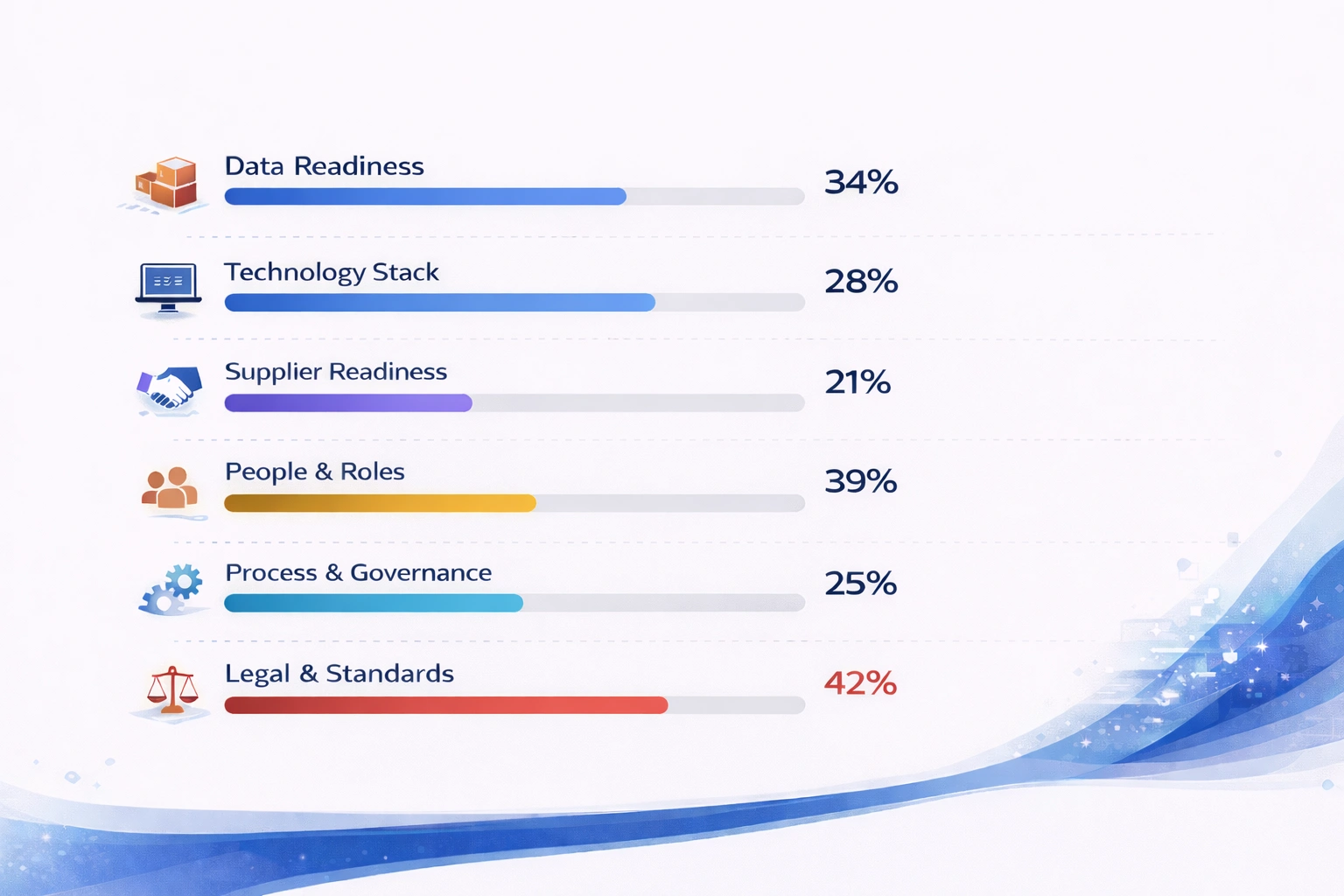
The benchmarks below represent indicative readiness levels across key DPP dimensions, based on industry research, expert insights, and Azilen’s implementation experience across enterprise engagements.

Six Pillars of DPP Readiness

As the bars show clearly, supplier readiness is the weakest point across UK enterprises.

That aligns with what Azilen sees in the field consistently, businesses are reasonably aware of the regulation, but completely unprepared when it comes to actually pulling structured data from their supply chains.

Let’s now go deep on each pillar.

Pillar One: Your Data (What the DPP Must Actually Contain)

Data is the soul of a Digital Product Passport. Without accurate, structured, and verified product data, everything else, the technology, the QR codes, the supplier workflows, is just empty infrastructure. So let’s be specific about what data you actually need.

The Core Data Categories

Every DPP, regardless of product category, must contain six core types of information. Think of these as the non-negotiables. Beyond these, sector-specific delegated acts add further requirementsm but start here.

DPP Data Requirements
Data Category
Specific Fields Required
Where It Typically Lives
Product Identity GTIN or SGTIN (GS1), batch/serial number, model name, manufacturing date, country of manufacture, importer EORI number ERP system, product master data
Material Composition Fibre/component breakdown by % weight, recycled content %, REACH substances of concern, hazardous material declarations PLM system, supplier declarations, test labs
Environmental & Carbon Footprint Product Carbon Footprint (PCF) in kg CO₂e — cradle to gate, transport, use phase. Must reference PEF or ISO 14067 methodology. Energy consumption, water usage (sector-dependent) LCA tools, emission factor databases (e.g. Climatiq), Scope 3 data
Durability & Repairability Expected lifespan, repairability score, spare part availability and lead time, disassembly instructions, repair event history Engineering specs, service manuals, after-sales systems
Circularity & End of Life Recyclability %, recycled content sources, disassembly guidance, designated collection/recycling routes, reuse potential score Product design data, waste management partnerships
Compliance & Certifications CE marking data, RoHS declarations, REACH compliance, third-party certifications (GOTS, FSC, etc.), declaration of performance (DoP) Compliance team, certification bodies, quality management system

Data Readiness Checklist

✅ Complete product data inventory across all in-scope SKUs (identify what exists and what’s missing)
✅ Material composition data validated to % weight level for all components
✅ Product Carbon Footprint (PCF) calculation completed using PEF or ISO 14067 methodology
✅ Recycled content % confirmed with supplier evidence, not just declarations
✅ REACH substances of concern identified and documented per product
✅ Repairability score calculated and spare part availability confirmed
✅ End-of-life routing documented per product category
✅ All existing data structured in machine-readable format (JSON-LD / GS1 Digital Link)
✅ Data governance model in place, owner assigned for every field
✅ Version control process defined for when product specs or suppliers change

Pillar Two: Your Technology (The Infrastructure Behind a Working DPP)

Technology is where most businesses start, and where most businesses go wrong by starting too small.

A DPP isn’t a digital label or a QR code generator. Rather, it’s a complex, multi-system infrastructure that connects your product development, supply chain, sustainability, and customer experience systems into a single, continuously-updated data ecosystem.

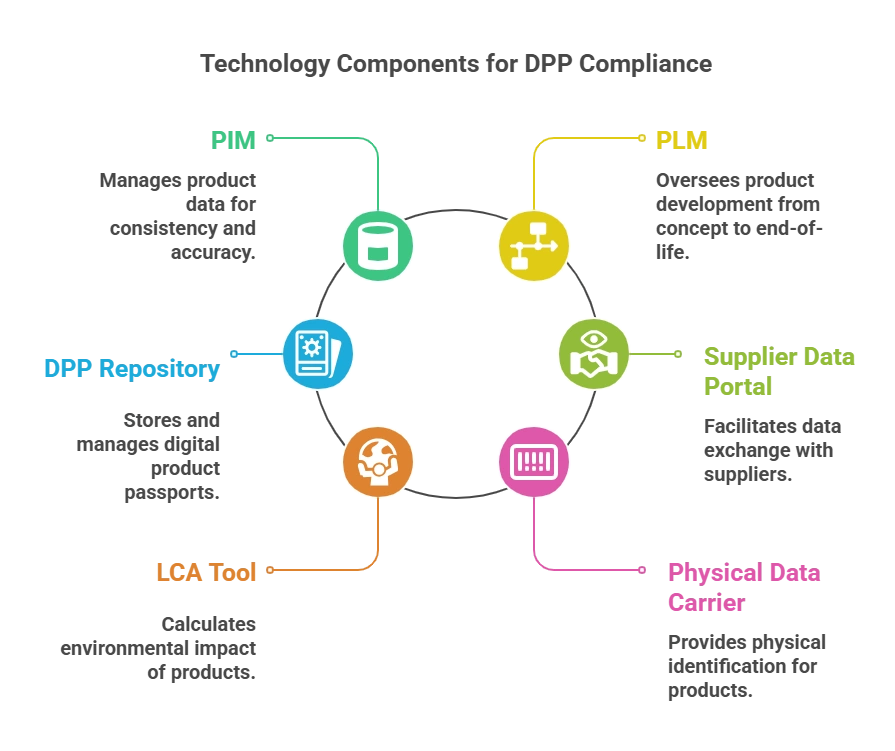
The Six Technology Components You Need

UK Business DPP-Ready

A DPP-ready ecosystem is built on interconnected systems that manage, validate, and distribute product data. At the core, a Product Information Management (PIM) system acts as the single source of truth, supported by Product Lifecycle Management (PLM) platforms that provide verified engineering and materials data.

A dedicated DPP repository then creates and serves compliant digital passports, ensuring interoperability and standards alignment.

Supporting this, supplier data portals enable structured data collection, while LCA tools calculate Product Carbon Footprint using recognised methodologies. Physical data carriers connect the digital passport to the product, ensuring end-to-end traceability.

And as discussed in “Why UK Manufacturers Who Adopt DPP Early Will Dominate EU Markets by 2027,” early adoption is quickly becoming a competitive necessity, not a choice.

Technology Readiness Checklist

✅ PIM system selected and configured as central product data hub
✅ PLM system connected to PIM for upstream engineering and material data
✅ DPP repository platform selected, supports GS1 Digital Link and RBAC
✅ Supplier data portal live with structured onboarding workflows
✅ API integrations mapped and tested between ERP, PLM, PIM, and DPP repository
✅ Carbon calculation tool integrated, outputs PCF in PEF-aligned format
✅ Physical data carriers (QR/NFC/RFID) specified, tested for product durability
✅ EU central registry interoperability confirmed (July 2026 go-live)
✅ Cloud hosting configured with GDPR-compliant EU data residency

Pillar Three: Your Suppliers (The Hardest Part)

Here’s the uncomfortable truth about DPP. The majority of the data your passport needs doesn’t come from inside your organisation.

It comes from your suppliers, sometimes from Tier 2 and Tier 3 suppliers who have never heard of ESPR and have no interest in filling out digital questionnaires.

Comment
by u/Plastic_Catch1252 from discussion
in BuyFromEU

The Supply Chain Data Problem

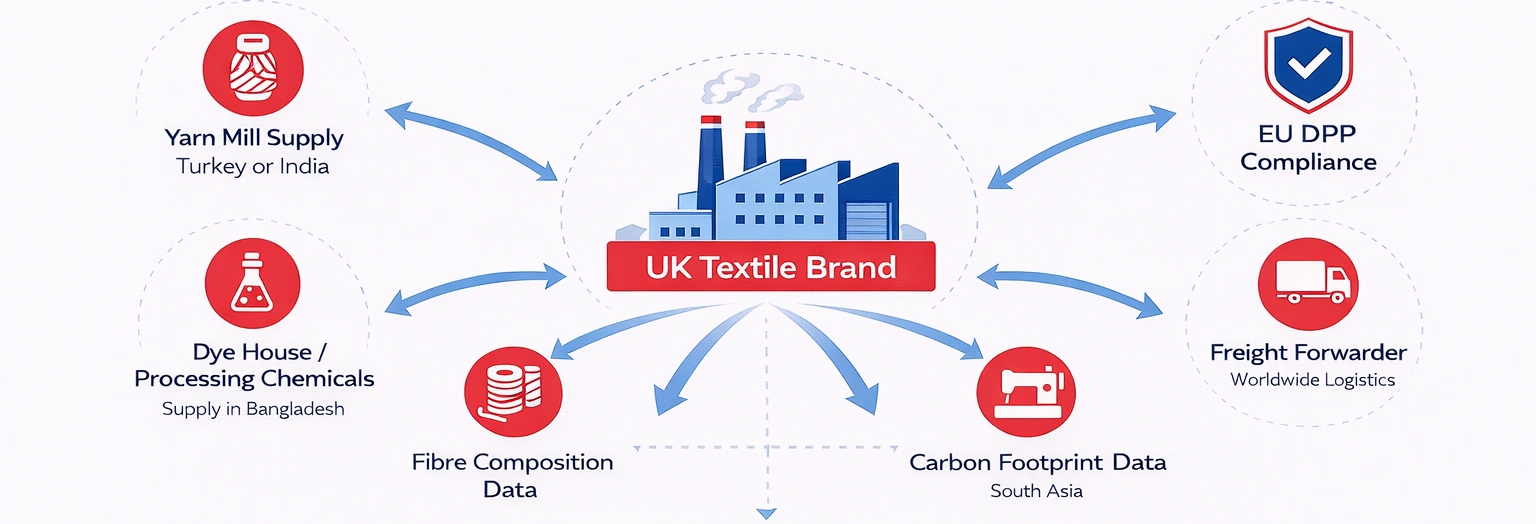
UK textile brand compliance flowchart

Consider what a compliant DPP for a UK textile brand actually requires.

You need fibre composition data from your yarn mill (probably in Turkey or India).

You need processing chemical data from your dye house (possibly in Bangladesh).

You need carbon footprint data from your fabric mill and cut-and-sew factory.

You need logistics emissions from your freight forwarder.

None of these parties have historically needed to provide this data. Moreover, many of them currently operate on paper, spreadsheets, or outdated ERPs with no API capability.

This is exactly where automation begins to play a critical role. As explored in “AI and Digital Product Passport: How UK Manufacturers Are Using AI DPP to Automate Compliance in 2026,” leading manufacturers are increasingly using AI to streamline data collection, validation, and standardisation across fragmented supply chains.

Therefore, supplier readiness isn’t just a data problem. It’s a relationship problem, a capability problem, and sometimes a commercial negotiation problem.

What If a Supplier Won’t Share Data?

This happens more often than businesses expect. Suppliers may refuse to share data for several legitimate reasons, trade secret concerns, IP protection, lack of internal capability, or simple unwillingness. Here’s how to handle it practically.

First, define the minimum viable dataset required to sell into EU channels and make that non-negotiable in procurement contracts going forward.

Second, build incentives for data sharing, preferred supplier status, faster payment terms, or co-investment in their data systems.

Third, offer a selective sharing mechanism where suppliers share DPP-required fields only, without exposing their entire bill of materials. Finally, where necessary, use third-party assurance firms to verify claims independently without requiring the supplier to expose proprietary details.

Supplier Readiness Checklist

✅ Full Tier 1-4 supply chain mapped and documented
✅ Key suppliers assessed for DPP data capability
✅ Supplier contracts updated with DPP data obligations and audit rights
✅ Standardised data submission templates shared with all in-scope suppliers
✅ Supplier portal live, tested, and supported with training
✅ Risk-based verification defined for high-impact materials and regions
✅ Change notification workflow in place, supplier changes trigger DPP review
✅ Escalation path defined for non-cooperative suppliers

Pillar Four: Your People (Who Needs to Own What)

DPP readiness fails when it belongs to “everyone”, because everyone means no one.

Without clear ownership and decision-making authority, DPP initiatives stall. Competing priorities across business units slow things down. Ultimately, the deadline arrives and nobody has the full picture. The fix is simple in theory but requires genuine organisational commitment: assign explicit ownership at every level.

The DPP team you need to build

Notice something about the team above, it spans IT, procurement, sustainability, legal, and the C-suite. That’s because DPP touches every part of the organisation.

But this doesn’t mean you need to build and manage a large, complex team internally. With the right partner, these capabilities come together seamlessly.

At Azilen, we bring this cross-functional expertise under one roof, handling the complexity, coordination, and execution, so your team stays focused on business priorities while we ensure your DPP readiness is delivered end-to-end.

“When digitalisation is left to a single individual, the opportunity is lost. Collaboration, training, and internal advocacy are key to DPP success.”

– Laura van den Aarssen, CoE-DPP / TNO Vector, DPP Festival 2025

People Readiness Checklist

✅ Executive-level ownership defined without overloading internal leadership
✅ Programme management handled without building a full internal team
✅ Data ownership and governance structured for accuracy and control
✅ Technology and integrations managed seamlessly with minimal internal effort
✅ Sustainability and LCA expertise supported internally or through partners like us
✅ Supplier onboarding coordinated end-to-end without burdening procurement teams
✅ Compliance and regulatory alignment guided without requiring in-house specialists
✅ Team awareness enabled with minimal training overhead

Pillar Five: Your Processes (Building DPP Into How You Work)

dpp_governance_animation

Technology and people are necessary but not sufficient. Without the right processes, your DPP programme will degrade over time.

New products launch without passports. Supplier changes go unrecorded. Certificates expire without renewal. Data drifts out of date. Slowly but surely, your compliance position erodes, while you think you’re covered.

The Core Processes to Establish DPP

Good DPP governance requires three categories of process: creation processes (how passports get built for new products), maintenance processes (how they stay accurate over time), and response processes (how you handle regulatory queries, audits, and data correction requests).

Creation Processes

Every new product entering your portfolio should trigger a DPP creation workflow automatically. This means integrating DPP data collection into your new product introduction (NPI) process.

Before a product can be approved for EU market launch, it needs a complete, validated passport. Building this as a gate review criterion ensures compliance by design rather than compliance as an afterthought.

Maintenance Processes

Products change. Suppliers change. Certifications expire. Energy consumption data updates. Manufacturing locations shift.

Each of these changes must trigger a DPP review and update cycle. Specifically, you need a defined Bill of Materials (BOM) change workflow that automatically flags DPP impacts whenever product specifications change in your PLM system.

Response Processes

Market surveillance authorities can request access to DPP evidence quickly. EU retailers increasingly make DPP data a condition of product listing.

Your response process must allow you to retrieve, verify, and share detailed compliance evidence within 48 to 72 hours of a request. Without pre-built response workflows, this becomes a scramble every time.

UK Sector DPP Revenue Table
UK Sector
DPP Data Advantage
B2B Premium Mechanism
Revenue Potential
Automotive Parts Component-level provenance, material safety data, recycled content % Subscription access for authorised repairers; premium for EV battery data £500K–£5M/year
Textiles & Apparel Fibre composition, dyeing chemicals, factory certifications, carbon footprint Premium supplier tier for EU fashion brands; resale authentication data £100K–£2M/year
Electronics Manufacturing PCB composition, conflict minerals, battery chemistry, repair schematics Licensed repair data subscriptions; recycler access fees for e-waste £1M–£10M/year
Construction Materials Embodied carbon, recyclability, fire safety data, material passports Building information modelling (BIM) integration; property developer premiums £200K–£3M/year

Process & Governance Checklist

✅ DPP creation workflow integrated into NPI gate process
✅ BOM change trigger workflow live with automatic DPP review flags
✅ Certificate renewal tracking system in place with automated expiry monitoring
✅ Audit response process defined with evidence retrieval within 48 hours
✅ DPP compliance scorecard established with regular KPI tracking
✅ Mock audit exercise completed before first mandatory deadline
✅ Escalation process defined for data disputes and supplier non-compliance

Pillar Six: Your Legal & Regulatory Foundation

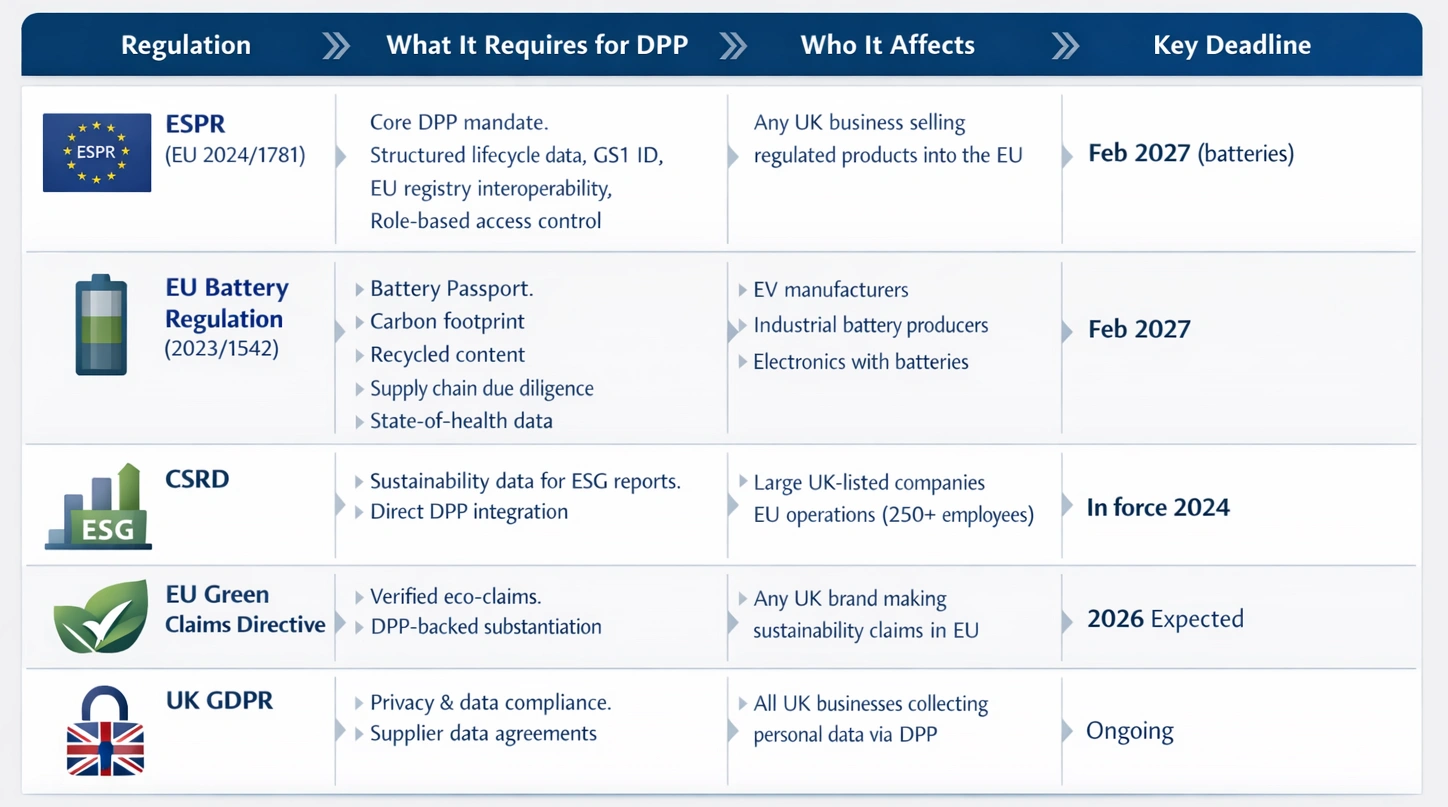
Regulatory landscape affecting UK businesses

DPP compliance lives at the intersection of multiple regulations simultaneously. Understanding which apply to your business, and how they interact, prevents costly overlaps, duplicate work, and missed requirements.

The Regulatory Landscape That Affects You

DPP Regulatory Landscape
Regulation
What It Requires for DPP
Who It Affects
Key Deadline
ESPR (EU 2024/1781) Core DPP mandate requiring structured lifecycle data, GS1-compliant identifiers, EU registry interoperability, and role-based access control Any UK business selling regulated products into the EU Feb 2027 (batteries)
EU Battery Regulation (2023/1542) Mandatory Battery Passport requiring carbon footprint, recycled content %, supply chain due diligence, and state-of-health data EV manufacturers, industrial battery producers, electronics with batteries Feb 2027
CSRD (Corporate Sustainability Reporting) Requires product-level sustainability data for ESG reporting, where DPP data can directly support compliance Large UK-listed companies and firms with EU operations (250+ employees) In force 2024
EU Green Claims Directive Requires environmental claims to be backed by verified data, with DPP acting as proof against greenwashing Any UK brand making sustainability claims in EU markets Expected 2026
UK GDPR Requires compliance for any consumer or supplier data collected via DPP, including privacy impact assessments All UK businesses processing personal data Ongoing

Legal & Regulatory Checklist

✅ Products assessed against ESPR scope with applicable delegated acts identified
✅ Battery Regulation obligations confirmed where products include batteries
✅ CSRD requirements mapped with DPP data aligned to reporting fields
✅ Green Claims Directive reviewed with DPP data supporting all claims
✅ UK GDPR impact assessment completed for consumer-facing DPP touchpoints
✅ GS1 Digital Link compliance confirmed within the DPP platform
✅ ISO/IEC 15459:2015 identifiers implemented for all product IDs

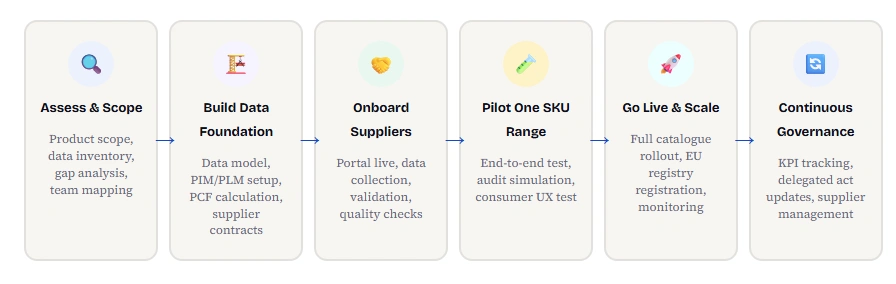
The DPP Readiness Journey: Step by Step

Here’s how the entire DPP readiness journey flows — from initial assessment all the way through to live, compliant passports and continuous improvement.

DPP READINESS → GO-LIVE → SCALE

Months 1–3 (Assessment & Foundation)

Product scope confirmation, data gap analysis, team assembly, governance structure, technology platform selection, initial supplier mapping

Months 4–8 (Data & Technology Build)

PIM/PLM configuration, DPP repository setup, supplier portal launch, PCF calculations for pilot SKUs, API integrations, supplier onboarding Wave 1

Months 9–12 (Pilot & Validate)

Pilot product line live, end-to-end audit simulation, consumer UX testing, security review, regulatory query simulation, KPI baseline established

Months 13–24 (Scale & Govern)

Full catalogue rollout by category wave, EU registry registration, ongoing supplier onboarding, delegated act monitoring, continuous improvement cycle

The Summary You Actually Need

DPP readiness is not a technology problem. It’s not a data problem. It’s not a supplier problem. Rather, it’s all three, simultaneously, plus people, process, and regulatory alignment.

The businesses that treat it as a single-team project will struggle. Conversely, the ones that treat it as an enterprise-wide programme will not only meet the 2027 deadlines comfortably, but will also build competitive infrastructure that generates value far beyond compliance.

Six pillars. Thirty-plus checklist items. One consistent message: start now, start structured, and don’t underestimate the supplier data challenge. Everything else can be learned, bought, or built. The supply chain data, however, takes time that can’t be compressed.

Azilen’s Strategic Approach: Turning DPP Readiness Into a Structured, Scalable Advantage

Digital Product Passport readiness is often approached as a checklist. But in reality, it is a multi-layered transformation across data, systems, suppliers, and governance.

As outlined across the six pillars, missing even one dimension creates gaps that can delay compliance and disrupt EU market access.

Azilen is a Digital Transformative Company working with UK enterprises to operationalise DPP readiness as a structured, end-to-end programme. The focus is not just to “get ready,” but to build systems that remain compliant, scalable, and resilient as regulations evolve.

Rather than treating DPP as a one-time implementation, Azilen embeds it into the way organisations manage product data, supplier relationships, and regulatory processes.

→ Pillar-Aligned Data Foundation: Azilen structures product data across identity, materials, carbon footprint, durability, circularity, and compliance. This ensures every DPP is complete, verifiable, and audit-ready from day one.

→ Connected Technology Ecosystem: Instead of isolated tools, Azilen integrates PIM, PLM, DPP repositories, and supplier portals into a unified architecture. This creates a continuously updated data environment rather than static passport records.

→ Supplier Data Enablement Framework: Recognising that most DPP data sits outside the organisation, Azilen builds supplier onboarding systems, validation workflows, and incentive mechanisms to ensure consistent and reliable data flow across the supply chain.

→ Governance-Driven Operating Model: Clear ownership across IT, procurement, sustainability, and legal ensures that DPP does not stall. Defined roles, workflows, and escalation paths keep the programme moving without fragmentation.

→ Process-Embedded Compliance Workflows: DPP is integrated into product lifecycle processes, from new product introduction to supplier changes and audit responses. Compliance becomes part of operations, not an afterthought.

→ Scalable Rollout and Continuous Adaptation: From pilot SKUs to full catalogue deployment, Azilen enables phased scaling while continuously aligning with new delegated acts, regulatory updates, and market expectations.

Azilen approaches Digital Product Passports as an enterprise capability, not a project, ensuring UK businesses are not only ready for 2027 deadlines, but also equipped to sustain compliance and compete effectively in EU markets long after.

FAQs: DPP Early Adopter Advantage for UK Manufacturers

What does it take for UK businesses to become DPP-ready?

DPP readiness for UK businesses involves more than compliance. It requires structured product data, integration across systems like ERP, PLM, and PIM, supplier data alignment, and strong governance. Businesses must ensure that product, material, and environmental data is complete, accurate, and machine-readable. A well-designed Digital Product Passport system ensures long-term scalability, audit readiness, and smooth alignment with evolving EU regulatory requirements.

When should UK manufacturers start preparing for Digital Product Passport requirements?

UK manufacturers should begin preparing for Digital Product Passport requirements immediately. With EU regulations starting to enforce DPP across sectors from 2027, and implementation timelines often taking 12 to 24 months, delaying preparation creates serious risk. Early adoption provides a competitive advantage, ensuring smoother compliance, better supplier alignment, and uninterrupted access to EU markets as regulations become mandatory.

Why is supplier data the biggest challenge in DPP implementation?

Supplier data is the most complex part of DPP implementation because critical information like material composition, carbon footprint, and certifications originates outside the organisation. Many suppliers are not equipped to provide structured, verifiable data. This creates gaps and inconsistencies. Successful DPP implementation requires structured supplier onboarding, validation frameworks, and continuous data collaboration to ensure accuracy, compliance, and audit readiness.

What systems are required to implement a Digital Product Passport?

Implementing a Digital Product Passport requires a connected ecosystem of systems. This includes PIM for product data management, PLM for engineering and material data, a DPP repository for passport creation and storage, supplier data portals, carbon calculation tools, and QR or NFC-based carriers. Integration between these systems ensures real-time updates, consistent data flow, and compliance with EU data standards.

Glossary

Digital Product Passport (DPP): A digital record that stores product data across its lifecycle, including materials, origin, sustainability, and compliance information.

DPP Early Adopter Advantage UK: The competitive edge UK manufacturers gain by implementing DPP systems early, enabling faster EU market access and stronger buyer positioning.

Product Lifecycle Data: Information collected from production to end-of-life, including usage, repair, resale, and recycling data.

GS1 Digital Link: A standard that connects physical products to digital information through QR codes, enabling access to DPP data.

Product Carbon Footprint (PCF): Measurement of total greenhouse gas emissions associated with a product, typically calculated using PEF or ISO 14067 standards.

Circular Economy: An economic model focused on reuse, repair, refurbishment, and recycling to extend product life and reduce waste.

EPCIS (Electronic Product Code Information Services): A standard used to capture and share supply chain event data across different systems.

PIM (Product Information Management): A system that centralises and manages product data, acting as the foundation for DPP data structure.

PLM (Product Lifecycle Management): A system that manages product design, materials, and engineering data throughout the product lifecycle.

Supplier Data Integration: The process of collecting and validating structured data from suppliers for use in DPP systems.

ESG Reporting: Environmental, Social, and Governance reporting that uses DPP data to disclose sustainability performance.

REACH Compliance: EU regulation ensuring safe use of chemicals, requiring manufacturers to disclose substances of concern in products.

Repairability Score: A metric that evaluates how easily a product can be repaired, often required for DPP compliance.

Data Monetisation: The process of generating revenue from structured product data through insights, subscriptions, or services.

Digital Passport Platform: A system that creates, manages, and distributes Digital Product Passports across supply chains and stakeholders.

Kulmohan Makhija
Kulmohan Makhija
Vice President – Growth & Enterprise Strategy

Kulmohan Makhija is an enterprise technology and business strategy writer with over 12 years of experience analyzing digital transformation across global and European markets. His work focuses on applied artificial intelligence, product engineering, enterprise architecture, and large-scale legacy modernization. He explores how complex organizations modernize core systems, adopt AI responsibly, and align innovation with regulatory, cultural, and operational realities — particularly within the UK and broader European technology landscape. With a pragmatic enterprise perspective, Kulmohan emphasizes transformation that delivers measurable impact without disrupting mission-critical operations. His writing bridges executive strategy with technical depth, providing clarity for technology leaders, product teams, and decision-makers navigating modernization journeys.

Related Insights