

Skip to content

Top 7 Insurance Technology Innovations in the UK

Featured Image

TL;DR:

The UK insurance sector is rapidly evolving through insurance technology innovation, placing true Insurance Innovators at the centre of change.

As a global insurtech hub, the UK is seeing strong growth in AI-led solutions across underwriting, claims, and fraud detection. This technology innovation in insurance industry is helping insurers reduce processing time, improve risk assessment, and enhance customer experience.

This shift is no longer experimental, it is strategic. While many insurers are still exploring AI, leaders are redesigning operations around intelligent systems.

With insurance technology innovation accelerating, UK insurers must innovate to stay competitive in a fast-changing market.

In This Blog, You’ll Learn

→ The seven most impactful insurance technology innovations introduced by UK insurance companies
→ How AI and technology innovation in insurance industry are transforming underwriting, claims, fraud detection, and customer experience
→ The measurable business impact behind cloud-native and AI-driven transformation
→ What separates true Insurance Innovators from insurers still running pilot projects
→ How UK insurers are balancing regulatory compliance, performance, and competitive advantage through technology innovation

This is a practical deep dive into how insurance technology innovation actually works, not at the surface level, but inside the architecture, data platforms, and decision engines reshaping risk in the UK market.

Insurance once meant paperwork, delays, and long underwriting cycles. Quotes took days, claims took weeks, and medical checks took months. Today, insurance technology innovation is changing that.

In November 2025, Aviva introduced an AI-powered tool that uses generative AI to analyse GP medical reports for life insurance underwriting.

It quickly summarises long reports, helping speed up decision-making and reducing processing time.

This is part of a bigger shift.

The UK’s insurtech sector contributes nearly £5 billion to GDP and supports over 60,000 jobs.

With strong growth in technology innovation in insurance industry, the UK has become one of the world’s leading insurtech hubs, producing multiple billion-dollar companies.

But here is the real shift: this is not about faster paperwork. It is about redefining how risk is priced, how fraud is detected, and how customers experience protection. The Insurance Innovators are not experimenting with AI. They are rebuilding their core around it.

How AI Is Driving Insurance Technology Innovation

Before we dive into the top innovations, here’s a table that separates the hype from reality:

HTML Table Generator
AI Application
Traditional Method
AI-Enhanced Method
Impact Metric
Claims Processing Manual review, 5–15 days Automated analysis, 3 seconds 99.9% time reduction
Underwriting Weeks of data analysis Minutes with predictive models 23-day reduction (complex cases)
Fraud Detection Random sampling, reactive Pattern recognition, proactive 30% accuracy improvement
Customer Service Call centres, 5 min wait AI chatbots, instant response 65% complaint reduction
Risk Assessment Historical data only Real-time IoT + satellite data 20–40% cost reduction
Premium Pricing Broad segmentation Hyper-personalised 10–15% growth rates
Claims Routing Manual assignment AI-powered triage 30% routing accuracy gain

Key Insight: The Insurance Innovators aren’t just using AI to do old things faster, they’re doing entirely new things that were impossible before.

Top 7 Insurance Technology Innovations in the UK Market

1. Aviva’s Generative AI Underwriting Revolution

The Innovation: Aviva launched the UK’s first AI-powered GP medical report summarisation tool in late 2024, using generative AI to transform life insurance underwriting.

Technical Architecture:

Natural Language Processing (NLP): Processes unstructured medical text
Generative AI Models: Create concise, accurate summaries from 90+ page reports
Machine Learning: Filters irrelevant information and highlights critical health indicators
Integration Layer: Works seamlessly within existing underwriting workflows
Underwriting Decision Engines: Convert extracted insights into faster, consistent underwriting decisions

Business Impact:

The numbers are staggering. Aviva’s broader AI deployment across claims has delivered:

➜ £60 million+ in annual savings (2024)
➜ 23-day reduction in liability assessment time for complex cases
➜ 30% improvement in claim routing accuracy
➜ 65% reduction in customer complaints

Why It Matters:

This is not just about speed. It is about expanding access to life insurance by removing the bureaucratic barriers that previously excluded many applicants.

Real-World Example:

An applicant with a complex medical history involving multiple specialists traditionally required underwriters to manually review extensive GP records over several weeks. With Aviva’s AI system, relevant conditions, medication histories, and risk factors are identified instantly, enabling same-day underwriting decisions in many cases.

2. Admiral’s Telematics-AI Fusion: LittleBox Pod

The Innovation: Admiral partnered with Cambridge Mobile Telematics (CMT) to launch LittleBox Pod, an AI-driven telematics offering that analyzes real driving behaviour to set fairer premiums.

Technical Architecture:

➜ IoT Sensors: The LittleBox Pod captures acceleration, braking and cornering data
➜ AI-Driven Platform (DriveWell®): Fuses sensor data from millions of devices
➜ Contextual Data Integration: Combines driving behaviour with road conditions, weather and time of day
➜ Predictive Analytics: Creates individual driver risk profiles

Business Impact:

➜ Over 60% of UK drivers express interest in usage-based insurance (UBI) programmes
➜ Drivers of all ages are now eligible (not just young drivers)
➜ Real-time feedback improves driver safety
➜ Crash detection and automatic emergency response

This is a strong example of technology innovation in insurance industry, where data and AI are reshaping pricing models.

The Game-Changer: Admiral’s approach reflects real insurance technology innovation, pricing based on behaviour, not age or postcode. Drive safely? Pay less.

Case Study: A 22-year-old driver in London typically pays £1,500–£2,000+ annually. With Admiral’s LittleBox and safe driving scores, premiums can drop by 20–30% in the first year.

3. Lemonade’s AI-Powered Speed: 3-Second Claims

The Innovation: Though US-based, Lemonade expanded to the UK in 2022 and has become a showcase for what AI-first insurance looks like. Their claims bot “AI Jim” processes over 30% of claims with zero human intervention.

Technical Architecture:

➜ AI Jim (Claims Bot): Uses NLP and machine learning to analyse video claim submissions
➜ AI Maya (Onboarding Bot): Handles policy purchases in 90 seconds
➜ 100x Data Collection: Captures exponentially more data points than traditional insurers
➜ Behavioral Analytics: Analyses tone, facial expressions and hesitation patterns for fraud detection

Business Impact (2024-2026):

Average claims settlement: 3 seconds
➜ 30% cost reduction in claims processing
➜ Revenue growth: 35% year-over-year to £164.1M (Q2 2025)
➜ Customer satisfaction: 92% on AI-processed claims

The UK Angle: Lemonade launched UK homeowners insurance in July 2024, quickly becoming one of the fastest-growing markets. In August 2025, they added buildings-only coverage in partnership with Aviva, reinforcing their commitment to the UK market.

What Makes It Special: Lemonade isn’t trying to make traditional insurance digital. They built a completely new model from scratch, one where AI isn’t a feature but the foundation.

4. AXA’s Research-Led AI Dominance

The Innovation: AXA leads the global insurance industry in AI maturity, scoring 63 points on the Evident AI Insurance Index, significantly ahead of competitors clustered around 35.5 points.

Technical Architecture:

➜ 60+ Agentic AI Use Cases: Deployed across underwriting, claims and customer service
➜ Research Partnerships: Collaborates with Stanford HAI, Sorbonne Université and EPFL Lausanne
➜ AI2 Partnership: £2M initiative with the University of Edinburgh, Warwick and Oxford to develop AI insurance frameworks
➜ Responsible AI Committee: Ensures ethical deployment and GDPR compliance

Business Impact:

➜ Underwriting analysis time: Reduced from weeks or months to hours or minutes
➜ Call centre query resolution: Reduced from 5 minutes to 5 seconds
➜ 24% of all AI research publications in insurance
➜ 42% of AI citations across the insurance industry

To understand how this fits into the bigger picture, explore: Digital Transformation in Insurance Industry: Beyond Customer Portals.

Why AXA Dominates: AXA stands out through consistent insurance technology innovation. While others experiment, AXA invests at scale, combining strong in-house AI teams with leading academic partnerships.

This enables risk engineers to provide clients with precise wildfire vulnerability assessments and prevention recommendations, transforming AXA from “payer to partner.”

5. Direct Line Group: AI-Powered Digital Transformation

The Innovation: Direct Line Group, one of the UK’s largest insurers serving over 10 million customers, has undergone a comprehensive AI-driven transformation that’s delivering measurable results across customer service, underwriting, and operational efficiency.

Technical Architecture:

➜ AI-Driven Chatbots: Automated customer support handling policy inquiries instantly
➜ Machine Learning Underwriting: AI-powered systems processing new policies
➜ Cloud-Based Infrastructure: £150M invested in technology upgrades and digital transformation
➜ Natural Language Processing: Intelligent call monitoring and quality assurance
Claims Processing Automation: Faster, automated claim handling with minimal manual steps

Business Impact (2023-2024):

➜ 30% reduction in call centre workload through AI chatbots
➜ 30% reduction in processing time for new policies via AI underwriting
➜ 25% improvement in claims processing times
➜ 88% customer satisfaction score achieved in 2023
➜ 200% year-over-year increase in mobile app downloads

The Strategic Shift: Direct Line isn’t just digitizing, they’re using AI to fundamentally reimagine customer experience. Their Churchill and Privilege brands now deliver instant quotes, automated renewals, and AI-assisted claims through seamless digital channels.

6. RSA’s Data Ingestion & Intelligent Underwriting

The Innovation: RSA Insurance leverages AI-powered data ingestion to streamline commercial underwriting, using automation to increase efficiency and reduce broker waiting times.

Technical Architecture:

➜ Automated Data Extraction: AI reads submission documents in multiple formats
➜ Intelligent Data Validation: Cross-checks information for consistency
➜ Risk Scoring Engines: ML models assess complex commercial risks
➜ Broker Portal Integration: Real-time status updates and communication

Business Impact:

➜ Speed to broker: Dramatic reduction in quote turnaround times
➜ Underwriting efficiency: Handles higher submission volumes with the same headcount
➜ Risk engineering differentiation: AI enhances expert risk assessor capabilities

The Competitive Edge: In the commercial insurance market, speed matters. Brokers shopping multiple insurers go with whoever responds fastest. RSA’s AI gives them that edge while maintaining underwriting discipline.

7. Hastings Direct: Cloud-Native AI Excellence

The Innovation: Hastings Direct has executed one of the UK insurance industry’s most comprehensive AI-powered transformations, migrating 100% to the cloud and leveraging Microsoft Azure, Snowflake AI Data Cloud, and machine learning to deliver exceptional customer experiences to 4 million customers.

Technical Architecture:

➜ Azure Machine Learning: Advanced analytics and predictive modelling
➜ Guidewire on Cloud: Core insurance platform running with 1.6× performance improvement
➜ AI-Powered Fraud Detection: Machine learning models identifying suspicious patterns
➜ Natural Language Processing: AI analysing customer feedback and sentiment

Business Impact (2022-2024):

➜ 100% cloud migration completed (November 2022)
➜ 1.6× performance increase in core systems
➜ 4–5× faster policy adjustment processing
➜ 26% productivity uptick across operations

Use Case: Data-Driven Pricing: A clear example of insurance technology innovation, Hastings Direct uses AI to analyse driving behaviour, claims history, and risk.

It identifies low-risk customers and adjusts premiums based on real data, not broad assumptions.

What True Insurance Innovators Understand That Others Miss

1. AI Isn’t a Department – It’s a Strategy

The leaders don’t have “AI projects.” They have AI-transformed business models. AXA scored 63 points on AI maturity because they integrated AI across every function, not just in isolated experiments.

2. Data Quality Beats Data Quantity

Lemonade’s 100x data advantage doesn’t come from collecting more, it comes from collecting smarter. Video claims capture behavioral signals impossible to get from forms.

3. Partnership Accelerates Innovation

Admiral + Cambridge Mobile Telematics. Lemonade + Aviva. AXA + Universities. The pattern? Insurance Innovators co-create rather than build alone.

4. Customer Experience = Competitive Moat

When Aviva reduces complaints by 65% and Admiral improves retention by 71%, that’s not operational efficiency, it’s sustainable competitive advantage.

The Business Case: Why CFOs Are Betting Big on AI

Insurance Innovation Azilen

Let’s talk money. Because ultimately, that’s what drives adoption.
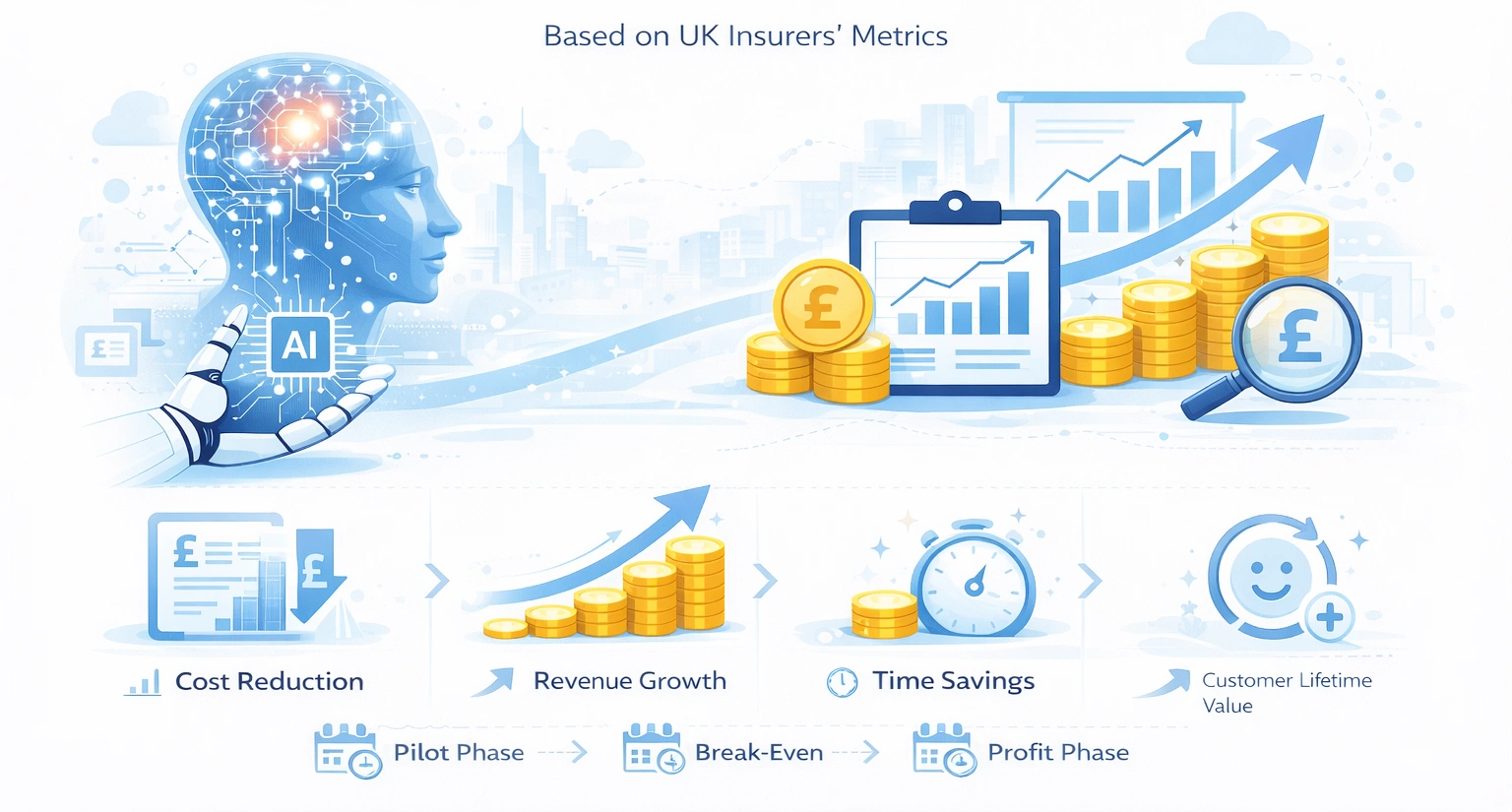
ROI Metrics (Based on UK Insurers):

Cost Reduction: 20–40% in claims processing costs
Revenue Growth: 10–15% from better pricing and retention
Time Savings: 70–90% reduction in underwriting staff needs by 2030
Customer Lifetime Value: 30%+ increase through improved satisfaction

Example: Aviva’s £60M annual savings from AI claims transformation represents roughly 2-3% of their total operating expenses. That’s profit directly to the bottom line.

Investment Timeline:

Year 1: Pilot projects, infrastructure setup and training (Investment phase)
Year 2: Scaled deployment and measurable efficiency gains (Break-even phase)
Year 3+: Full ROI realisation and sustained competitive advantage (Profit phase)

The Azilen Technologies Perspective

At Azilen Technologies, a Digital Transformative Company,  we work with UK insurers who are ready to move beyond experimentation and build real, scalable AI capabilities. True Insurance Innovators do not adopt technology for headlines, they embed intelligence into underwriting, claims, fraud detection and customer engagement at the architectural level.

Our focus is helping insurers modernise core operations, strengthen regulatory readiness and unlock measurable ROI without destabilising the systems that keep the business running.

How We Enable AI Innovation for UK Insurance Leaders

AI-First Architecture Design: We build cloud-native, modular platforms that support predictive underwriting, real-time claims automation and intelligent fraud detection from day one.

Regulatory-Ready by Design: Solutions aligned with FCA Consumer Duty, GDPR and explainable AI frameworks — ensuring transparency, auditability and risk control.

Seamless Core Integration: Deep expertise integrating with Guidewire, Duck Creek and legacy policy administration systems without operational disruption.

Data Foundation Modernisation: Structured and unstructured data pipelines engineered for machine learning, advanced analytics and generative AI deployment.

Continuous AI Optimisation: Feedback-driven models that improve accuracy, reduce bias and evolve with changing risk patterns and market conditions.

Final Thoughts: Top Insurance Technology Innovations

The UK insurance market is not cautiously experimenting with technology anymore, it is redefining itself through it. From AI-powered underwriting and real-time claims decisioning to cloud-native infrastructure and hyper-personalised pricing, today’s Insurance Innovators are rebuilding the industry from the core outward.

The difference is not the tools. It is the mindset. Leaders are embedding AI into architecture, workflows and strategy, not layering it on top of legacy processes. The result is faster decisions, smarter risk assessment, lower operational costs and stronger customer trust.

As the AI-in-insurance market accelerates over the next five years, the competitive gap will widen. The insurers that scale intelligently will compound efficiency, profitability and customer loyalty. Those that hesitate will struggle to keep pace.

FAQs: Insurance Technology Innovations

1. What is insurance technology innovation in the UK?

Insurance technology innovation in the UK refers to the use of AI, cloud, data platforms, and automation to improve underwriting, claims, and customer experience. UK insurers are using these technologies to reduce costs, speed up processes, and meet FCA regulations while delivering faster, more personalised services to customers.

2. Why is insurance technology innovation important for UK insurers?

Insurance technology innovation helps UK insurers stay competitive in a fast-changing market. It improves efficiency, reduces manual work, and enhances risk assessment. With rising customer expectations and regulatory pressure from the FCA, innovation is no longer optional, it is essential for growth and long-term sustainability.

3. How is AI driving insurance technology innovation in the UK?

AI is a key driver of insurance technology innovation in the UK. It is used in underwriting, fraud detection, claims processing, and customer support. AI helps insurers make faster decisions, detect risks more accurately, and automate processes, leading to better customer experiences and lower operational costs.

4. What are examples of insurance technology innovation in the UK market?

Examples of insurance technology innovation in the UK include usage-based insurance, AI-powered underwriting, automated claims processing, and cloud-based platforms. Companies like Aviva, AXA, and Admiral are leading this shift by using AI and data to improve pricing, speed, and customer service.

5. How does insurance technology innovation improve customer experience?

Insurance technology innovation improves customer experience by making services faster, simpler, and more personalised. UK insurers use AI and automation to provide instant quotes, quicker claims settlement, and better communication. This reduces delays, increases transparency, and builds stronger trust with customers.

Glossary

Insurance Technology Innovation: The use of AI, cloud, and automation to improve insurance processes like underwriting, claims, and customer service.

Artificial Intelligence (AI): Technology that enables systems to analyse data, learn patterns, and make decisions with minimal human intervention.

Usage-Based Insurance (UBI): A pricing model where premiums are calculated based on real-world usage data, such as actual driving behaviour.

Underwriting Decision Engines: AI-powered systems that assess risk and make faster, more accurate underwriting decisions.

Claims Processing Automation: The use of technology to handle claims tasks automatically, reducing manual work and speeding up settlements.

Fraud Detection Systems: AI and data-driven tools used to identify suspicious claims and prevent insurance fraud.

Cloud Computing: Technology that allows insurers to store and process data on remote servers, enabling scalability and flexibility.

Telematics: Technology that collects real-time data (like driving behaviour) through devices or apps to support risk assessment.

Generative AI: AI that can create summaries, insights, or content by analysing large volumes of data, often used in underwriting and claims.

Customer Experience (CX): The overall interaction and satisfaction a customer has with an insurer across all touchpoints.

Kulmohan Makhija
Kulmohan Makhija
Vice President – Growth & Enterprise Strategy

Kulmohan Makhija is an enterprise technology and business strategy writer with over 12 years of experience analyzing digital transformation across global and European markets. His work focuses on applied artificial intelligence, product engineering, enterprise architecture, and large-scale legacy modernization. He explores how complex organizations modernize core systems, adopt AI responsibly, and align innovation with regulatory, cultural, and operational realities — particularly within the UK and broader European technology landscape. With a pragmatic enterprise perspective, Kulmohan emphasizes transformation that delivers measurable impact without disrupting mission-critical operations. His writing bridges executive strategy with technical depth, providing clarity for technology leaders, product teams, and decision-makers navigating modernization journeys.

Related Insights