
Skip to content

DPP Compliance Guide and Checklist for Consumer Goods Manufacturers

Featured Image

Executive Summary

The Digital Product Passport (DPP) is a structured digital record that captures a product’s full lifecycle data, from raw material sourcing to end-of-life disposal. Mandated by the European Union’s Ecodesign for Sustainable Products Regulation (ESPR), DPPs will become legally required across a wide range of product categories between 2026 and 2030. For manufacturers, especially those exporting to EU markets, this isn’t a distant policy consideration. It’s an operational reality that’s arriving fast.

This guide breaks down what the DPP framework requires, which sectors face the earliest deadlines, what data must be captured, and how to build internal systems capable of meeting compliance without disrupting your existing production workflows. A practical checklist is included for teams ready to move from awareness to action.

The FMCG Problem No Other Sector Has Quite Like This

Every sector facing DPP compliance has its own version of the supply chain data problem. But FMCG’s version is structurally distinct in three ways that make generic DPP guidance genuinely unhelpful.

The first is volume. A mid-size personal care or household goods brand might manage 3,000 to 8,000 active SKUs across EU markets. Each one needs its own compliant DPP record. Each record needs verified data at the ingredient, material, and packaging level. Multiply the data collection effort by the SKU count and you start to see why companies treating this as a documentation project never finish.

The second is velocity. FMCG formulations change. Packaging substrates change. Contract manufacturers change. In some categories, reformulation happens multiple times a year in response to ingredient availability, cost pressures, or regulatory updates. Every change triggers an update obligation across every affected DPP. Static compliance infrastructure doesn’t survive contact with the rate of change typical in consumer goods.

The third is regulatory overlap. FMCG is the only major DPP sector where two distinct EU regulatory frameworks, ESPR and PPWR, converge on the same physical product. If a product falls under ESPR and requires a DPP, packaging data must be included in that passport, especially when packaging contributes significantly to the product’s environmental impact. Designing separate compliance systems for each regulation isn’t just inefficient. It creates data inconsistencies that become audit liabilities.

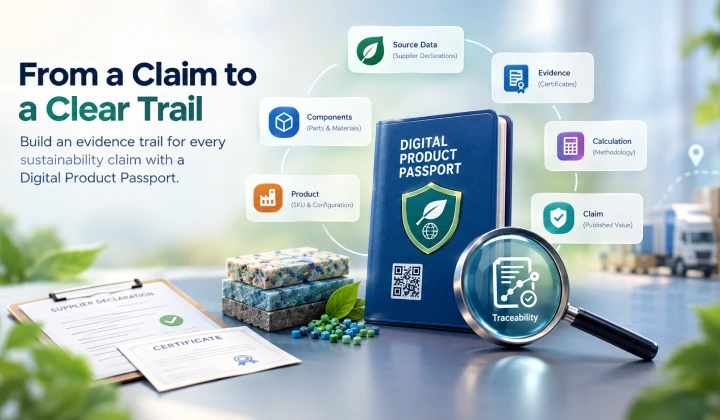
Add to that the greenwashing enforcement dimension. The Empowering Consumers for the Green Transition Directive applies from 27 September 2026, restricting generic environmental claims and uncertified labels. For FMCG brands that have spent years making broad sustainability claims on packaging, “naturally derived,” “eco-friendly,” “sustainably sourced,” the DPP becomes the mechanism by which those claims get verified or exposed. A DPP that contradicts the marketing copy on your label is a compliance problem and a brand problem simultaneously.

DPP Readiness Assessment

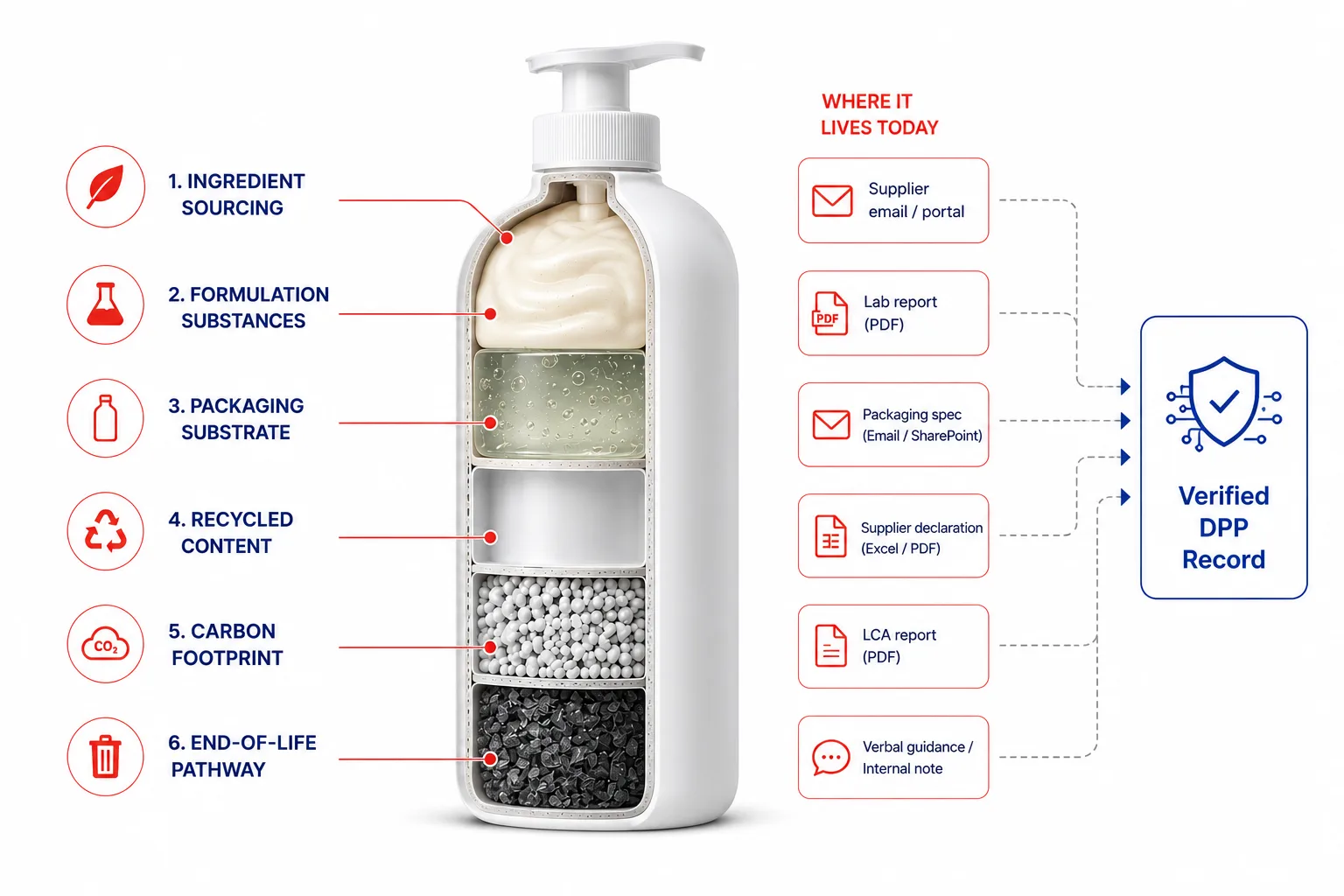
Where Your Compliance Data Actually Lives Right Now

Before any implementation conversation, it’s worth being honest about the baseline. For most FMCG manufacturers, the data required to populate a compliant DPP is scattered across a landscape that was never designed to surface it quickly.

Take a standard liquid detergent with a recycled-content HDPE bottle. The ingredient provenance for the surfactant blend might sit in a supplier questionnaire last updated two years ago. The REACH substance status for the fragrance components exists in a lab report PDF filed in a procurement folder. The recycled content percentage for the bottle substrate is a number the packaging converter gave you verbally and that lives in an email thread. The carbon footprint data for your contract manufacturing site was compiled for an internal sustainability report and doesn’t conform to any regulatory schema.

None of that is unusual. It’s how most consumer goods companies have operated because nobody previously required that data to be machine-readable, verified, and accessible on demand. The DPP changes all of that at once.

69% of compliance and supply chain teams currently spend 11 or more hours each week on manual data translation just to standardize formats for regulatory submissions. That’s before DPP requirements arrive. When they do, the data points required multiply significantly, and the verification standard rises from “we have a document somewhere” to “we have a validated, audit-ready digital record.” – Trade Verifyd

The gap between where most FMCG manufacturers are today and where DPP compliance requires them to be is not primarily a technology gap. It’s a data architecture gap, and closing it requires a different approach than the one that got you here.

Where Your Compliance Data Actually Lives Right Now

The FMCG DPP Readiness Checklist

This checklist is designed for the realities of consumer goods manufacturing, not for a generic product category. Work through each phase sequentially. Don’t start Phase 2 until Phase 1 outputs are documented and signed off internally.

Phase 1: Data Inventory and Regulatory Scoping

Identify which of your product lines fall under ESPR’s current working plan and which will be covered by PPWR obligations from August 2026. These aren’t the same list, and they don’t have the same data requirements. Map both.

Select five to ten representative SKUs that span your portfolio’s complexity range. The highest-volume line, the most complex formulation, the one with the most packaging configurations, and the one sourced from the most geographically distributed supply chain. Run a data trace exercise on each: for every mandatory DPP field, document whether the data exists, where it lives, what format it’s in, and when it was last verified. This exercise will tell you more about your actual readiness than any audit.

Inventory your substances of concern. For consumer goods, this list is typically longer than manufacturers expect. Fragrances, preservatives, surfactants, colorants, UV filters, and packaging adhesives all carry potential REACH obligations above specific concentration thresholds. Don’t rely on supplier declarations alone for this step. Cross-reference against the current SVHC Candidate List from ECHA.

Confirm your packaging composition data at substrate level. Recycled content percentages need to be batch-verified, not estimated at product design stage. If your packaging converter provides a single annual recycled content declaration, that’s not sufficient for DPP purposes. You need batch-level traceability.

Map the overlap between your ESPR data requirements and your PPWR reporting obligations. Design a unified data schema that serves both from a single record. Build it now, before you have two separate teams maintaining two separate data sets that will inevitably drift.

Phase 2: Supplier Network and Data Pipeline Architecture

Complete a full tier-mapping exercise for each priority product line. For FMCG, this means tracing ingredient sourcing to the extraction or agricultural origin point for any substance covered by REACH or included in your sustainability claims. For packaging, it means knowing your converter’s substrate source, not just the converter.

Issue structured data requirements to your top-tier suppliers with a defined response format. Not a questionnaire PDF. A data template that can be ingested into your system directly, covering material composition, substance declarations, recycled content, and environmental certifications. Make this a contractual requirement in all new agreements and upcoming renewals.

Audit which of your supplier relationships still run on email attachments and spreadsheets for compliance data. Every one of those is a point of failure in your DPP infrastructure. Prioritize replacing them with API-connected or SFTP-based structured data feeds, starting with your highest-volume and highest-risk supply relationships.

Build an update trigger protocol. Every formulation change, every packaging substrate switch, every new contract manufacturing site needs a corresponding DPP update workflow. Define that workflow before it becomes an emergency. Who authorizes the update? Who validates the new data? What’s the SLA between the operational change and the published passport update?

Phase 3: Integration Infrastructure and System Architecture

Make the build-versus-buy decision at the integration layer level. Your ERP is the system of record. It was not designed to output ESPR-compliant data schemas, manage multi-tiered access control, or serve live DPP records to regulatory scanners. Those functions belong in a dedicated DPP integration layer that sits above your existing systems and draws from them, rather than attempting to extend a system designed for a different purpose.

Align your product identifier architecture with GS1 Digital Link. If you’re not already using serialized GTINs as the master identifier per SKU and batch, that work starts now. For FMCG, where product variants and packaging configurations multiply the identifier requirement significantly, GS1 Digital Link gives you a standardized resolution mechanism that connects physical carriers to DPP records without custom infrastructure per retailer or regulatory authority.

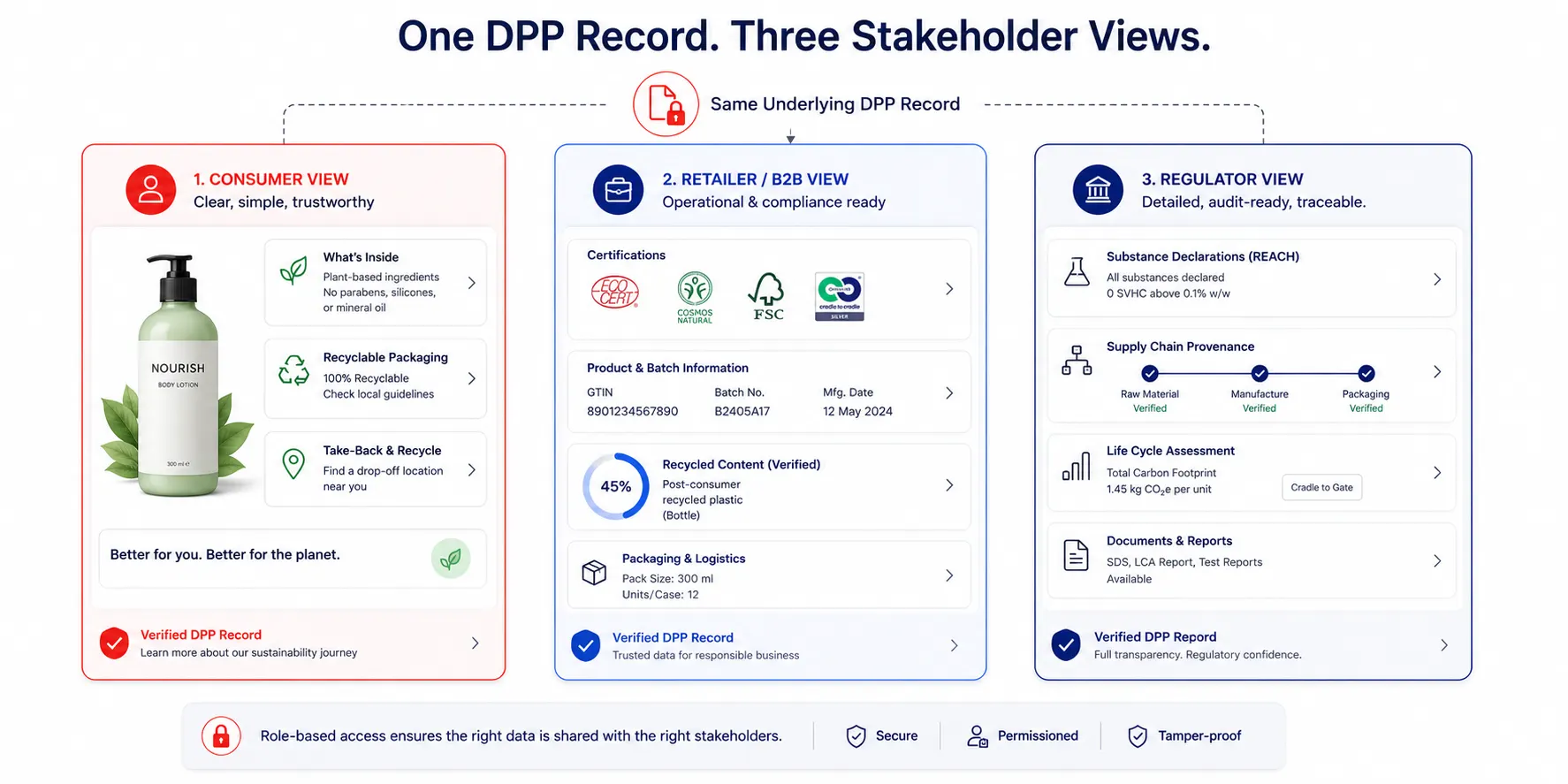
Design your access control architecture before you populate a single data field. Consumer-facing data, retailer-facing data, regulator-facing data, and internal operational data are not the same layer. A consumer scanning a QR code in a supermarket should see ingredient transparency and recyclability guidance. A regulator should see verified substance declarations and supply chain provenance. Your proprietary formulation ratios and supplier commercial terms should never surface in either view. Build those distinctions into the architecture from the start.

For high-SKU portfolios, evaluate AI-assisted data quality monitoring as part of your integration layer. At the volume of active records most FMCG manufacturers will carry, manual data quality review is not scalable. Automated anomaly detection that flags inconsistencies between incoming supplier data and the master DPP record is what prevents a formulation change at a contract manufacturer from sitting undetected in a published passport for months.

Phase 4: Consumer Interface and Commercial Integration

Design the consumer-facing DPP interface as a product, not a compliance output. The regulatory requirement is a machine-readable data record. What the consumer sees when they scan the QR code is a separate design brief entirely. Ingredient transparency, provenance storytelling, recyclability guidance, and take-back program information are the data points that drive engagement. Compliance language that reads like a safety data sheet does not.

Localize for every EU market your products reach. Recycling pictograms, sorting categories, and take-back scheme information vary materially across member states. A German consumer and a Spanish consumer have different recycling infrastructure available to them, and the DPP should reflect that at the point of scan, not default to a generic EU-level disposal instruction.

Build commercial utility into the interface without touching the regulatory data layer. Product registration, loyalty enrollment, refill station locators for applicable product lines, and sustainability certification links all belong in the consumer interface as secondary elements. They don’t affect compliance and they transform a mandatory QR code into a direct post-purchase engagement channel.

The FMCG DPP Readiness Checklist

What This Looks Like When It Works

Two deployments from Azilen’s consumer goods practice demonstrate the difference between DPP as a compliance burden and DPP as operational infrastructure.

Automated Compliance at Scale: A Multi-Category FMCG Manufacturer

A manufacturer with product lines spanning personal care, household cleaning, and home fragrance needed DPP-ready data infrastructure across more than 4,000 active SKUs. Their compliance data was distributed across three ERP instances, two PLM systems, and a supplier communication model that had never moved beyond email. No single system held a complete, validated record for any product.

Azilen deployed a decoupled integration engine built on Node.js and PostgreSQL, structured around the ESPR data schema from day one. API connectors extracted product and packaging data from SAP S/4HANA and Oracle Fusion. A standardized supplier data portal replaced the existing email workflow for vendor submissions, eliminating unstructured document ingestion. A rules-based validation engine checked incoming supplier data against REACH thresholds and PPWR recyclability requirements automatically, routing exceptions for resolution rather than allowing non-compliant data to flow through to published records.

The result: supplier data reconciliation dropped from an average of 14 hours per SKU to under two hours including validation. The first 1,200 SKUs reached compliant DPP record status within the initial deployment phase, with projected annual compliance overhead reduction exceeding 6,000 person-hours once the full portfolio is live.

Why FMCG DPP Integration Is Not a Generic Technology Problem

The platforms and tools marketed as DPP solutions were mostly designed with simpler product architectures in mind: one product, one manufacturer, a contained supply chain, a stable formulation. FMCG breaks every one of those assumptions.

High SKU counts, fast reformulation cycles, multi-layer packaging with multiple substrate sources, ingredient sourcing that spans commodity markets in multiple continents, and the convergence of ESPR and PPWR on the same physical product: these aren’t complications that a standard DPP SaaS tool handles elegantly out of the box.

Azilen’s approach to FMCG DPP engineering is built around the sector’s actual operating conditions, not a simplified version of them. Legacy system modernization that extends existing ERP and PLM environments without forcing high-risk replacements. Data engineering pipelines that aggregate, validate, and serve high volumes of product data continuously. Enterprise AI integration for data quality monitoring at scale. And architecture designed for the obligations that exist today alongside the expanded regulatory scope that’s coming between now and 2030.

The goal isn’t a technically compliant DPP that your compliance team files away. It’s a data infrastructure that serves regulatory requirements, commercial objectives, and operational efficiency from the same underlying investment, continuously, across your entire portfolio.

Why Azilen Technologies Stands Out in DPP Engineering

As an AI-first digital transformation company in the UK, Azilen focuses on creating connected, intelligent, and future-ready technology ecosystems while preserving the systems businesses already depend on. We help organizations move beyond legacy constraints by turning existing environments into scalable, compliant infrastructure through core engineering capabilities:

From supplier chaos to compliant DPP record — we automate ingredient, packaging, and substance data aggregation across your entire supply network, no quarterly spreadsheet chases.

→ Your ERP stays. Your compliance gaps don’t — Azilen connects to SAP, Oracle, and legacy PLM environments and extends them into a DPP-ready architecture without core system replacement.

→ One data record, two regulations served — our schema satisfies both ESPR and PPWR from a single integrated record, so your compliance teams aren’t reconciling two datasets that will eventually contradict each other.

→ We build what’s behind the QR code — GS1-aligned identifiers, role-differentiated access control, and formulation IP protection baked into the architecture, not bolted on after.

FAQs: DPP Engineering

1. Which consumer goods subcategories face the earliest DPP mandates, and should FMCG brands be acting now or waiting?

Detergents are among the first consumer goods categories expected to face mandatory DPPs, with obligations anticipated from 2027 as delegated acts are approved. Packaging, plastics, chemicals, and other consumer goods follow between 2028 and 2030. But the question of whether to act now or wait misframes the actual decision. The foundational work, supplier mapping, substance inventory, data architecture decisions, integration platform selection, takes 12 to 18 months minimum under realistic conditions. That work doesn’t require the final delegated act. Brands that wait for regulatory certainty before starting foundational work consistently arrive at their deadline under time pressure, paying a premium for urgency, and making architecture decisions they’ll regret.

2. Our reformulation cycle means product data changes frequently. How does DPP infrastructure handle that without becoming a compliance liability?

This is exactly where generic DPP platforms fail FMCG brands. A static DPP record that doesn’t reflect the current formulation isn’t just outdated, it’s a false declaration to regulators and consumers. The architecture that handles reformulation velocity correctly is one with automated update propagation built into the integration layer: a formulation change in the PLM triggers a supplier data refresh request, which flows through validation, and updates the published passport record with a versioned audit trail. Brands managing this manually, via a content update workflow triggered by a compliance team notification, will find the process breaks down quickly at any meaningful SKU volume. The update trigger protocol has to be designed into the system, not added as a process later.

3. We operate contract manufacturing across multiple countries. Does that multiply our DPP obligations?

Each manufacturing site that produces a product for EU markets contributes data to that product’s DPP record: production batch data, quality certifications, any site-level environmental performance indicators required by the delegated act for your category. Multiple CMOs mean multiple data source integrations, which multiplies the integration scope but doesn’t multiply the compliance obligation itself. One DPP per SKU per batch is the requirement. The integration architecture needs to be built to aggregate data from multiple CMO systems into that single record, rather than treating each manufacturing site as a separate compliance entity.

4. How do ESPR and PPWR interact for packaged consumer goods, and do we need separate compliance infrastructure for each?

No, and building separate systems would create the exact data inconsistency problem regulators will eventually audit. If a product falls under ESPR and requires a DPP, packaging data must be included in that passport, especially when packaging contributes significantly to the product’s environmental impact. This convergence creates an opportunity for unified sustainability documentation across your entire product portfolio. The practical architecture decision is to design a single data schema that captures ESPR product lifecycle data and PPWR packaging composition, recycled content, and recyclability data in one integrated record. That requires deliberate schema design at the start. Brands that build ESPR compliance first and PPWR compliance second will spend significant time reconciling two data sets that should have always been one.

5. Can the consumer-facing DPP interface actually drive commercial value, or is it just a compliance output?

It depends entirely on how it’s designed. A DPP interface that surfaces a list of regulatory data fields in compliance language adds no commercial value. A DPP interface designed around what sustainability-oriented consumers actually want to know, verified ingredient sourcing, what the packaging is actually made of and how to dispose of it correctly, whether and where a take-back option exists, delivers measurable engagement uplift. The EU’s Empowering Consumers for the Green Transition Directive applies from September 2026, restricting generic environmental claims and uncertified labels. That regulation effectively turns the DPP into the mechanism through which sustainability claims get verified rather than just asserted. Brands that have designed their DPP interface to substantiate those claims actively rather than bury them in data fields will have a material advantage when generic “eco-friendly” label claims are no longer legally permissible across EU markets.

Kulmohan Makhija
Kulmohan Makhija
Vice President – Growth & Enterprise Strategy

Kulmohan Makhija is an enterprise technology and business strategy writer with over 12 years of experience analyzing digital transformation across global and European markets. His work focuses on applied artificial intelligence, product engineering, enterprise architecture, and large-scale legacy modernization. He explores how complex organizations modernize core systems, adopt AI responsibly, and align innovation with regulatory, cultural, and operational realities — particularly within the UK and broader European technology landscape. With a pragmatic enterprise perspective, Kulmohan emphasizes transformation that delivers measurable impact without disrupting mission-critical operations. His writing bridges executive strategy with technical depth, providing clarity for technology leaders, product teams, and decision-makers navigating modernization journeys.

Related Insights