


Skip to content

Building a Digital Product Passport In-House vs. Buying a DPP Solution: Which Is Right for Your Business?

Featured Image

Executive Summary

Businesses implementing a Digital Product Passport face a fundamental choice: build the capability in-house or buy a specialist DPP solution. Building offers greater control and customization, while buying can accelerate implementation and reduce internal development effort.

The right approach depends on cost, integration, internal expertise, scalability, customization needs, and long-term ownership. For some businesses, a hybrid model can offer the best balance, using a DPP platform as the foundation while building custom capabilities around it.

The DPP conversation is moving from “what is required?” to “how will we build it?”

With the EU’s DPP Registry now operational and further DPP standards scheduled for adoption in September 2026, the technical foundations for implementation are becoming clearer.

For businesses, this raises a critical question:

Should you build your DPP capability in-house or buy it from a specialist provider?

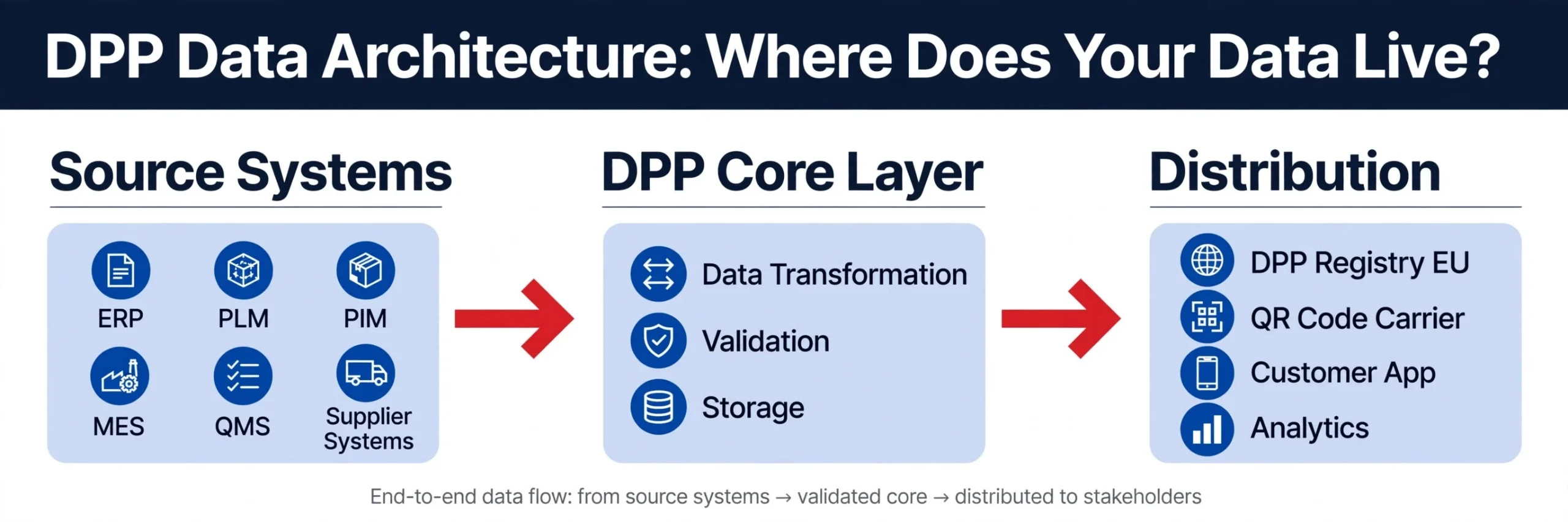
Under the EU’s Ecodesign for Sustainable Products Regulation (ESPR), DPP requirements are being introduced progressively. But implementing a DPP is not simply about meeting a compliance requirement. Product information may already sit across ERP, PLM, PIM, MES, QMS and supplier systems.

That makes integration, scalability, control and long-term cost central to the decision.

So, which approach makes more sense: build, buy, or combine the two?

Building a Digital Product Passport In-House

Building a DPP in-house means developing and operating the core capability yourself, from the underlying architecture and data model to integrations, workflows, APIs and user-facing experiences.

What You Gain

Control: Your organization controls the architecture, roadmap, data flows, and technology decisions.

Customization: The DPP can be designed around proprietary products, processes and business requirements rather than adapting your processes to a standard platform.

Integration flexibility: Your team can build integrations around existing ERP, PLM, PIM, MES, and other enterprise systems.

Long-term ownership: You are not dependent on a vendor’s roadmap, pricing model or product decisions.

What You Take On 

That control comes with responsibility.

Your organization must manage development, testing, infrastructure, security, monitoring, integrations, maintenance, and future enhancements. It also needs to keep the solution aligned with evolving DPP requirements and interoperability standards.

The real cost of building, therefore, is not simply development cost.

It is the cost of owning and operating the capability over time.

When Does Building Make Sense?

Building can be appropriate when:

→ DPP is strategically important to your technology landscape.

→ Your products or processes require significant customization.

→ You already have mature engineering and data capabilities.

→ You need deep integration with proprietary systems.

→ Long-term technology ownership is strategically valuable.

Buying a DPP Solution

Buying means using a specialist DPP platform and configuring or integrating it with your existing environment.

Instead of developing every capability internally, you rely on a provider that already has DPP-related functionality, infrastructure, and expertise.

What You Gain

Speed: Existing capabilities can reduce development and implementation time.

Specialist expertise: The provider takes responsibility for maintaining and evolving its DPP platform.

Lower internal development burden: Your teams can focus on integration, data readiness, and business processes rather than developing the entire platform.

Platform evolution: Updates and new capabilities can be incorporated into the vendor’s product roadmap.

The EU’s DPP architecture itself supports a decentralized model, where product data remains under the responsibility of economic operators and may be hosted internally or through DPP service providers.

What You Need to Evaluate

Buying does not eliminate complexity, but it moves some of it outside the organization.

You still need to assess:

→ API and integration capabilities

→ Data ownership and portability

→ Customization limits

→ Security and access controls

→ Scalability

→ Vendor roadmap

→ Pricing and commercial model

→ Exit and migration options

A platform may meet today’s DPP requirements but become restrictive if your product portfolio, data requirements or integration of landscape changes.

When Does Buying Make Sense?

Buying can be attractive when:

→ Speed to implementation is important.

→ DPP requirements are relatively standard.

→ Internal DPP expertise is limited.

→ You want to reduce development and maintenance responsibilities.

DPP is important, but building the underlying platform is not a strategic differentiator.

Build vs. Buy: A Side-by-Side Comparison

DPP Architecture Flow

HTML Table Generator
Factor
Build In-House 
Buy DPP Solution
 Implementation    Generally slower   Generally faster
Control    High  Provider-dependent 
Customization  Very High  Platform-dependent  
 Initial Effort  High  Lower 
Internal Expertise  High  Moderate 
Integration   Fully Controlled  API\Connectors
Maintenance  Internal Responsibility  Primarily vendor-led 
 Scalability  You own the Architecture Platform-dependent 
Vendor Dependency   Low   Higher 
Best For  Custom, Strategic Needs  Speed, Standardization 
 Data Portability  Direct Control  Contractually and technically assessed 
 Technology Roadmap  Fully Owned  Shared with vendor 

The key point is that neither option is universally cheaper or better. Build shifts more complexity into your organization. Buy shifts some complexity to the vendor while introducing dependency on its technology, roadmap and commercial model.

Which Approach Is Right for Your Business?

The decision should start with your business and technology landscape, not with a preference for building or buying.

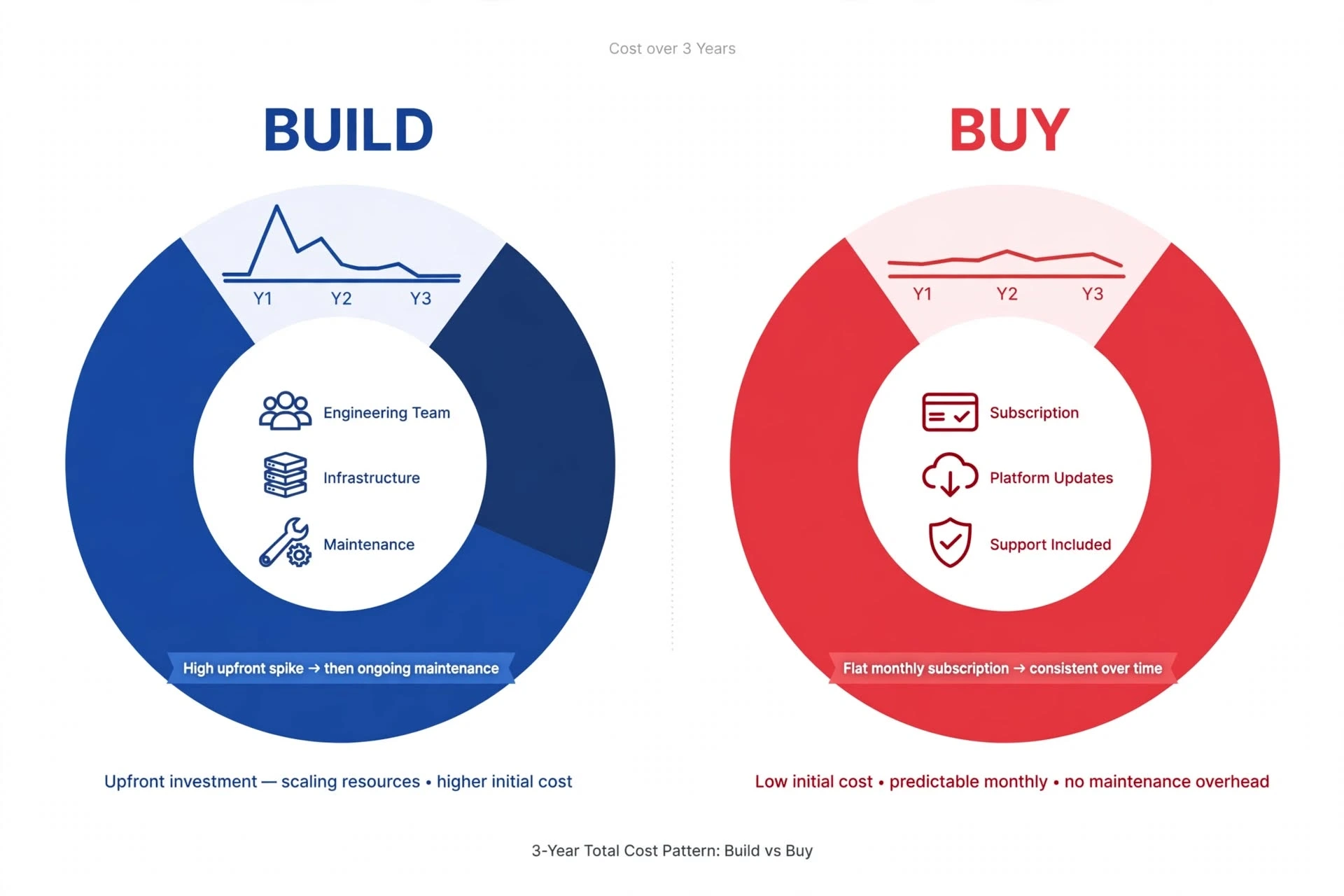
build_vs_buy_donut_comparison

Build if…

You need extensive customization, have strong internal engineering capabilities, require deep control over architecture and data, or see DPP as a strategic digital capability that you want to own.

Buy if…

You need to move quickly, have relatively standard requirements, want to minimize internal development effort, or would rather focus your resources on your core products and processes.

Ask Yourself Four Questions

1. Do we need to build capabilities that already exist in the market?

If a specialist platform already solves most of your requirements, rebuilding the same functionality may not create strategic value.

2. Can we operate what we build long term?

A DPP is not finished when it goes live. Data, integrations, security, standards and business requirements will continue to evolve.

3. How much customization do we genuinely need?

Not every business requirement justifies a custom platform. Identify which capabilities are truly differentiating before committing to development.

4. Is owning the technology strategically valuable?

The objective is not to own more technology. It is to own the parts that genuinely matter to your business.

What About a Hybrid Approach?

For many enterprises, the answer does not have to be purely build or buy.

A hybrid approach can combine a specialist DPP platform with custom enterprise capabilities.

For example, a business could buy the DPP foundation while building:

→ ERP, PLM or PIM integrations

→ Product-specific workflows

→ Data transformation and validation

→ Analytics and reporting

→ Customer-facing applications

→ Business-specific extensions

The objective is to avoid rebuilding capabilities that already exist while retaining control over the parts of the DPP ecosystem that create business value.

Get More From Your DPP Technology Investment

The build-vs-buy decision is ultimately an architecture decision.

Azilen can help organizations evaluate where DPP capabilities should sit within their existing technology landscape, from application and data architecture to enterprise integrations, custom engineering and platform extensions.

The focus is not simply on implementing a DPP. It is on designing an architecture that can

→ Connect product data across existing systems

→ Support interoperability

→ Scale with your product portfolio

→ Adapt as requirements evolve

From DPP architecture and system integration to custom development and platform extension, Azilen help businesses build the technology foundation needed for scalable DPP implementation.

DPP Blog CTA
DPP Technology Background

Architect Your DPP Strategy with Azilen

Build what differentiates your business. Buy what does not.

Talk to a DPP Expert

FAQs 

Can we switch from a bought DPP solution to an in-house platform later?

Yes, but switching can become difficult if your data, integrations and workflows are tightly tied to the vendor’s platform. Assess data portability, API access, interoperability and exit provisions before buying.

What if our DPP works technically but fails operationally?

A technically successful DPP can still fail if ownership, data governance, support and maintenance are unclear. The operating model should be defined alongside the technology.

Do we really need a full DPP platform?

Not necessarily. The right level of technology depends on your product complexity, data requirements, integrations and long-term objectives. Overengineering can increase cost without adding proportional value.

Could a “quick” DPP implementation create technical debt?

Yes. A solution designed only around an immediate deadline can create problems with integrations, data models, APIs or scalability later. Speed matters, but the architecture must support future requirements.

Kulmohan Makhija
Kulmohan Makhija
Vice President – Growth & Enterprise Strategy

Kulmohan Makhija is an enterprise technology and business strategy writer with over 12 years of experience analyzing digital transformation across global and European markets. His work focuses on applied artificial intelligence, product engineering, enterprise architecture, and large-scale legacy modernization. He explores how complex organizations modernize core systems, adopt AI responsibly, and align innovation with regulatory, cultural, and operational realities — particularly within the UK and broader European technology landscape. With a pragmatic enterprise perspective, Kulmohan emphasizes transformation that delivers measurable impact without disrupting mission-critical operations. His writing bridges executive strategy with technical depth, providing clarity for technology leaders, product teams, and decision-makers navigating modernization journeys.

Related Insights