

Skip to content

Digital Product Passport for Electronics Manufacturers

Featured Image

Executive Summary

Digital Product Passports (DPPs) are set to transform how electronics manufacturers manage product transparency, compliance, and supply chain visibility.

As regulatory expectations around sustainability, traceability, repairability, and circular economy practices continue to evolve, manufacturers will need access to accurate product data across suppliers, components, materials, and product lifecycles.

In this guide, we explore:

→ What a Digital Product Passport for Electronics Manufacturers is and why it matters

→ The supply chain data required to support DPP initiatives

→ How DPP improves traceability, compliance, and sustainability reporting

→ Key implementation challenges electronics manufacturers must address

→ Practical strategies for building a DPP-ready and transparent supply chain

For electronics manufacturers, DPP is becoming more than a compliance requirement, it is a strategic foundation for resilient, transparent, and future-ready operations.

“You cannot manage what you cannot trace. And in the age of Digital Product Passports, you cannot sell what you cannot prove.”

For decades, electronics manufacturers have built products through complex global supply chains involving hundreds of components, multiple suppliers, and manufacturing partners spread across different regions.

Yet when it comes to answering critical questions about a product’s journey, many organisations still struggle to find clear and reliable answers.

→ Where did the components and materials originate?

→ How sustainable and compliant is the product?

→ Can the product be repaired, reused, or recycled at the end of its life?

As Digital Product Passport initiatives gain momentum across Europe, these questions are quickly moving from “nice to know” to “need to know.”

Industry experts increasingly view Digital Product Passports as a key enabler of transparency, sustainability, and traceability across the electronics value chain, helping manufacturers better manage product information from production through recycling.

A Digital Product Passport for Electronics Manufacturers creates a digital identity for every product, bringing together sourcing, compliance, sustainability, and lifecycle data into a single, accessible record.

What Is a Digital Product Passport for Electronics Manufacturers?

A Digital Product Passport for Electronics Manufacturers is a digital record that stores and shares product information throughout the entire product lifecycle.

Rather than relying on fragmented spreadsheets, supplier documents, certificates, and disconnected systems, manufacturers can create a single source of truth for product-related information.

DPP include:

Required DPP Information Required DPP Information
1. Product Specifications and Identifiers 6. Carbon Footprint Information
2. Material Composition Data 7. Repairability and Maintenance Details
3. Component Sourcing Information 8. Recycling and End-of-Life Instructions
4. Supplier Records 9. Regulatory Compliance Documentation
5. Sustainability Metrics 10. Product Lifecycle Traceability Data

The objective is to ensure that every stakeholder, from manufacturers and suppliers to regulators, distributors, repair providers, and recyclers, can access trusted product information when required.

For electronics manufacturers, this level of transparency creates the foundation for both regulatory compliance and operational excellence.

As DPP requirements evolve, many manufacturers are turning to AI and Digital Product Passport solutions to automate compliance, improve data accuracy, and strengthen supply chain traceability.

Not sure where you stand on Digital Product Passport readiness?

Run our free DPP Assessment Calculator and get a clear, personalised readiness score in under five minutes.

Try Free DPP Assessment

Why Is Supply Chain Transparency the Foundation of DPP Success?

Supply chain transparency is the core principle behind every Digital Product Passport initiative.

Without reliable visibility into products, components, suppliers, and materials, creating a meaningful Digital Product Passport becomes nearly impossible.

This challenge is particularly significant for electronics manufacturers because modern electronics products often contain:

→ Hundreds or thousands of individual components

→ Raw materials sourced globally

→ Multi-tier supplier networks

→ Complex manufacturing and assembly processes

→ Numerous regulatory obligations

Historically, many manufacturers have only maintained visibility into direct suppliers. However, risks often emerge much deeper within the supply chain.

Digital Product Passports can deliver value beyond compliance and transparency. Explore Top 5 Ways Digital Product Passports Create New Revenue Streams for UK Enterprises to discover how DPP initiatives can unlock new business and growth opportunities.

Key Statistics Electronics Manufacturers Should Know About DPP

As Digital Product Passport requirements continue to evolve, electronics manufacturers must prepare for increasing expectations around product transparency, traceability, and sustainability. The statistics below highlight why DPP is becoming a strategic priority across the industry.

70%+

Environmental impact is largely determined during product design, sourcing, and material selection.

1,000+

Components can exist within one product, making end-to-end traceability increasingly difficult.

2030

European sustainability initiatives will drive greater product transparency and reporting requirements.

What Data Must Electronics Manufacturers Collect for a Digital Product Passport?

Data readiness is one of the biggest challenges in implementing a Digital Product Passport for Electronics Manufacturers. Product information is often scattered across ERP, PLM, MES, supplier, quality, and compliance systems, making it difficult to create a single, reliable source of truth.

To support a comprehensive DPP, electronics manufacturers must capture and manage the following data:

Data Area Information Required
Product Data Product IDs, Serial Numbers, Technical Specifications
Material Data Material Composition, Critical Raw Materials, Recycled Content
Supplier Data Supplier Identities, Sourcing Locations, Certifications
Manufacturing Data Production Sites, Manufacturing Processes, Batch Information
Environmental Data Carbon Footprint, Emissions Data, Energy Consumption
Compliance Data RoHS Compliance, REACH Declarations, CE Certifications
Circularity Data Repairability Information, Spare Parts Availability, Recycling Guidance

The challenge is not just collecting this information but ensuring it remains accurate, consistent, and accessible throughout the entire product lifecycle. This is where a well-structured DPP for Electronics Manufacturers delivers long-term value.

How Can Electronics Manufacturers Prepare for Digital Product Passport Requirements?

Preparing for a Digital Product Passport for Electronics Manufacturers requires a structured approach focused on data, suppliers, and processes. The following steps can help organisations build a strong foundation for successful DPP adoption.

Assess Current Data Readiness: Identify existing product data sources, evaluate information quality, and uncover traceability gaps.

Map Supply Chain Information Flows: Understand how data moves across suppliers, partners, and internal systems to identify visibility limitations.

Engage Suppliers Early: Establish data-sharing expectations and strengthen collaboration to improve supply chain transparency.

Standardise Product Data: Create consistent data models and formats to improve accuracy, accessibility, and reporting.

Strengthen Governance: Define data ownership, validation processes, and accountability to maintain reliable product information.

Launch Pilot Programmes: Start with selected product lines, test traceability processes, and scale implementation gradually.

At Azilen Technologies, we recommend a phased approach that helps electronics manufacturers reduce implementation risks while accelerating DPP readiness and compliance.

How Does a Digital Product Passport Improve Supply Chain Traceability?

Traceability is one of the biggest benefits of a Digital Product Passport for Electronics Manufacturers. By connecting data across the entire product lifecycle, DPP provides greater visibility into products, materials, suppliers, and processes.

Component Traceability: Track components from supplier to finished product and support faster recalls.

Material Provenance: Verify material origins, responsible sourcing, and sustainability claims.

Supplier Transparency: Monitor supplier performance, certifications, and compliance requirements.

Lifecycle Visibility: Track products through manufacturing, repair, refurbishment, and recycling.

For electronics manufacturers, improved traceability leads to stronger supply chain visibility, reduced risk, and better operational decision-making.

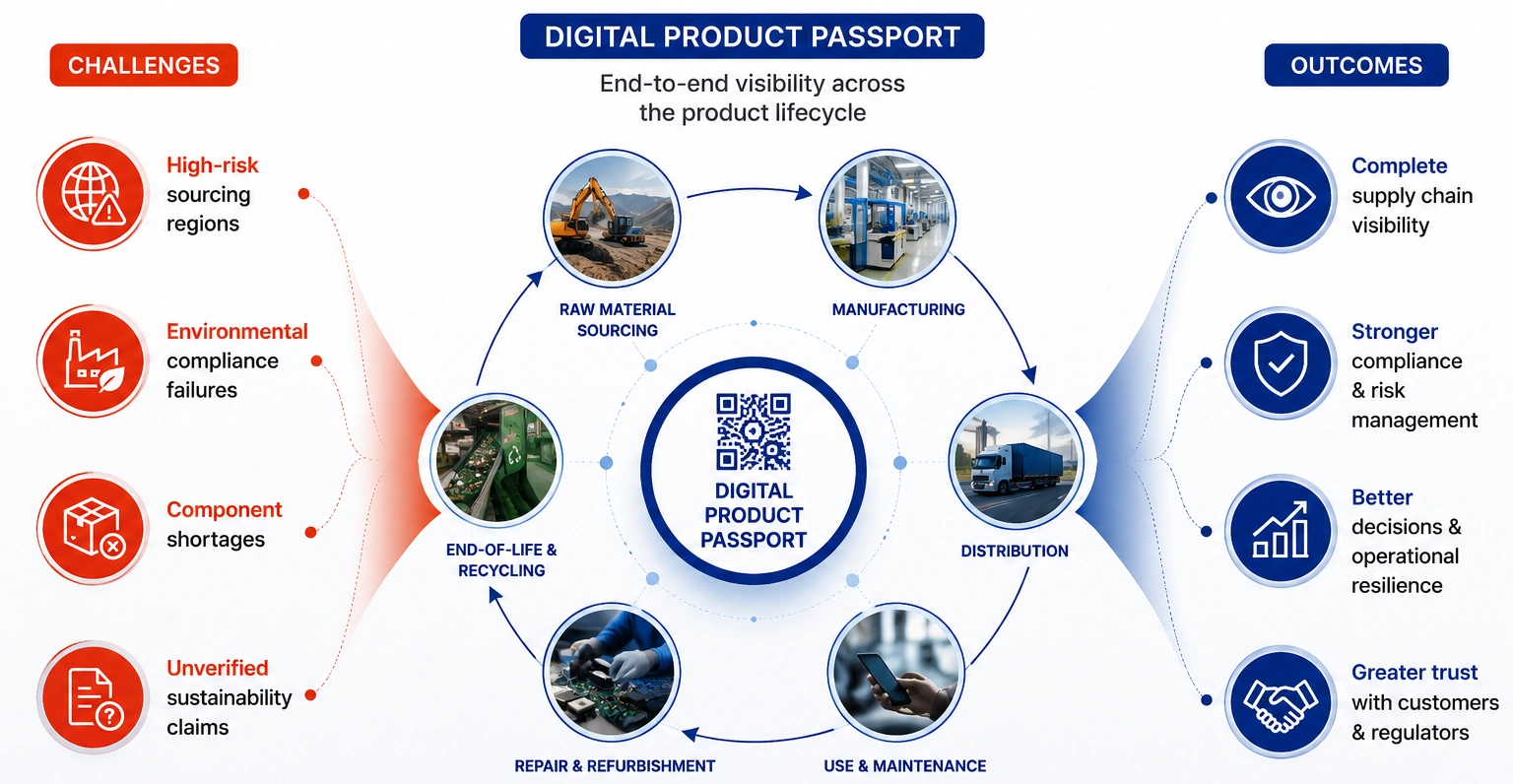
Example: How Digital Product Passports Improve Supply Chain Transparency

The diagram below illustrates how common supply chain risks can be connected and managed through a Digital Product Passport, creating visibility across the entire product lifecycle.

How Digital Product Passports Improve Supply Chain Transparency

Key Takeaway: By bringing together product, supplier, sustainability, and compliance data, DPP helps electronics manufacturers build more transparent and resilient supply chains.

Which Technologies Support DPP for Electronics Manufacturers?

A successful Digital Product Passport for Electronics Manufacturers relies on connected digital systems that enable traceability, transparency, and lifecycle visibility.

Technology Purpose
PLM Manages product design, engineering, and lifecycle information.
ERP Centralizes supplier, procurement, inventory, and operational data.
MES Captures production and traceability information.
IoT & Smart Manufacturing Provides real-time visibility into manufacturing operations.
Cloud Platforms Enables data sharing and collaboration across ecosystems.
Data & AI Platforms Supports data quality, analytics, reporting, and traceability.

Together, these technologies provide the foundation for a scalable and effective DPP for Electronics Manufacturers strategy.

Why Azilen Technologies for Digital Product Passport Initiatives?

With 17+ years of experience as a Digital Transformation Company, Azilen helps electronics manufacturers build the data, traceability, and technology foundations required for Digital Product Passport adoption.

Supply Chain Traceability: Improves visibility across suppliers, components, materials, and manufacturing processes.

Connected Data Ecosystems: Integrates ERP, PLM, MES, and supplier systems to create a unified product data foundation.

DPP Readiness Assessment: Identifies data gaps, compliance risks, and implementation priorities.

Product Lifecycle Visibility: Enables traceability from sourcing and production to repair, reuse, and recycling.

Scalable Digital Solutions: Builds future-ready platforms that support compliance, sustainability, and circular economy goals.

By combining deep technology expertise with 17+ years of digital transformation experience, Azilen helps electronics manufacturers accelerate their journey towards transparent, compliant, and resilient supply chains.

FAQs: Digital Product Passport for Electronics Manufacturers

What Is a Digital Product Passport for Electronics Manufacturers?

A Digital Product Passport for Electronics Manufacturers is a digital record that stores and shares key product information throughout the product lifecycle. It includes details such as material composition, supplier information, compliance documentation, sustainability metrics, repairability data, and recycling instructions. The goal is to improve transparency, traceability, and circular economy participation while helping manufacturers meet evolving regulatory requirements.

Why Is the Digital Product Passport Important for Electronics Manufacturers?

The Digital Product Passport helps electronics manufacturers improve supply chain transparency, track product origins, verify sustainability claims, and support regulatory compliance. As supply chains become increasingly complex, DPP enables manufacturers to maintain visibility across suppliers, components, and materials while improving risk management, customer trust, and operational efficiency.

What Information Should Be Included in a Digital Product Passport for Electronics Products?

A Digital Product Passport typically includes product specifications, component and material data, supplier information, manufacturing records, environmental impact metrics, compliance certifications, repair instructions, and end-of-life recycling guidance. The exact data requirements may vary depending on product type, industry regulations, and sustainability reporting obligations.

How Can Electronics Manufacturers Prepare for Digital Product Passport Requirements?

Electronics manufacturers can prepare by assessing current product data, improving supplier collaboration, standardising information across systems, and strengthening traceability processes. Many organisations also invest in ERP, PLM, MES, and data management platforms to create a connected digital ecosystem capable of supporting Digital Product Passport initiatives.

What Are the Business Benefits of Implementing a Digital Product Passport?

Beyond compliance, Digital Product Passports help electronics manufacturers improve supply chain visibility, strengthen sustainability reporting, reduce operational risks, support product recalls, and enable circular economy initiatives. They also provide a competitive advantage by demonstrating transparency, responsible sourcing, and commitment to sustainable manufacturing practices.

Glossary

→ Digital Product Passport (DPP): Digital record containing product lifecycle, sustainability, compliance, and traceability data.

→ Digital Product Passport for Electronics Manufacturers: Framework enabling electronics product transparency, traceability, compliance, and sustainability.

→ Supply Chain Traceability: Tracking materials, components, and products throughout the supply chain.

→ Product Lifecycle Management (PLM): System managing product data from design through end-of-life stages.

→ Enterprise Resource Planning (ERP): Software integrating procurement, inventory, manufacturing, finance, and operations.

→ Circular Economy: Model promoting product reuse, repair, refurbishment, and recycling practices.

→ Product Carbon Footprint: Total greenhouse gas emissions generated throughout a product lifecycle.

Kulmohan Makhija
Kulmohan Makhija
Vice President – Growth & Enterprise Strategy

Kulmohan Makhija is an enterprise technology and business strategy writer with over 12 years of experience analyzing digital transformation across global and European markets. His work focuses on applied artificial intelligence, product engineering, enterprise architecture, and large-scale legacy modernization. He explores how complex organizations modernize core systems, adopt AI responsibly, and align innovation with regulatory, cultural, and operational realities — particularly within the UK and broader European technology landscape. With a pragmatic enterprise perspective, Kulmohan emphasizes transformation that delivers measurable impact without disrupting mission-critical operations. His writing bridges executive strategy with technical depth, providing clarity for technology leaders, product teams, and decision-makers navigating modernization journeys.

Related Insights