
Skip to content

How Digital Product Passports Are Rewiring Denim Manufacturing

Featured Image

Executive Summary

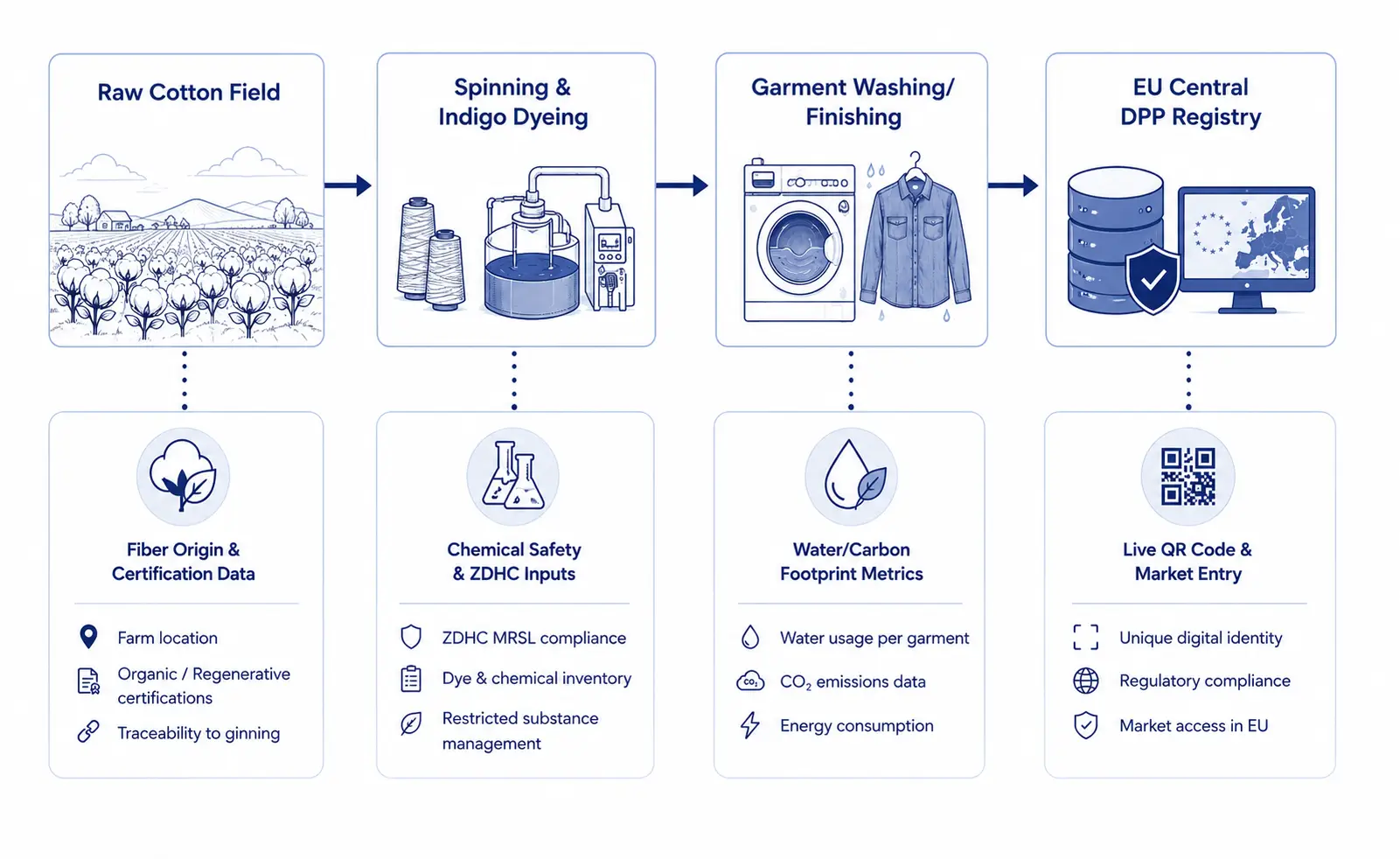
The impending enforcement of the EU’s Ecodesign for Sustainable Products Regulation (ESPR) is introducing a profound operational shift across the global denim supply chain. Historically scrutinized for its high resource intensity, denim manufacturing is now the priority target for mandatory Digital Product Passports (DPPs). To maintain access to the European market, manufacturers must transition from fragmented, static tracking methods to machine-readable digital twins that map a garment’s journey from raw cotton bale to retail hanger.

What this executive brief delivers:

• Regulatory Milestones: A practical breakdown of the ESPR textile delegated acts and timeline.

• Data Integration: A structural roadmap to unite raw material, wet processing, and chemical data without disrupting legacy systems.

• Commercial Advantage: Proven strategies to turn mandatory compliance data into a premium differentiator for global brands.

For decades, the denim industry has operated under a cloud of environmental scrutiny. Producing a single pair of traditional jeans demands an estimated 3,800 liters of water and a heavy cocktail of finishing chemicals. Historically, brands and manufacturers managed these pressures with voluntary sustainability collections, selective third-party certifications, and glossy PDF marketing reports.

But those days are officially over.

The European Union’s Ecodesign for Sustainable Products Regulation (ESPR) has entered into force, and textiles have been designated as a priority sector. The core enforcement mechanism of this sweep is the Digital Product Passport (DPP)—a mandatory, machine-readable digital record that must accompany every garment sold in the EU.

“The Digital Product Passport is not merely a bureaucratic requirement; it is the digital thread that will weave together circularity, supply chain accountability, and regulatory trust across the global apparel trade.”Dr. A. Sakthivel, Chairman of the Apparel Export Promotion Council of India (AEPC), commenting on the launch of the first live, EU-compliant textile DPP pilots.

If your manufacturing facility cannot supply verified, batch-level data covering raw materials, chemical formulations, and environmental impact, your products will be legally barred from the European market.

Digital Product Passports for Denim Manufacturing

This is not just a challenge for compliance departments; it is a structural shift in how B2B apparel deals are won. For forward-thinking denim manufacturers, building a robust DPP data engine is the ultimate commercial lever to secure preferred vendor status with the world’s largest fashion groups.
DPP Readiness Assessment

Where Your Compliance Assets Live Today

The biggest hurdle in building an EU-ready denim product passport is data fragmentation. Denim supply chains are notoriously complex, often spanning multiple continents.

Critical information is currently scattered across mismatched formats, leaving manufacturers exposed to massive administrative friction and compliance gaps:
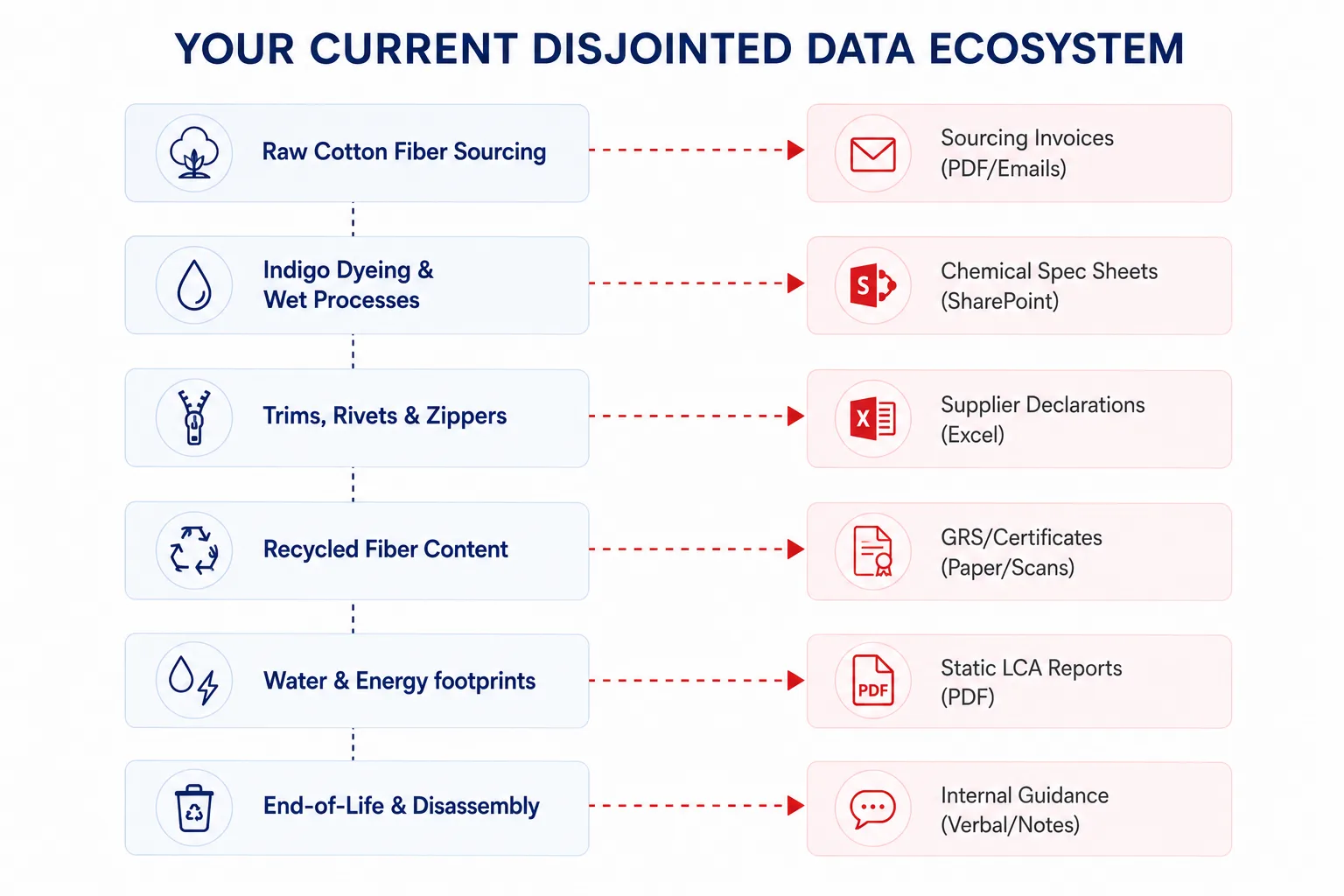
Where Your Compliance Data Actually LivesWithout a unified system to capture, validate, and structure these inputs, your compliance pipeline will remain a bottleneck.

The Anatomy of an EU-Ready Denim Passport

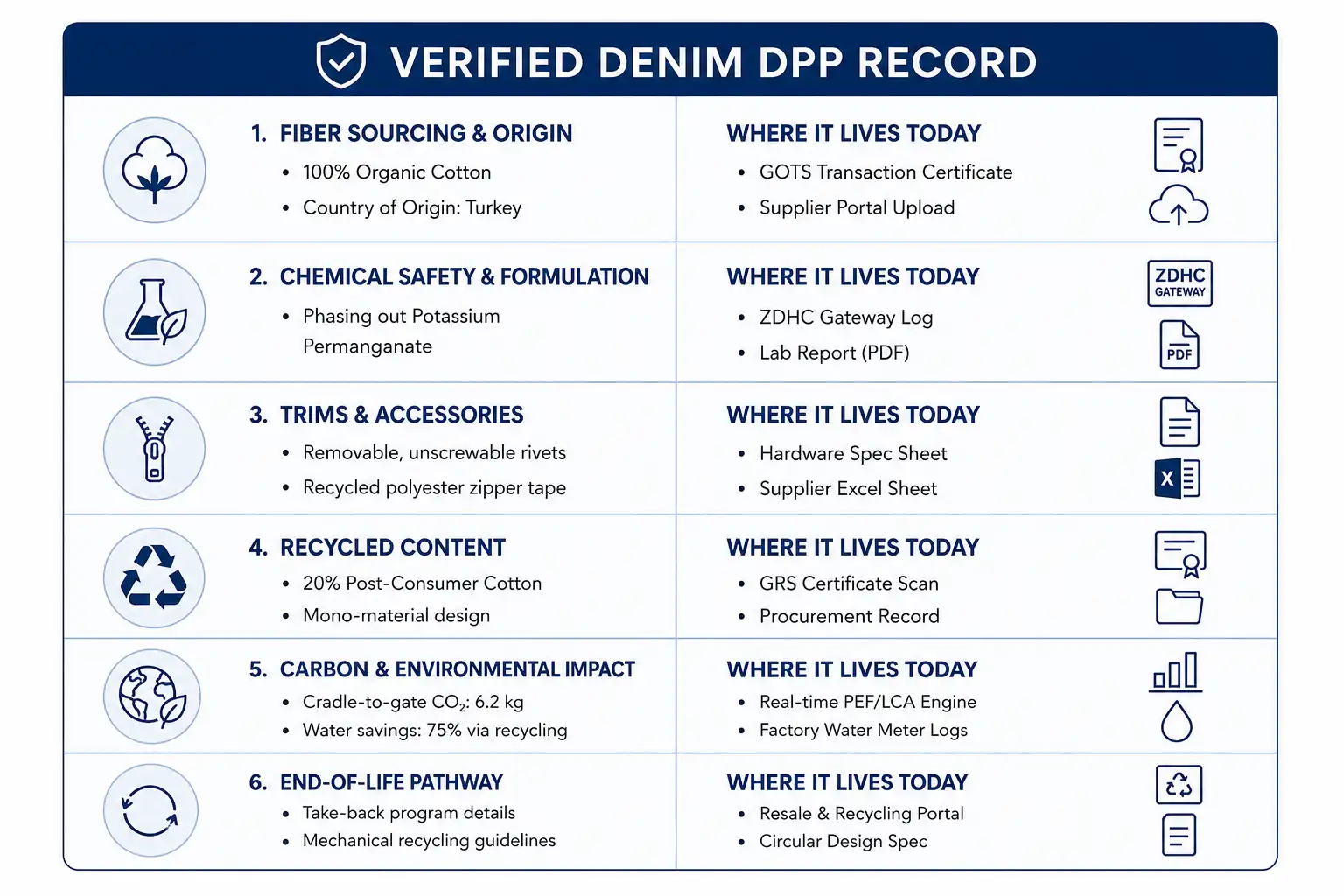
To comply with the emerging textile specifications published by the European Joint Research Centre (JRC), a denim DPP must bring together 49 distinct data points grouped into core operational categories.

Below is how a compliant denim DPP structures this data, turning a complex regulatory mandate into a clean, scan-ready digital record:
Compliance data

Mitigating Brand Liability: Why Traceability is the Ultimate Sales Closer

For fashion brands, greenwashing is no longer a reputation risk; it is a legal liability. Under the EU’s Green Claims Directive and the ESPR, fashion houses face severe penalties if their sustainability claims cannot be verified on demand.

Consequently, brands are actively consolidating their vendor lists, favoring manufacturers who can instantly deliver verified, machine-readable environmental data.

Integrating a Digital Product Passport for Denim Manufacturers into your operations turns data transparency into your strongest commercial tool:

• Zero-Friction Auditing: Give buying teams and customs authorities instant access to GOTS, GRS, or OEKO-TEX certificates via a single scan, eliminating weeks of manual documentation.

• Verified Chemical Compliance: Prove that your denim washing and distressing processes are free from hazardous substances (like lead, PFAS, or restricted phthalates) by linking your ZDHC gateway logs directly to the batch passport.

• Validated Environmental Performance: Show real-time water recycling metrics and carbon footprint calculations that align with European PEF (Product Environmental Footprint) standards, allowing brands to confidently log these savings in their Scope 3 disclosures.

Operational Blueprint: The Phased Implementation Timeline

Developing a compliant passport system does not require a complete overhaul of your existing ERP or PLM software. Instead, our decoupled middleware sits quietly on top of your current setup, pulling data from various systems and translating it into a secure, machine-readable format.

Your implementation team should execute this transition across four standard operational phases:

Phase 1: Supplier Mapping & Data Cleansing

Establish secure data-sharing protocols with your raw material suppliers. Identify gaps in fiber origin declarations, chemical inputs, and facility certifications.

Phase 2: Schema Harmonization

Convert scattered PDFs, supplier emails, and Excel spreadsheets into standardized, JRC-compliant digital twins. Ensure your product data aligns natively with the global GS1 GTIN framework to allow seamless retail and warehouse integration.

Phase 3: Hardware Carrier Deployment

Select and integrate the right physical data carrier—such as laser-etched QR codes on care labels, washable NFC threads, or high-temperature RFID tags—capable of surviving industrial stonewashing and customer wear.

Phase 4: Circular Integration

Embed clear disassembly instructions, fiber-to-fiber recycling guidelines, and brand take-back instructions directly into the passport, preparing your business for profitable, circular-leasing and buy-back models.

What the Industry is Saying: Real-Time Social Sentiment

The structural shift toward textile traceability is already generating active discussions among global supply chain experts and circular fashion pioneers:

“The future of denim relies on a radical shift in transparency. Companies that embrace the Digital Product Passport today aren’t just meeting a regulatory requirement—they are rebuilding trust with a new generation of conscious partners.”Alison De Miersman, Creative Director at DEMCO, highlighting how the passport is driving the modernization of denim finishing and recycling workflows.
Why Azilen Technologies Stands Out in DPP Engineering

As an AI-first digital transformation company in the UK, Azilen focuses on creating connected, intelligent, and future-ready technology ecosystems while preserving the systems businesses already depend on. We help organizations move beyond legacy constraints by turning existing environments into scalable, compliant infrastructure through core engineering capabilities:

Enterprise AI & Product Engineering: Building scalable AI, data engineering, IoT, and custom cloud-native software.

Seamless Legacy Modernisation: Connecting modern applications to existing systems using decoupled APIs and middleware.

Industry-Specific Solutions: Engineering tailored digital products for regulated sectors like HRTech, FinTech, and Manufacturing.

Local UK Presence: Supporting UK and European enterprises from London’s Covent Garden with production-grade deployments.

FAQs: DPP Engineering

1. When will the Digital Product Passport become legally mandatory for denim products in the EU?

Following the implementation of the ESPR, the specific textile delegated act is expected to be finalized by the end of 2027. Mandatory enforcement for priority sectors, including denim and apparel apparel, is set to begin on collections starting in the Spring/Summer 2028 season.

2. Does the DPP require us to reveal proprietary dyeing formulas or commercial secrets?

No, the DPP does not require you to expose sensitive business secrets or proprietary chemical formulations. By utilizing a secure data governance model with tiered access controls, public consumers and retailers only see high-level safety certifications (like OEKO-TEX or ZDHC level compliance) and recycling instructions, while detailed chemical data remains restricted to authorized regulatory bodies.

3. What is the minimum data granularity required for a compliant textile passport?

According to the EU specifications published in May 2026, the mandatory minimum data granularity for a textile DPP is at the production batch level, rather than the individual garment. Item-level tracking remains voluntary, meaning you do not need unique data for every single pair of jeans, but rather for each manufacturing run.

4. How does the denim DPP support the circular economy and take-back programs?

By embedding standardized fiber composition data (such as the exact percentage of organic cotton and elastane), the passport allows high-speed mechanical and optical sorting facilities to process post-consumer garments efficiently. Additionally, it allows brands to link physical jeans to automated take-back, resale, and leasing platforms.

5. How long must the passport data remain active and accessible?

Under the ESPR framework, product passport data must remain fully accessible, secure, and persistent for a minimum of 10 years after the specific batch has been placed on the market, ensuring data availability even if a brand or manufacturer undergoes structural transitions.

Kulmohan Makhija
Kulmohan Makhija
Vice President – Growth & Enterprise Strategy

Kulmohan Makhija is an enterprise technology and business strategy writer with over 12 years of experience analyzing digital transformation across global and European markets. His work focuses on applied artificial intelligence, product engineering, enterprise architecture, and large-scale legacy modernization. He explores how complex organizations modernize core systems, adopt AI responsibly, and align innovation with regulatory, cultural, and operational realities — particularly within the UK and broader European technology landscape. With a pragmatic enterprise perspective, Kulmohan emphasizes transformation that delivers measurable impact without disrupting mission-critical operations. His writing bridges executive strategy with technical depth, providing clarity for technology leaders, product teams, and decision-makers navigating modernization journeys.

Related Insights