 11 mins
Jul 30, 2026

“The future of furniture is not defined by what is manufactured, but by what can be repaired, reused, refurbished, and recycled.”
The furniture industry is entering a new era of accountability and transparency.
Today’s customers, regulators, and business buyers increasingly want to know more than just the appearance, functionality, or price of a furniture product. They want visibility into where materials come from, how products are manufactured, their environmental impact, and what happens when they reach the end of their useful life.
Questions such as:
→ Where was the timber sourced?
→ What materials are used within the product?
→ Can the furniture be repaired or refurbished?
→ What is its environmental footprint?
→ How should it be recycled at end-of-life?
are becoming increasingly important across the industry.
As Digital Product Passport initiatives gain momentum across Europe, these questions are moving from optional disclosures to business-critical requirements.
A Digital Product Passport for Furniture Manufacturers creates a digital identity for every furniture product, bringing together sourcing, material, sustainability, compliance, and lifecycle data into a single accessible record.
For organisations focused on sustainability and circular economy goals, DPP for Furniture Manufacturers provides the foundation for more transparent, efficient, and responsible operations.
A Digital Product Passport for Furniture Manufacturers is a structured digital record that stores and shares essential product information throughout the entire lifecycle of a furniture product.
Rather than relying on fragmented documents, spreadsheets, supplier records, and certifications, manufacturers can create a centralised source of trusted product information.
| Information Category | Examples |
|---|---|
| Product Information | Product ID, model number, dimensions, specifications |
| Material Composition | Wood, metal, plastic, fabric, recycled materials |
| Sourcing Information | Timber origin, supplier details, material provenance |
| Manufacturing Data | Production location, manufacturing processes, batch information |
| Sustainability Data | Certifications, environmental declarations, carbon footprint |
| Product Durability | Expected lifespan, durability ratings, maintenance requirements |
| Repair Information | Repair instructions, spare parts availability |
| Circularity Information | Refurbishment guidance, disassembly instructions, recycling recommendations |
A well-implemented Digital Product Passport for Furniture Manufacturers creates a trusted source of product information that supports transparency across the entire value chain.
As adoption grows, many organisations are also exploring AI and Digital Product Passport solutions to automate data collection, improve data accuracy, and streamline lifecycle information management.
Run our free DPP Assessment Calculator and get a clear, personalised readiness score in under five minutes.
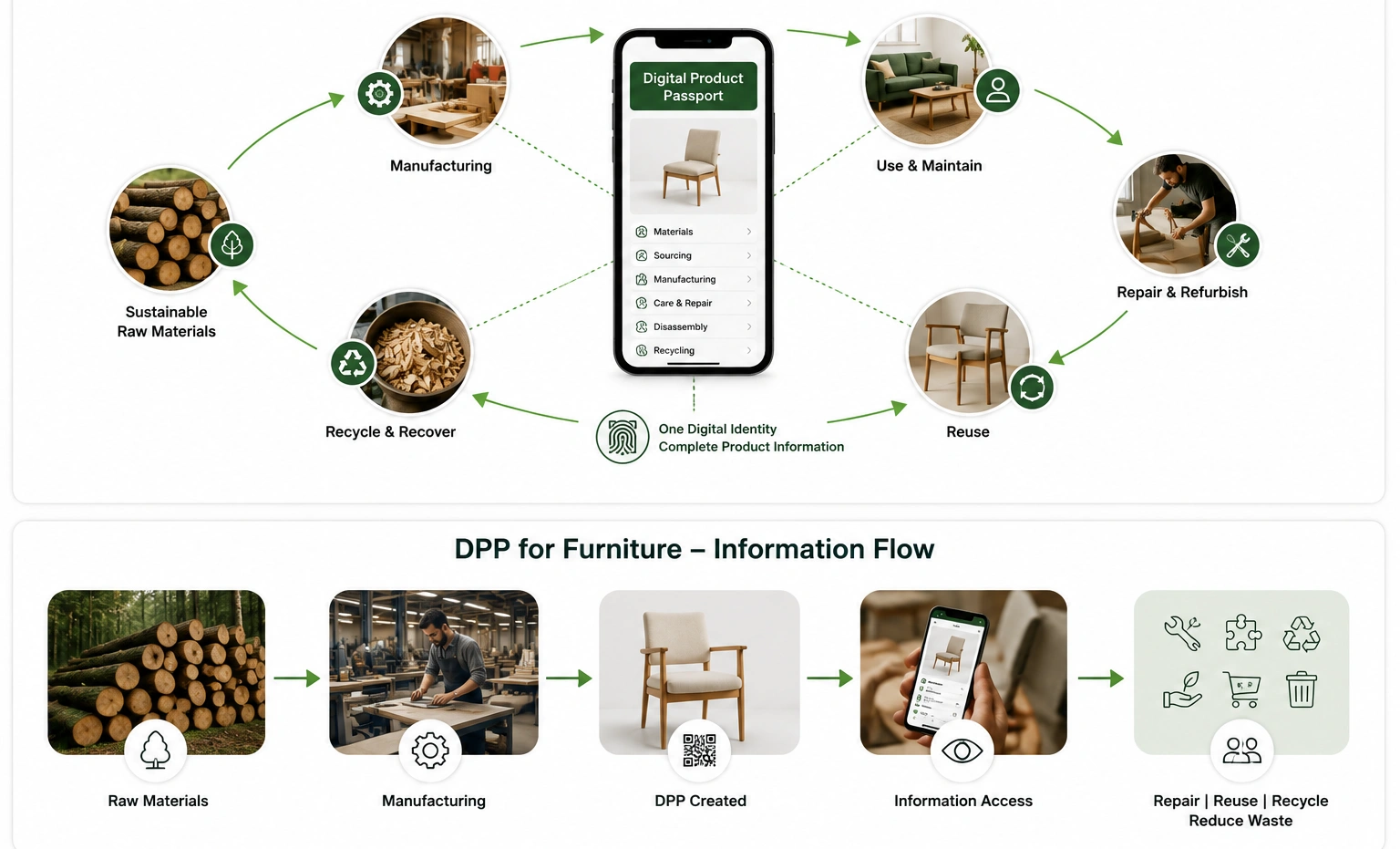
One of the biggest challenges for furniture manufacturers is maintaining visibility into products after they leave the factory.
To support circular economy initiatives, stakeholders need access to accurate information about materials, components, repair options, and end-of-life handling.
This is where DPP for Furniture Manufacturers creates value.
By providing product and lifecycle information in a single digital record, a Digital Product Passport helps extend product lifespans and reduce waste.
→ Supports furniture repair with maintenance and replacement information
→ Enables refurbishment by identifying reusable components and materials
→ Improves recycling through material composition and disassembly guidance
→ Helps customers make informed end-of-life decisions
As sustainability expectations continue to rise, DPP for Furniture helps manufacturers support more circular, resource-efficient, and sustainable product lifecycles.
As sustainability and circular economy initiatives continue to reshape manufacturing, furniture companies are under increasing pressure to improve product transparency and lifecycle visibility.
The European Commission’s Circular Economy Action Plan highlights the importance of designing products that are more durable, repairable, and resource-efficient, making Digital Product Passports an important enabler for the future of sustainable manufacturing.
Learn more about the EU Circular Economy Action Plan: Circular Economy
Successful implementation of a Digital Product Passport for Furniture Manufacturers depends on accurate, complete, and accessible data.
Many furniture manufacturers currently manage information across multiple systems and supplier networks.
Key DPP data categories include:
| Data Category | Examples |
|---|---|
| Product Data | Product IDs, dimensions, specifications |
| Material Data | Timber, metals, plastics, textiles, recycled content |
| Supplier Data | Supplier details and sourcing locations |
| Manufacturing Data | Production sites and processes |
| Sustainability Data | Environmental certifications and declarations |
| Circularity Data | Repairability, refurbishment, recycling instructions |
| Compliance Data | Product safety and regulatory requirements |
To maximise the value of DPP for Furniture Manufacturers, organisations must ensure data remains accurate throughout the product lifecycle.
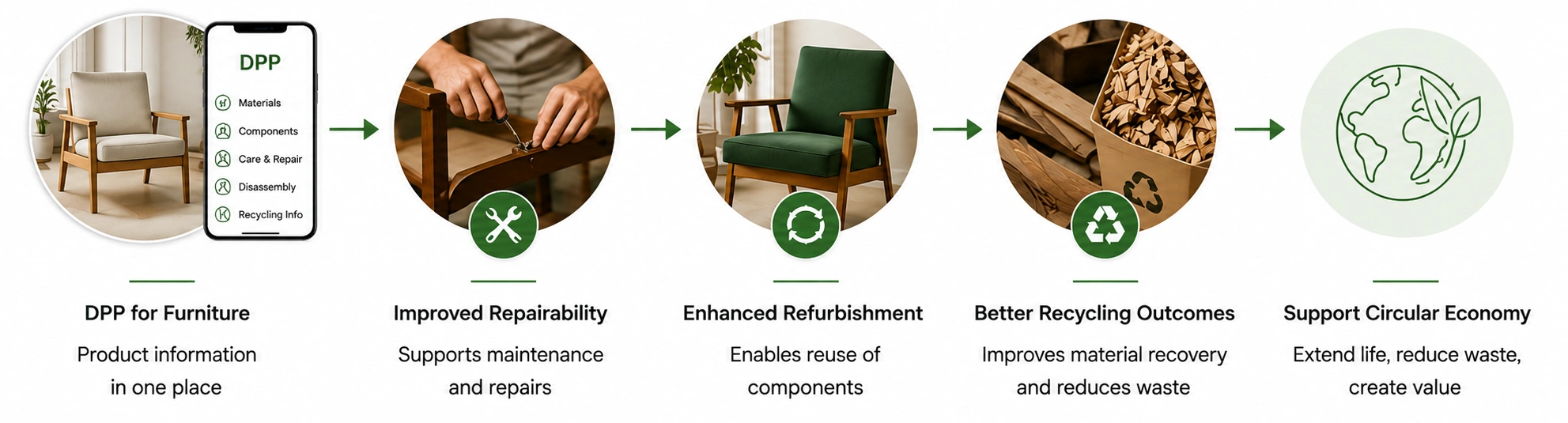
One of the primary objectives of DPP for Furniture is to support circular economy strategies by making product information accessible throughout the entire lifecycle.
→ Improved Repairability: Provides maintenance and repair information that helps extend product lifespans and reduce unnecessary replacements.
→ Enhanced Refurbishment: Identifies reusable materials and components, making refurbishment programmes more efficient and sustainable.
→ Better Recycling Outcomes: Improves material recovery by providing clear information on product composition and disassembly requirements.
For many organisations, DPP for Furniture Manufacturers becomes the foundation for successful circular economy initiatives.
As Digital Product Passport regulations continue to evolve across Europe, furniture manufacturers should focus on building strong data and traceability foundations today.
Preparing early can help organisations reduce compliance risks, improve reporting capabilities, and support future sustainability requirements.
→ Assess existing product and material data
→ Improve supplier transparency and traceability
→ Standardise product information across systems
→ Establish clear data governance processes
→ Strengthen lifecycle and sustainability reporting capabilities
A proactive approach helps manufacturers move from reactive compliance to long-term operational readiness.
Successfully implementing a Digital Product Passport for Furniture Manufacturers requires more than collecting product data. It requires a connected ecosystem that links products, materials, suppliers, and sustainability information across the entire lifecycle.
Azilen follows a structured framework to help manufacturers accelerate DPP readiness.
While requirements continue to evolve, Digital Product Passports are expected to play an increasingly important role in helping furniture manufacturers improve transparency, sustainability reporting, traceability, and circular economy compliance.
A Digital Product Passport for Furniture should include product specifications, material composition, supplier information, sustainability certifications, repair instructions, and recycling guidance to support transparency throughout the product lifecycle.
A Digital Product Passport helps recyclers identify material composition, disassembly methods, and reusable components, making it easier to recover valuable materials and reduce waste.
Furniture manufacturers can prepare by improving product data management, strengthening supplier visibility, standardising information across systems, and building stronger traceability capabilities.
DPP for Furniture Manufacturers helps improve supply chain transparency, support circular economy initiatives, enhance sustainability reporting, strengthen customer trust, and create new opportunities for repair, refurbishment, and reuse.
→ Digital Product Passport (DPP): Digital record containing product lifecycle, sustainability, compliance, and traceability data.
→ Digital Product Passport for Furniture Manufacturers: Framework supporting furniture product transparency, traceability, and circular economy initiatives.
→ DPP for Furniture Manufacturers: Digital approach to managing furniture lifecycle and sustainability information.
→ DPP for Furniture: Product data framework supporting transparency, repairability, and recyclability goals.
→ Circular Economy: Economic model focused on reuse, repair, refurbishment, and recycling.
→ Supply Chain Traceability: Tracking materials, suppliers, and products throughout their lifecycle.
→ Product Lifecycle Management (PLM): System managing product data from design to end-of-life.
→ Enterprise Resource Planning (ERP): Software integrating procurement, inventory, manufacturing, finance, and operations.
→ Material Provenance: Information showing the origin and sourcing of materials.
→ Product Carbon Footprint: Total greenhouse gas emissions generated throughout a product lifecycle.
 11 mins