

Skip to content

How Can Digital Product Passports Support Reverse Logistics?

Featured Image

AI Overview

Digital Product Passports (DPPs) can support reverse logistics by connecting returned products to their digital identity, product configuration, component information, material composition and lifecycle data. When this information is connected with ERP, PLM, WMS and service systems, businesses can make more informed decisions about what happens to a returned product next.

A DPP can help businesses:

→ Identify returned products: Connect a physical product to its unique digital record and relevant product information.

→ Access product lifecycle data: Retrieve information about components, materials, configuration, repair and maintenance history.

→ Improve recovery decisions: Support decisions around repair, refurbishment, resale, remanufacturing and material recovery.

→ Connect disconnected systems: Make relevant product data available across returns, inspection and service workflows.

→ Support circular operations: Carry product information into its next lifecycle stage instead of treating a return as the end of the data trail.

The real value of DPP in reverse logistics is not simply storing more product information. It is making the right product data available at the moment a recovery decision needs to be made.

A returned product is not simply a product moving in the opposite direction through the supply chain.

Once a product comes back, a business has to answer several operational questions:

→ What exactly has been returned?

→ Which product version or configuration is it?

→ What components does it contain?

→ What materials were used?

→ Has it previously been repaired or serviced?

→ Which parts can be reused?

→ Can it be refurbished?

→ Is it suitable for resale?

→ Should it be remanufactured?

→ Which materials can be recovered?

The physical product may arrive at a warehouse, service center or returns facility within minutes. The information needed to make those decisions may be spread across PLM, ERP, PIM, WMS, CRM, service platforms and supplier systems.

This creates a fundamental reverse-logistics problem:

The product comes back to the business, but the context needed to decide what happens next may not come back with it.

Digital Product Passports can help close that information gap by connecting a physical product with a persistent digital identity and relevant product lifecycle information.

The opportunity, therefore, is bigger than simply improving traceability.

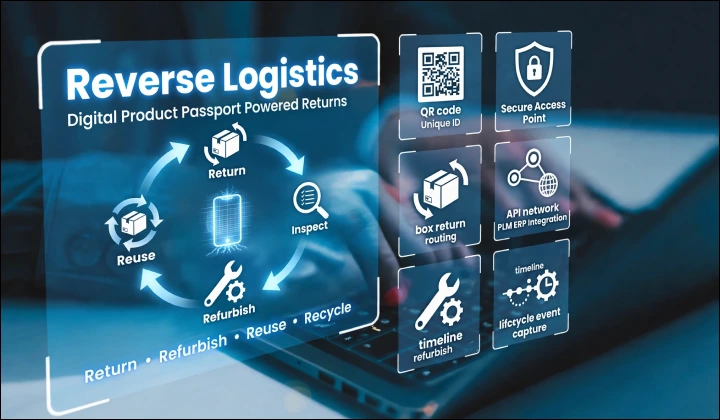
A DPP can become part of the digital infrastructure that connects – product identification → product data → inspection → recovery decision → next lifecycle stage. 

Why Reverse Logistics Needs Better Product Data

Traditional forward supply chains are designed around getting the right product to the right destination.

Reverse logistics is different.

A returned product can follow several possible paths depending on its condition, configuration, remaining value and material composition.

A simplified flow might look like this:

Return

Identification

Inspection

Recovery Decision

Repair | Refurbishment | Resale | Remanufacturing | Material Recovery

The challenge is that each decision requires different information.

For example, a repair operation may need:

→ Product configuration

→ Service history

→ Component specifications

→ Replacement-part information

→ Maintenance instructions

Material recovery may instead require:

→ Material composition

→ Component structure

→ Hazardous-substance information

→ Disassembly information

→ Recycling guidance

Without reliable product-level information, reverse logistics can become dependent on manual inspection, disconnected records and operational assumptions.

A Digital Product Passport provides an opportunity to connect that information to the product itself.

What Is a Digital Product Passport in the Context of Reverse Logistics?

A Digital Product Passport is a structured digital record associated with a physical product through a unique identifier and data carrier.

For reverse logistics, its importance lies in the ability to retrieve relevant information about the product when it re-enters the supply chain.

The DPP does not need to contain every piece of operational information in a single repository.

Instead, it can act as a controlled access point to relevant product information, with data connected through APIs and enterprise integration.

For Instance:

Returned Product

Unique Product Identifier

DPP Record

Product & Lifecycle Data

Reverse-Logistics Workflow 

This approach is consistent with the broader enterprise DPP architecture Azilen describes across its DPP work: product information needs to be structured, machine-readable and connected with existing enterprise systems rather than treated as an isolated compliance database.

How Can Digital Product Passports Support Reverse Logistics?

1. Identify Products at the Point of Return

The first requirement in reverse logistics is knowing exactly what has been returned.

A unique product identifier can connect the physical item to its corresponding digital record.

Instead of relying solely on:

→ SKU

→ Product name

→ Manual paperwork

→ Customer descriptions

→ Warehouse records

The returns process can use the product’s digital identity as the starting point.

Example flow

Physical Product

QR Code / Data Carrier / Identifier

DPP Lookup

Product Record

Relevant Product Information

This can reduce ambiguity when businesses handle multiple product versions, configurations or variants.

For organizations managing large product portfolios, this distinction becomes particularly important at SKU, batch or item level.

2. Retrieve Product Lifecycle Data

Identifying a product is only the first step.

The next question is:

What do we know about this product?

Depending on the product and business architecture, relevant data may include:

→ Product configuration

→ Bill of Materials (BOM)

→ Component information

→ Material composition

→ Supplier information

→ Manufacturing information

→ Maintenance history

→ Repair records

→ Product documentation

→ Sustainability information

→ Lifecycle events

The DPP can provide the digital entry point while enterprise systems remain the systems of record for specific information.

This distinction is important.

A business does not necessarily need to move its ERP, PLM, WMS or service data into a new DPP platform.

Instead, the DPP architecture can establish controlled connections between these systems.

3. Support Product Inspection and Condition Assessment

A DPP cannot physically inspect a returned product.

However, it can provide the information required to make the inspection more meaningful.

Consider a returned product with a known service history.

An inspection team could access:

→ Original product configuration

→ Installed components

→ Previous repairs

→ Maintenance records

→ Relevant technical documentation

→ Replacement-part information

The physical inspection then adds current-condition data.

This creates a more complete assessment:

DPP Product Data

Enterprise Service Data

Physical Inspection

Condition Assessment

The distinction matters because DPP data should support operational decisions rather than be presented as an automated replacement for physical inspection or engineering judgement.

4. Support the Right Recovery Path

One of the biggest opportunities for DPP-enabled reverse logistics is improving the decision about where a returned product goes next.

A returned item does not necessarily have a single predetermined destination.

Depending on the product and condition, it could enter:

→ repair

→ refurbishment

→ resale

→ remanufacturing

→ component recovery

→ material recycling

The DPP can provide information that supports the decision.

HTML Table Generator
Recovery Rate 
Relevant DPP Information 
Operational Question 
 Repair   Service history, configuration, components   Can the product be repaired? 
Refurbishment  Condition, configuration, documentation   Can it be restored for another use cycle?  
Resale  Product identity, specifications, condition   Is it suitable for the secondary market?  
Remanufacturing  Components, configuration, lifecycle history   Can it enter another manufacturing cycle?  
Material Recovery  Material composition, components   Which materials can be recovered?  

The DPP does not make the commercial or engineering decision on its own.

It provides the product data that can feed that decision.

The DPP-to-Recovery Decision Chain

This is where the role of a Digital Product Passport becomes more interesting.

Instead of viewing DPP as simply a digital information repository, businesses can treat it as part of a DPP-to-Recovery Decision Chain.

The Chain Looks Like This:

Product Return

Product Identification

DPP Lookup

Product + Lifecycle Data

Physical Inspection

Recovery Assessment

Repair / Refurbish / Resell / Remanufacture / Recover Materials

Lifecycle Update

The objective is to ensure that the people and systems making those decisions have access to the information they need.

This shifts the role of DPP from:

“Where do we store product information?”

to:

“How do we use product information when the product enters its next lifecycle stage?”

That is the more strategic role DPP can play in reverse logistics.

What Product Data Matters After a Product Is Returned?

Not every DPP data element has equal operational value during reverse logistics.

The most useful information depends on the recovery pathway.

HTML Table Generator
Product Information 
Reverse Logistics Use 
Unique Product Identifier   Identify the exact product and associated digital record   
 Product Configuration  Determine model, version, and configuration  
Component Information   Identify replaceable or reusable components  
 Material Composition  Support dismantling, sorting and material recovery  
Repair History   Understand previous interventions  
Maintenance Information   Support serviceability assessment  
 Product Lifecycle Data  Understand previous and current lifecycle stages  
 Product Documentation  Support inspection, repair and refurbishment  
 Supplier Information   Trace relevant components or materials 
 Sustainability Data  Support circularity and recovery assessments  

The important point is not simply the quantity of data, it is:

→ The connection between data and operational decisions.

→ A material composition record that becomes useful when a product is being dismantled.

→ A repair history that becomes useful when a service team evaluates whether another repair is viable.

→ A component record that becomes useful when a refurbisher needs to determine which parts can be reused.

DPP Integration Architecture for Reverse Logistics

A Digital Product Passport becomes significantly more valuable when it is connected to the enterprise systems already managing product and operational information.

A practical architecture can look like this:

Digital Product Passport

API / Integration Layer

ERP | PLM | PIM | WMS | CRM | Service & Repair Systems

Returns & Recovery Workflows

Each system can continue to perform its existing role.

→ ERP

Provides relevant commercial, product and transaction information.

→ PLM

Provides product structures, configurations, engineering information and lifecycle data.

→ PIM

Provides structured product information and attributes.

→ WMS

Supports warehouse receiving, returns, inspection and physical product movement.

→ CRM

Provides customer and return context.

Service & Repair Systems

Provide maintenance records, repair history, service events and component-level information.

The architecture does not need to create another isolated data silo. Instead, the objective is to create controlled data flows between the DPP and the systems that already manage the product lifecycle.

What Does a DPP-Enabled Reverse-Logistics Workflow Look Like? 

Consider a returned product entering a distribution or service facility.

Step 01 — Product Identification

→ The product’s QR code, RFID tag or other data carrier is scanned.

→ The identifier is used to locate the relevant digital product record.

Step 02 — DPP Lookup

The system retrieves the information relevant to the returned product.

This could include:

→ Product configuration

→ Materials

→ Components

→ Lifecycle information

→ Documentation

Step 03 — Data Enrichment

The DPP record can be supplemented with information from connected enterprise systems.

For example:

DPP

ERP

PLM

Service System

Enriched Product Context

Step 04 — Physical Inspection

The returned product is assessed for:

→ Physical condition

→ Component condition

→ Functionality

→ Damage

→ Repairability

Step 05 — Recovery Decision

Rules, operational policies and human assessment determine the most appropriate pathway.

Step 06 — Operational Workflow

The product is routed to the appropriate process:

Repair

or

Refurbishment

or

Resale

or

Remanufacturing

or

Material Recovery

Step 07 — Lifecycle Update

Relevant events and outcomes can be recorded so the product’s digital information remains useful for subsequent lifecycle stages.

The result is a connected workflow rather than a standalone DPP lookup.

Where Can Workflow Automation Fit?

The biggest operational opportunity comes when DPP data becomes part of an automated workflow.

An API-driven architecture could:

Receive a product return.

Identify the product.

→ Retrieve the DPP.

→ Pull relevant ERP, PLM or service information.

→ Validate required data.

→ Create an inspection task.

→ Apply predefined recovery rules.

→ Route the product to the appropriate workflow.

→ Capture the recovery outcome.

→ Update the relevant lifecycle information.

This is where DPP integration moves beyond compliance and becomes an operational capability.

How DPP Can Support Repair and Refurbishment

Repair and refurbishment depend heavily on product-level information.

A service team may need to know:

→ Which configuration was originally manufactured?

→ Which components were installed?

→ What parts are replaceable?

→ Has the product already been repaired?

→ Which maintenance procedures apply?

→ What technical documentation is relevant?

→ Which components can be reused?

Without this information, technicians may spend additional time identifying the product and reconstructing its history.

With a connected DPP architecture, relevant information can be surfaced as part of the service workflow.

This can support a transition from:

Return → Inspect → Dispose

towards:

Return → Identify → Assess → Repair / Refurbish → Reuse

The business value comes from recovering more of the product’s remaining functional value.

How DPP Can Support Resale and Secondary Markets

A returned product may still have significant commercial value.

However, resale requires confidence about what the product is, what condition it is in and what information can be provided to the next buyer.

A persistent digital product record can help carry relevant information across ownership or use cycles.

This can make the product easier to identify, assess and represent in a resale environment.

The DPP itself does not create market demand.

But better product information can reduce information gaps that make secondary-market transactions harder to manage.

How DPP Can Support Material Recovery and Recycling

Reverse logistics eventually intersects with end-of-life management.

At this stage, material and component information becomes particularly important.

A product may contain multiple materials or components that require different recovery processes.

Relevant DPP information can help provide context around:

→ Material composition

→ Component structure

→ Disassembly requirements

→ Relevant product documentation

→ Reusable components

→ Recoverable materials

This can support more informed dismantling, sorting and recovery workflows.

The broader circular-economy opportunity is therefore not simply:

“Recycle the product.”

It is:

“Understand the product well enough to determine what value can still be recovered from it.” 

What Digital Product Passports Cannot Do on Their Own 

It is important not to overstate what a DPP does.

A Digital Product Passport does not automatically:

→ Inspect the physical condition of a returned product

→ Determine whether repair is economically viable

→ Perform a repair

→ Guarantee resale demand

→ Dismantle a product

→ Recycle materials

→ Replace a WMS or reverse-logistics platform

→ Eliminate the need for operational processes

Instead, DPP provides structured product identity and information that can support these processes.

This distinction is important when designing a DPP implementation.

The objective should not be to turn the DPP into another monolithic enterprise system.

It should be to make trusted product information available to the systems and people that need it.

What Businesses Need to Get Right 

A DPP-enabled reverse-logistics strategy depends on more than creating a digital record.

Businesses need to address several architectural and operational considerations.

1. Product Identity

Each product needs a reliable way to connect its physical identity with the correct digital record.

2. Data Quality

Incorrect or incomplete product information can undermine downstream decisions.

3. Data Ownership

Businesses need clear ownership for different categories of product and lifecycle information.

4. System Integration

DPP data needs controlled connections to ERP, PLM, WMS, PIM, CRM and service environments where relevant.

5. Lifecycle Updates

Product information should remain useful as the product moves through repair, refurbishment, resale or other lifecycle events.

6. Access Control

Not every stakeholder should necessarily have access to every piece of product information.

DPP architecture therefore needs to consider access, data boundaries and security alongside interoperability.

7. Scalability

A solution that works for a small pilot may struggle when extended across thousands of SKUs, multiple suppliers, product variants and large volumes of lifecycle events.

These considerations reflect a broader DPP implementation reality: the difficult part is rarely creating a QR code or digital page. The larger engineering challenge is connecting fragmented product data and enterprise systems into a reliable, scalable architecture.

From Reverse Logistics to Circular Operations 

Reverse logistics has traditionally been viewed as a cost and operational challenge.

→ Products are returned.

→ Warehouses process them.

→ Service teams inspect them.

→ Some are repaired.

→ Some are resold.

→ Others are discarded or recycled.

Digital Product Passports create an opportunity to make the information layer connecting these activities more structured.

The potential lifecycle pathways become:

Return → Repair → Reuse

Return → Refurbish → Resale

Return → Remanufacture → New Lifecycle

Return → Dismantle → Material Recovery

The common element is product information.

The DPP can provide a persistent digital identity around which that information is connected.

This is where DPP starts to support a broader circular operating model.

The strategic shift is from “managing returned products to managing the remaining value within returned products.” 

The Business Case for DPP in Reverse Logistics

The business case for connecting DPP with reverse logistics should not be based solely on compliance.

A well-designed DPP architecture can support several operational objectives:

→ Better Product Traceability

Connect returned products with the right product and lifecycle records.

→ Faster Information Retrieval

Reduce the time spent searching across disconnected systems.

→ More Informed Recovery Decisions

Give inspection and service teams access to relevant product information.

→ Better Component Recovery

Identify components that may be reusable or replaceable.

→ Improved Refurbishment

Provide product and service context needed for restoration.

→ Stronger Secondary-Market Operations

Make relevant product information available for resale and reuse.

→ More Structured Material Recovery

Provide information that supports dismantling and material recovery.

The exact business value will vary by industry, product complexity, return volumes and existing technology architecture.

The important point is that DPP can become part of the data infrastructure behind circular operations, rather than functioning only as a compliance record.

How to Build a DPP Architecture for Reverse Logistics 

Phase 1 — Map the Product Data

Identify where product, component, material, service and lifecycle information currently resides.

Phase 2 — Establish Product Identity

Define how physical products, SKUs, batches or individual items connect to digital records.

Phase 3 — Map Enterprise Systems

Identify relevant ERP, PLM, PIM, WMS, CRM and service systems.

Phase 4 — Define Integration Architecture

Determine which data should be exchanged through APIs, integration services or other controlled interfaces.

Phase 5 — Design Reverse-Logistics Workflows

Map the journey from return through inspection, recovery decision and next lifecycle stage.  

Phase 6 — Automate Where It Adds Value

Automate repetitive data retrieval, validation, task creation and workflow routing.

Phase 7 — Capture Lifecycle Events

Ensure relevant outcomes feed back into the product’s digital information ecosystem.

The objective is not to replace existing enterprise infrastructure. It is to connect it around a reliable product identity and lifecycle data model.

Turn DPP Data Into Circular Value With Azilen

What if your returned products could tell you what to do with them next?

A Digital Product Passport becomes significantly more valuable when its data can move beyond a compliance record and into the operational systems managing returns, service, recovery and reuse.

Azilen helps businesses connect Digital Product Passport capabilities with the enterprise architecture required to operationalize product lifecycle data.

→ DPP & Data Architecture

Design product data models, digital identity structures and lifecycle information flows that support DPP and circular operations.

→ Enterprise Integration

Connect DPP environments with ERP, PLM, PIM, WMS, CRM and service platforms through APIs and integration architecture.

→ Reverse-Logistics Workflow Automation

Automate product identification, data retrieval, inspection workflows, recovery routing and lifecycle-event processing.

→ Custom Engineering

Build applications, dashboards, services and workflow components around specific reverse-logistics and product-recovery requirements.

Scalable DPP Architecture

Design for growing product portfolios, higher data volumes, multiple enterprise systems and expanding ecosystem participation.

The objective is not simply to create a Digital Product Passport. It is to make product data useful when the product comes back. Talk to our Azilen’s expert panel about your DPP and circular-operations strategy!

What if every product return could become a recovery opportunity?

Azilen helps you connect Digital Product Passports, enterprise systems and operational workflows to make that possible.

Let’s Build Your DPP Strategy →

FAQs

How can Digital Product Passports help reduce waste from returned products?

Digital Product Passports can help businesses identify whether a returned product still has recoverable value before it is treated as waste. Access to product configuration, component and material information can support decisions around repair, refurbishment, resale, remanufacturing or material recovery. This can help shift reverse logistics from a disposal-focused process toward value recovery.

Can a Digital Product Passport help determine whether a returned product should be repaired or replaced?

It can provide information that supports that decision. Product configuration, previous repairs, maintenance history and component information can give service or inspection teams greater context when assessing a returned product. The actual repair-versus-replacement decision would still depend on the product’s physical condition, business rules, cost and operational processes.

How does a Digital Product Passport support product returns after the original sale?

A DPP can give returned products a persistent digital identity that links the physical item to relevant product and lifecycle information. When that identity is retrieved during a return, businesses can use the available information alongside inspection and returns data to understand what has come back and determine the appropriate next step.

Can Digital Product Passports improve the value recovery of returned products?

Yes. The more confidently a business can identify a returned product and understand its configuration, components, materials and lifecycle, the easier it can be to evaluate potential recovery routes. Instead of treating every return in the same way, businesses can assess whether the product is better suited for repair, refurbishment, resale, remanufacturing or material recovery.

What happens if the information in a Digital Product Passport is incomplete or outdated?

Incomplete or outdated data can reduce the reliability of decisions made during inspection, repair, refurbishment or recovery. For example, missing component or material information could make it harder to determine the appropriate recovery route. Businesses therefore need processes for data validation, lifecycle updates, versioning and ownership so that the DPP remains a trustworthy source of product information throughout its lifecycle.

Kulmohan Makhija
Kulmohan Makhija
Vice President – Growth & Enterprise Strategy

Kulmohan Makhija is an enterprise technology and business strategy writer with over 12 years of experience analyzing digital transformation across global and European markets. His work focuses on applied artificial intelligence, product engineering, enterprise architecture, and large-scale legacy modernization. He explores how complex organizations modernize core systems, adopt AI responsibly, and align innovation with regulatory, cultural, and operational realities — particularly within the UK and broader European technology landscape. With a pragmatic enterprise perspective, Kulmohan emphasizes transformation that delivers measurable impact without disrupting mission-critical operations. His writing bridges executive strategy with technical depth, providing clarity for technology leaders, product teams, and decision-makers navigating modernization journeys.

Related Insights