Skip to content

The EU Central DPP Registry Is Operational: The Executive Strategy & Action Guide

Featured Image

The Breakthrough News (July 20, 2026)

On July 20, 2026, the European Commission officially launched the central Digital Product Passport (DPP) Registry and its live testing sandbox under Commission Implementing Regulation (EU) 2026/1778.

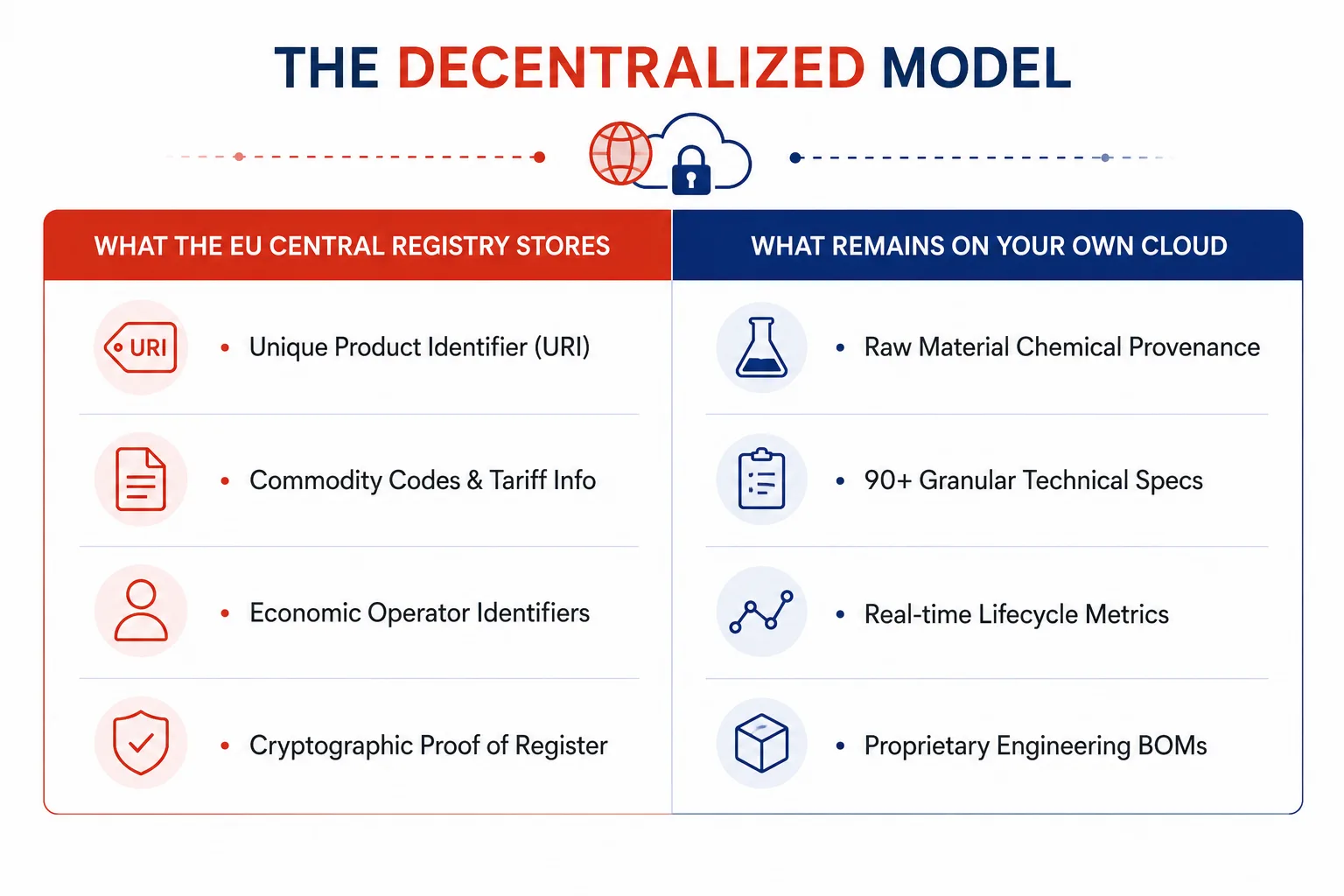
The transition from theoretical legislation to live European infrastructure is complete. However, a critical technical misunderstanding poses a massive risk to international enterprise software architectures: The EU Registry is not a central database.

Why the 80% Data Gap Exists

DPP Registry

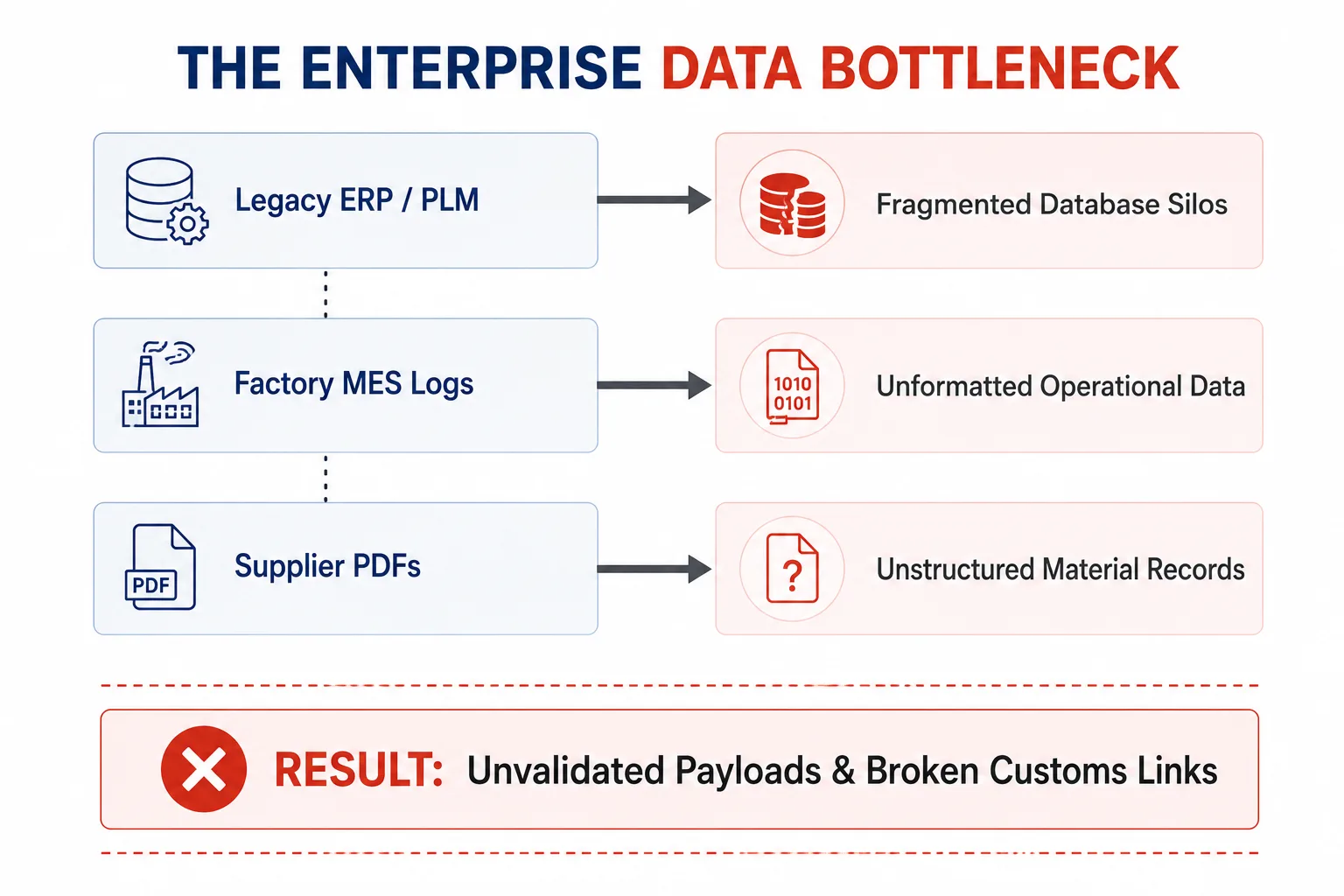
As manufacturers prepare to connect to this live index, they face a silent operational bottleneck: data fragmentation.

Over decades of enterprise IT development, product information was engineered to serve isolated functions:

  • Procurement captured supplier invoices as flat PDFs.

  • Manufacturing plants logged process parameters in localized MES environments.

  • R&D and Quality teams stored metallurgical breakdowns and test certifications in standalone PLM databases.

  • Sustainability groups logged carbon footprints in third-party EPD tools.


Because these legacy systems were never designed to communicate natively, up to 80% of the raw data required to generate a JRC-compliant passport currently sits trapped inside disconnected, non-interoperable enterprise silos. When the central EU Registry queries your system for a product’s URI pointer, a single broken link or unformatted dataset risks customs holds and market disqualification.

Market Dynamics: The Financial & Technical Scale

The stakes for global manufacturers and technology providers could not be higher:

35%

Europe’s share of total global DPP revenue—driven by enforcement under the Ecodesign for Sustainable Products Regulation (ESPR).

90+

Distinct data points required per product under mandatory EU Battery Passport rules (from chemical formulas to dismantling manuals).

80%

Share of required compliance data currently locked inside disconnected enterprise silos (ERP, MES, PDFs, and EPDs).

If your enterprise systems cannot automatically aggregate these 90+ data points and expose them via standardized, secure APIs, your product cannot register with the EU central index, creating instant logistics bottlenecks at European borders.

The Decoupling Principle

Attempting to resolve this data gap by forcing legacy SAP, Oracle, or Siemens PLM core databases to directly service public external API calls introduces severe risks—including system latency, high engineering costs, and accidental exposure of trade secrets.The Enterprise Challenge-Breaking Down System SilosThe architectural mandate for modern enterprises is decoupling. Instead of rewriting validated legacy code, leaders deploy an API-first middleware layer that extracts raw inputs, harmonizes them into standardized JSON-LD schemas, and securely serves the central EU Registry.

How Azilen Powers End-to-End DPP Compliance

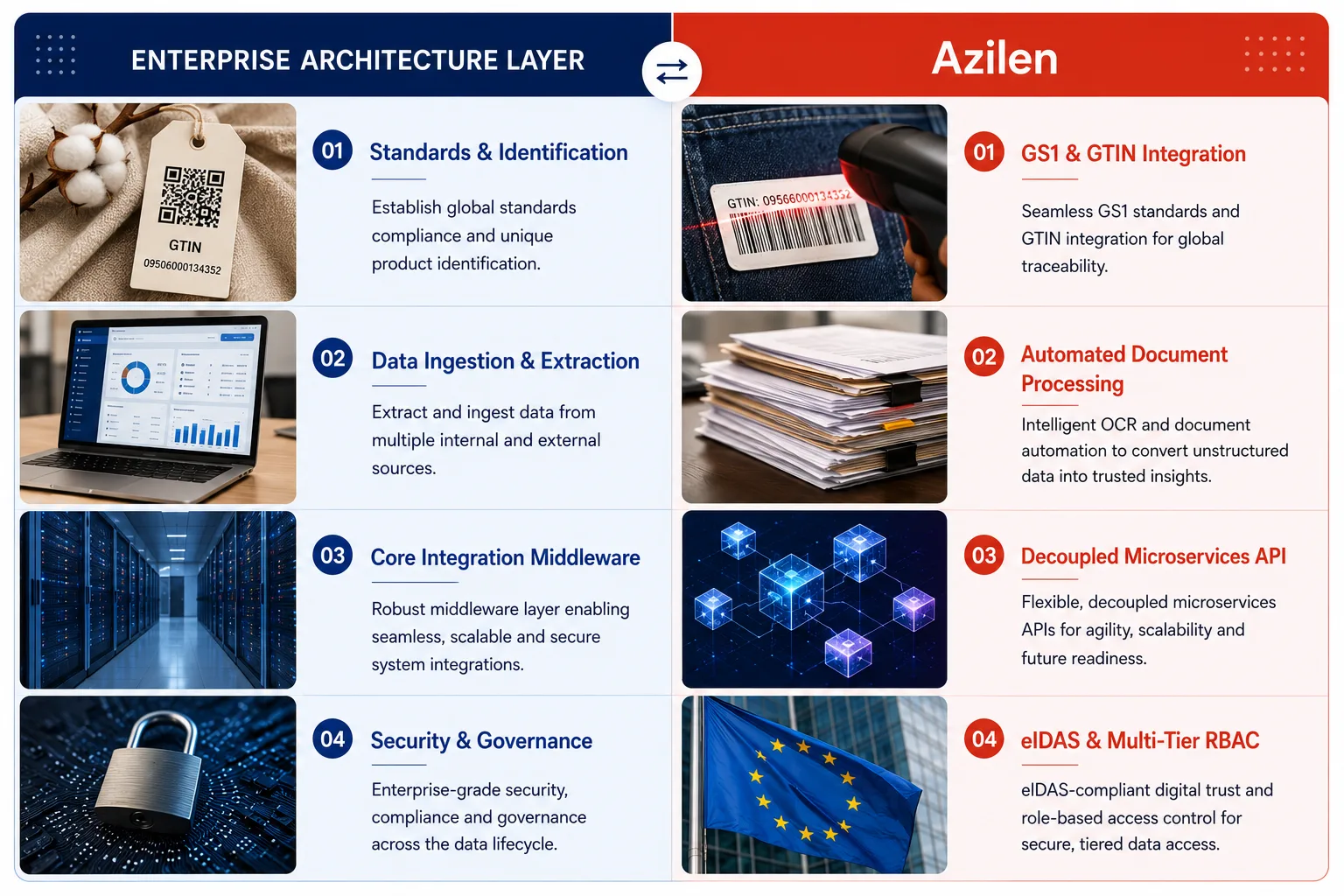
Rather than forcing a costly “rip-and-replace” of core transactional systems, Azilen  approaches the central EU DPP Registry through decoupled integration middleware, standards-backed architectures, and product engineering excellence.

1. Standards-Backed Identification Layer (Azilen × GS1 Partnership)

• GS1-Compliant Identity: Azilen embeds globally recognized GS1 GTIN (Global Trade Item Number) standards into the foundational product identification layer, ensuring every passport is globally unique, interoperable, and audit-ready from day one.

• Scan-to-Passport Carrier Access: Integrates physical data carriers—including 2D Data Matrix codes and GS1 Digital Link QR codes—enabling instant resolution from physical assets to secure cloud payloads.

2. Decoupled Integration & Legacy Modernization

Zero Core ERP Disruption: Azilen builds lightweight, high-throughput middleware adapters that sit between legacy SAP/Oracle ERPs, factory MES logs, and supplier databases without modifying validated core codebase.

• Automated Data Extraction & Harmonization: Extracts unstructured material disclosures (PDF certificates, lab reports, supplier logs) and cleanses them into machine-readable JSON-LD schemas compliant with CEN/CENELEC JTC 24 specifications.

3. Enterprise Governance, Security & High Availability

eIDAS Digital Signatures: Integrates Qualified Electronic Seals (QES) to authenticate corporate identity and verify cryptographic proofs before submitting URI pointers to the EU Central Registry index.

• Granular Access Control (RBAC): Natively enforces role-based access tiers—encrypting trade secrets and vendor cost structures while exposing public carbon metrics and authority-level compliance proofs.

• 10-Year Data Persistence Uptime: Engineers resilient, high-availability cloud host infrastructure (AWS/Azure/GCP) to guarantee 99.99% API uptime across the mandatory 10-year regulatory window.

The Post-Registry Action Checklist

To navigate this transition seamlessly, executive teams must execute a dual-track roadmap spanning business governance and technical readiness.

Business-Level Checklist

✅ Audit Supply Chain Contracts & Data Ownership: Update supplier SLAs to mandate structured, machine-readable material disclosures (e.g., chemical composition, recycled content percentages) rather than unstructured PDF attachments.

✅ Establish Multi-Tiered Governance: Define clear internal ownership over passport data categories across Legal, R&D, Procurement, and IT to prevent compliance gaps.

✅ Map Sector-Specific Enforcement Horizons: Align IT development budgets with your industry’s enforcement dates (e.g., Industrial & EV Batteries in February 2027; Textiles, Steel, and Electronics following shortly after).

✅ Protect Commercial Trade Secrets: Implement clear policies defining which data points are public (carbon intensity, recyclability) versus restricted (proprietary alloy ratios, vendor cost structures).

Technical-Level Checklist

Data Lineage Mapping: Identify where the 90+ data points required per product reside across legacy ERP, PLM, MES, and external supplier databases.

✅ Deploy Decoupled API Middleware: Establish a dedicated middleware integration layer capable of aggregating siloed inputs without altering core transactional databases.

✅ Format JRC & CEN-CENELEC Data Schemas: Ensure data transformation engines automatically convert raw inputs into validated, machine-readable formats (JSON-LD) compatible with EU standards.

✅ Implement eIDAS Digital Signatures: Integrate Qualified Electronic Seals (QES) to authenticate corporate identity and verify data integrity before transmitting URI pointers to the central index.

[ ] Connect to the EU Testing Sandbox: Test automated registration payloads against the live European Commission sandbox environment to validate system uptime and error handling.

Recommended Industry Briefing

To understand how product data models and 2D QR codes are replacing traditional supply chain operations under the new EU Registry, watch this breakdown:

Real-World Case Study

Case Study: Decoupling Legacy ERP Architecture for ESPR Compliance

Client Challenge

An international industrial components manufacturer exporting into Europe faced impending disqualification from primary distribution networks due to mandatory EU Ecodesign for Sustainable Products Regulation (ESPR) requirements.

While 95% of their physical material quality testing was completed accurately on the factory floor, over 40% of the required compliance data remained locked across disconnected, non-interoperable enterprise systems—including legacy SAP ERPs, localized MES logs, and supplier PDF material test reports.

Direct public API integration with their core ERP risk-exposed proprietary metallurgical formulas, introduced severe database latency, and threatened high operational downtime.

Solution Engineering by Azilen

Azilen deployed a decoupled, API-first DPP integration architecture without altering or rewriting the validated core ERP code:

  1. GS1 Identification Integration: Embedded GS1 GTIN standards into the identification layer, enabling scan-to-passport access via serialized 2D Data Matrix and GS1 Digital Link QR codes.
  2. Data Extraction & Harmonization: Implemented automated middleware adapters to extract unstructured supplier material certificates, converting multi-tier supply chain records into JRC-compliant JSON-LD schemas.
  3. Multi-Tiered Access Control (RBAC): Built a secure cloud payload host enforcing role-based access—encrypting proprietary manufacturing specs while exposing certified carbon metrics, recyclability scores, and time-in-service tracking to customs officials and consumers.

Business Outcomes

• Zero Core Downtime: Established real-time automated data extraction pipelines without disrupting live manufacturing operations.

• EU Registry Integration: Connected seamlessly to the central EU testing sandbox environment, validating eIDAS digital signatures and meeting 99.99% uptime requirements for the 10-year data persistence window.

• Secured Single Market Access: Secured preferred supplier status across European procurement lines by delivering instant, audit-ready Digital Product Passports at production speed.

Choose Azilen Technologies for Your Digital Product Passport Journey

With 17+ years of experience delivering enterprise digital transformation solutions, Azilen Technologies helps tyre manufacturers build the data, integration, and traceability capabilities needed for successful Digital Product Passport (DPP) implementation.

DPP Consulting & Architecture Design: Defining complete target architectures, mapping enterprise data lineage, and ensuring alignment with CEN/CENELEC standards and ESPR regulations.

→ Custom DPP Platform Engineering: Building scalable, cloud-native DPP solutions featuring multi-tier Role-Based Access Control (RBAC) to ensure trade secrets remain protected while consumers and auditors access required metrics.

→ Decoupled API Middleware Integration: Designing secure connectors that pull raw compliance metrics from legacy SAP, Oracle PLM, and factory MES logs, converting them into compliant JSON-LD schemas automatically.

→ Data Harmonization & Lifecycle Analytics: Transforming unstructured supplier PDF certificates and EPDs into structured, machine-readable datasets that remain accessible across the mandatory 10-year persistence window.

FAQs: DPP Registry

1. Does registering on the EU central index mean the EU stores our commercial data?

No. The EU Registry acts as a central lookup index. Your bill of materials, supplier details, and carbon footprint metrics remain hosted securely on your own cloud infrastructure or private servers.

2. What happens if our server hosting the DPP data experiences downtime?

Because the central registry directs requests to your host endpoints, server downtime can trigger compliance flags at EU customs. Azilen builds high-availability cloud middleware ensuring 99.99% uptime and reliable API availability.

3. How do we test our enterprise IT stack against the live EU Registry?

The European Commission launched an official testing environment alongside the live Registry. Azilen helps your IT team connect to this sandbox environment to test automated registration payloads, validate eIDAS digital signatures, and eliminate bugs before enforcement dates take effect.

4. What physical data carriers are supported, and how do they map to the central EU Registry?

The EU framework under CEN/CENELEC JTC 24 supports standard physical data carriers—including 2D Data Matrix codes, GS1 Digital Link QR codes, and RFID/NFC tags—attached directly to the product, packaging, or accompanying documentation. Scanning the data carrier resolves a standardized Unique Product Identifier (URI) that acts as a lookup pointer, querying the EU Central Registry to verify compliance and directing users directly to your decentralized, Azilen-hosted cloud payload.

5. How are sensitive commercial data points protected from public access or competitors?

Not all 90+ data points are public. The European Commission enforces strict role-based access control (RBAC) tiers:

Public Tier (Consumers & Buyers): Basic sustainability metrics, carbon footprints, repair scores, and recyclability guides.

Restricted Tier (Recyclers & Repairers): Detailed disassembly schematics, chemical component locations, and replacement part numbers.

Authority Tier (Customs & Market Surveillance): Certified compliance proofs, full bill of materials (BOM), and factory testing logs.

Azilen UK’s middleware natively enforces these granular encryption and authorization layers, ensuring regulators receive mandatory compliance proofs while trade secrets and pricing models remain completely locked.

Kulmohan Makhija
Kulmohan Makhija
Vice President – Growth & Enterprise Strategy

Kulmohan Makhija is an enterprise technology and business strategy writer with over 12 years of experience analyzing digital transformation across global and European markets. His work focuses on applied artificial intelligence, product engineering, enterprise architecture, and large-scale legacy modernization. He explores how complex organizations modernize core systems, adopt AI responsibly, and align innovation with regulatory, cultural, and operational realities — particularly within the UK and broader European technology landscape. With a pragmatic enterprise perspective, Kulmohan emphasizes transformation that delivers measurable impact without disrupting mission-critical operations. His writing bridges executive strategy with technical depth, providing clarity for technology leaders, product teams, and decision-makers navigating modernization journeys.

Related Insights