

Skip to content

DPP ROI: How to Maximise Your Digital Product Passport Investment

Featured Image

Executive Summary

Digital Product Passports are often viewed as another compliance requirement. But the real DPP ROI comes from how businesses structure their investment across data, technology, processes and people.

Here’s what businesses need to understand:

Where the DPP investment goes: From regulatory compliance to product data, system integration and workflow improvements.

Why data and processes matter: Getting product data right and reducing manual work can create value beyond compliance.

How to build the business case: Evaluate Digital Product Passport ROI based on efficiency, data quality, integration and potential business value—not just the initial implementation cost.

For many UK businesses, the conversation around Digital Product Passports starts with regulation: What do we need to comply with, and how much will it cost? But that question may be too narrow.

The bigger opportunity is hidden in the work required to implement DPP. Product data has to be collected, cleaned, connected and maintained. Systems have to communicate. Processes have to become more efficient. Once this foundation is in place, businesses can use it for far more than regulatory reporting.

The European Commission highlights DPPs as a way to improve traceability, transparency, interoperability and circular business models, making them potentially valuable beyond compliance.

“A Digital Product Passport should not simply prove compliance; it should prove the value of better data.”

Where Does DPP Investment Actually Go?

A useful way to understand DPP implementation cost is to break the investment into four connected areas.

The following model is based on the investment split shown in the reference material provided for this article. It should be treated as an illustrative DPP investment model, rather than a universal industry benchmark.

DPP Investment Area Share What It Covers
EU Regulation 10% Regulatory requirements and compliance foundations
Data 40% Collecting, cleaning, structuring, and governing product data
Systems & Platforms 20% Connecting DPP infrastructure with existing systems
Workflows 30% Redesigning and automating processes around DPP data

The important insight is that only a relatively small part of the investment is about regulation itself. Much of the work is about getting the organisation ready to actually operate with product data at scale.

Let’s break down each part.

Not sure where you stand on Digital Product Passport readiness?

Run our free DPP Assessment Calculator and get a clear, personalised readiness score in under five minutes.

Try Free DPP Assessment

1. Fulfilling EU Regulation

The first part of the investment is the most obvious: compliance.

DPP requirements introduce obligations around product information, identifiers, data accessibility and accuracy. Under the EU Ecodesign for Sustainable Products Regulation, applicable products must have a Digital Product Passport containing required information, with data expected to be accurate, complete and up to date.

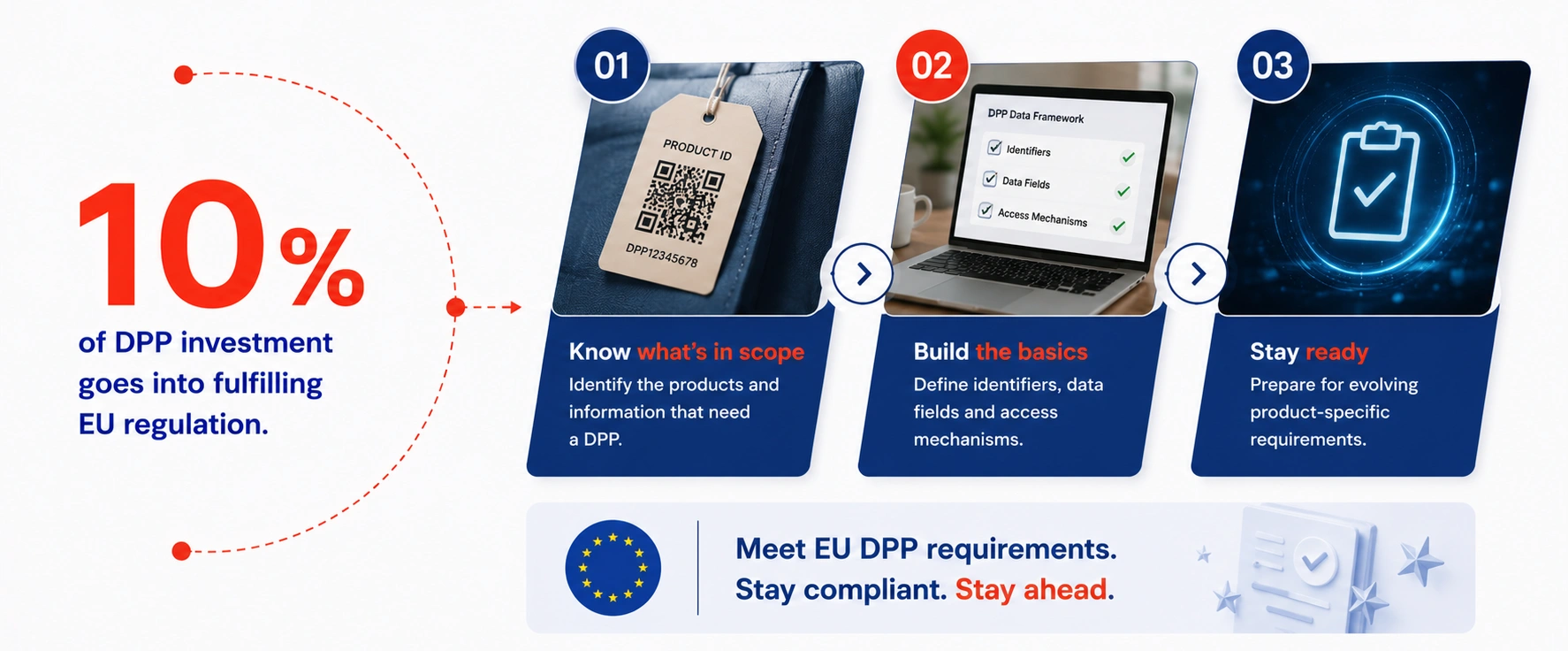
10% Fulfilling EU Regulation

→ Identify which products and product information fall within the relevant requirements.

→ Establish the required identifiers, data fields and access mechanisms.

→ Prepare the organisation to meet evolving product-specific requirements.

But compliance is only the starting point. The bigger investment comes from making the underlying product data usable.

2. Getting Product Data Right

The biggest share of DPP investment goes into something often overlooked: getting product data right.

A Digital Product Passport is only as reliable as the information behind it. Product data can be scattered across ERP and PLM systems, supplier records, spreadsheets and quality documentation. Bringing it together, cleaning it and governing it is essential for long-term DPP ROI.

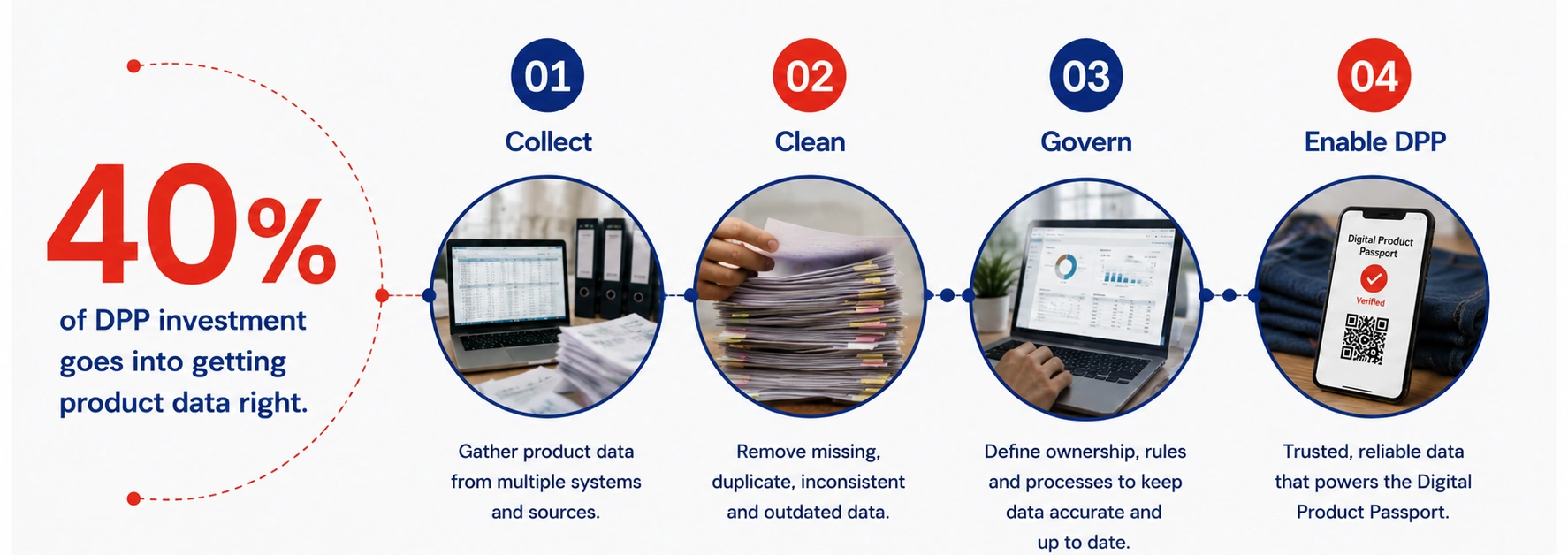
40% Getting Product Data Right

DPP requirements are moving quickly across major industries, with batteries leading the way and textiles, tyres, construction, furniture and ICT products following in the EU roadmap. This means businesses need to start preparing their product data before compliance deadlines arrive.

Collect the right product, material and supplier data.
Clean missing, duplicated or outdated information.
Govern data so it stays accurate and usable.

Learn more: Explore our guides on DPP for Tyres, Construction, Pharmaceuticals and Medical Devices

3. Integrating Existing Systems and Platforms

Once the data foundation is in place, businesses need to connect the DPP environment with the systems already running the organisation.

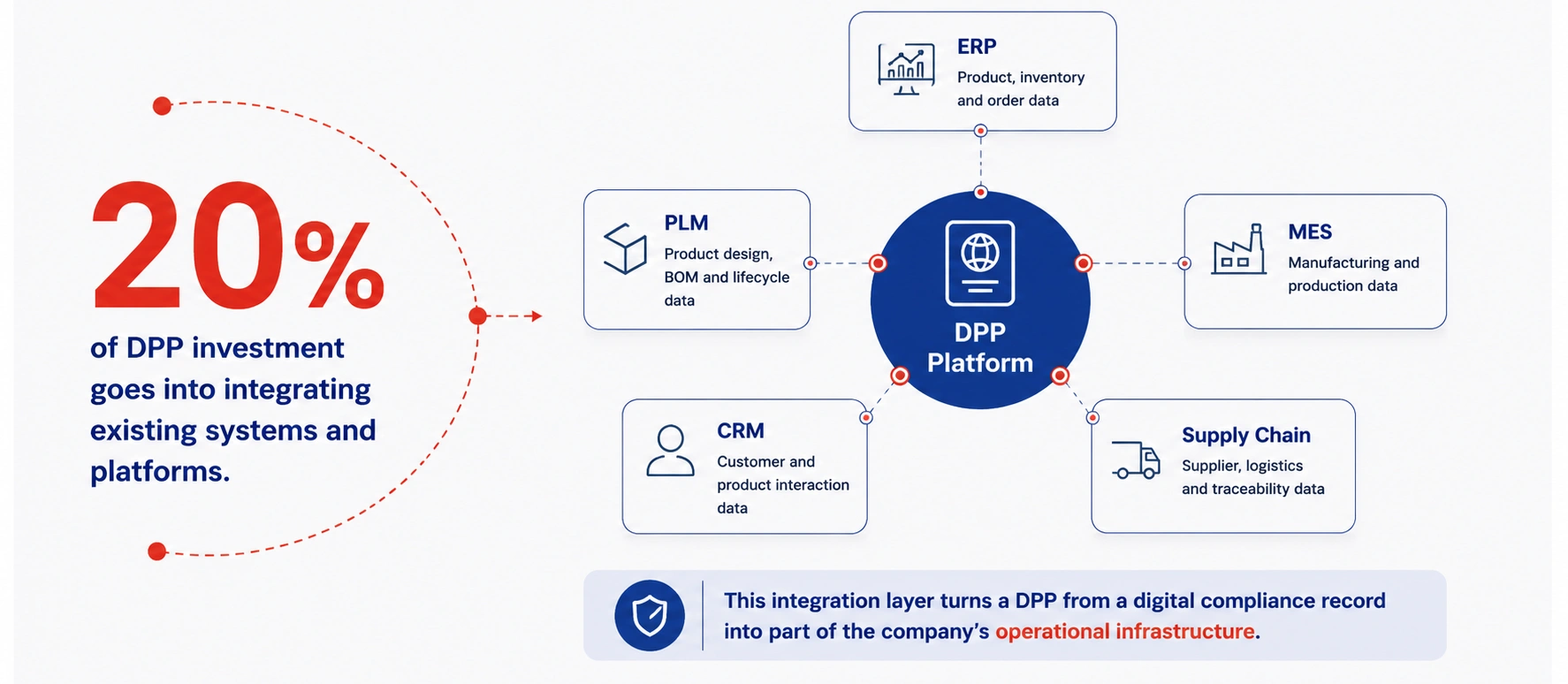
20% Integrating Existing Systems and Platforms

The goal is not to create another isolated data silo.

→ Connect DPP infrastructure with ERP, PLM, MES, CRM and supply-chain platforms where relevant.

→ Automate the movement of product information between systems instead of relying on manual uploads.

→ Use interoperable identifiers and data structures so information can be accessed across the product lifecycle.

The European Commission describes interoperability and traceability as important aspects of the DPP ecosystem, while ISO highlights the need for data exchange, access control and interoperability.

This integration layer is what turns a DPP from a digital compliance record into part of the company’s operational infrastructure.

4. De-bureaucratising Existing Workflows

The final part is where DPP can start creating operational ROI.

If employees still have to manually search for product information, request supplier documents, validate spreadsheets and repeatedly prepare compliance reports, simply adding a DPP does not solve the underlying problem.

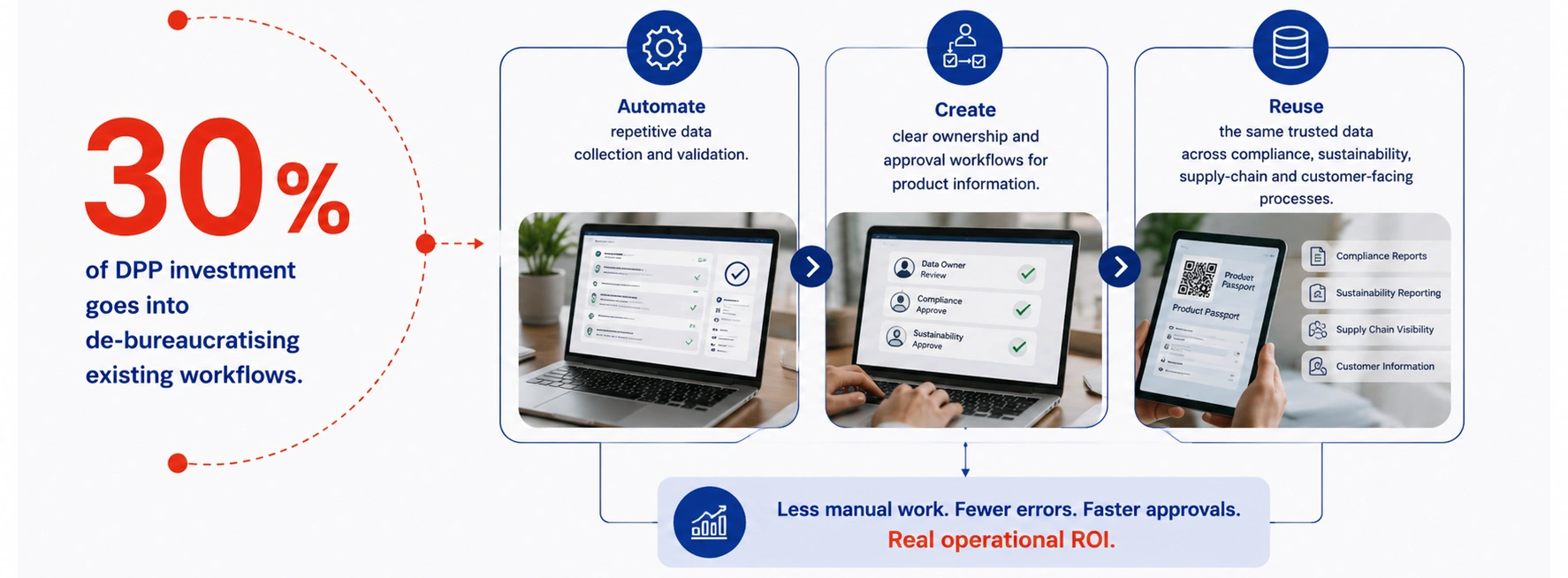
30% De-bureaucratising Existing Workflows

The workflow itself needs to change.

→ Automate repetitive data collection and validation.

→ Create clear ownership and approval workflows for product information.

→ Reuse the same trusted data across compliance, sustainability, supply-chain and customer-facing processes.

This is where businesses can move from “implementing DPP” to “using DPP to work differently.

And that distinction matters when calculating Digital Product Passport ROI.

Ways to Get ROI From Your Digital Product Passport

DPP investment can create value beyond simply meeting regulatory requirements. The real ROI comes from using the same infrastructure to improve operations, connect systems and unlock new business opportunities.

1. Reduce Manual Work

DPP requires businesses to manage large amounts of product and compliance data. By structuring and automating these processes, companies can reduce the time spent on repetitive administrative work.

→ Automate product-data collection and validation
→ Reduce manual compliance and reporting tasks

The result: Less manual effort, fewer errors and lower operational costs.

2. Make Existing Systems More Valuable

DPP works best when it connects with the systems businesses already use. Integrating product data across ERP, PLM and supply-chain platforms can eliminate duplication and improve information flow.

→ Reuse existing product data across systems
→ Reduce duplicate data entry and disconnected workflows

This approach also aligns with the broader principles of a digital transformation roadmap.

The result: Better-connected systems with less operational friction.

3. Turn Compliance Data Into Business Value

Once reliable product data is available, businesses can use it for more than compliance. DPP data can support transparency, traceability and circular business models.

→ Enable repair, reuse and recycling initiatives
→ Create opportunities for new digital services and customer experiences

Azilen explores this transition in DPP Regulatory Framework to Operational Reality.

The result: A compliance investment that can contribute to long-term business growth.

Get More ROI From Your DPP Investment With Azilen

Choosing the right technology partner can make a major difference to your Digital Product Passport ROI. Azilen Digital Product Passport service helps businesses move beyond basic compliance by building DPP solutions that connect product data, existing systems and business workflows, so the investment delivers value across the organisation.

Azilen DPP Expertise How It Helps You Get More ROI
DPP Strategy & Consulting Build a roadmap aligned with your business and regulatory needs
Product Data Management Turn fragmented product data into trusted, usable information
System Integration Connect DPP with your existing ERP, PLM, and business systems
AI & Workflow Automation Reduce manual effort, improve efficiency, and scale DPP operations

With its end-to-end DPP capabilities, Azilen helps businesses turn DPP from a compliance expense into a long-term digital investment, reducing operational costs while creating opportunities for greater efficiency, transparency and business growth.

Choose Azilen Technologies for Better DPP ROI

With 17+ years of experience as a Digital Transformation Company, Azilen helps UK businesses turn Digital Product Passport requirements into measurable business value and stronger DPP ROI.

→ DPP Strategy & Consulting to define the right roadmap, priorities and investment approach

→ Product Data Management to structure, clean and connect the data required for effective DPP implementation

→ DPP System Integration connecting ERP, PLM, supply chain and other existing business platforms

→ DPP Readiness Assessment to identify data gaps, technology challenges and implementation priorities

→ AI-Powered Automation to reduce manual DPP processes, improve efficiency and maximise the value of your investment

By combining DPP expertise, digital transformation, data and AI automation, Azilen helps businesses move beyond compliance and get more ROI from their DPP investment, while building efficient, connected and future-ready operations.

FAQs: Digital Product Passport ROI

1. What is DPP ROI?

DPP ROI (Digital Product Passport ROI) measures the business value generated from a Digital Product Passport investment compared with its implementation and operating costs. It can include savings from automation, better data management, improved workflows and new business opportunities.

2. How much does a Digital Product Passport cost?

Digital Product Passport cost varies depending on the number of products, data complexity, existing systems, integration requirements and level of automation. Businesses should assess their current data and technology landscape before estimating the total DPP implementation cost.

3. How can businesses maximise Digital Product Passport ROI?

Businesses can maximise Digital Product Passport ROI by focusing on data quality, system integration and workflow automation, not just regulatory compliance. Reusing existing data and systems can also help reduce duplication and ongoing operational costs.

4. What are the business benefits of implementing a Digital Product Passport?

A DPP can help businesses improve product traceability, data transparency and operational efficiency while supporting circular business models. When integrated into existing processes, it can create value beyond meeting regulatory requirements.

5. How can I calculate the ROI of a Digital Product Passport?

A simple starting point is:

DPP ROI = (Annual Benefits − Annual DPP Operating Cost) ÷ Initial DPP Investment × 100

Businesses should consider operational savings, reduced manual work, compliance costs, data-quality improvements and potential new revenue opportunities when calculating their DPP business case.

Glossary

Digital Product Passport (DPP): Digital record containing key product, sustainability, compliance and lifecycle information.

DPP ROI: Measure of the business value generated from a Digital Product Passport investment compared with its cost.

→ Digital Product Passport ROI: The financial and operational returns a business can achieve through DPP implementation.

DPP Implementation Cost: Total investment required to implement, integrate and operate a Digital Product Passport.

DPP Business Case: Assessment of the costs, benefits, risks and potential value of implementing a DPP.

Product Data Management: Process of collecting, structuring, validating and maintaining product information.

System Integration: Connecting DPP infrastructure with existing ERP, PLM, supply-chain and business systems.

Workflow Automation: Using technology to reduce manual DPP data, compliance and reporting processes.

Product Lifecycle Visibility: Ability to access and track relevant product information across its lifecycle.

Circular Business Models: Business models supporting activities such as repair, reuse, refurbishment and recycling through better product information.

Kulmohan Makhija
Kulmohan Makhija
Vice President – Growth & Enterprise Strategy

Kulmohan Makhija is an enterprise technology and business strategy writer with over 12 years of experience analyzing digital transformation across global and European markets. His work focuses on applied artificial intelligence, product engineering, enterprise architecture, and large-scale legacy modernization. He explores how complex organizations modernize core systems, adopt AI responsibly, and align innovation with regulatory, cultural, and operational realities — particularly within the UK and broader European technology landscape. With a pragmatic enterprise perspective, Kulmohan emphasizes transformation that delivers measurable impact without disrupting mission-critical operations. His writing bridges executive strategy with technical depth, providing clarity for technology leaders, product teams, and decision-makers navigating modernization journeys.

Related Insights