

Skip to content

Digital Product Passport for Medical Device Manufacturers: Enhancing Product Traceability

Featured Image

Executive Summary

The intersection of the EU’s Medical Device Regulation (MDR) and the upcoming Ecodesign for Sustainable Products Regulation (ESPR) is forcing a massive shift in life sciences manufacturing. For UK medical device exporters, traditional traceability is no longer enough. The impending Digital Product Passport (DPP) demands an end-to-end, auditable lifecycle ledger—tracking everything from raw biocompatible materials and sterile production to hospital usage and safe medical-grade disposal.

What this guide delivers:

Medical-Grade Checklist: A definitive data readiness framework mapped directly to healthcare hardware standards.

Architectural Blueprints: Proven system designs to decouple compliance layers from your core ERP and PLM systems.

Implementation Strategies: Production-ready steps to mitigate technical risk while driving circular efficiency and product safety.

The regulatory landscape is tightening rapidly for UK medical device manufacturers. While the UK operates outside the European Union, its healthcare manufacturing economy remains fundamentally bound to it. Under emerging frameworks extending the EU’s Ecodesign for Sustainable Products Regulation (ESPR) alongside strict Medical Device Regulations (MDR), any brand selling clinical equipment, surgical instruments, or durable medical goods into the European single market must prepare for a validated Digital Product Passport (DPP).

“Medical device manufacturers already prepare for regulatory approval,” said Dr. Yuan Li, Director of Medical Business at DQS. “Soon, they’ll also need to prepare for procurement approval. Healthcare organizations want confidence that connected devices and AI-enabled technologies are secure, reliable, and responsibly governed before they reach patients.”

Key lifecycle data points required:

• Material Provenance: Tracking raw metallurgical or medical-grade polymer origins.

• Sterilization Records: Verifying chemical and material-level sterilization history.

• Software Bills (SBOM): Documenting embedded software and firmware components.

• Carbon Metrics: Capturing exact operational and supply chain carbon footprints.

• End-of-Life Pathways: Mapping out safe, compliant medical-grade recycling or disposal.

Note: The European Commission has not yet finalized specific implementation rules or deadlines for medical devices under the DPP framework. While medical devices are a primary focus for upcoming delegated acts, the precise timeline and compliance criteria are still evolving.

DPP Readiness Assessment

The Current Reality of the UK Medical Supply Chain Data Break

The primary obstacle to medical DPP readiness isn’t a lack of willingness; it’s the fragmented and highly siloed reality of modern medical device supply chains. The data required to populate a single device’s digital passport currently lives across a chaotic, disconnected ecosystem of global specialized vendors.

Consider the baseline data lineage required for a standard diagnostic ultrasound component or orthopedic implant kit:

• Tier 4 (Raw Materials): Biocompatible titanium ingot certifications and metallurgical purity sheets sitting in a legacy database at a milling facility in Germany.

• Tier 3 (Component Production): Electronic sensor board schematics and silicon sourcing manifests in Taiwan.

• Tier 2 (Sub-Assembly & Sterilization): Cleanroom environment logs, chemical sterilization receipts, and social audit results locked in a disconnected system in Costa Rica.

• Tier 1 (Final Assembly & Testing): Quality assurance calibration sheets, firmware installation logs, testing PDFs, and shipping manifests scattered across factories in the UK.

According to global operational benchmarks, an overwhelming 70% of enterprise industrial and goods firms cite supplier data silos as their top barrier to compliance. When you layer on the fact that 89% of operations leaders see subpar tech returns due to data quality issues (PwC), trying to manually aggregate this information is a recipe for operational gridlock. Furthermore, industry data confirms that 93% of cross-industry stakeholders lack accessible DPP data out of the box.

Without an automated DPP middleware layer to ingest, validate, and standardize these incoming data fragments, your compliance journey will stall before it even begins.

Deconstructing the DPP Technical Architecture: Raw Sourcing to Hospital Floor

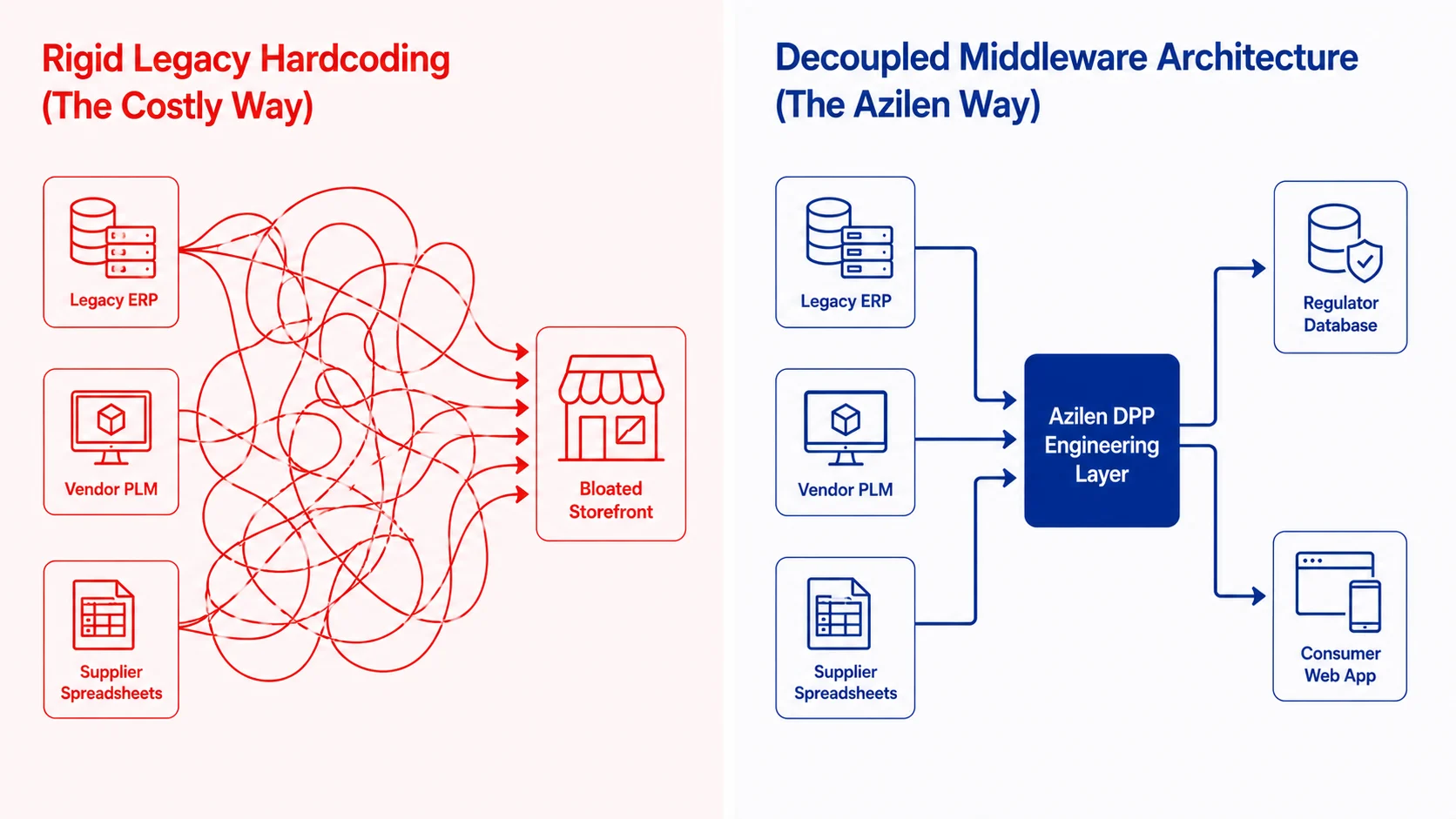
A professional DPP integration service functions as the intelligent connective tissue sitting quietly on top of your existing software stack. It does not require a high-risk, multi-million pound replacement of your core validated systems to achieve end-to-end medical device traceability. Instead, it deploys a decoupled data layer that extracts data via secure APIs, standardizes it, and publishes it seamlessly.

Steering clear of rigid, hard-coded integrations, a modern enterprise architecture relies on three clear layers:

1. The Ingestion Layer

This system automatically pulls diverse, inconsistent data, such as flat files, supplier portals, and raw APIs, from global component vendors into a secure environment, removing the need for manual email chasing.

2. The Harmonization Engine

This layer cleanses and standardizes raw multi-national metrics into schema-compliant records, ensuring full regulatory compliance without altering your core, FDA/MHRA-validated legacy master data.

3. The Global Standard Layer

By implementing GS1 Digital Links, the middleware ensures that every device receives a unique identifier that maps a single physical label (like a laser-etched UDI or secure QR code) to dual destinations, giving secure, unredacted data to regulators and simplified usage/maintenance experiences to UK NHS and private hospital procurement teams.

Before and after Azilen DPP Engineering

When you bridge those global supplier data gaps, something powerful happens. The passport ceases to be a dry compliance document and becomes a direct, unmediated communication channel with your B2B clients. Proving that compliance is the floor, not the ceiling, allows you to transform a rigid legal checklist into a massive competitive advantage.

Deploying a dedicated medical device DPP strategy means that once a hospital procurement team or biomedical engineer scans the device, you have their undivided attention. By viewing the Digital Product Passport for Medical Devices as a value-added asset rather than a regulatory burden, you can unlock true operational efficiency right within the scanning interface:

• Streamlining Maintenance & Recalls: Allow hospital clinical staff to instantly pull up localized calibration manuals, firmware update histories, or targeted recall statuses with a single scan, significantly reducing equipment downtime.

• Automating Circular Refurbishment: Provide clear instructions for safe deinstallation, hazardous material isolation, and manufacturer take-back schemes for high-value components, aligning perfectly with NHS Net Zero procurement requirements.

• Simplifying Scope 3 Audits: Clean Product Carbon Footprint (PCF) data automatically feeds into broader healthcare trust sustainability reporting, establishing your brand as a preferred vendor in competitive NHS tenders for DPP Compliance for Medical Manufacturers.

Architectural Blueprints: Real-World Medical Device & Materials DPP Use Cases

Deploying a real-world, scalable DPP framework requires deep expertise in system data models, enterprise systems, and interoperability layers. Here is how Azilen successfully architects and implements enterprise-grade solutions for complex manufacturing leaders:

Use Case 1: Automated Material-to-Device Traceability for Multi-Tier Component Supply Chains

Managing disjointed inputs from raw material suppliers, specialized electronics molders, and cleanroom sterilization facilities often leads to operational blindness.

• The Technical Solution: Azilen deploys an automated data validation and ingestion layer using Node.js and PostgreSQL to sync data from distributed supplier portals and global SCM networks. This engine connects with premier supply chain environments, including Blue Yonder (WMS) and Manhattan Associates (WMS).

• The Architectural Blueprint: To guarantee an unalterable, audit-ready material provenance trail, a distributed ledger layer is established using Hyperledger Fabric. This framework tracks compliance for more than 1.2 million products annually while driving over $15M in operational savings through optimized circular logistics and automated batch tracking.

Use Case 2: AI-Enabled Compliance Sync for Enterprise Customer & Enterprise Portals

Manufacturers frequently struggle to dynamically update thousands of live medical SKUs and serialized assets with certified product passports without introducing core system latency.

• The Technical Solution: Azilen engineers a high-performance integration sitting directly on top of the client’s enterprise environment, utilizing secure integration hubs like Salesforce Commerce Cloud (SFCC) or dedicated enterprise service buses.

• The Architectural Blueprint: Utilizing enterprise B2B APIs and MuleSoft, the architecture orchestrates complex supplier attestation feeds and automated compliance validation workflows across a complex catalog of over 6,500+ active SKUs. The backend dynamically deploys more than 203,000+ certified digital product passports directly to clients and auditors, achieving an outstanding 98% compliance accuracy rate for automated, SKU-level regulatory audits.

The Ultimate Medical Device DPP Readiness Checklist

To transition your brand from a state of data fragmentation to complete compliance readiness, your implementation teams should track progress across four distinct phases:

Phase 1: Data Governance & Lineage Mapping

✅ Map your entire supply chain down to Tier 4 raw material and chemical providers, identifying where data black holes exist.

✅ Deploy secure API and SFTP pipelines to replace manual email and spreadsheet chasing with global vendors.

✅ Establish clear data boundaries separating public-facing marketing data, hospital-facing compliance records, and highly confidential proprietary schematics.

Phase 2: System Architecture Integration

✅ Integrate your existing ERP, PLM, and Manufacturing Execution Systems (MES) to eliminate duplicate manual entry.

✅ Deploy a data validation layer to clean and harmonize inconsistent multi-national supplier metrics into standard schemas.

✅ Align your data architecture with GS1 standards, linking your existing UDI (Unique Device Identification) seamlessly with the DPP twin.

Phase 3: Physical & Digital Carrier Deployment

✅ Choose the appropriate physical carrier, such as secure QR codes, RFID, or permanent laser etching, based on device sterilization requirements and line speeds.

✅ Create a secure, high-performance frontend experience that translates clinical compliance data into a clear, scannable interface.

✅ Turn the passport into a retention channel by embedding direct links for component registration, warranty logs, and maintenance scheduling.

Phase 4: Circular & Lifecycle Management

✅ Input clear, certified sterilization, safe disassembly, and end-of-life recycling paths directly into the data payload.

✅ Connect the DPP interface directly to your medical refurbishment or take-back infrastructure, enabling smooth hospital equipment trade-ins.

Why Azilen Technologies Stands Out in DPP Engineering

As an AI-first digital transformation company in the UK, Azilen focuses on creating connected, intelligent, and future-ready technology ecosystems while preserving the systems businesses already depend on. We help organizations move beyond legacy constraints by turning existing environments into scalable, compliant infrastructure through core engineering capabilities:

Legacy System Modernisation: Upgrades aging applications and infrastructure seamlessly, ensuring there is zero disruption to day-to-day business operations.

IoT & Enterprise Integration: Creates flawless connectivity between existing core systems, IoT devices, cloud platforms, and third-party applications.

→  Data Engineering Services: Constructs highly scalable data pipelines that transform fragmented, siloed operational data into trusted, actionable business intelligence.

→  Enterprise AI Development Services: Builds predictive analytics, intelligent automation, and advanced AI-powered decision-making capabilities directly on top of your existing software stack.

FAQs: DPP Engineering

1. How do Digital Product Passport mandates interact with existing medical device regulations like EU MDR or UK MHRA frameworks?

The DPP does not replace existing medical device regulations like the EU MDR; rather, it complements them. While the MDR focuses primarily on clinical safety, performance, and risk management through systems like UDI, the emerging DPP framework under the ESPR extends this data profile to cover environmental sustainability, circularity, and raw material origins. A professional integration service unifies these requirements into a single data twin, preventing duplication of effort.

2. How do DPP integration services protect highly sensitive proprietary designs and trade secrets in medical manufacturing?

Enterprise-grade DPP integration solutions employ granular, multi-tiered data access control models. The architecture strictly separates internal master operational data from public-facing transparency data. While regulators or authorized auditors see verified, unredacted certifications via secure cryptographic keys, hospital procurement teams or end-users interact with a curated, user-friendly interface that completely hides proprietary design elements, supplier identities, and commercial trade secrets.

3. Will implementing a DPP system require us to completely re-validate our core ERP, PLM, or MES software?

No. Professional integration services are explicitly engineered to sit as a decoupled layer on top of your existing software ecosystem. They use secure APIs, middleware connectors, and web services to systematically aggregate, extract, and format data from existing platforms like SAP, Oracle, or PTC Windchill without requiring expensive, high-risk alterations to your core validated software baselines.

4. What physical data carriers are recommended for medical devices that undergo aggressive sterilization processes?

The choice of physical data carrier depends on the device’s material and use case. For surgical instruments and implants subjected to autoclave or chemical sterilization, permanent direct part marking (DPM) via fiber laser etching is standard. For larger diagnostic equipment or durable medical goods, secure high-durability QR codes, industrial RFID tags, or embedded NFC chips are utilized based on manufacturing line configurations and line speeds.

5. How can a medical device manufacturer track the direct business ROI of an integrated DPP system?

Beyond avoiding massive compliance non-access penalties in European markets, ROI is measured through increased contract win-rates in competitive, sustainability-weighted healthcare procurement tenders (such as the UK NHS Net Zero framework). Additionally, manufacturers track operational cost reductions achieved through automated supplier data collection, optimized material take-back schemes, and faster equipment field servicing via instant data access.

Kulmohan Makhija
Kulmohan Makhija
Vice President – Growth & Enterprise Strategy

Kulmohan Makhija is an enterprise technology and business strategy writer with over 12 years of experience analyzing digital transformation across global and European markets. His work focuses on applied artificial intelligence, product engineering, enterprise architecture, and large-scale legacy modernization. He explores how complex organizations modernize core systems, adopt AI responsibly, and align innovation with regulatory, cultural, and operational realities — particularly within the UK and broader European technology landscape. With a pragmatic enterprise perspective, Kulmohan emphasizes transformation that delivers measurable impact without disrupting mission-critical operations. His writing bridges executive strategy with technical depth, providing clarity for technology leaders, product teams, and decision-makers navigating modernization journeys.

Related Insights