
 11 mins
Jul 30, 2026

The era of relying on static PDF brochures and vague marketing claims to prove the sustainability of building materials is ending. The regulatory framework of the European construction market is being rebuilt from the ground up, and the central mechanism driving this transformation is the Digital Product Passport (DPP).
For executives and operational leaders in construction material manufacturing, the DPP represents a fundamental shift in how product data is generated, managed, and shared across an asset’s entire lifecycle. Backed by the twin forces of the Ecodesign for Sustainable Products Regulation (ESPR) and the newly revised Construction Products Regulation (CPR), this digital twin record will soon become an absolute prerequisite for doing business in Europe.
Key strategic realities of this transition:
• Hard Market Thresholds: If you cannot track, verify, and digitally transmit your material data, your products will lose legal access to the European single market.
• Operational Integration: Compliance requires a fundamental rewiring of digital architecture to expose real-time carbon, material, and circularity data.
• Commercial Opportunities: Decisive action allows manufacturers to break down stubborn data silos, strengthen global supply chains, and capture premium market share.
The transition to digital traceability has been discussed for years, but the revised CPR has turned these concepts into hard law. The regulation entered into force in January 2025, and its operational milestones are already rolling out.
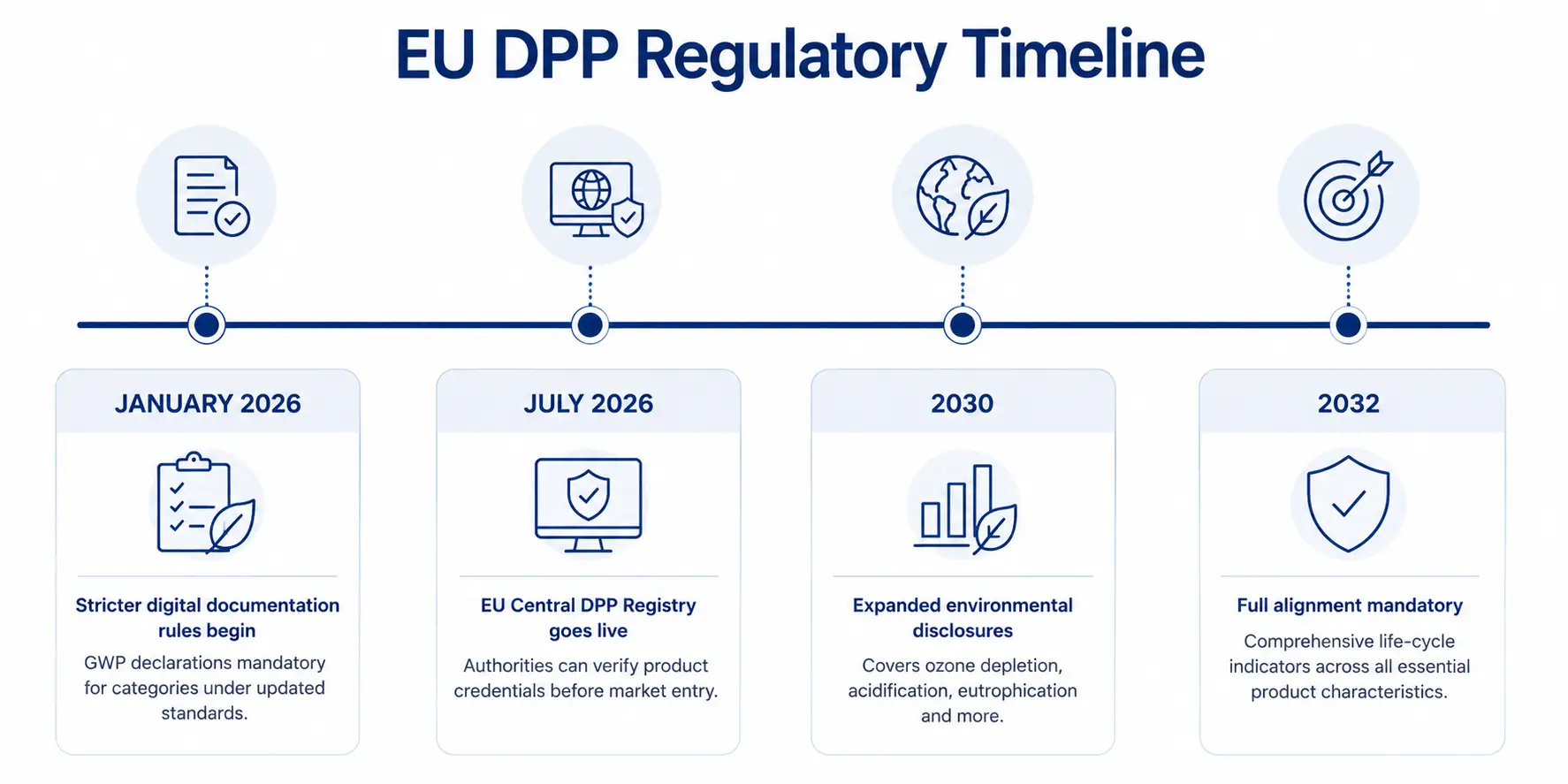
Understanding the specific phases of this rollout is critical for strategic planning:
 The consequence of failing to prepare for these dates is straightforward. The EU framework removes the option of non-compliance; without a verified, machine-readable DPP linked to a physical data carrier like a QR code or an RFID tag, your products cannot legally be sold within the single market.
The primary obstacle to achieving DPP compliance is not a lack of data, but rather where and how that data is currently stored. In most manufacturing organizations, critical product information is scattered across fragmented, disconnected systems.
Material formulations live within specialized R&D platforms. Environmental performance metrics are buried inside third-party Environmental Product Declaration (EPD) documents. Production parameters sit on the factory floor, while supply chain origin details are trapped in procurement spreadsheets.
This fragmentation creates severe vulnerabilities when measured against the strict criteria of the DPP framework, which demands data that is:
• Interoperable: Capable of being seamlessly exchanged across different technology platforms without vendor lock-in.
• Machine-Readable: Structured so that Building Information Modeling (BIM) software, automated procurement systems, and regulatory databases can ingest it without manual entry.
• Persistent: Guaranteed to remain accessible and secure for a minimum of 5 to 10 years after the product is sold, even if the manufacturer undergoes insolvency or exits the market.
To bridge these gaps, manufacturers must move away from manual data consolidation. Achieving compliance requires building a single digital source of truth that links a unique product identifier with specific facility and operator tracking data. This structured approach ensures that when an architect scans a component on-site, the system pulls accurate, real-time data across every operational tier.
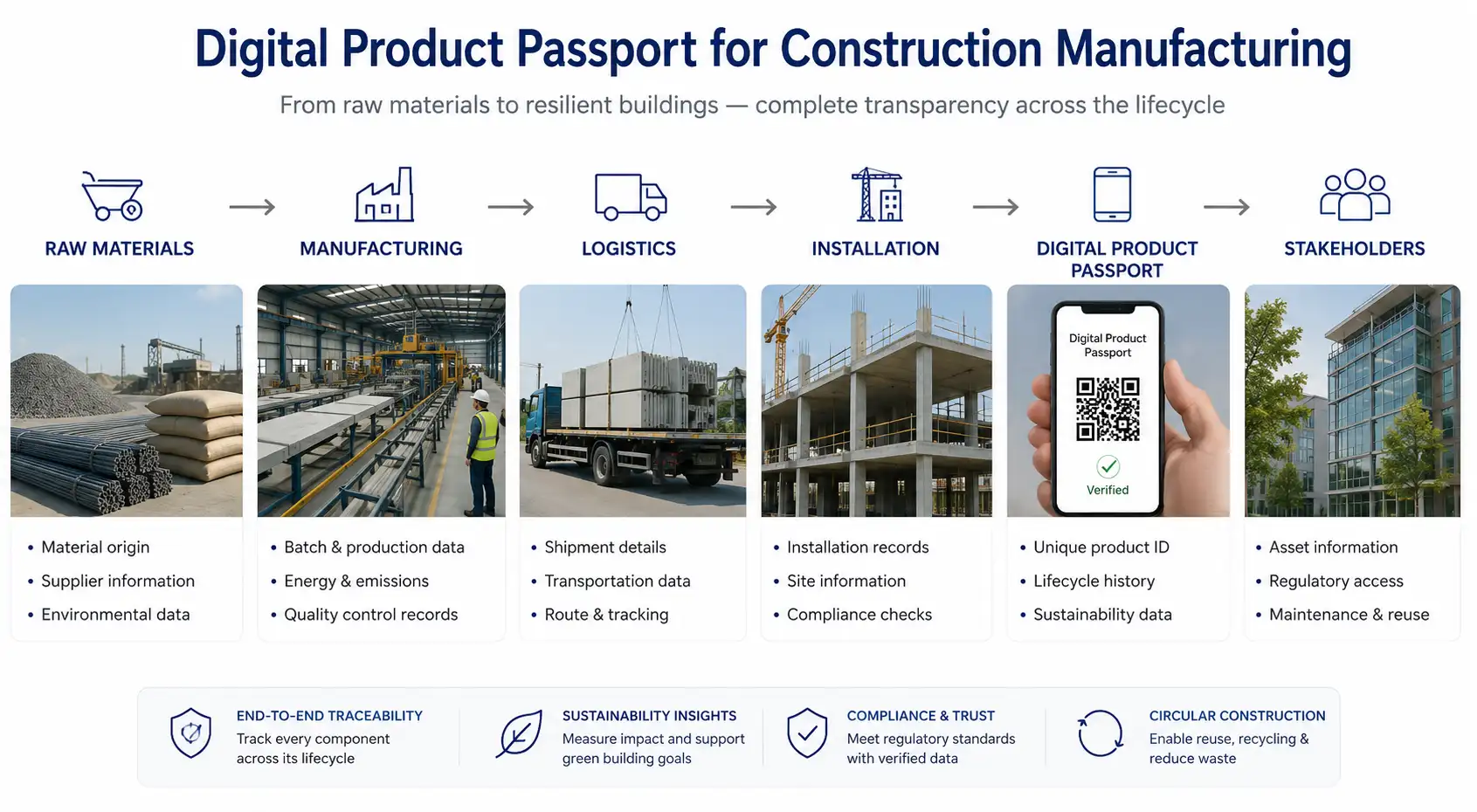
For structural engineers and tier-one contractors, a material’s green credentials mean nothing if its structural integrity fails. With the revised CPR enforcing stricter penalties, relying on easily misplaced paper certificates or unverified supply chains is a high-stakes operational risk. The Digital Product Passport for Construction Materials eliminates this vulnerability by embedding a product’s precise performance DNA directly into an immutable digital twin.
For critical materials governed by AVCP Systems 1 and 1+ (like structural steel and pre-cast concrete), this digital ledger turns traceability into a strict quality control engine. Waiting to secure your data pipeline means risking project disqualification and severe legal liability.
Immediate risk mitigation delivered by a live DPP:
• Guaranteed Batch Integrity: Instantly link factory production logs, metallurgical purity records, and non-destructive testing results to a physical QR code or RFID tag, completely blocking counterfeit or sub-standard materials from the site.
• Real-Time Performance Verification: Expose exact load-bearing capacities, fire-resistance ratings, and mechanical resistance directly to procurement teams to ensure absolute alignment with design specifications.
• Protected Asset Diagnostics: Provide tier-one builders and facility managers with instant, scan-and-go access to installation records and structural diagnostics, stripping out the administrative friction that stalls competitive B2B sales cycles.
The ESPR (Regulation EU 2024/1781) establishes the overarching, horizontal framework for Digital Product Passports across the entire European economy. The revised CPR (Regulation EU 2024/3110) directly adapts these core sustainability rules specifically for the built environment, mandating life-cycle environmental reporting and providing the distinct legal basis for product passports for construction materials.
No, traditional static EPDs are not sufficient on their own, though they provide the foundational environmental data needed for compliance. EPDs are typically delivered as static PDF documents, whereas the DPP requires that this data be fully digitized, machine-readable, and integrated with unique product, operator, and facility identifiers accessible via automated APIs.
The revised CPR introduced a phased implementation schedule. Mandatory Global Warming Potential (GWP) declarations for priority categories under updated harmonized standards began in January 2026. Expanded environmental indicators roll out in January 2030, with full compliance across all life-cycle indicators mandatory by January 2032.
The EU Central DPP Registry, which goes live in July 2026, acts as a centralized database for verifying product identifiers before goods enter the market. Customs authorities and market regulators will use this registry to electronically check for a valid product passport, making an active digital record a hard condition for customs clearance and market entry.
The DPP framework does not require the public exposure of trade secrets or proprietary recipes. Compliance is achieved by implementing secure data governance systems that utilize tiered access controls. This architecture allows public users to view necessary circularity indicators and recycling workflows, while restricting access to sensitive business data to verified regulatory authorities under strict data-protection compliance.
 11 mins