
Skip to content

Digital Product Passport for Aerospace Manufacturers: Managing Lifecycle and Compliance Data

Featured Image

Executive Summary

The convergence of European Aviation Safety Agency (EASA) conformity protocols, AS9100 quality baselines, and the impending Ecodesign for Sustainable Products Regulation (ESPR) is introducing a massive shift in aerospace manufacturing. For aerospace and defense organizations exporting to or operating within Europe, structural component and material traceability is already high-stakes. However, the impending Digital Product Passport (DPP) demands a much more comprehensive, lifecycle-wide data ledger. This framework requires a verifiable account of an asset’s entire footprint, tracking everything from raw titanium ingot sourcing and precision composite curing parameters to commercial airline utilization, maintenance intervals, and specialized end-of-life component recycling or safe material reclamation.

What this executive brief delivers:

• Regulatory Compliance Timelines: A clear operational roadmap for navigating EASA, FAA, and upcoming EU Central DPP Registry data compliance.

• Decoupled Architecture Integration: Practical methods to capture and unify fragmented supplier data without introducing latency or security risks to core Product Lifecycle Management (PLM) baselines.

• Commercial Procurement Value: Strategic blueprints to transform raw component transparency into a powerful tool for winning tier-one aerospace and defense contracts.

The era of relying on static, paper-heavy First Article Inspection (FAI) reports and disconnected PDF safety certificates to verify complex aerospace components is ending. As global procurement networks and aviation regulators tighten enforcement, manufacturers who rely on fragmented legacy tracking risk complete operational standstill.

Failing to transition to a machine-readable Digital Product Passport for Aerospace Manufacturers introduces severe baseline risks to your enterprise:

• Imminent Market Exclusion: Without the ability to securely transmit standardized, digital twin records, your components will face immediate disqualification from primary European aviation lines and tier-one defense networks.

• Severe Technical Debt: Relying on manual data aggregation to track multi-tier supplier metrics, curing parameters, and metallurgical provenance creates massive operational bottlenecks and limits engineering scalability.

• Vulnerability to Counterfeit Parts: Opacity within the deeper tiers of the supply chain leaves your operational pipeline exposed to unapproved or sub-standard components, compromising strict AS9100 and EASA conformity.

• Forfeited B2B Vendor Advantage: Competitors who deploy integrated data networks early will capture preferred status with major global airframers by instantly delivering the verified lifecycle carbon and material metrics required in modern tenders.

DPP Readiness Assessment

The Current Reality: Where Your Aerospace Data Actually Lives Right Now

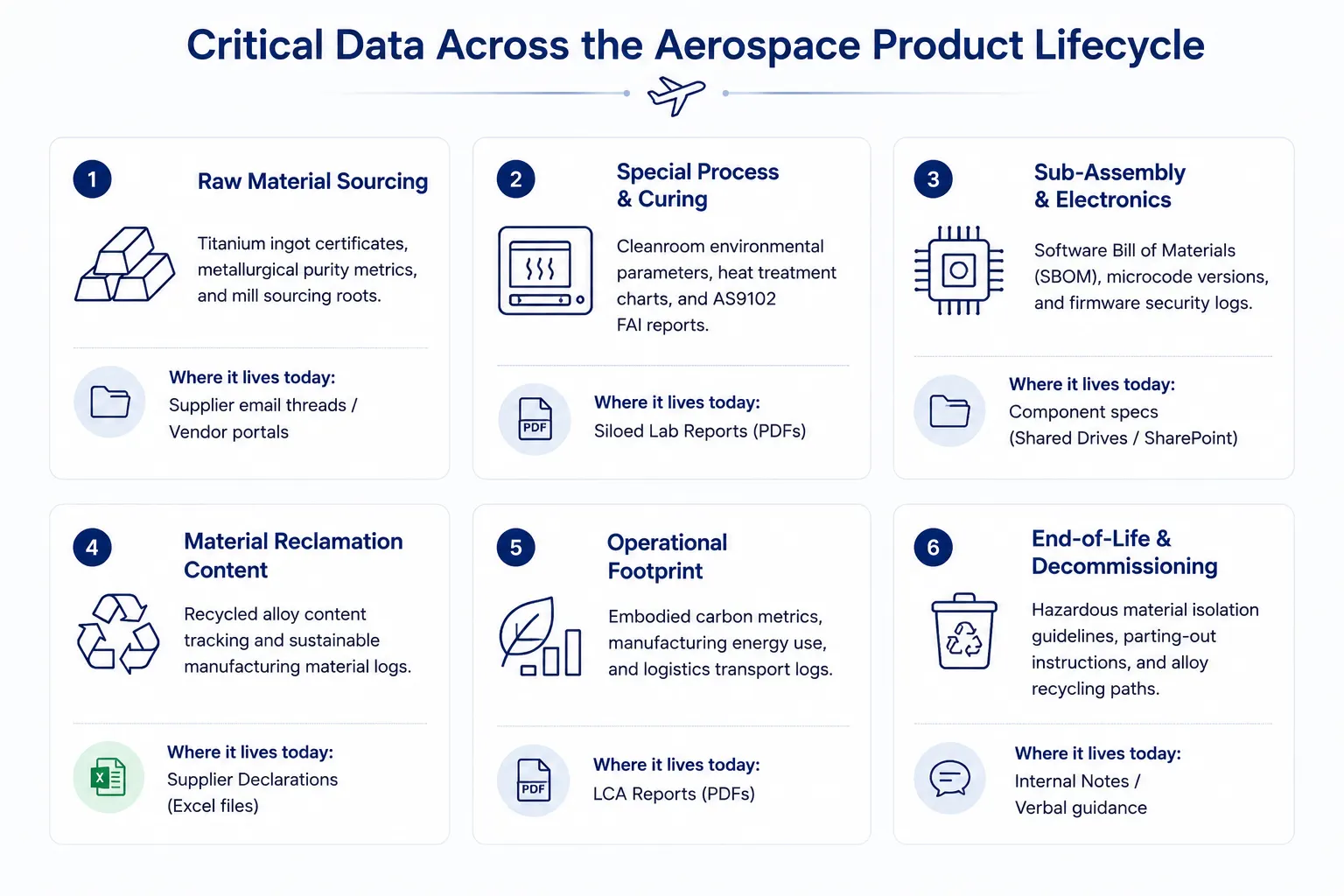
The primary obstacle to achieving DPP compliance is not a lack of data, but rather where and how that data is currently stored. In most manufacturing organizations, critical product information is scattered across fragmented, disconnected systems. Material formulations live within specialized R&D platforms. Environmental performance metrics are buried inside third-party Environmental Product Declaration (EPD) documents. Production parameters sit on the factory floor, while supply chain origin details are trapped in procurement spreadsheets.

To visualize how fractured your current ecosystem is, consider where the data for a single turbine blade or critical structural bracket lives today before it ever reaches a Verified DPP Record:

The Aerospace Data Disconnect

Aerospace data

Without a dedicated middleware layer to ingest, validate, and standardize these incoming data fragments, your compliance journey will stall before it even begins.

Deconstructing the DPP Technical Architecture: Raw Ingot to Hangar Floor

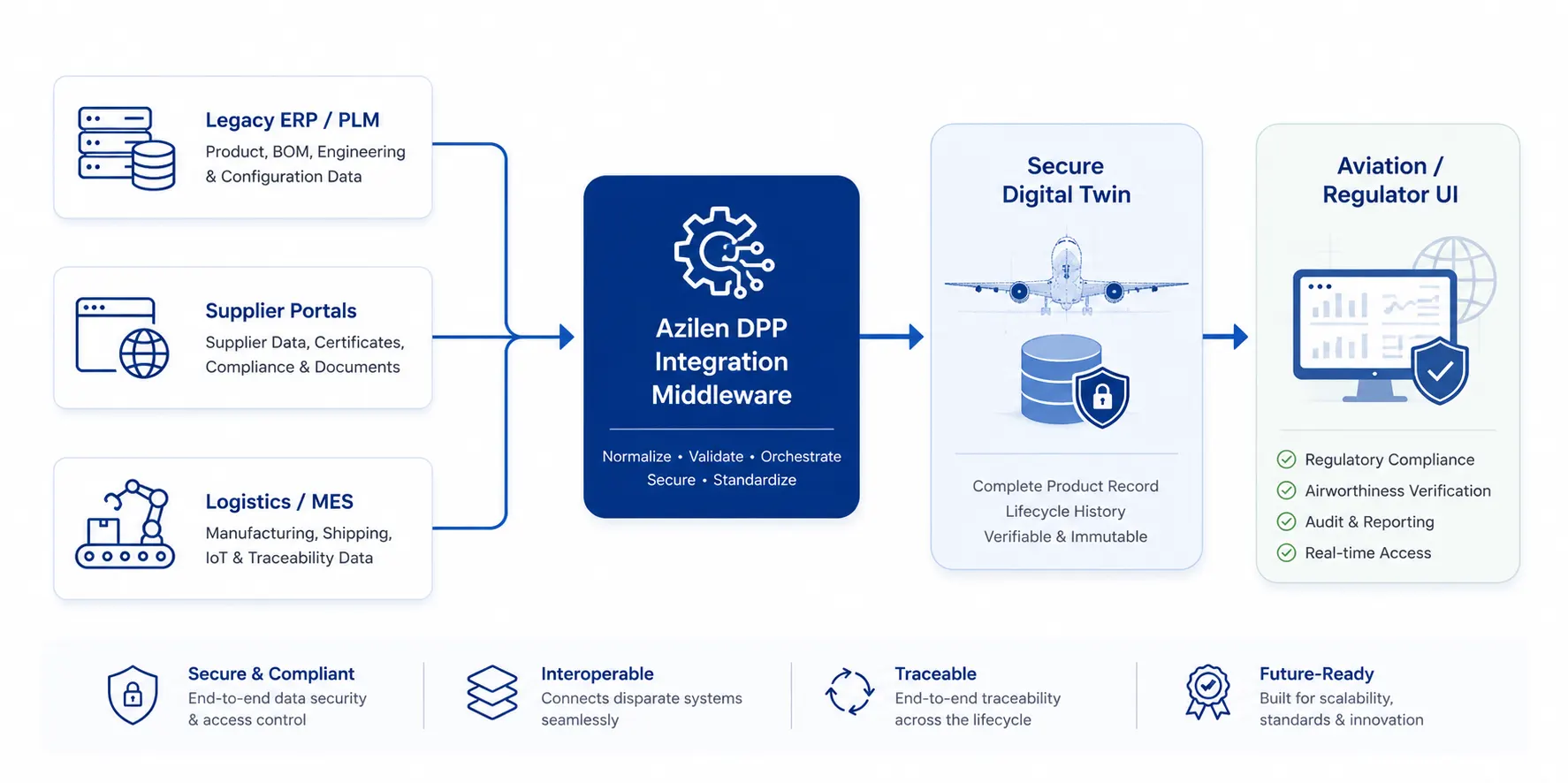
A professional DPP integration service functions as the intelligent connective tissue sitting quietly on top of your existing software stack. It does not require a high-risk, multi-million pound replacement of your core validated systems to achieve end-to-end aerospace product traceability. Instead, it deploys a decoupled data layer that extracts data via secure APIs, standardizes it, and publishes it seamlessly.

Deconstructing the DPP Technical Architecture Raw Ingot to Hangar FloorSteering clear of rigid, hard-coded integrations, a modern enterprise architecture relies on four clear layers:

1. The Ingestion Layer

This system automatically pulls diverse, inconsistent data, such as flat files, supplier portals, and raw APIs, from global component vendors into a secure environment, removing the need for manual email chasing.

2. The Harmonization Engine

This layer cleanses and standardizes raw multi-national metrics into schema-compliant records, ensuring full regulatory compliance without altering your core, AS9100-validated legacy master data.

3. The Digital Twin Core

This engine aggregates the validated data points to create an unalterable, audit-ready data lineage using scalable enterprise databases or secure distributed ledgers.

4. The Global Standard Layer

By implementing GS1 Digital Links, the middleware ensures that every device receives a unique identifier that maps a single physical data carrier (like a laser-etched matrix code or secure RFID chip) to dual destinations, giving secure, unredacted data to regulators and simplified usage/maintenance experiences to MRO (Maintenance, Repair, and Overhaul) teams.

Driving Component Quality and Structural Safety Through the DPP

Environmental data means nothing without verified physical performance. The Digital Product Passport (DPP) transforms the digital twin from a green compliance chore into a rigorous quality control engine.

By linking non-destructive testing (NDT) data directly to serialized parts—like landing gear or turbine blades—you replace vulnerable paper logs with an immutable, audit-ready ledger.

Risk mitigation delivered by a live aerospace DPP:

• Zero Counterfeits: Links factory logs, metallurgical breakdowns, and ultrasonic testing to a physical data carrier, blocking unapproved parts.

• Instant Verification: Exposes exact mechanical tolerances and stress-test ratings directly to engineering teams.

• Faster MRO: Grants maintenance crews instant access to time-in-service tracking via an RFID or laser-etched scan, slashing aircraft downtime.

Architectural Blueprints: Real-World Aerospace DPP Use Cases

Deploying a real-world, scalable DPP framework requires deep expertise in system data models, enterprise systems, and interoperability layers. Here is how Azilen successfully architects and implements enterprise-grade solutions for complex manufacturing leaders:

Use Case 1: Automated Material-to-Component Traceability for Multi-Tier Component Supply Chains

Managing disjointed inputs from raw material suppliers, specialized electronics molders, and cleanroom sterilization facilities often leads to operational blindness.

• The Technical Solution: Azilen deploys an automated data validation and ingestion layer using Node.js and PostgreSQL to sync data from distributed supplier portals and global SCM networks. This engine connects with premier supply chain environments, including Blue Yonder (WMS) and Manhattan Associates (WMS).

• The Architectural Blueprint: To guarantee an unalterable, audit-ready material provenance trail, a distributed ledger layer is established using Hyperledger Fabric. This framework tracks compliance for more than 1.2 million products annually while driving over $15M in operational savings through optimized circular logistics and automated batch tracking.

Use Case 2: AI-Enabled Compliance Sync for Enterprise Portals & MRO Assets

Manufacturers frequently struggle to dynamically update thousands of live aerospace SKUs and serialized assets with certified product passports without introducing core system latency.

• The Technical Solution: Azilen engineers a high-performance integration sitting directly on top of the client’s enterprise environment, utilizing secure integration hubs like Salesforce Commerce Cloud (SFCC) or dedicated enterprise service buses.

• The Architectural Blueprint: Utilizing enterprise B2B APIs and MuleSoft, the architecture orchestrates complex supplier attestation feeds and automated compliance validation workflows across a complex catalog of over 6,500+ active SKUs. The backend dynamically deploys more than 203,000+ certified digital product passports directly to clients and auditors, achieving an outstanding 98% compliance accuracy rate for automated, SKU-level regulatory audits.

The Ultimate Aerospace DPP Readiness Checklist

To transition your brand from a state of data fragmentation to complete compliance readiness, your implementation teams should track progress across four distinct phases:

Phase 1: Data Governance & Lineage Mapping

✅ Map your entire supply chain down to Tier 4 raw material and chemical providers, identifying where data black holes exist.

✅ Deploy secure API and SFTP pipelines to replace manual email and spreadsheet chasing with global vendors.

✅ Establish clear data boundaries separating public-facing marketing data, MRO-facing maintenance records, and highly confidential proprietary defense schematics.

Phase 2: System Architecture Integration

✅ Integrate your existing ERP, PLM, and Manufacturing Execution Systems (MES) to eliminate duplicate manual entry.

✅ Deploy a data validation layer to clean and harmonize inconsistent multi-national supplier metrics into standard schemas.

✅ Align your data architecture with GS1 standards, linking your existing serial numbers seamlessly with the DPP twin.

Phase 3: Physical & Digital Carrier Deployment

✅ Choose the appropriate physical data carrier, such as high-temperature RFID tags, rugged matrix codes, or permanent laser etching, based on environmental exposure and line speeds.

✅Create a secure, high-performance frontend experience that translates complex engineering metrics into a clear, scannable interface.

✅ Turn the passport into a retention channel by embedding direct links for component registration, warranty logs, and maintenance scheduling.

Phase 4: Lifecycle & Circular Management

✅ Input clear, certified material reclamation, safe disassembly, and end-of-life recycling paths directly into the data payload.

✅ Connect the DPP interface directly to your parts-pooling or take-back infrastructure, enabling smooth component exchange loops.

Why Azilen Technologies Stands Out in DPP Engineering

As an AI-first digital transformation company in the UK, Azilen focuses on creating connected, intelligent, and future-ready technology ecosystems while preserving the systems businesses already depend on. We help organizations move beyond legacy constraints by turning existing environments into scalable, compliant infrastructure through core engineering capabilities:

Legacy System Modernisation: Upgrades aging applications and infrastructure seamlessly, ensuring there is zero disruption to day-to-day business operations.

IoT & Enterprise Integration: Creates flawless connectivity between existing core systems, IoT devices, cloud platforms, and third-party applications.

Data Engineering Services: Constructs highly scalable data pipelines that transform fragmented, siloed operational data into trusted, actionable business intelligence.

Enterprise AI Development Services: Builds predictive analytics, intelligent automation, and advanced AI-powered decision-making capabilities directly on top of your existing software stack.

Scalable Architecture Design: Designs flexible, future-proof technological foundations specifically engineered to support ongoing corporate growth and business innovation.

FAQs: DPP Engineering

1. How do Digital Product Passport mandates interact with existing aerospace quality frameworks like AS9100 or EASA Part 21?

The DPP does not replace existing aviation safety frameworks; rather, it complements them. While frameworks like AS9100 and EASA Part 21 focus primarily on clinical airworthiness, flight safety, and risk management through systems like FAI logs, the emerging DPP framework under the ESPR extends this profile to cover environmental sustainability, lifecycle carbon metrics, and raw material circularity. A professional integration service unifies these datasets into a single data twin, preventing duplication of effort.

2. How do DPP integration services protect highly sensitive proprietary military or commercial designs?

Enterprise-grade DPP integration solutions employ granular, multi-tiered data access control models. The architecture strictly separates internal master operational data from public-facing transparency data. While regulators or authorized defense auditors see verified, unredacted certifications via secure cryptographic keys, line maintenance crews or commercial clients interact with a curated, user-friendly interface that completely hides proprietary design elements, supplier identities, and commercial trade secrets.

3. Will implementing a DPP system require us to completely re-validate our core PLM or ERP software?

No. Professional integration services are explicitly engineered to sit as a decoupled layer on top of your existing software ecosystem. They use secure APIs, middleware connectors, and web services to systematically aggregate, extract, and format data from existing platforms like SAP, Oracle, or PTC Windchill without requiring expensive, high-risk alterations to your core validated software baselines.

4. What physical data carriers are recommended for aerospace components that undergo extreme thermal or mechanical stress?

The choice of physical data carrier depends on the component’s operating environment. For hot-section turbine parts or external structural components subjected to extreme heat and pressure, permanent direct part marking (DPM) via high-density fiber laser etching is standard. For internal avionics bays, line-replaceable units (LRUs), or cargo hardware, high-temperature ruggedized RFID tags or industrial matrix plates are utilized based on manufacturing line configurations and line speeds.

5. How can an aerospace manufacturer track the direct business ROI of an integrated DPP system?

Beyond avoiding massive compliance non-access penalties in European markets, ROI is measured through increased contract win-rates in competitive, sustainability-weighted commercial and defense procurement tenders. Additionally, manufacturers track structural cost reductions achieved through automated supplier data collection, optimized material take-back schemes, and faster aircraft field servicing via instant data access.

Kulmohan Makhija
Kulmohan Makhija
Vice President – Growth & Enterprise Strategy

Kulmohan Makhija is an enterprise technology and business strategy writer with over 12 years of experience analyzing digital transformation across global and European markets. His work focuses on applied artificial intelligence, product engineering, enterprise architecture, and large-scale legacy modernization. He explores how complex organizations modernize core systems, adopt AI responsibly, and align innovation with regulatory, cultural, and operational realities — particularly within the UK and broader European technology landscape. With a pragmatic enterprise perspective, Kulmohan emphasizes transformation that delivers measurable impact without disrupting mission-critical operations. His writing bridges executive strategy with technical depth, providing clarity for technology leaders, product teams, and decision-makers navigating modernization journeys.

Related Insights